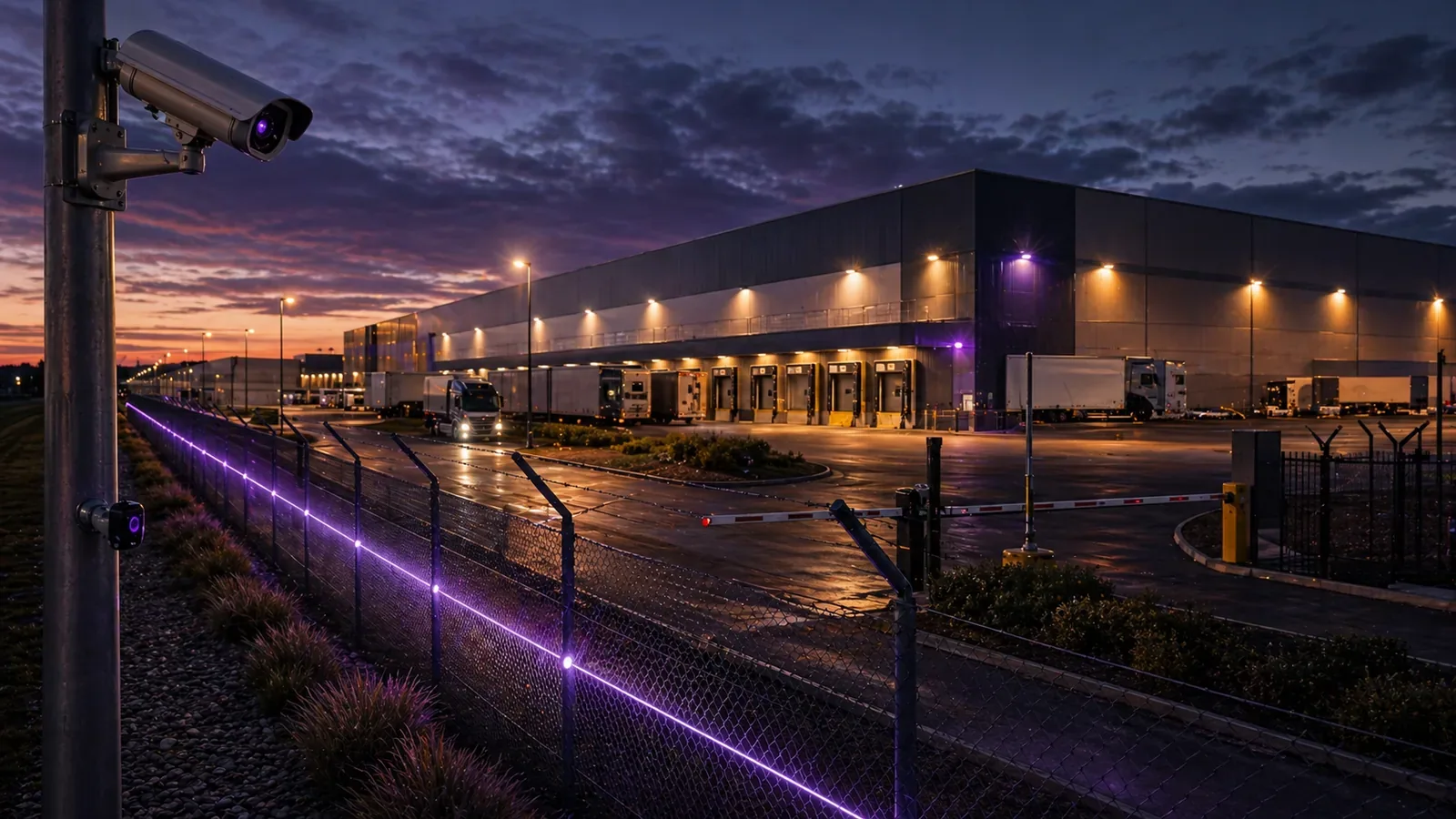
Distribution centers often span dozens of acres with chain-link fencing, multiple truck gates, and employee access points, making them prime targets for organized theft rings that exploit blind spots during night shifts. When retrofitting these sites, security teams face the challenge of layering detection technologies without disrupting 24/7 loading operations or inflating operational costs. The key decision hinges on balancing sensitive perimeter intrusion detection systems (PIDS) with video verification to minimize false alarms while ensuring rapid response.
In practice, the strongest designs integrate ground-based sensors like geophones or fiber-optic cables along fence lines with overhead PTZ cameras positioned at 100-200 meter intervals. This hybrid approach catches vibrations from climbing attempts early and uses analytics to confirm threats, outperforming standalone IR beams or microwaves in dusty, windy environments common to logistics hubs. Teams upgrading from basic fencing see immediate gains in deterrence, as visible sensors signal a defended perimeter without relying solely on patrols.
Consider a typical retrofit at a regional distribution hub: existing fencing gets augmented with accelerometers every 10 meters, tied into a central VMS that triggers camera slews on alerts. This setup not only covers 5km of perimeter but scales for future expansions like new loading docks, addressing the dynamic nature of these facilities.
What the design decision looks like in practice
Picture a 50-acre distribution center with a mix of high-security fencing around storage yards and lighter barriers near administrative buildings. The design decision starts with mapping threat vectors—primarily fence climbs, gate tailgating, and vehicle ramming—then selecting sensor fusion over single-tech reliance. For instance, pairing taut-wire sensors with microwave barriers creates a dual-detection zone: the wire detects physical contact, while microwaves cover gaps under vehicle shadows.
During implementation, integrators run sensor cabling in conduit buried 30cm deep to withstand forklift traffic and weather exposure. Cameras mount on 10m poles for line-of-sight dominance, with IR illuminators extending coverage to pre-dawn hours when theft peaks. Operators configure rulesets where low-confidence alerts prompt audio deterrents before escalating to guards, streamlining workflows in high-volume sites. This layered method proves resilient in real deployments, adapting to seasonal changes like snow buildup that can mask vibrations on simpler systems.
System architecture and integration considerations
A robust architecture centers on a unified platform that ingests data from disparate sensors—vibration, IR, video—into a common event stream. Avoid siloed systems; instead, use open protocols like ONVIF for cameras and Modbus for sensors to feed into a PSIM or VMS backbone. In distribution centers, this means zoning the perimeter into segments: high-risk yard areas get fiber-optic distributed acoustic sensing (DAS) for 100% coverage, while gates use RFID with video overlay for access logging.
Integration extends to enterprise systems, syncing alerts with dispatch software for automated guard routing. Power redundancy via UPS at sensor nodes prevents outages from grid flickers common in industrial zones. Bandwidth planning is critical—compress video to H.265 and prioritize metadata over full streams to handle 4K feeds from multiple PTZs without choking networks. When tying into existing CCTV, map IP overlaps early to prevent addressing conflicts that delay go-live.
Operational workflows and field constraints
Daily operations demand workflows that filter nuisance alarms from wind, rain, or passing trucks without desensitizing true threats. Operators train on dashboards showing real-time sensor health, like battery levels on wireless nodes or cable integrity on fiber lines. In distribution centers, maintenance windows align with shift changes, using handheld testers to baseline vibrations before recalibrating after dock repairs.
Field constraints shape choices: dusty atmospheres foul lens housings, so opt for IP67-rated enclosures with auto-wipers. Expansive sites require PoE extenders for remote sensors, and solar backups for edge locations beyond trenching feasibility. Staff turnover means intuitive UIs win over complex consoles; mobile apps for verification let supervisors confirm alerts from loading bays, reducing response times from minutes to seconds.
Common failure points and design mistakes
One frequent oversight is uneven sensor spacing, where 15m gaps allow ladder-assisted climbs undetected. Teams fix this by surveying terrain with LiDAR beforehand, ensuring coverage overlaps at corners and gates. Another pitfall: ignoring electromagnetic interference from nearby conveyor motors, which swamps vibration sensors—mitigate with shielded cabling and frequency tuning.
Underestimating video latency leads to missed verifications; specify sub-2s slew times for PTZs and edge analytics to process locally. Scalability slips occur when designs cap at current footage, overlooking yard expansions—build modular with daisy-chained nodes. Finally, skipping ground testing post-install leaves buried lines vulnerable to rodent damage, underscoring the need for phased rollouts with live drills.
What to verify before procurement
Scrutinize sensor detection ranges against your fence height and material—taut-wire suits 2.4m chain-link but falters on rigid mesh. Request third-party test data for environmental resilience, focusing on false alarm immunity in simulated wind gusts up to 50km/h. Confirm protocol support matches your VMS; no vendor lock-in via proprietary APIs.
Evaluate total cost beyond CAPEX: factor MTBF for field-replaceable parts and software update cadences. Probe integration case studies from similar logistics sites, verifying seamless failover in multi-site management. Demand demos of alarm fusion logic, ensuring it escalates correctly without overwhelming operators.
Where to go next
Explore FortSense 4 for scalable perimeter solutions tailored to critical infrastructure. For site-specific advice, request a design review. Dive deeper into fundamentals with the Perimeter Intrusion Detection System glossary. See proven results in critical infrastructure security and North America deployments.