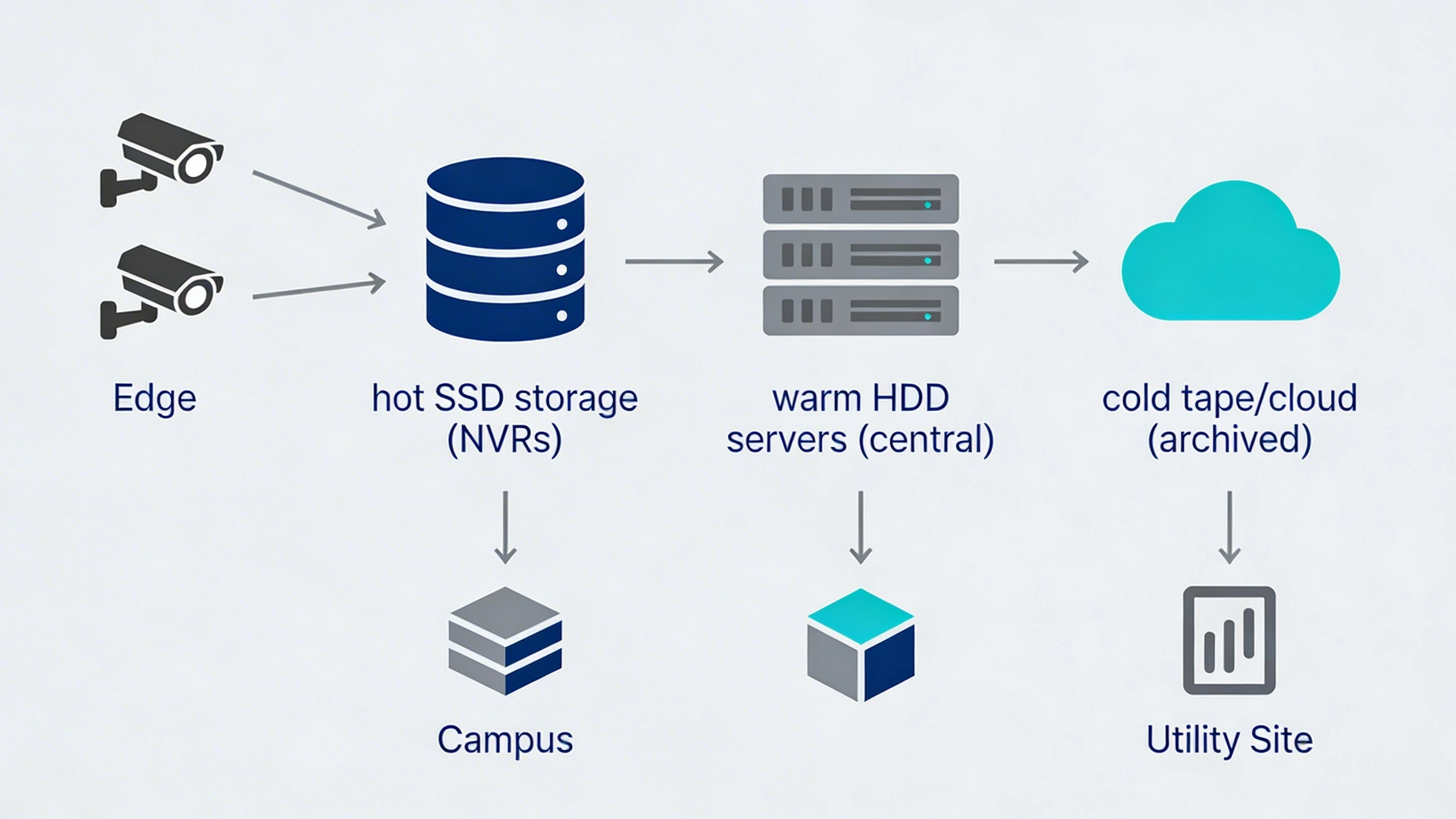
When retrofitting an aging NVR setup at a multi-building utility substation, the security team faces a familiar bind: cameras generate terabytes of footage weekly, but budgets constrain how much high-speed storage they can deploy. Instant access to recent video for incident response demands fast drives, yet long-term retention for regulatory audits stretches into years. Tiered storage—hot for live and immediate review, warm for routine searches, and cold for archival—emerges as the pragmatic path forward, allowing integrators to match media velocity to access patterns without overprovisioning.
In this setup, hot storage typically handles the last 7-30 days on NVMe SSDs or high-endurance flash, delivering sub-second seeks for live verification or exports during active threats. Warm tiers shift older footage to enterprise HDDs for 90-day windows, sufficient for most investigations, while cold storage offloads compliant archives to cheaper, sequential-access media like LTO tape or cloud S3-compatible buckets. This isn't just cost optimization; it's about ensuring operational resilience in environments where downtime for scrubbing full arrays equals lost evidence. A campus integrator upgrading from monolithic RAID might start by assessing peak query loads from guard stations, then layer tiers to sustain 4K multi-stream playback without frame drops.
The decision hinges on your site's footprint: a compact access-controlled facility might lean on hybrid NAS with automated tiering, while sprawling critical infrastructure demands distributed edge-to-core pipelines. Early pilots reveal that mismatched tiers lead to export delays during peak events, underscoring why security managers prioritize designs that align storage physics with forensic timelines.
What the design decision looks like in practice
Picture a security integrator tasked with modernizing a regional data center's perimeter surveillance. Legacy systems relied on uniform HDD pools, forcing operators to either retain everything expensively or purge prematurely, risking compliance gaps. Implementing tiers starts with profiling: analyze VMS logs to quantify access frequency—live feeds and 24-hour rollbacks dominate 80% of queries, justifying hot SSD allocation there. Warm HDDs then absorb the 30-90 day band for shift reviews, and cold tiers engage for ad-hoc deep dives into historical patterns.
Deployment unfolds in phases. First, configure the NVR or VMS—such as FortSense 4—to apply retention policies that transparently migrate footage based on age or event tags. Operators interact seamlessly: pulling a week's worth from hot storage yields instant multi-camera mosaics, while warm exports queue in seconds rather than minutes. In a real retrofit at a utility yard, this cut routine investigation times by streamlining workflows, as guards no longer waited on full-array scans. Cold access, invoked rarely for legal holds, routes through index-only restores, preserving chain-of-custody without full rehydration.
Tradeoffs surface quickly. Hot tiers demand power-efficient SSDs rated for video write endurance, avoiding consumer drives that wear under constant overwrites. Integrators learn to size warm capacity against average case loads, buffering for seasonal spikes like construction phases. The payoff? Systems that scale predictably as camera counts grow, sidestepping the forklift upgrades that plague flat-storage relics.
System architecture and integration considerations
At the core, tiered storage integrates via the VMS or NVR's policy engine, which transcribes video streams into containerized chunks—H.265 or AV1 for efficiency—and assigns them to tiers by metadata rules. Architecturally, this spans edge appliances writing to hot NAS, with warm servers pulling via iSCSI or NFS, and cold gateways exporting to object stores. In a campus deployment, edge NVRs at building clusters handle hot duties locally, federating to a central warm pool over 10Gbe links hardened against fiber cuts. Compatibility hinges on standards like ONVIF Profile T for analytics tagging, ensuring tiers respect motion events without proprietary lock-in.
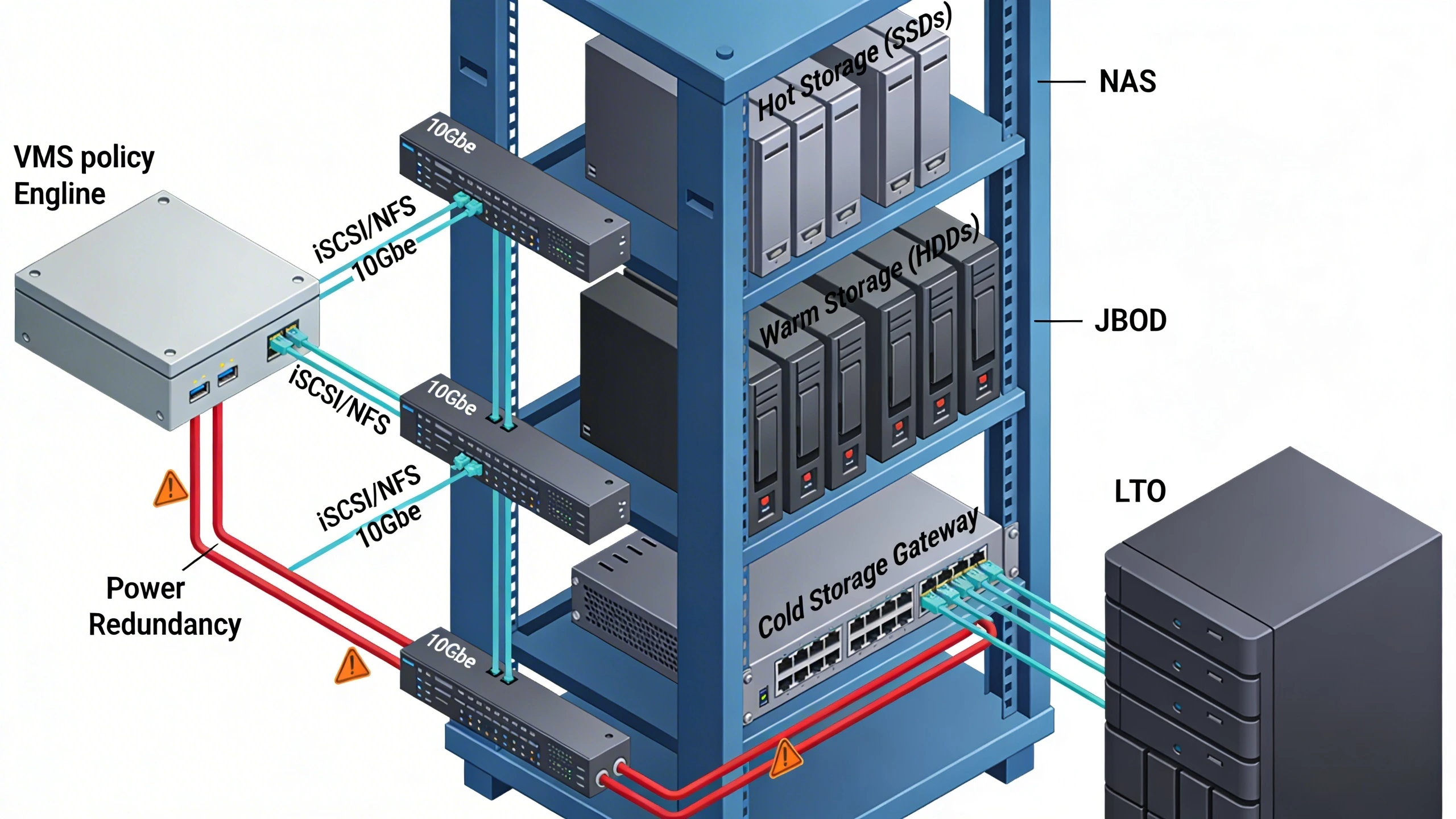
Integration pitfalls abound when overlooking network topology. For instance, placing warm storage behind a congested VLAN chokes exports during multi-site syncs, so dedicated QoS pipes become essential. Power and cooling factor in too: SSD hot tiers in rackmounts need airflow baffles to avert thermal throttling, while HDD warm bays benefit from vibration-dampened chassis in seismic zones. A utility site retrofit might chain FortSense nodes in a stretched cluster, using RAID—detailed in our RAID glossary—for warm redundancy without hot-mirroring everything. This hybrid keeps latency low while distributing failure domains.
Scalability demands forethought. Start with modular JBODs for warm expansion, avoiding controller bottlenecks. Test failover: simulate tier promotion during hot failure, confirming warm can temporarily shoulder live duties without VMS hiccups. Such diligence ensures the architecture withstands growth from 100 to 1000 cameras seamlessly.
Operational workflows and field constraints
Day-to-day, operators treat tiers as a unified pool, with the VMS masking migrations behind search APIs. A guard querying a gate incident pulls thumbnails from warm indexes first, forensically drilling into hot if needed—all via familiar timelines. Field constraints shape this: remote utility outposts prioritize hot edge storage for offline resilience, syncing to central warm during satcom windows. Export workflows automate tier-aware packaging, bundling clips with audit logs for chain-of-evidence, critical in regulated sectors.
Constraints bite in bandwidth-starved sites. Integrators deploy content-aware compression at ingest, tiering low-res proxies to warm while reserving full-res for hot. Maintenance workflows adapt too: hot SSD health checks run nightly, preempting wear, while warm HDD scrubs tolerate longer windows. In a multi-door enterprise building, badge-event correlations trigger selective cold restores, minimizing tape mounts. Operators train on tier limits—e.g., no bulk exports from cold without staging—to avoid workflow stalls.
Adaptations for harsh environments include IP67-rated edge hot nodes and warm racks with redundant PSUs. Bandwidth budgeting ensures WAN links handle peak warm promotions, with caching proxies easing latency. These workflows evolve from field feedback, turning constraints into refined policies that sustain uptime.
Common failure points and design mistakes
One frequent misstep cascades from undersizing hot tiers: during a perimeter breach, overwhelmed SSDs throttle writes, dropping frames and corrupting timelines. Integrators fix this by modeling worst-case ingest from all cameras plus looped playback, padding capacity 20-50% for bursts. Another trap lies in ignoring index fragmentation across tiers; without unified metadata stores, warm searches devolve into full scans, frustrating investigators. Proper design embeds relational databases spanning tiers, enabling federated queries.
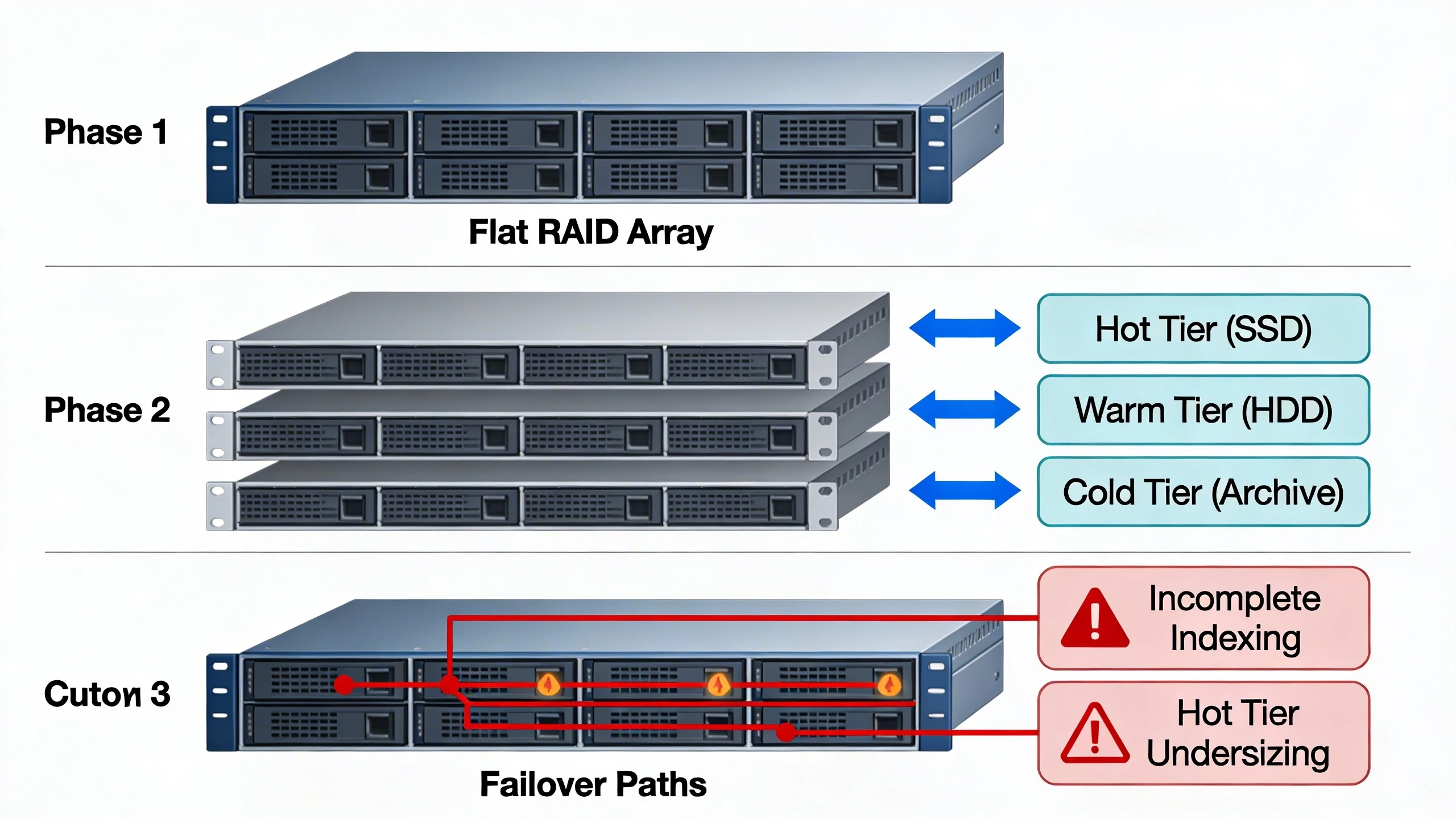
Migration stumbles often stem from incomplete cutover planning. Rushing tier enablement mid-cycle leaves legacy footage stranded, demanding manual relocations that spike CPU. Best practice: stage parallel tiers during quiet periods, validating policy handoffs before decommissioning flats. Overlooking cold egress costs plagues cloud hybrids—frequent restores incur fees, so hybrid on-prem cold with tape libraries proves wiser for high-retention sites. Field reports highlight vibration-induced HDD failures in mobile warm units; specifying CMR drives over SMR mitigates this.
Vendor mismatches exacerbate issues: ONVIF-compliant VMS falter if tiers rely on proprietary dedupe. Audit your stack for tier transparency, simulating failures like hot array faults to confirm automatic warm failover. These lessons, drawn from campus overhauls, underscore iterative testing over theoretical sizing.
What to verify before procurement
Before signing off on drives or enclosures, profile your workload rigorously. Capture a week's VMS logs to chart access curves—quantify hot query peaks, warm export volumes, and cold retention spans. Cross-reference against camera specs: 4K H.265 at 15fps demands ~10TB/day per 100 streams, dictating tier baselines. Scrutinize endurance ratings; hot SSDs must log DWPD figures exceeding your overwrite cycles, sourced from vendor datasheets.
Validate integration via PoCs. Spin up a lab mirroring your topology—edge hot, core warm, gateway cold—and stress with synthetic queries. Confirm VMS policies execute without leaks, and measure export latencies tier-by-tier. Check redundancy: does RAID6 on warm survive dual failures without rebuild storms? For cold, test restore times from tape or object, ensuring index-only previews suffice for triage.
- Network readiness: 10Gbe minimum between tiers, with QoS for video multicast.
- Power envelope: Calculate VA draw, including UPS sizing for hot failover.
- Software maturity: Confirm tiering in your NVR version, with rollback paths.
- Support SLAs: Vendor response for array rebuilds under load.
Where to go next
Ready to tier your security video infrastructure? Dive into FortSense 4 for robust policy engines tailored to these designs. For critical infrastructure projects, explore our critical infrastructure security resources or review North America deployments. Need expert input? Request a design review today. Supporting concepts await in the NVR glossary and RAID glossary.