Picture a mid-sized utility substation with 20 doors controlled by a Wiegand-based system installed in the early 2000s. Credential readers at perimeter gates and internal rooms pulse simple bit streams back to controllers over short runs of unshielded cable. It works for badge swipes, but diagnostic blind spots emerge during routine maintenance, and sniffing attacks on those exposed data lines loom as a compliance risk. Security managers now push for upgrades, eyeing OSDP to meet evolving standards without a full rip-and-replace.
This decision plays out across campuses, hospitals, and data centers too. Teams weigh keeping Wiegand's plug-and-play familiarity against OSDP's bidirectional capabilities. In practice, the move delivers encrypted reader-controller links, real-time health checks, and scalable topologies—but only if wiring and firmware align from day one. What starts as a reader swap ripples into controller ports, power budgets, and field testing protocols.
Fundamentally, Wiegand transmits fixed-format credentials unidirectionally as voltage pulses on two data lines, while OSDP employs RS-485 for packetized, two-way exchanges that support encryption and configuration. This evolution resolves longstanding limitations in monitoring and tamper resistance, though it demands attention to device addressing and cable integrity during deployment.
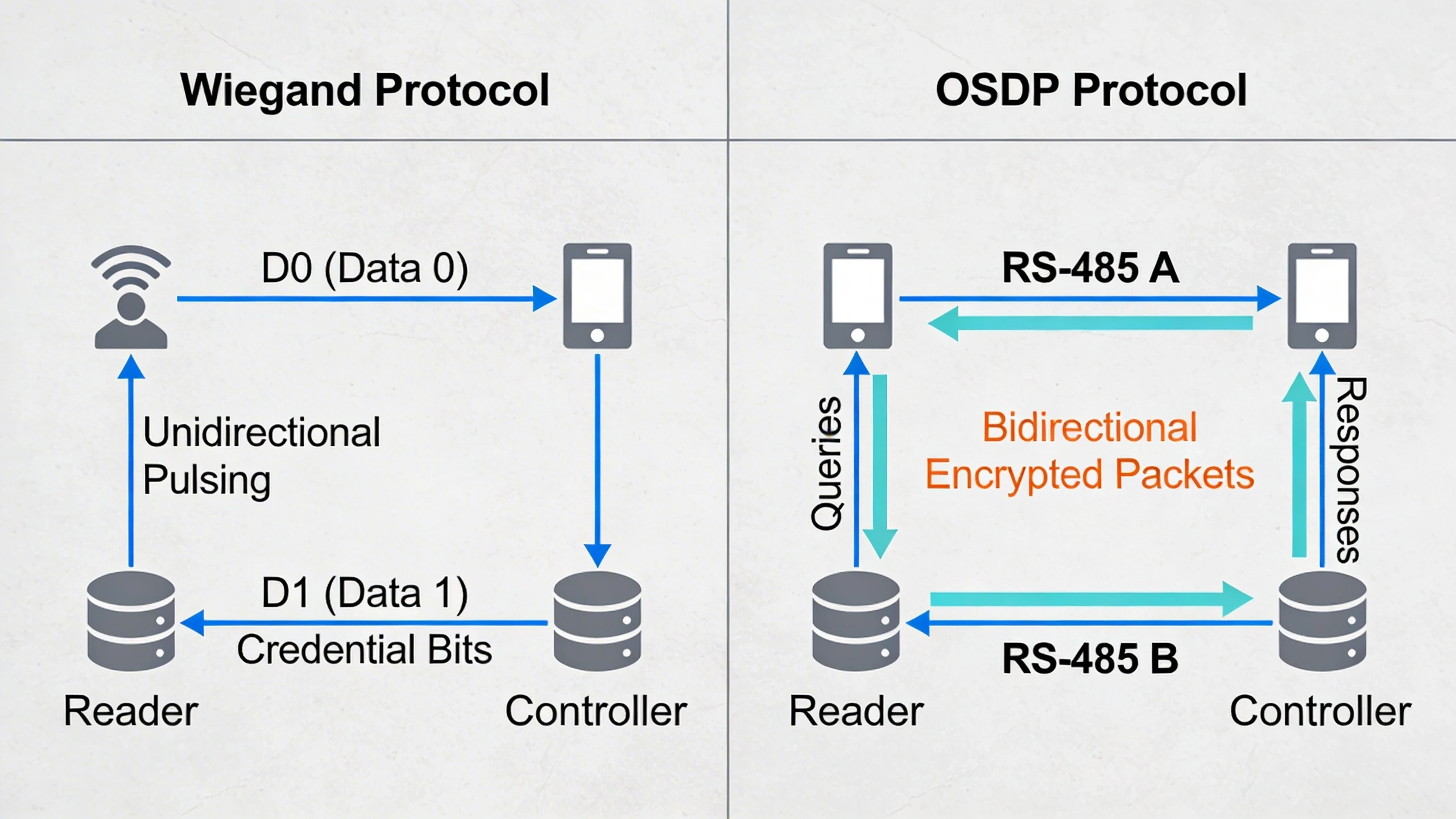
What changes when you move from Wiegand to OSDP
Swapping protocols alters the core conversation between readers and controllers. Wiegand pushes credential data one-way, with no feedback loop for errors or status. OSDP flips this to a full-duplex model, where controllers query readers for battery levels, door positions, or input states, and readers acknowledge receipt. In a retrofit at a multi-building campus, this means technicians can poll all readers from a central panel during a site walkdown, spotting a failing tamper switch before it triggers alarms.
Configuration shifts too. Wiegand readers arrive pre-set for formats like 26-bit, with DIP switches or proprietary tools for tweaks. OSDP centralizes this via over-the-wire commands, using predefined profiles for facility codes or encryption keys. Field teams appreciate fewer ladder climbs, but initial setup requires verifying controller firmware supports OSDP v2 features like biometric data tunneling. Get this wrong, and readers go dark, mimicking a cabling fault.
Operational tempo accelerates with OSDP's higher baud rates—up to two megabits per second versus Wiegand's 10 kilobits—reducing latency in high-traffic areas. Yet the real win lies in diagnostics: event logging now captures reader-side details, aiding root-cause analysis after a failed unlock sequence.
Security differences and secure channel impact
Wiegand's plaintext pulses travel openly, letting anyone with a logic analyzer capture facility codes and PINs within seconds. This vulnerability bites in exposed runs, like fence-line readers at remote sites. OSDP counters with a secure channel option, layering AES-128 encryption atop mutual authentication between reader and controller. Once keys exchange during pairing, all data—including credentials and commands—stays ciphered, thwarting replay or man-in-the-middle plays.
Implementing the secure channel demands deliberate steps: generate session keys at install, rotate them periodically, and monitor for desyncs. In practice, unsecured OSDP falls back to cleartext, mimicking Wiegand risks, so audit logs must flag non-encrypted links. For critical infrastructure, this upgrade satisfies audit requirements without custom overlays, but mismatched key lengths or revoked certificates can lock out readers mid-shift.
Beyond encryption, OSDP profiles enforce reader authentication, preventing rogue devices from spoofing legit ones. This matters in daisy-chained setups where a compromised endpoint could eavesdrop upstream. Teams transitioning from Wiegand often overlook key management, leading to fallback modes that erode the security lift.
Wiring, topology, and field-device implications
Wiegand favors star topologies: each reader runs dedicated twisted-pair back to the controller, capping practical distances around legacy cable specs. OSDP leverages RS-485 differential signaling for daisy-chaining up to dozens of readers on a single bus, slashing trunk-line pulls in long corridors or perimeter loops. Power delivery consolidates too—OSDP readers draw from a shared 12-24VDC rail, versus Wiegand's ubiquitous 5VDC per unit.
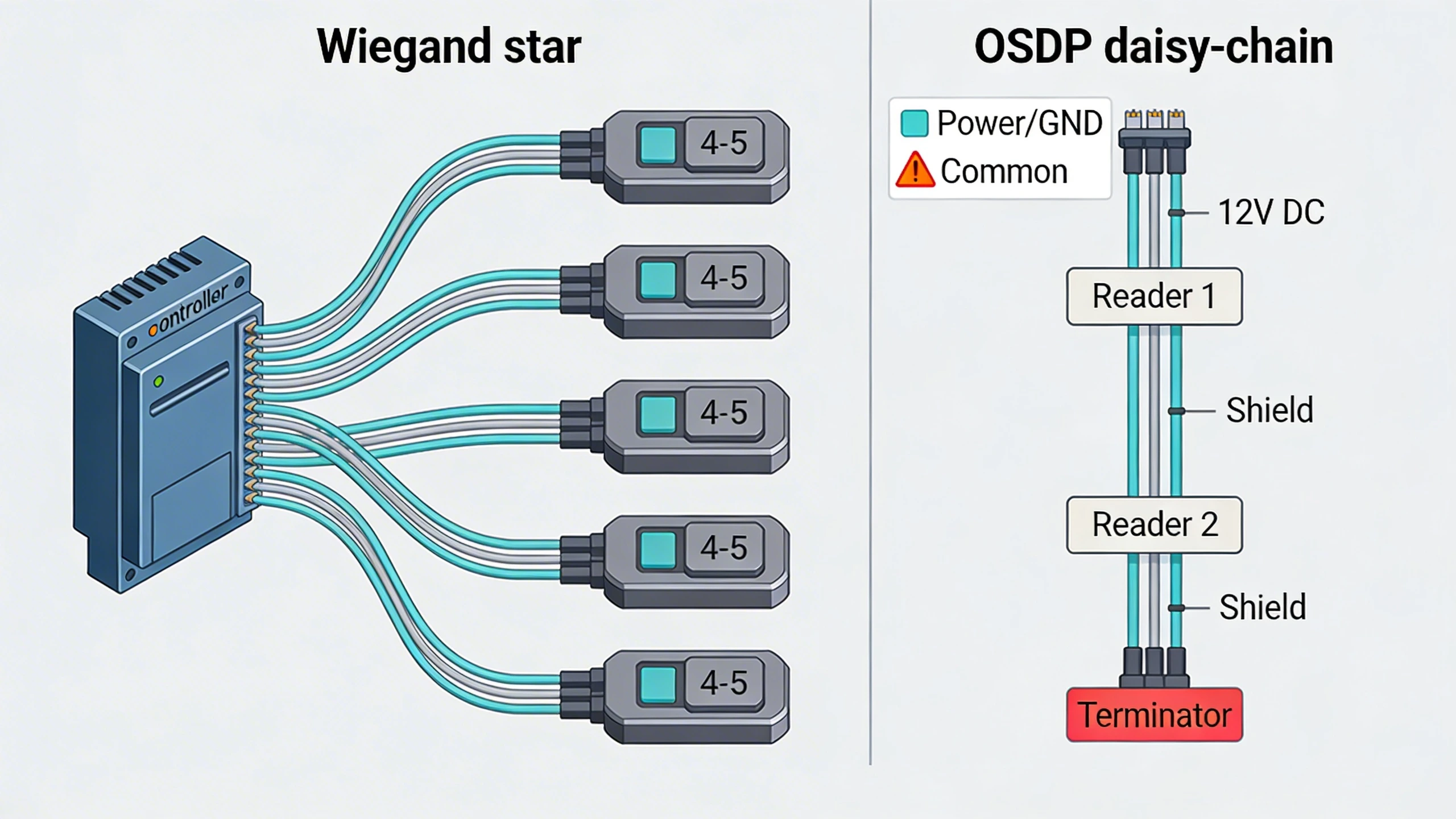
Cable choices evolve: shielded twisted-pair becomes essential for OSDP's A/B lines to reject EMI in industrial zones, while Wiegand tolerates simpler runs. During a substation upgrade, integrators re-use existing conduit but add terminators at bus ends to curb reflections. Field devices gain smarts—OSDP readers expose auxiliary inputs for egress buttons or motion sensors, wired directly without extra modules.
Power budgeting tightens with longer chains; voltage drop across multiple drops can starve endpoints, triggering brownout resets. Test with a loopback tool pre-population, as live swaps risk bus faults propagating site-wide.
Migration planning and common failure points
Phased rollouts shine here: map existing Wiegand ports, then pilot OSDP on low-risk doors while controllers bridge protocols. Firmware flashes often unlock dual-mode support, letting old readers limp alongside new ones. In a 50-door facility, sequence by zone—perimeter first for security gains—while staging spares for DOA units.
Pitfalls abound: address clashes in daisy chains halt the bus; default zeros from unconfigured readers collide. Secure channel pairing fails if controllers lack RNG for keys, forcing factory resets. Cable pinouts trip teams too—OSDP's A/B swap with Wiegand's D0/D1 invites crossed signals. Mitigate with a pre-cut checklist: verify polarity, termination, and shielding continuity door-by-door.
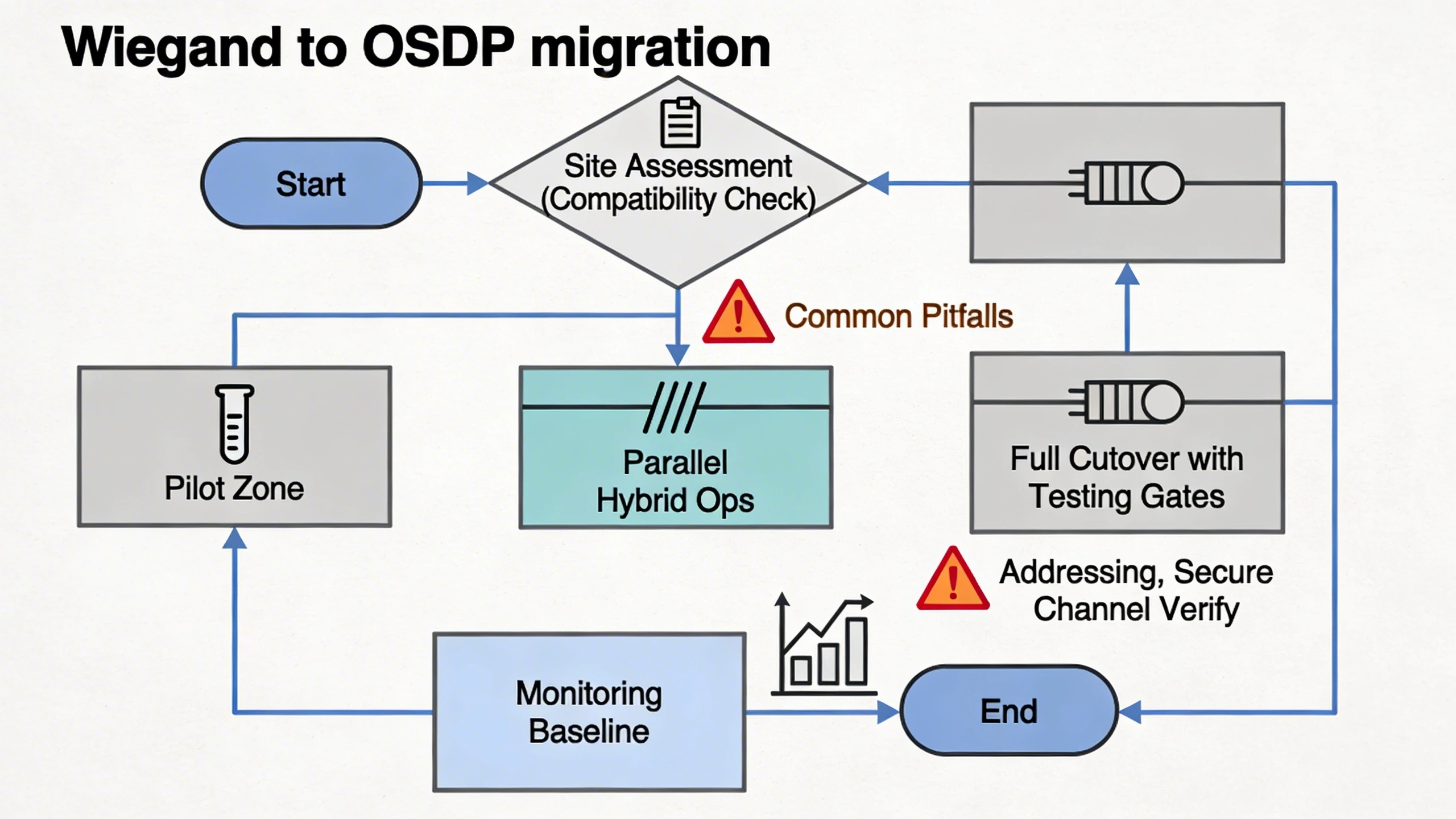
Post-cutover, baseline diagnostics: command reader self-tests and log throughput. Hybrid phases expose latency mismatches, where Wiegand doors lag OSDP peers, confusing operators.
Where Wiegand still appears and what to verify
Budget single-door installs cling to Wiegand for its zero-config appeal—no addressing, just plug in. Legacy readers dominate aftermarket stock, and some proprietary controllers shun OSDP to cut costs. Verify compatibility early: probe for multi-format support and LED/buzzer control, as OSDP centralizes these.
In mixed fleets, audit exposure—prioritize high-value assets for OSDP. Check cable gauge for voltage sag, and sniff runs for ambient RF. Wiegand endures where simplicity trumps features, but verify against site threats; a perimeter gate demands more than a closet lock.
Where to go next
Ready to deploy OSDP in your access control setup? Explore FortSense 4 for seamless integration. For tailored advice, request a design review. Dive deeper into OSDP glossary or Wiegand glossary terms. See critical infrastructure security solutions or North America deployments for case parallels.