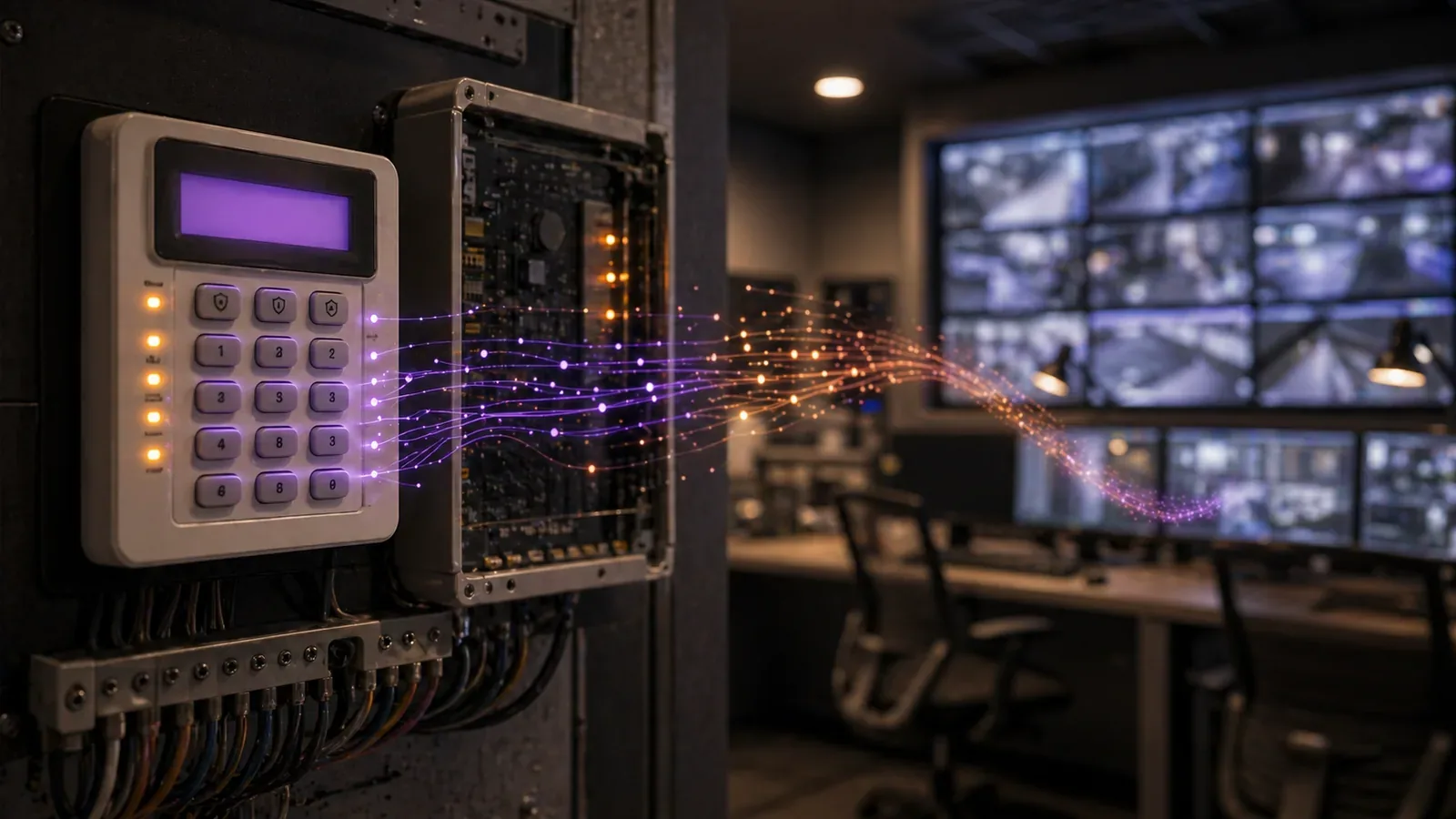
When retrofitting security systems at a multi-building campus or remote utility substation, integrators often encounter legacy intrusion panels still transmitting events via the Contact ID protocol. These panels, common in installations from the 1990s and 2000s, send concise three-digit codes over POTS lines to central receivers, signaling everything from burglar alarms (code 130) to AC power loss (301).2021 The core design decision revolves around translating these codes faithfully into a unified platform like a PSIM, without losing critical qualifiers like zone IDs or restore signals, while bridging to IP-based monitoring.
In practice, this means selecting receivers that decode the DTMF tones accurately and map codes to actionable events in your central software. For a typical upgrade at a North American power facilityNorth America deployments, teams replace failing POTS gateways with cellular or IP translators, ensuring fire supervisory codes (200 series) trigger immediate escalation distinct from routine troubles. Getting the mapping right upfront prevents dispatch errors, such as mistaking a tamper restore (e.g., 137 restore) for an ongoing alarm.
Success hinges on understanding how Contact ID's structure—qualifier (alarm/restore), event code, and partition/zone—interacts with modern workflows. Panels like those from Honeywell or DSC output these in a fixed format: four-digit account, one-char qualifier, three-digit code, three-digit user/zone, group info, and checksum.10 During migration, prioritize code groups that align with your operational priorities, like distinguishing 110 (fire alarm) from 114 (heat sensor) to comply with response protocols in critical infrastructure.Critical infrastructure security
What the design decision looks like in practice
Picture a security manager overseeing 15 panels across a manufacturing campus, each wired to dial a receiver during events. The decision to standardize on Contact ID mappings starts with auditing existing code usage: do doors trigger 132 (interior burglary) or 134 (entry/exit)? In a retrofit, configure the receiver—say, a third-party IP gateway—to forward parsed events via SNMP or API to your PSIM, preserving the full message payload. This allows operators to filter 600-series closings from alarms without custom scripting.
For implementation, teams define rulesets in the monitoring software. A fire alarm (110-119) might auto-notify FD responders, while system troubles (300-399) route to maintenance tickets. In one campus upgrade, integrators mapped 570 (walk test begin) to suppress non-critical alerts during maintenance windows, reducing operator fatigue. The key is testing end-to-end: simulate a 130 burglary on zone 005 and verify it escalates correctly, including checksum validation to drop garbled transmissions.
This approach scales to larger deployments by grouping codes logically. Rather than one-to-one mappings, cluster 1xx/2xx as life-safety for priority queuing, ensuring retrofits maintain pre-upgrade reliability while adding IP redundancy.
System architecture and integration considerations
At the heart of Contact ID integration lies the receiver's role in demodulating POTS signals or emulating them over IP. Legacy dialers punch out 1400Hz/2300Hz DTMF bursts encoding the message, so architecture demands robust capture devices tolerant of line noise common in utility vaults. Integrate via middleware that normalizes codes into JSON payloads, feeding into platforms supporting SNMP traps or REST APIs for seamless PSIM ingestion.
Consider partitioning: Contact ID's group digit (e.g., 4 for open/close) must map to site-specific logic. In a multi-tenant building, segregate 400-series user arm/disarms by account code to avoid cross-talk. For FortSense 4FortSense 4, this means provisioning event parsers that handle variable zone lengths and qualifiers, with failover to secondary paths like cellular for POTS obsolescence. Tradeoffs emerge in bandwidth: raw Contact ID is lightweight (under 50 bytes per event), ideal for low-data links, but requires precise timing sync to avoid checksum rejects.
Hybrid setups shine in migrations, blending Contact ID translators with native IP panels. Ensure architecture supports bidirectional acknowledgments where possible, though many legacy panels lack them, shifting confirmation to the receiver layer.
Operational workflows and field constraints
Once integrated, Contact ID codes dictate dispatch cadence. Operators train on code families: 900-series panics demand silent verification, while 113 (waterflow) triggers flood protocols. In field ops at remote sites, constraints like poor cellular coverage mean relying on code restores (e.g., 137 for tamper) to clear tickets automatically, freeing technicians for high-value tasks.
Workflows adapt to code granularity. A 301 AC trouble might initiate generator checks, but without zone context, it defaults to system-wide. Field teams mitigate by labeling zones consistently—door 001 always 132—and using panel programming to suppress tests (7xx) during shifts. In critical setups, layer audio verification atop codes, as DTMF lacks sensor details, ensuring 162 (CO alarm) prompts immediate evac.
Constraints peak in retrofits: aging wiring drops packets, so buffer queues in receivers prevent loss. Train responders on code evolutions, like distinguishing 380 sensor trouble from 330 peripheral faults, to streamline root-cause analysis.
Common failure points and design mistakes
Mismapping tops the list: treating all 3xx as generic alarms ignores 330 (sounder trouble) vs. 350 (comm failure), leading to unnecessary truck rolls. In one utility retrofit, overlooked qualifiers sent restores as new events, flooding queues. Design flaw: skipping checksum verification, where line glitches corrupt codes into invalids like 999, halting comms.
Another pitfall: ignoring partition handling. Multi-area panels send user/zone tied to codes, but unconfigured receivers broadcast globally, confusing operators. Field mistakes include unprogrammed test codes (570/571) mimicking alarms. Avoid by staging migrations: parallel old/new paths, logging raw payloads for audits. Scalability fails when receivers overload on 6xx closings during shift changes; throttle or filter at source.
- Validate mappings against Contact ID glossary standards.
- Test edge cases: garbled checksums, rapid-fire events.
- Document custom codes per site to ease handoffs.
What to verify before procurement
Before committing to panels or receivers, confirm Contact ID compliance per SIA DC-05, ensuring full code support from 100-799.14 Probe vendor docs for DTMF tolerance and IP encapsulation—critical for POTS-to-Ethernet bridges. Check zone expansion: does it handle 3-digit IDs up to 999 without truncation?
Assess integration hooks: API schemas must expose qualifier, code, and group distinctly. For critical infrastructure, verify failover—does it retry on 354 (fail to communicate)? Field-test samples under noise: simulate 20dB loss and measure decode rates. Review firmware update paths, as code lists evolve (e.g., new 16x for CO2).
Procure with scalability: support for 100+ accounts, syslog export for forensics. Align with your PSIM's parser, avoiding proprietary extensions that lock in vendors.
Where to go next
Explore FortSense 4FortSense 4 for advanced event fusion beyond Contact ID. For tailored advice, Request a design review. Dive deeper into protocols via the Contact ID glossary, and review deployments in North America or critical infrastructure.