When retrofitting a coastal utility substation, security integrators often confront the stark limitations of legacy perimeter systems. Fog rolling in from the sea, persistent rain, and salt-laden air degrade optical and infrared sensors, leading to coverage gaps that expose critical assets to intrusion risks. Teams tasked with maintaining 24/7 detection must weigh retrofit options that prioritize penetration through atmospheric obscurants while addressing corrosion from coastal environments.
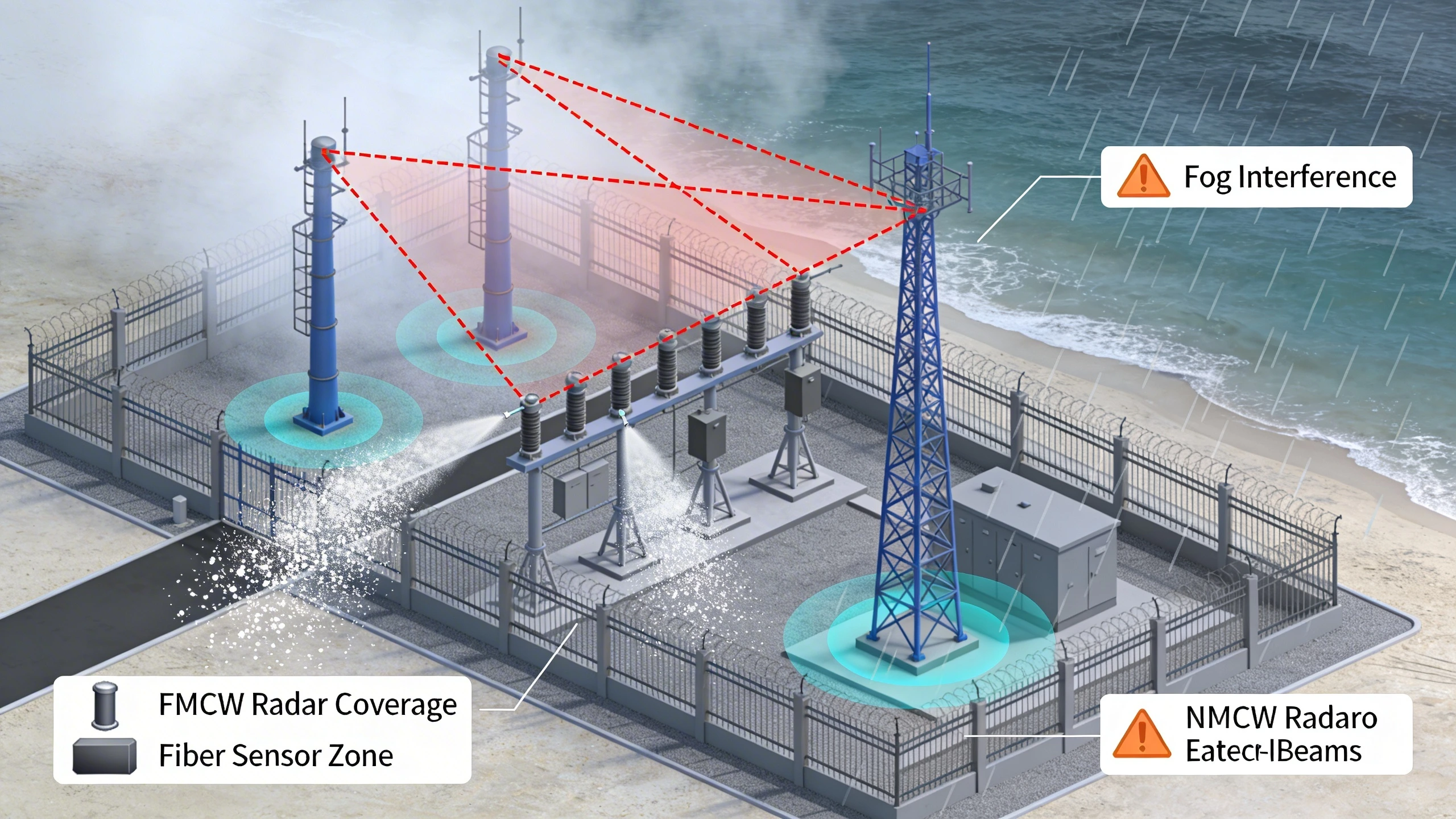
A practical pivot involves shifting from visible-light or thermal cameras to radar-based or fiber-optic solutions, which maintain line-of-sight integrity without relying on light propagation. For instance, at a multi-fence oil refinery perimeter, engineers might layer frequency-modulated continuous-wave (FMCW) radar over existing taut-wire fences, ensuring detection persists through heavy mist. This approach not only restores reliability but also integrates with existing physical barriers, minimizing downtime during upgrades.
Selection hinges on site-specific microclimates: inland fog differs from ocean-driven salt fog, and tropical downpours demand different tuning than drizzle. Early decisions here shape long-term operational costs, as mismatched sensors amplify maintenance calls from weather-induced nuisance alerts.
What the design decision looks like in practice
In the field, designing for fog and rain starts with mapping environmental baselines from historical weather data and site surveys. At a campus-like power generation facility spanning several acres, integrators assess zones where fog density peaks at dawn, pairing short-range radar for precise target classification with longer-range microwave links for broad coverage. This hybrid avoids over-reliance on any single modality, as radar excels at velocity discrimination to filter birds or debris while fiber strain sensors detect climbing attempts on fences regardless of visibility.
Coastal air introduces salt deposition, accelerating sensor degradation, so material choices become critical. Retrofit teams at harbor-adjacent sites often specify housings with marine-grade coatings and self-draining designs. A real-world example unfolds during a phased upgrade: first, deploy radar masts at high-vulnerability gates, then extend coverage with buried coaxial sensors along fence lines. Operators tune sensitivity thresholds post-installation using playback of archived weather events, achieving balanced performance before full handover.
Transitioning from legacy photoelectric beams illustrates the shift. Where beams once triggered hourly false alarms in drizzle, radar provides directional tracking, logging crawler paths for forensic review. This evolution supports compliance with standards for critical infrastructure without introducing new single points of failure.
System architecture and integration considerations
Architecture for adverse weather demands modularity to layer detection over physical perimeters. Core to this is positioning radar heads 3-5 meters above ground on stable masts, oriented to scan exclusion zones while avoiding ground clutter from waves or vegetation sway. Integration with a PSIM platform unifies alerts, correlating radar tracks with access control logs to suppress transients like rain splatter. For coastal deployments, Ethernet-over-fiber backhaul resists corrosion better than copper, enabling IP-based fusion at edge processors.
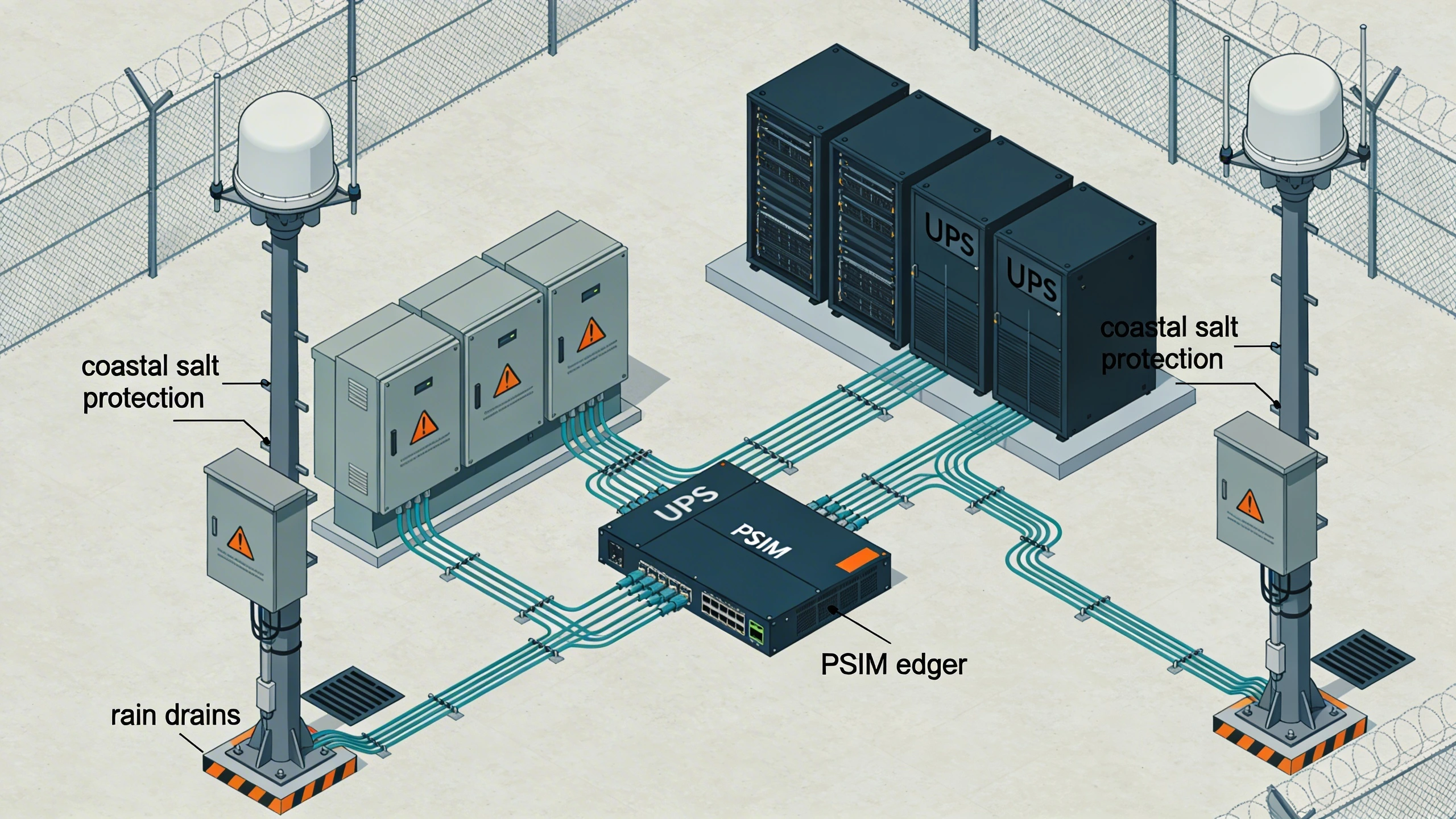
Power redundancy factors heavily, as fog often coincides with high humidity that stresses backup batteries. Integrators design dual-path feeds from UPS-equipped enclosures, with solar augmentation viable in sunnier coastal bands. Scalability shines in multi-site rollouts: standardized radar APIs allow central provisioning, where a single dashboard adjusts gain curves for varying rain rates across locations. At a North American refinery chain, this setup streamlined firmware updates, pushing weather-tuned profiles without site visits.
Seamless handoff to video verification remains key, though limited to clear conditions. Smart rules route radar detections to nearest PTZ cameras only when precipitation eases, conserving bandwidth and operator fatigue.
Operational workflows and field constraints
Daily operations pivot around proactive tuning to weather forecasts. Guards at foggy industrial parks run pre-shift diagnostics, verifying radar Doppler signatures against baseline wind profiles to preempt false positives. Field constraints like uneven terrain demand elevated sensors, but coastal erosion complicates pole foundations, requiring geotechnical assessments before trenching for buried sensors.
Maintenance workflows emphasize accessibility: self-calibrating radar reduces visits, but salt buildup necessitates quarterly wipes with deionized water. Training focuses on alert triage, teaching operators to distinguish human crawls from rain-induced Doppler shifts via velocity vectors. In practice, integrating with SCADA systems flags environmental anomalies, like sudden humidity spikes, triggering automated sensitivity dips.
Shift handovers include active intrusion logs filtered by weather metadata, ensuring continuity. Constraints peak during storms, where tethered drones for spot checks supplement fixed sensors, though regulatory limits on flight in low visibility guide their use.
Common failure points and design mistakes
A frequent misstep is undersizing radar field-of-view for site geometry, leaving blind spots where fog pools in low-lying areas. Installers at coastal campuses overlook multipath interference from metal structures, causing ghost tracks that overwhelm PSIM queues. Another pitfall: ignoring power harmonics from nearby grids, which inject noise into microwave bands, mimicking intrusions during rain.
Overlooking enclosure IP ratings leads to saltwater ingress, corroding connectors within months. Design teams err by static configurations, failing to implement dynamic gain control that ramps down during heavy rain, resulting in alert fatigue. Retrofitting without baseline nuisance logging invites callbacks, as operators battle uncharacterized weather patterns.
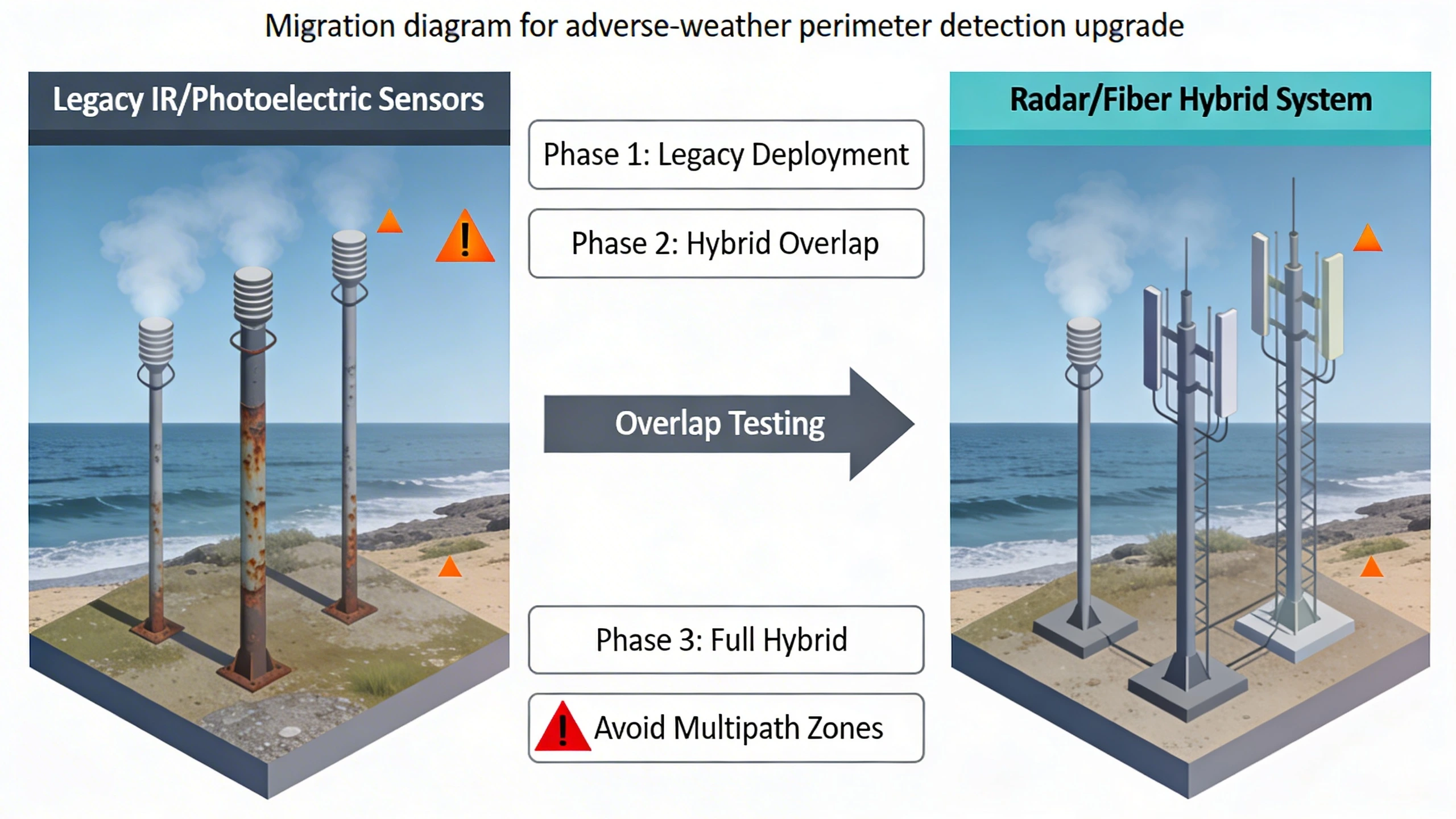
Migration oversights compound issues: abrupt swaps from IR to radar without overlap testing create temporary gaps. Vendor lock-in via proprietary protocols hinders future expansions, stranding integrators with siloed data.
What to verify before procurement
Scrutinize environmental test data from independent labs, confirming detection probability through simulated fog densities up to 90% obscuration. Probe signal-to-noise ratios in rain attenuation models, ensuring classifiers handle micro-Doppler from foliage sway. For coastal suitability, demand proof of accelerated corrosion testing, like salt fog chamber exposure exceeding 1,000 hours.
Validate integration APIs against your PSIM, testing alert payloads for position accuracy within 0.5 meters. Request field trial footage from similar deployments, assessing false alarm rates qualitatively across weather cycles. Confirm mounting hardware withstands 100+ mph gusts, with seismic bracing for earthquake-prone coasts.
Review service models: remote diagnostics capability and firmware update cadence matter for dispersed sites. Cross-check scalability claims with reference architectures matching your zone counts.
Where to go next
Explore FortSense 4 for modular radar integration tailored to harsh environments. For tailored advice, request a design review. Dive deeper into critical infrastructure security or review North America deployments. Supporting terms: Perimeter Intrusion Detection System glossary and PSIM glossary.