When upgrading the perimeter security at a remote utility substation, the engineering team faces a familiar tension: sensors must detect intrusions fast enough to enable effective response, yet the full chain from detection to guard dispatch cannot tolerate excessive delays. Allocating budgets for detection latency—the time from physical event to confirmed alert—and response time—the span to actionable mitigation—becomes the linchpin of the design. Get this wrong, and a climber scaling a fence goes unnoticed until footage review hours later; get it right, and the system flags the anomaly in seconds, cueing patrols before escalation.
Consider a typical retrofit scenario at an industrial campus where legacy microwave barriers feed into a central PSIM. The total end-to-end budget might target confirmation within five seconds for high-risk zones, with detection latency claiming no more than half that slice. This forces deliberate choices: vibration sensors on the fence fabric might excel at sub-second triggers, but integrating them with video verification stretches the chain if network hops introduce jitter. Engineers learn quickly that uniform budgets across all segments fail; instead, zone-specific allocations account for terrain, threat models, and integration depth.
These decisions ripple through procurement, cabling runs, and tuning sessions. A power plant perimeter, for instance, demands microsecond sensor response for buried fiber optics but buffers for wireless camera uplinks prone to interference. Balancing these ensures the system meets operational SLAs without overprovisioning hardware.
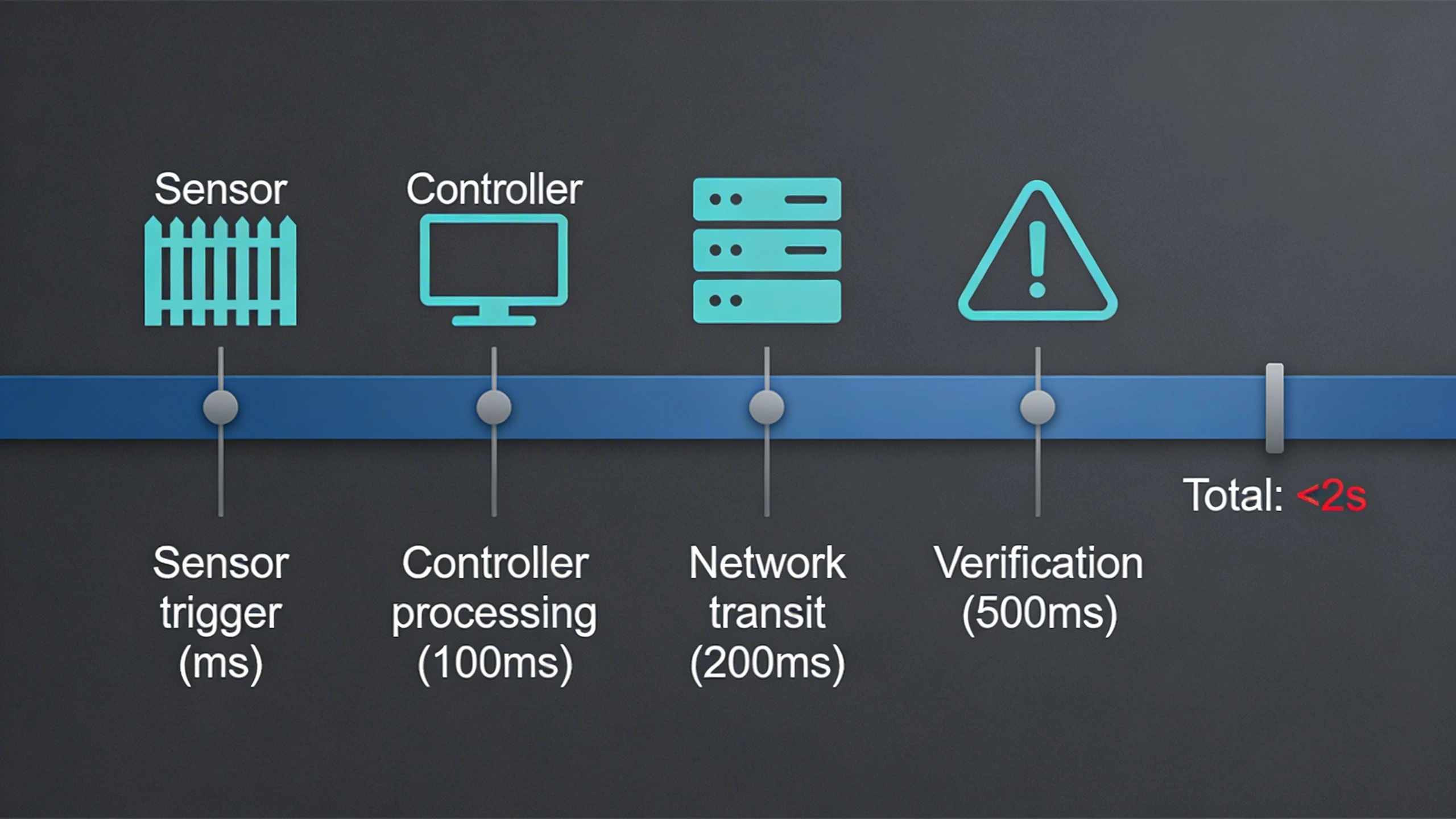
What the design decision looks like in practice
In the field, designing latency budgets starts with mapping the threat timeline against system capabilities. For a multi-zone airport perimeter, engineers break down the path: a taut-wire sensor trips in milliseconds, the controller processes and polls adjacent IR beams for confirmation over RS-485 in under 200ms, then pushes the event via Modbus TCP to the head-end server. Here, the budget allocation shines—assign 40% to sensing and local logic, 30% to network transit, and 30% to verification rules—revealing if video analytics will bottleneck the flow.
Practitioners document this as a cascade diagram during site surveys, iterating based on walkthroughs. At a chemical facility retrofit, one team discovered that legacy ported video streams consumed 1.5 seconds per frame pull, blowing the budget until they switched to RTSP multicast. The result? Alerts hit operator consoles in under three seconds consistently, aligning with response protocols that dispatch rovers within the next two minutes. This granular approach prevents the common pitfall of assuming vendor specs translate directly to deployed performance.
Such budgets also adapt to hybrid deployments. When layering microwave links over buried coaxial sensors, the design specifies failover logic where primary latency targets 500ms but secondary paths allow 2 seconds, ensuring redundancy without paralysis.
System architecture and integration considerations
PIDS architectures demand scrutiny of every hop's contribution to latency. Distributed edge controllers minimize cabling delays but introduce synchronization challenges across IP backbones; centralized setups consolidate logic for faster rule engines yet risk single points of congestion. In a campus expansion, integrating Perimeter Intrusion Detection Systems with VMS requires API polling intervals under 100ms to stay within budgets, often necessitating custom middleware for ONVIF compliance.
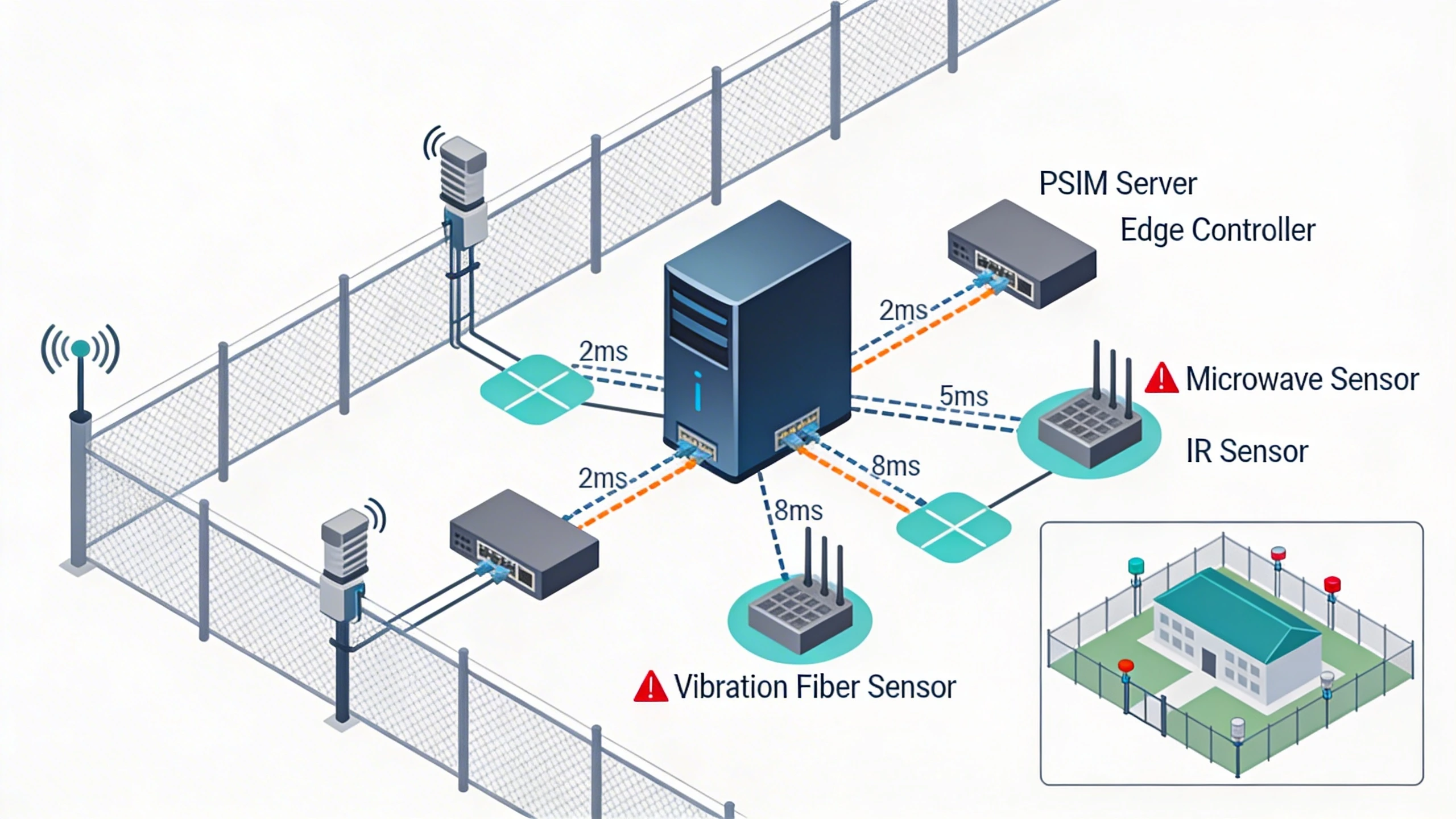
Network design proves pivotal. VLAN segregation isolates PIDS traffic from IT flows, curbing jitter from DHCP renewals or multicast storms. For fiber-optic distributed sensing, the architecture embeds Brillouin OTDR processing at the interrogator, shaving seconds off what point sensors demand via repeated queries. Yet, marrying this to a PSIM layer exposes integration latency: asynchronous event buses like MQTT outperform polling, but only if publishers timestamp accurately to avoid desync.
Power redundancy factors in too—UPS failover on controllers must not exceed 50ms to preserve budgets, a detail overlooked in brownout-prone sites.
Operational workflows and field constraints
Once deployed, workflows test budget resilience against real-world variables. Daily patrols recalibrate sensors for drift, but wind-induced vibrations on guyed fences can inflate false positive processing, stretching confirmation times. Operators at oil refineries tune dewars algorithms to discriminate wildlife within 1-second windows, logging metrics to refine budgets quarterly.
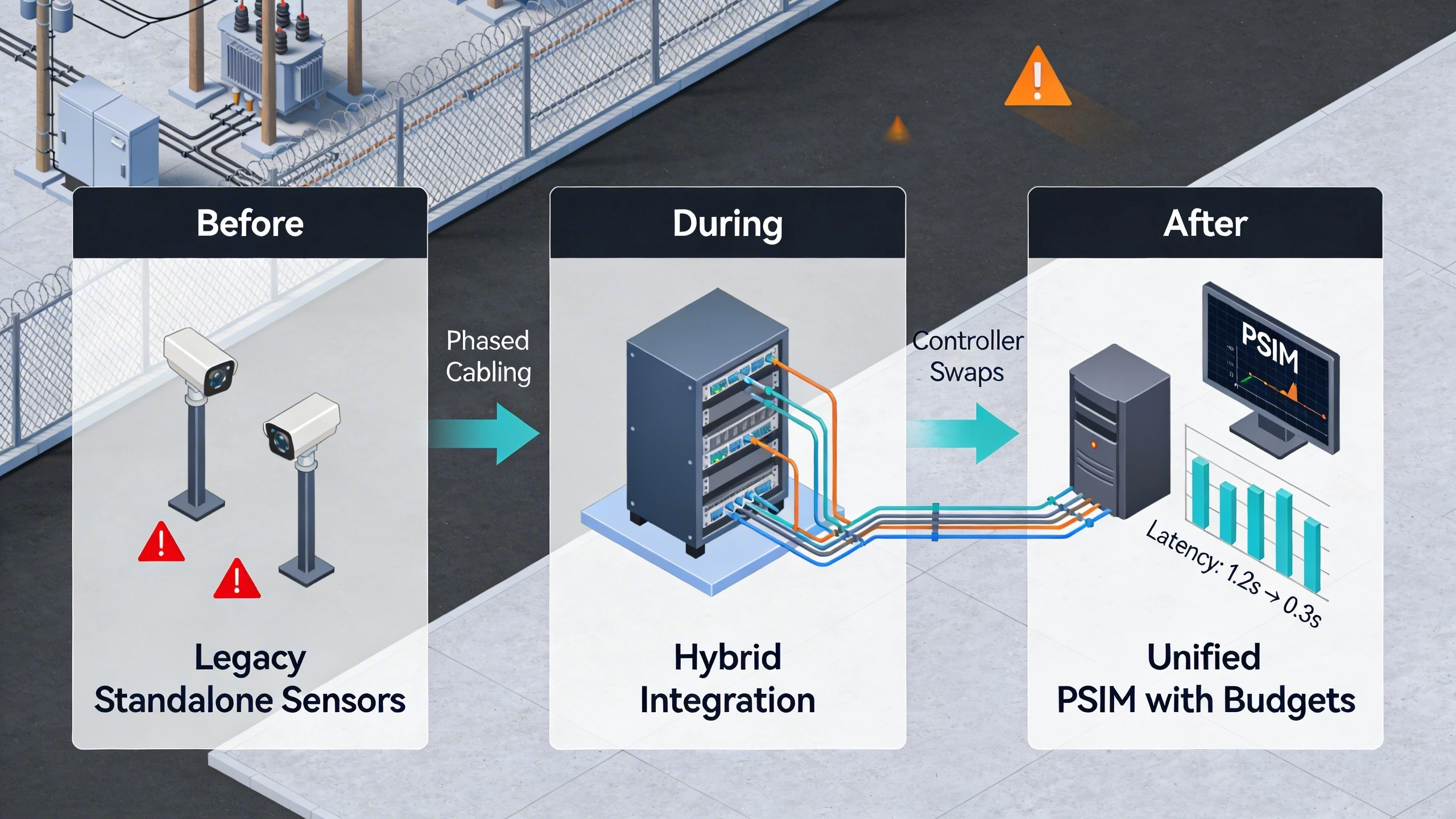
Field constraints like terrain amplify issues: hilly perimeters delay microwave propagation, mandating asymmetric budgets where uphill zones get extra verification buffer. Maintenance windows enforce dry-run simulations, verifying that firmware updates don't regress latency. In rainy seasons, integrators enable heated optics to prevent fog-induced stalls, ensuring workflows sustain sub-five-second alerts even under load.
- Schedule latency audits post-weather events.
- Integrate operator acknowledgments to close response loops dynamically.
Common failure points and design mistakes
Overlooking cumulative latency tops the list—individual components meet specs, but chained together exceed budgets by 300%. A warehouse retrofit suffered this when balun converters added 100ms per segment across 2km runs, unaccounted until go-live. Similarly, unbuffered MQTT queues in PSIM integrations drop events during spikes, mimicking latency when it's actually loss.
Designers err by ignoring asymmetric threats: climb-overs demand faster budgets than crawl-under detection, yet uniform configs fail both. Network QoS misconfigurations let VoIP prioritize over PIDS UDP packets, inflating transit times. Failover testing exposes another gap—redundant paths often lack heartbeat tuning, causing seconds-long handoffs that nullify tight budgets.
Underestimating tuning overhead compounds issues; initial deployments shine, but six months in, detuned IR pairs double latency from beam bounce.
What to verify before procurement
Scrutinize vendor datasheets for worst-case latencies, not averages—insist on oscilloscope traces from sensor trigger to Ethernet output. Probe integration docs for protocol overhead: does DNP3 add 500ms headers versus SNMP? Request reference architectures matching your topology, like daisy-chained controllers for linear fences.
During RFIs, demand load-tested metrics: 100 simultaneous events at 90% CPU utilization. Confirm API idempotency for retries without doubling budgets. Field demos should simulate your constraints—fog machines for optics, vibration tables for sensors—timing full chains to PSIM mocks.
- Validate failover handover under 100ms.
- Check timestamp precision across components.
- Audit cabling loss budgets for analog legs.
Where to go next
With latency budgets mapped, explore FortSense 4 for unified PIDS orchestration in critical infrastructure security. For site-specific tuning, review North America deployments. Request a design review to benchmark your perimeter.
Measure the end-to-end budget against independent ground truth with the blind PIDS intrusion testing protocol rather than timing only the sensor processor.