When retrofitting video surveillance at a multi-building campus or utility substation, one of the first design decisions integrators face is setting pre-alarm and post-alarm clip durations. These parameters determine how much footage captures the lead-up to a trigger event—like a door sensor activation or motion detection—and how long recording continues afterward. Getting this right ensures security teams can reconstruct incidents without sifting through endless streams, while avoiding storage bloat that strains NVR capacity.
In a typical upgrade scenario, such as hardening access points across a sprawling industrial site, pre-alarm clips might need to cover the 15-30 seconds before an unauthorized entry attempt, revealing if someone loitered or tested the perimeter. Post-alarm durations, meanwhile, extend to capture the intruder's path or response from guards. The sweet spot emerges from site-specific workflows: too brief, and context evaporates; too generous, and irrelevant footage overwhelms operators during high-volume reviews.
This balance directly impacts operational efficiency. For instance, in critical infrastructure security deployments, where response times are measured in minutes, designs often prioritize longer post-alarm windows to align with patrol arrival, while pre-alarm settings focus on behavioral precursors like tailgating.
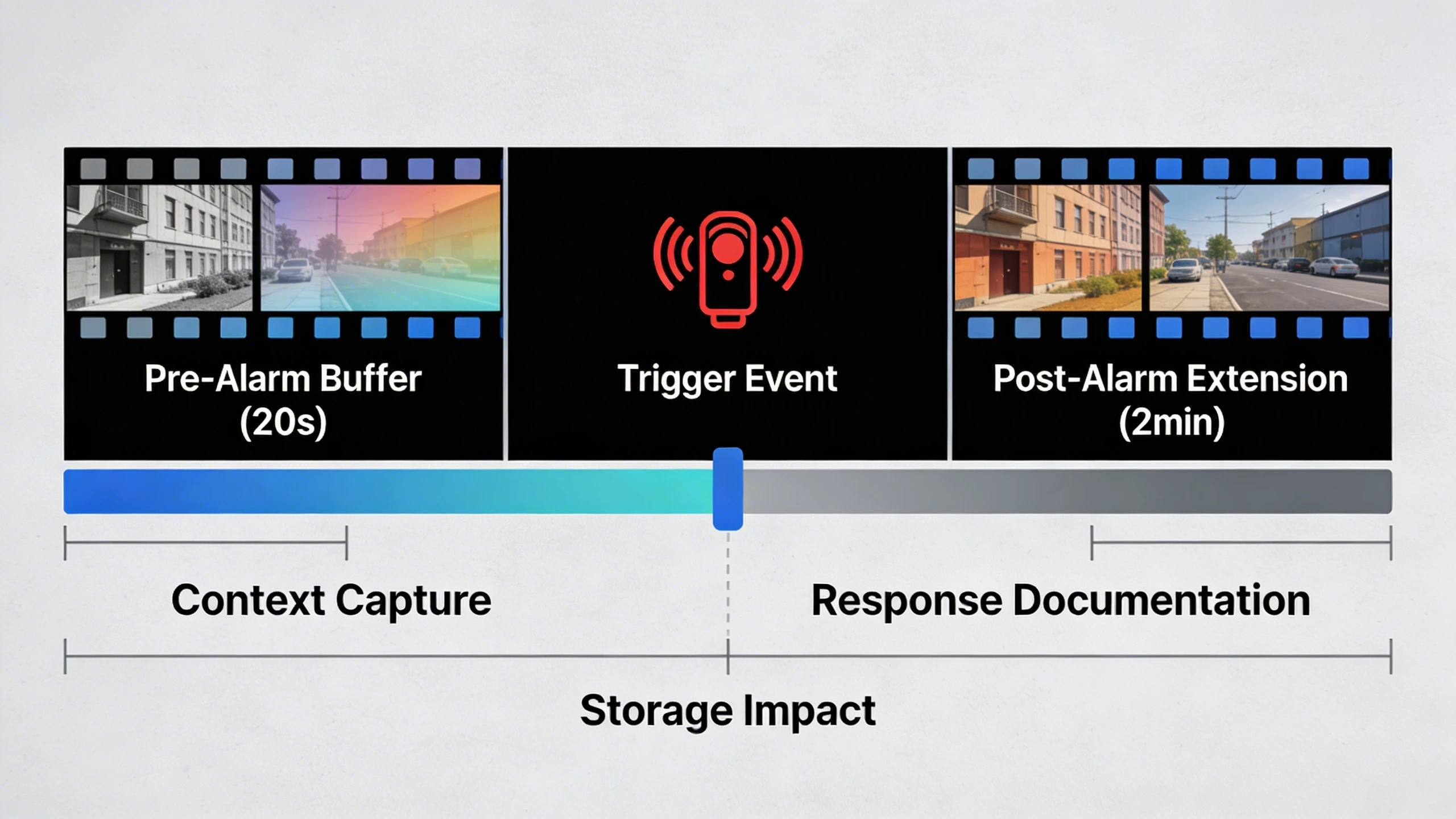
What the design decision looks like in practice
Picture a retrofit at a regional data center with 50 access-controlled doors. Each camera feeds into a centralized VMS, triggered by badge readers. Here, pre-alarm duration might be tuned to 20 seconds to catch hesitation or accomplices outside the frame, based on historical incident logs showing most tailgating attempts build over 10-15 seconds. Post-alarm extends to two minutes, enough time for the full evasion sequence without pulling operators into manual scrubbing.
In field deployments, these settings manifest during commissioning. Integrators test by simulating breaches—walking through doors without credentials—and reviewing clips side-by-side. A common refinement comes from operator feedback: if SOC analysts repeatedly zoom out for more prelude footage, bump pre-alarm incrementally. This iterative approach, grounded in real walkthroughs, prevents over-engineering while tailoring to the site's rhythm, whether it's a quiet warehouse shift or a 24/7 perimeter watch.
Across North America deployments, patterns emerge. Utility sites favor symmetric durations for balanced storage, while corporate campuses lean toward extended post-alarm for forensic depth, reflecting varied threat models from vandalism to insider risks.
System architecture and integration considerations
Pre- and post-alarm designs hinge on the underlying architecture, particularly how edge devices interface with recording servers. Cameras with onboard buffering—storing seconds of video in RAM before a trigger—enable seamless pre-alarm capture without constant streaming. When integrating with systems like FortSense 4, verify that the VMS supports configurable buffers across hybrid cloud-edge setups, as mismatched firmware can truncate clips unpredictably.
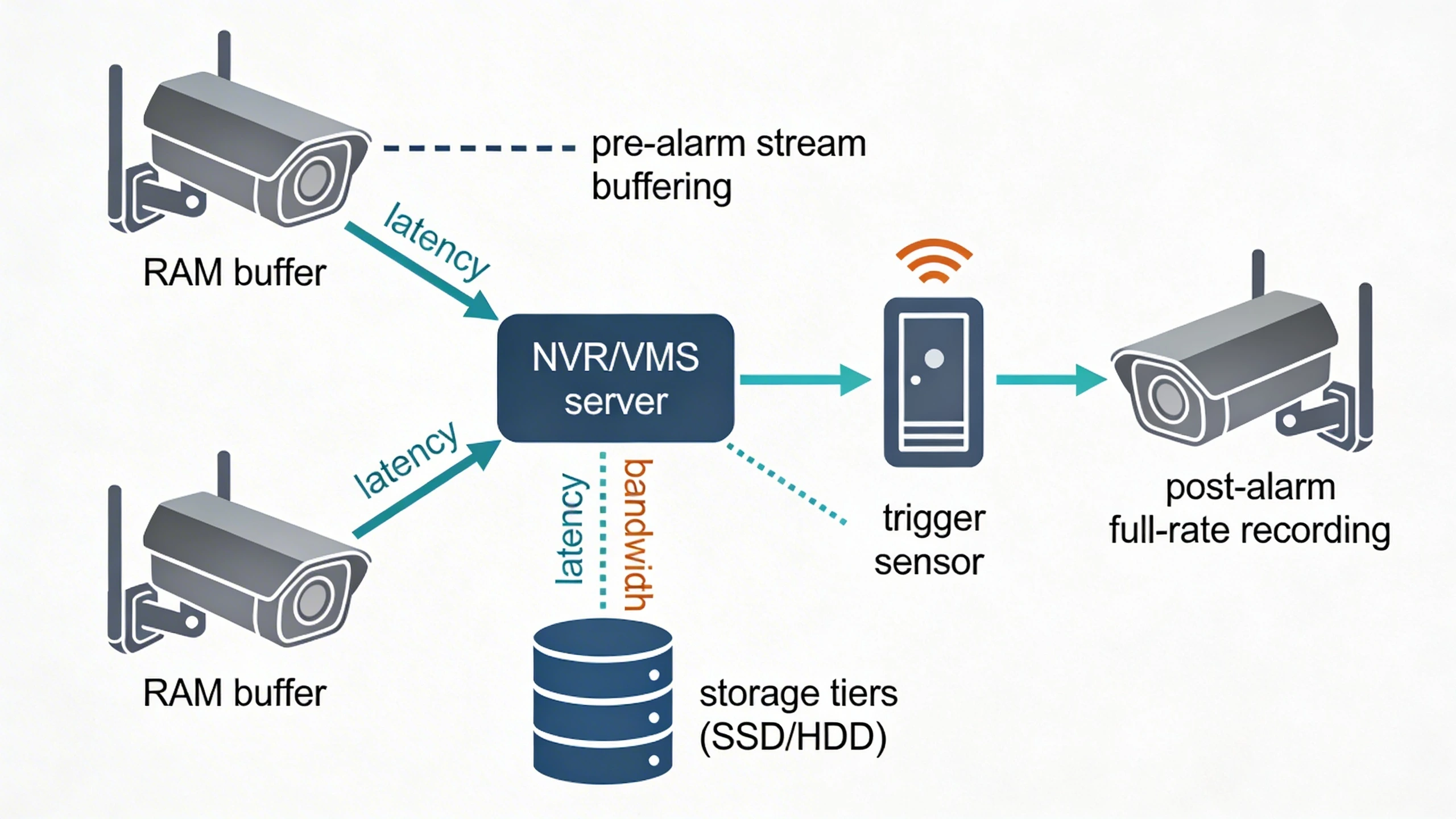
Storage topology plays a pivotal role. Continuous recording sidesteps duration limits but explodes disk usage; event-driven modes with generous pre/post settings demand tiered storage—SSD for active clips, HDD for archives. In multi-site consolidations, bandwidth constraints force tradeoffs: shorter pre-alarm reduces upstream traffic during quiet periods, preserving quality for post-event surges. Integrators must map trigger sources—PIR sensors, analytics, or I/O—to ensure durations align with signal latency, avoiding partial clips from network hiccups.
Operational workflows and field constraints
Daily operations reveal the human side of these designs. Security managers rely on clips for rapid triage: a 30-second pre-alarm might expose a dropped badge, speeding investigations, while post-alarm footage documents guard interventions for compliance reports. In shift handovers, consistent durations prevent confusion—analysts expect full context without hunting timelines.
Field constraints like power fluctuations or extreme temperatures add layers. At remote utility poles, battery-backed cameras need conservative pre-alarm to preserve uptime, as extended buffering drains resources. Workflows evolve with these: SOC protocols might dictate auto-export of clips exceeding custom durations, feeding into case management tools. Training emphasizes duration-aware searches, ensuring teams exploit the design rather than fighting it.
Common failure points and design mistakes
One frequent pitfall is uniform durations across heterogeneous sites. A campus door might need 10 seconds pre-alarm for pedestrian flow, but a fence line demands 60 to capture vehicle approaches—blanket settings lead to blind spots or storage waste. Another arises from ignoring trigger overlap: rapid successive events overwrite buffers, fragmenting narratives unless systems queue intelligently.
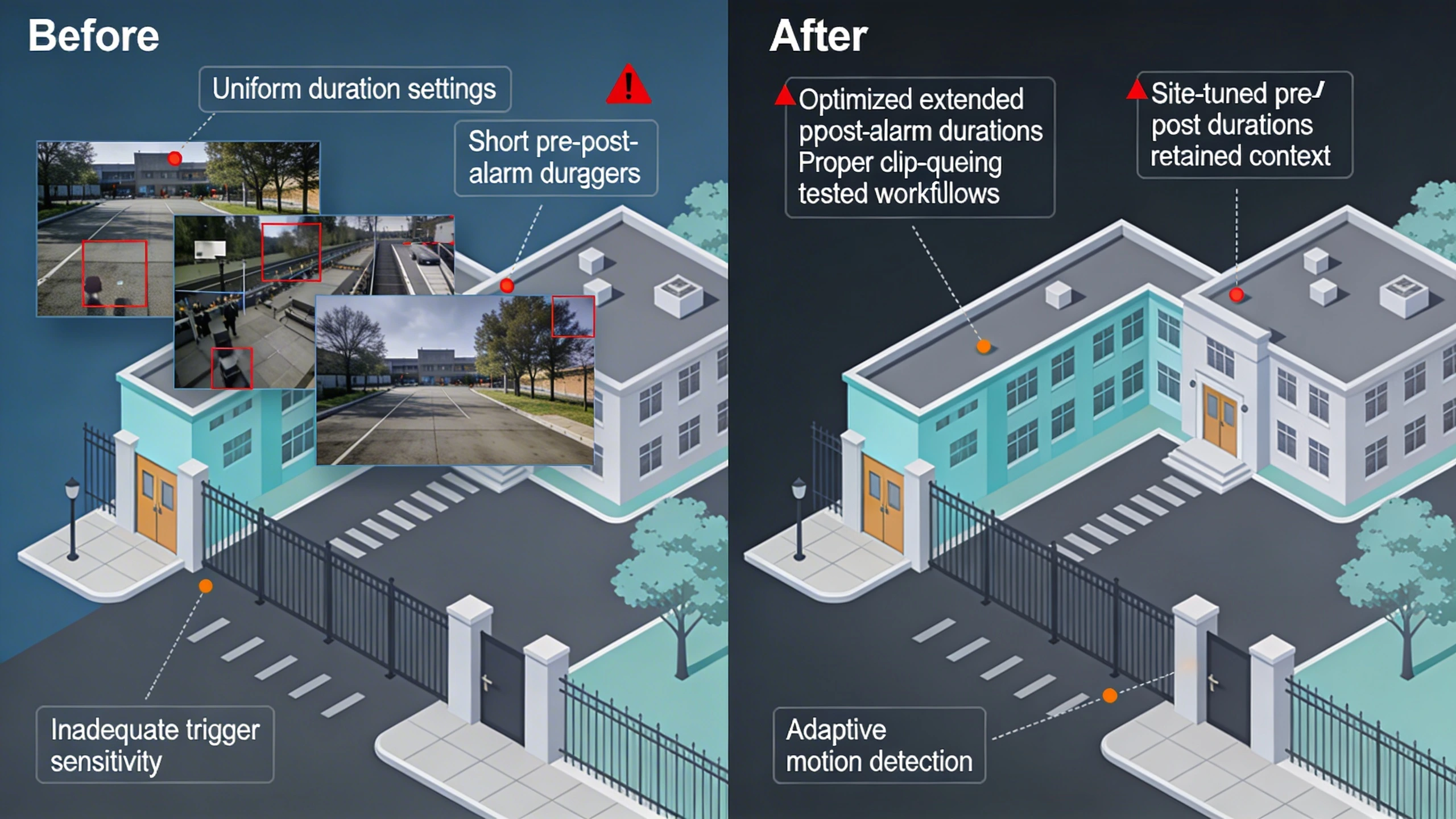
Misaligned expectations tank reviews. Operators expecting Hollywood-style long takes chafe at realistic 20-second pre-clips, blaming the system when prelude actions fall just outside. Firmware mismatches exacerbate this, where vendor updates reset durations silently. Field tests expose these early: simulate peak loads and review for completeness, adjusting before go-live to sidestep post-deployment finger-pointing.
What to verify before procurement
Before specs lock in, audit camera datasheets for buffer specs—RAM size dictates max pre-alarm reliably. Cross-check VMS compatibility matrices for duration granularity; some cap at 30 seconds, inadequate for perimeter scans. Probe storage calculators with projected event rates, ensuring headroom for peak days without auto-purge risks.
Engage end-users in workshops: walk through mock incidents, polling for ideal durations based on response SLAs. Test interoperability in lab mocks, confirming I/O triggers propagate without delay. Finally, review scalability—does the design flex for future analytics overlays, like AI loitering detection extending effective pre-windows?
Where to go next
Refine your surveillance architecture with FortSense 4 capabilities tailored for high-stakes environments. For site-specific guidance, explore critical infrastructure security case studies or connect via Request a design review.