Upgrading surveillance at a remote utility substation often uncovers the limits of indoor-rated cameras pushed into harsh outdoor environments. Teams face freezing winters that frost over lenses, summer downpours that infiltrate seals, and dust storms that clog vents. The right housing transforms these vulnerabilities into reliable assets, but mismatched IP ratings or inadequate heating lead to fogged views, electrical shorts, and costly truck rolls. In one campus retrofit, swapping basic enclosures for IP67-rated housings with thermostat-controlled heaters cut false alarms from condensation by ensuring clear optics year-round.
Designers must weigh power budgets alongside environmental specs: a PoE-powered camera paired with a high-wattage heater might overload injectors, while underpowered defrosting fails in sub-zero conditions. Prioritizing enclosures that integrate seamlessly with existing FortSense 4 video management resolves these tensions, delivering consistent performance without custom cabling. This approach grounds decisions in field realities, where a housing's IP rating dictates water ingress tolerance and heater activation thresholds prevent ice buildup during -20°C nights followed by humid thaws.
Balancing these elements upfront avoids the cascade of failures seen in rushed deployments, such as blurred footage triggering unnecessary alerts or outright camera failures during storms. Forward-thinking integrators map site microclimates—coastal salt spray demands corrosion-resistant seals beyond standard IP66, while inland arid zones prioritize dust-tight designs.
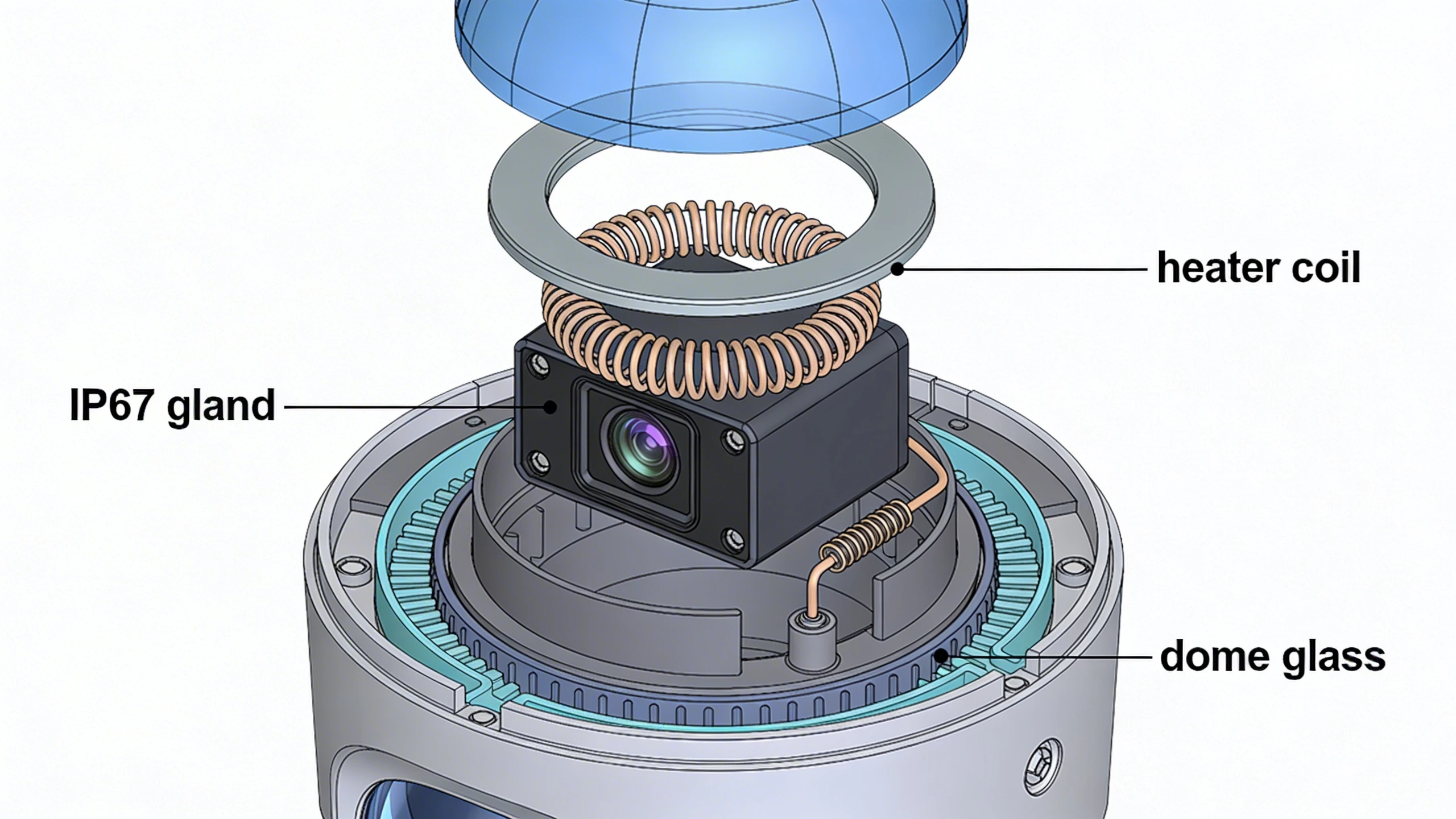
What the design decision looks like in practice
Picture a multi-building campus where legacy analog cameras give way to IP models mounted on eaves and poles. Without proper housings, rain sheeting down a dome lens creates persistent glare, while overnight frost obscures fields of view until midday melt. Installing vandal-resistant enclosures with IP66 ratings and low-profile PTC heaters addresses this directly: the IP spec ensures jets of water from sprinklers or storms don't penetrate, and the heater cycles on at 5°C to evaporate dew before it condenses.
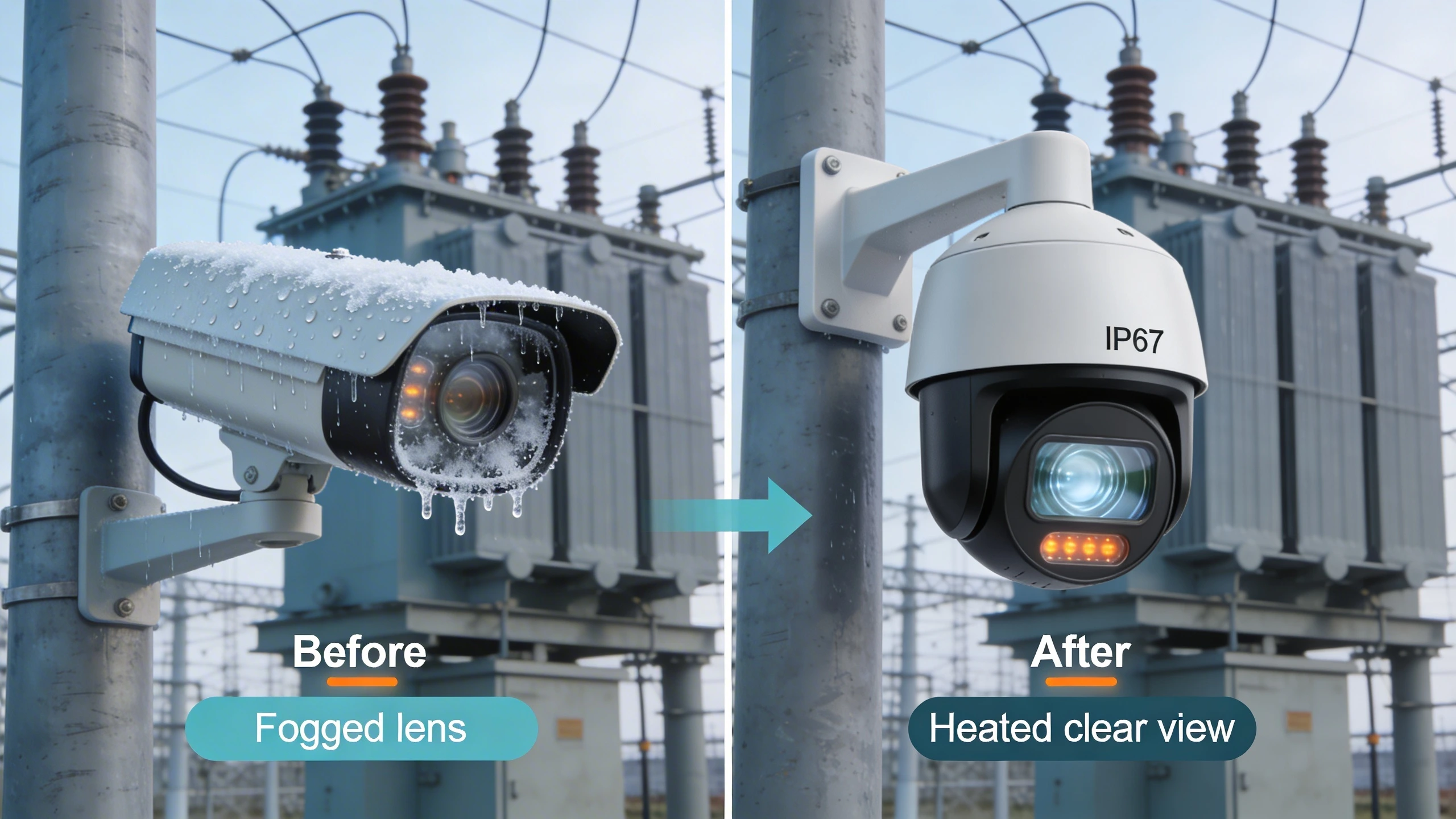
In a utility site retrofit, engineers assess pole-mounted cameras exposed to 50 mph winds and -30°C snaps. A migration here involves sleeving existing conduits with weatherproof glands, then bolting on housings that maintain internal temperatures above freezing without exceeding 802.3at PoE limits. Technicians verify heater draw via multimeter during commissioning, confirming the enclosure's thermal envelope keeps the imager operational. This hands-on process reveals how IP67 housings excel in submerged-risk areas like flood-prone perimeters, outperforming IP65 in prolonged exposure tests.
Teams transitioning from unprotected bullet cameras to turret styles in gable mounts experience fewer adjustments post-install. The housing's sunshield extension prevents direct heating that warps plastics, while integrated wipers—rare but effective in pollen-heavy regions—pair with heaters for pristine glass.
System architecture and integration considerations
Outdoor housings slot into layered architectures where power, data, and environmental controls converge. For PoE deployments, select enclosures supporting up to 30W heaters without auxiliary feeds, as splitting DC lines introduces failure points. Integration with NVRs demands housings that preserve MJPEG or H.265 streams undistorted by internal reflections, often requiring anti-glare coatings inside the dome.
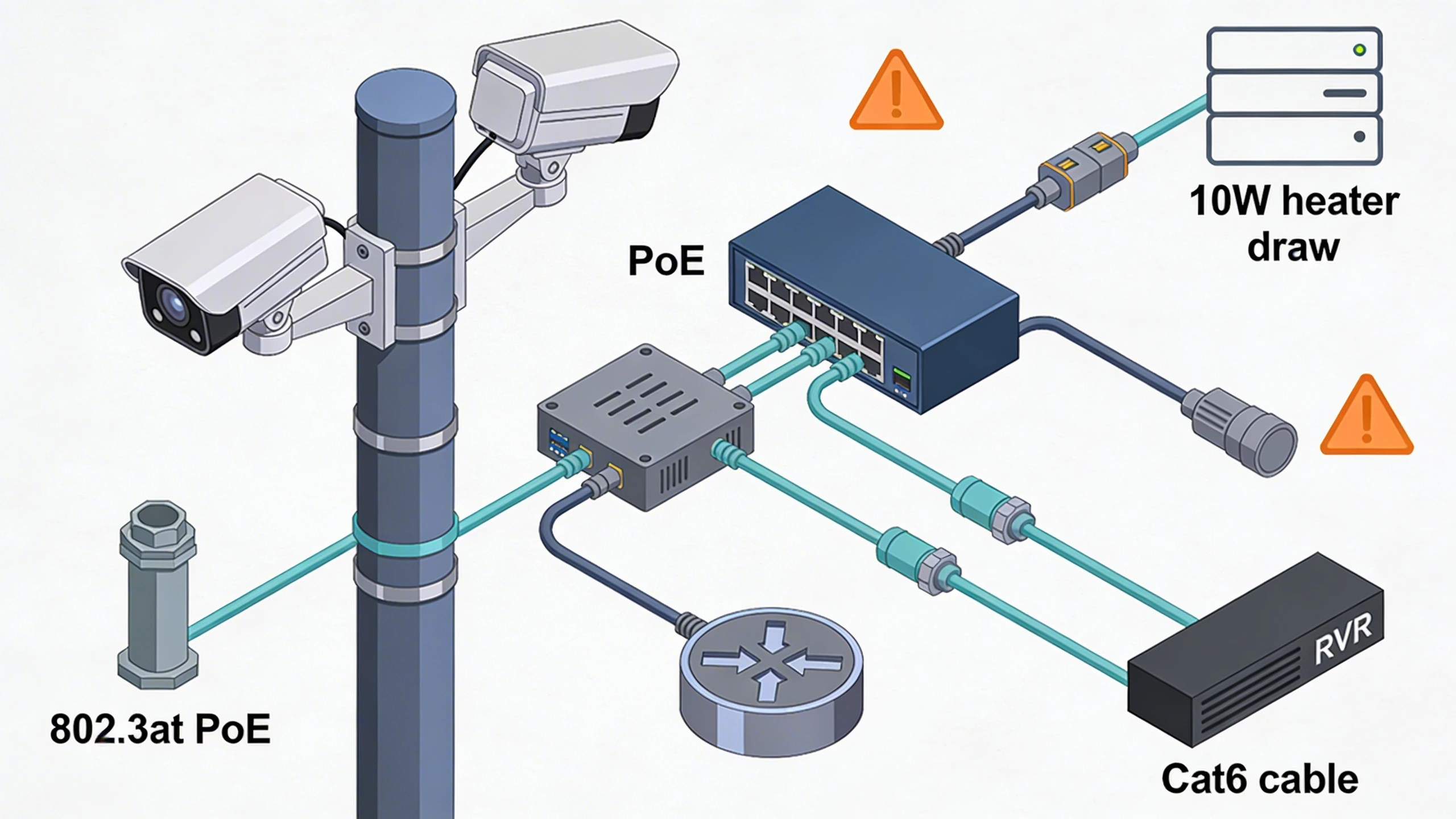
Cabling through IP68-rated glands maintains the enclosure's integrity, but architects must model total draw: a 10W heater activating 40% of the time adds negligible overhead to Class 4 PoE, yet clusters of 20 cameras strain switches. In critical infrastructure security, redundant power injectors feed heaters separately, ensuring video uptime even if primary PoE falters. Mounting patterns—wall arms versus pole clamps—affect vibration damping, with rubber isolators in housings mitigating wind-induced blur.
Scalability favors modular housings allowing heater retrofits without full replacement. When tying into access control gateways, position enclosures to avoid thermal exhaust venting near sensors, preserving WDR performance in backlit scenes.
Operational workflows and field constraints
Field crews contend with housings that demand precise leveling for drainage channels to shed water, a step overlooked in 20% of rushed installs leading to pooled moisture. Heaters simplify patrols by auto-regulating via bimetallic switches, but operators monitor via VMS overlays showing activation logs—essential for predicting maintenance in seasonal climates. In North America deployments, where freeze-thaw cycles stress seals, workflows include quarterly gland torque checks to sustain IP ratings.
Constraints like restricted roof access favor lightweight polycarbonate housings over metal, easing lifts while heaters draw from the same Cat6 as video. Technicians sequence installs: mount first, wire heaters last to test continuity before sealing. For solar-powered remote sites, low-power 5W heaters extend battery life, integrating with motion-triggered recording to minimize constant draw.
- Pre-stage heaters offline to benchmark camera temps.
- Document baseline IP test results post-assembly.
Common failure points and design mistakes
Underspecced IP ratings fail spectacularly in pressure-washed areas, where IP54 housings leak under 3m hose blasts, shorting PCBs. Heaters exacerbate this if ungrounded, arcing during condensation peaks. A frequent error: ignoring altitude effects, where thinner air reduces heater efficiency above 2000m, demanding oversized elements that overheat in valleys.
Over-reliance on manufacturer claims bites during migrations—IP67 certified on paper cracks under UV-aged seals after two years. Mistimed heater thermostats cycle excessively, wearing relays and spiking power logs that mimic faults. Poor gasket compression from overtightened screws warps seals, inviting dust that scratches domes over time.
Vibration from nearby HVAC units loosens heater mounts, causing intermittent contact. Designers sidestep these by specifying IK10 impact alongside IP, ensuring housings withstand thrown objects without compromising internals.
What to verify before procurement
Request third-party lab reports for IP ratings, confirming submersion times match your worst-case rain events—IP67 housings endure 1m immersion for 30 minutes, vital for low-mount perimeters. Scrutinize heater specs: PTC self-regulating types outperform fixed resistors by capping temps at 60°C, preventing imager damage.
Cross-check power profiles against your PoE infrastructure, simulating peak draw with a load bank. Inspect material datasheets for UV and salt resistance, especially in coastal or industrial zones. Prototype one unit in a environmental chamber mimicking site swings: -30°C to 50°C with 95% humidity.
- Confirm gland thread compatibility with your cabling diameter.
- Test heater activation hysteresis to avoid short-cycling.
- Validate mounting torque specs against pole sway models.
Where to go next
With housings selected, explore full FortSense 4 integrations for unified management. For tailored advice on your site, request a design review. Dive deeper into critical infrastructure security or North America deployments for regional insights.