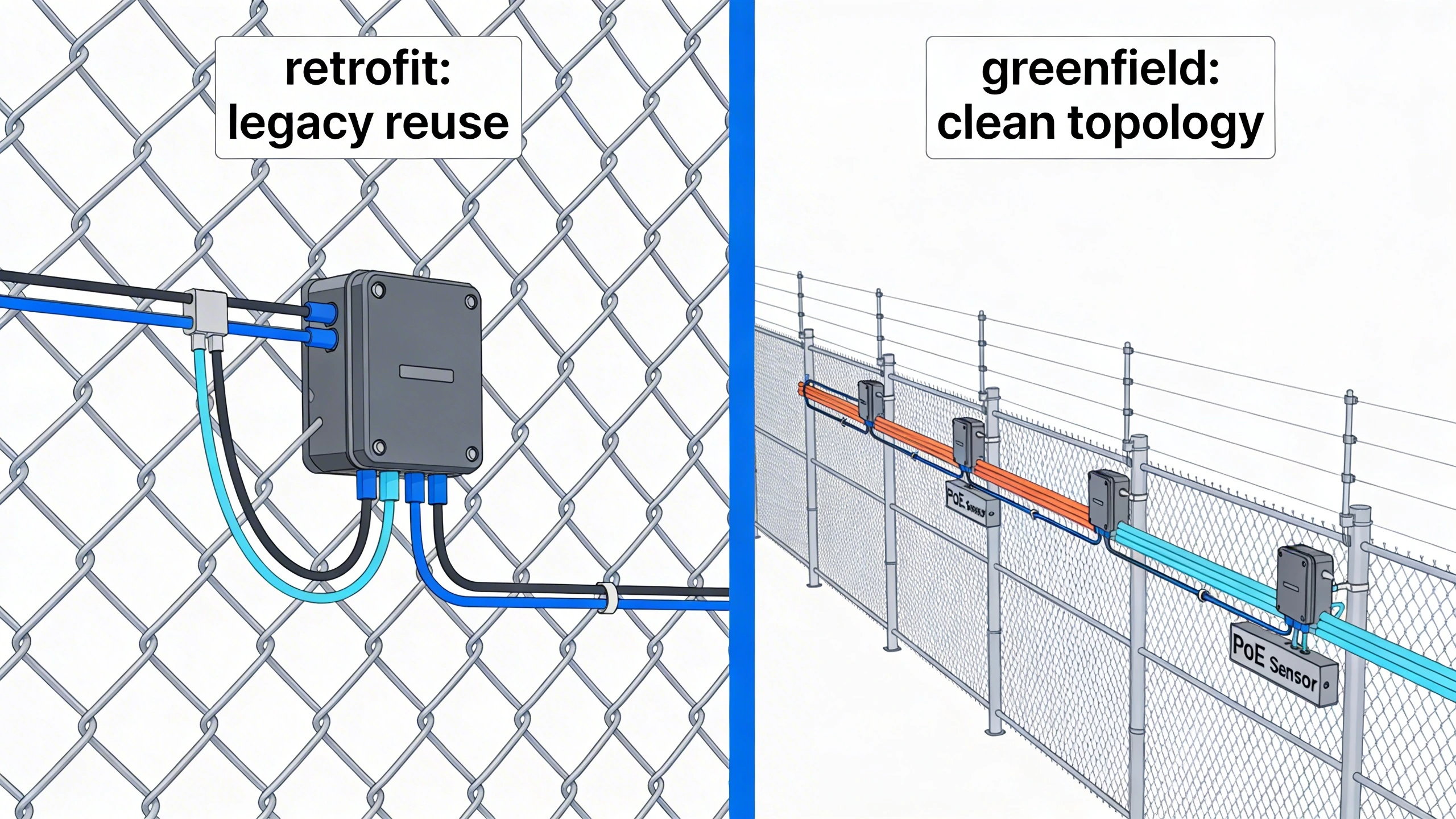
Security integrators tackling perimeter protection at critical sites like utility substations or multi-building campuses often hit a familiar crossroads. An aging chain-link fence with buried sensors from a decade ago needs an upgrade to meet modern threat models, but ripping it all out for a fresh Perimeter Intrusion Detection System (PIDS) feels disruptive. Retrofit projects layer new fiber-optic or microwave sensors onto the existing fence fabric and cabling runs, preserving the physical barrier while enhancing detection. In contrast, greenfield approaches start clean, designing topology from the ground up with integrated video, ground sensors, and PSIM tie-ins.
The upfront pull often favors retrofit for brownfield sites where downtime costs skyrocket—think a refinery gate where halting operations for weeks invites regulatory scrutiny. Yet greenfield shines in expansions, like a new solar farm perimeter, where you avoid legacy constraints from day one. Early in the process, map your site's maturity: if cabling predates IP convergence or sensors lack tamper-proofing, retrofit might patch symptoms without addressing root topology flaws. Teams that rush the choice without auditing existing runs frequently end up with hybrid messes, where new detectors clash with old power budgets or false alarm floods from mismatched processing.
Primary shifts emerge in integration depth. Retrofit demands compatibility shims, like protocol converters for tying legacy coaxial sensors to Ethernet switches, while greenfield lets you spec end-to-end PoE with unified analytics. This isn't abstract; at a Midwest utility yard, retrofit kept costs down but required custom middleware to fuse IR cameras with vibration sensors, delaying go-live by months. Greenfield at a fresh data center campus, however, synced everything natively, cutting tuning time.
What changes in real deployments
Deployment realities diverge sharply between retrofit and greenfield, starting with site surveys. In retrofit scenarios, like bolting taut-wire sensors onto an existing 2km industrial fence, teams inherit uneven terrain, buried utilities, and mismatched post spacing that dictate sensor placement. You adapt microwave links to skirt overhead power lines rather than redesigning the layout. Greenfield flips this: at a greenfield airport apron expansion, engineers lay out balanced zones with 50m sensor spacing optimized for bi-directional detection, unhindered by prior builds.
Installation cadence shifts too. Retrofit crews work in phases—night shifts at active ports to splice fiber without halting truck traffic—extending timelines as they navigate live environments. Greenfield allows parallel trenching and pole-setting, compressing schedules but demanding precise material staging. A common pivot point: retrofit often uncovers hidden cable faults during pull tests, forcing scope creep, whereas greenfield's blank slate lets you pre-qualify soils and embed future-proof conduits from the outset.
Operational handoff reveals subtler changes. Retrofit sites carry forward operator familiarity with the old fence patrol routes, easing training, but greenfield introduces holistic dashboards that demand VMS retraining. In practice, this means retrofit deploys faster for urgent threat responses, like post-incident hardening at oil depots, while greenfield builds in scalability for phased rollouts.
Security and reliability differences
Security postures evolve differently under each model. Retrofit bolsters legacy fences with active detectors, but cut-through attacks exploiting weak fabric persist unless you reinforce posts—a frequent oversight at warehouses where new sensors flag climbs but miss ladder-assisted breaches. Reliability hinges on hybrid resilience: power redundancy from old UPS might not cover IP converters, leading to outage cascades during storms.
Greenfield enforces defense-in-depth from design, pairing fence-mounted IR with buried geophones and drone-defeat radar in a unified topology. This reduces single points of failure, as failover paths route through redundant switches rather than daisy-chained legacy runs. Reliability data from field trials shows greenfield systems holding uptime through EMI-heavy zones near substations, where retrofit struggles without shielding retrofits.
Threat model alignment matters most. Retrofit suits incremental hardening against known vectors like vehicle ramming at gates, preserving budget for analytics upgrades. But for evolving risks—think UAV incursions—greenfield's clean RF planning integrates counter-drone seamlessly, avoiding retrofit's spectrum clutter from mismatched legacy emitters.
Wiring, topology, and integration implications
Wiring topologies tell the fullest story of divergence. Retrofit reuses conduit where possible, splicing Cat6 into old armored cable for hybrid runs, but voltage drops over long hauls necessitate mid-span boosters. At a campus retrofit, this meant zoning power separately for PoE cameras, complicating troubleshooting when a single splice fails an entire sector.
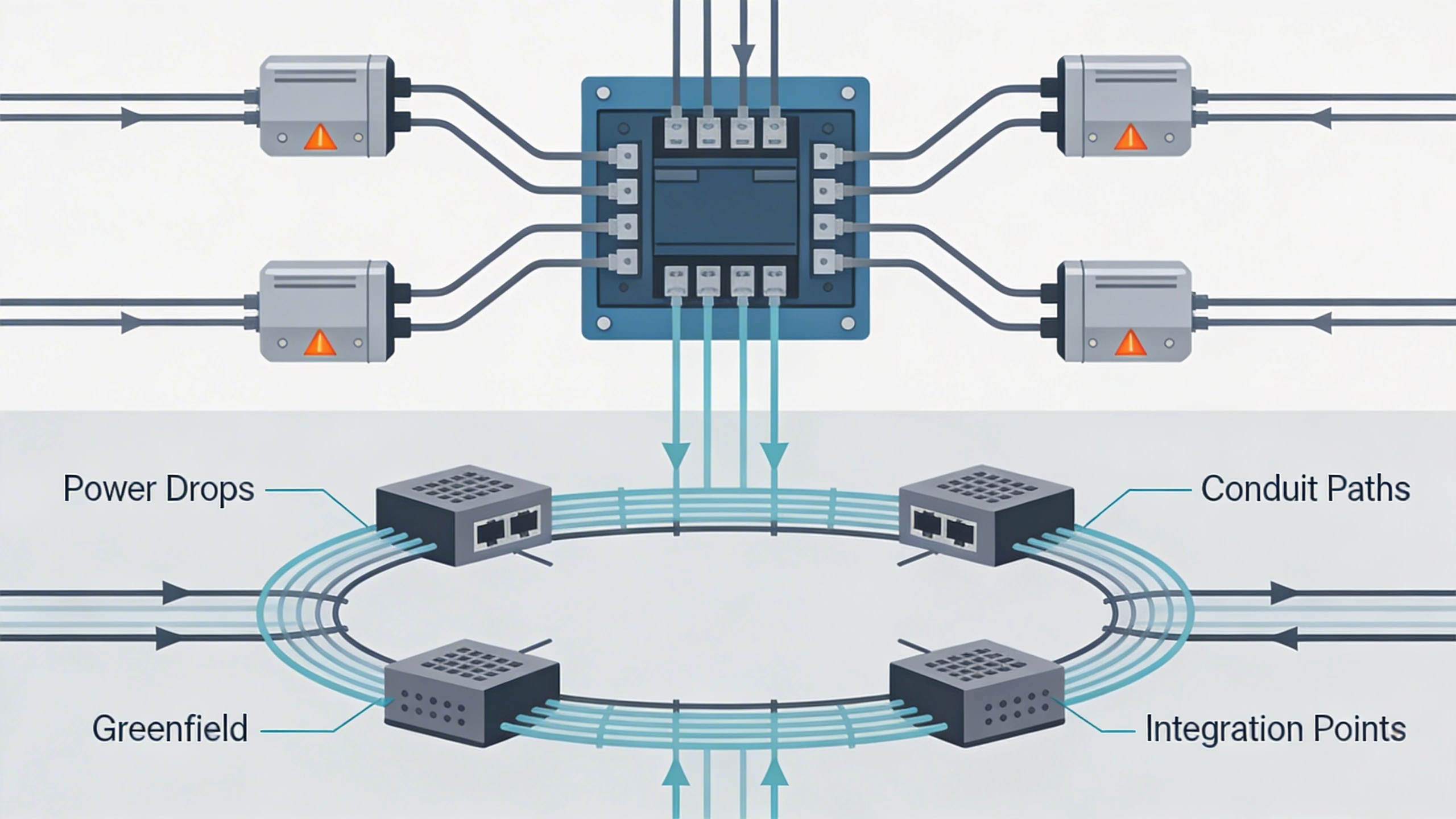
Greenfield topologies prioritize ring architectures with fiber backbone, enabling sub-10ms latency for PSIM fusion. Integration flows naturally: FortSense 4 processors handle multi-sensor inputs without gateways, unlike retrofit's protocol translators that introduce jitter. Topology diagrams reveal the crux—retrofit's star patterns radiate from central panels, vulnerable to hub failures, while greenfield meshes distribute processing.
Scalability bites hardest in retrofit expansions; adding zones overloads legacy backbones, forcing parallel networks. Greenfield anticipates growth with spare pairs and modular heads, easing future critical infrastructure add-ons like access gates.
Migration planning and common failure points
Migration planning starts with phased audits: baseline false alarm rates on legacy PIDS before retrofit overlays. Common pitfalls include ignoring earthing differences—new fiber OTDR tests clash with ungrounded old coax, spiking noise. At utility sites, rushed cutovers flood SOCs with uncued alerts until baselining completes.
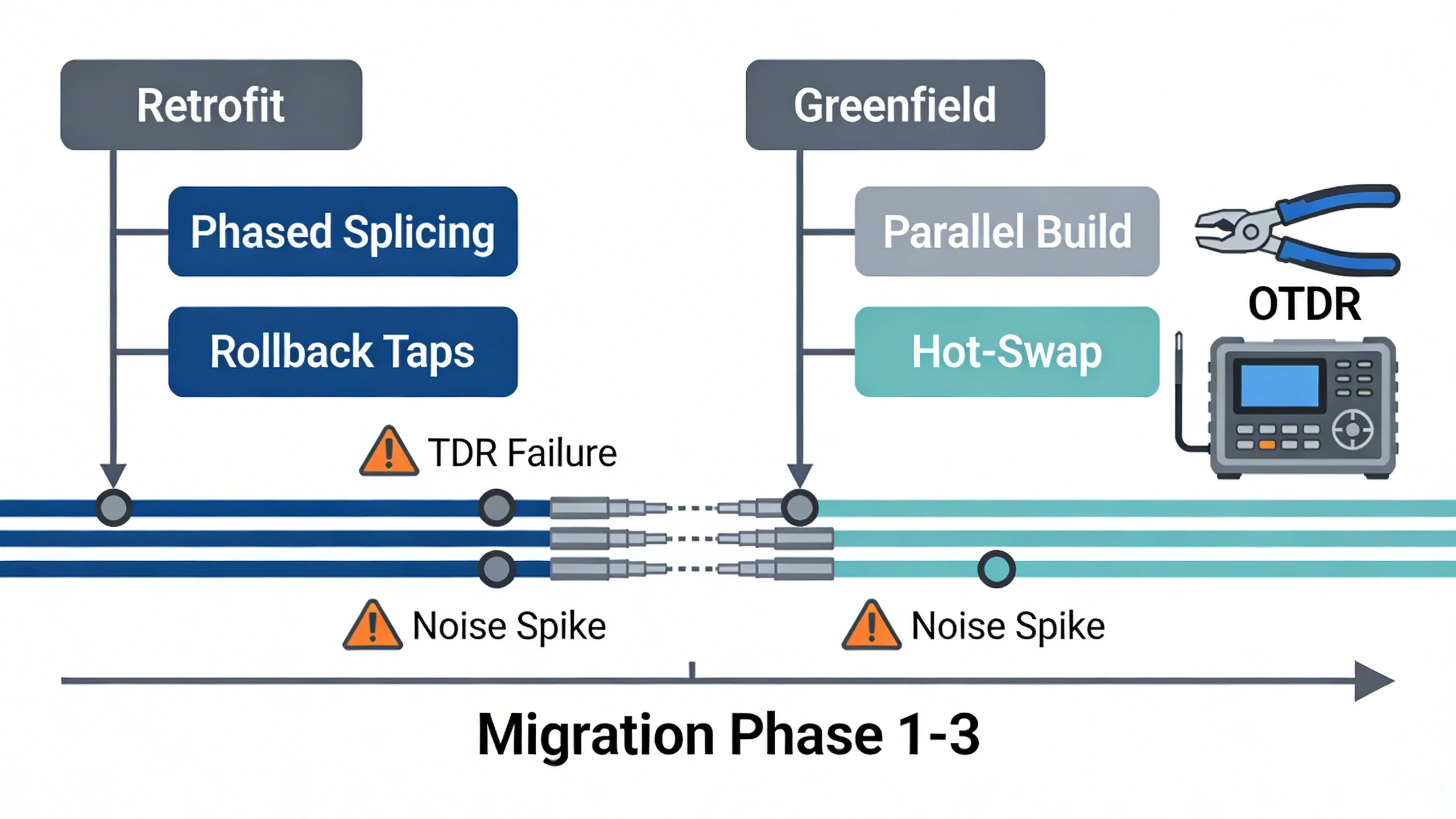
Greenfield migrations sidestep this via parallel builds, hot-swapping at go-live with dual-path monitoring. Failures cluster around change management: retrofit teams skip as-built validation, leading to drift where maps don't match buried turns. Greenfield's controlled site prep avoids this but risks over-spec'ing for hypothetical threats.
- Verify legacy cable integrity with TDR before splicing.
- Stage retrofit in off-peak windows with rollback power taps.
- Greenfield: Prototype one zone fully before scaling.
Where each approach still fits
Retrofit endures where disruption trumps perfection, like hardening existing North America deployments at active refineries. It leverages sunk infrastructure costs, layering AI classifiers atop vibration sensors without fence replacement, ideal for compliance-driven upgrades.
Greenfield claims new builds or total rebuilds, such as campus perimeters demanding seamless VMS/PSIM. It fits when legacy is irredeemable—think asbestos-wrapped conduits—or when zoning laws favor underground-only sensors. Hybrids emerge in pilots: retrofit core fence, greenfield gate zones.
Selection hinges on TCO beyond CapEx: retrofit's OPEX swells with maintenance on patchwork wiring, while greenfield's upfront hit yields lower long-term tuning.
Where to go next
Assess your site's readiness with a tailored audit. Explore FortSense 4 for unified processing in either path, or request a design review to model tradeoffs. Dive deeper into critical infrastructure security challenges and reference the PIDS glossary for terms.