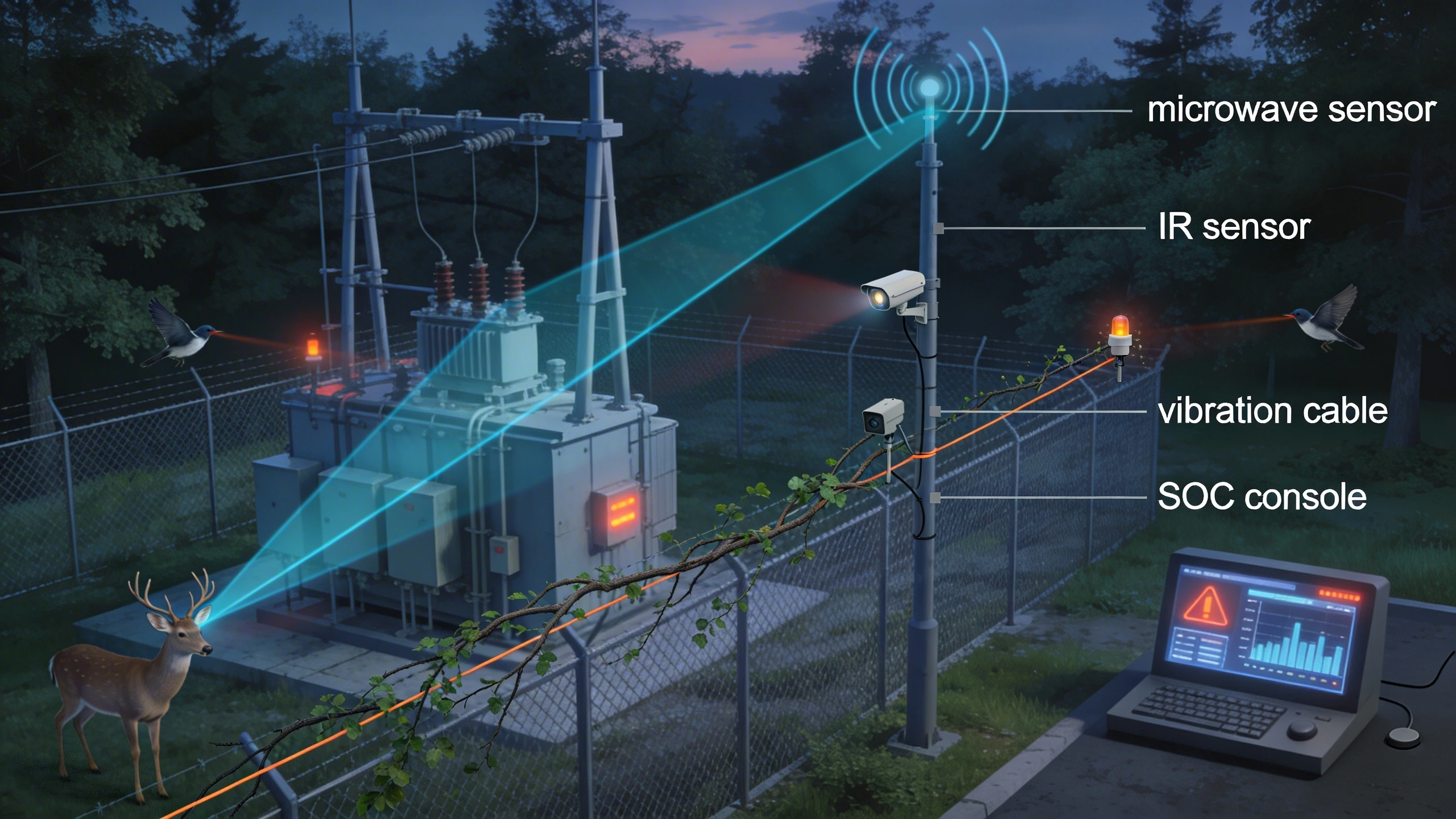
When retrofitting perimeter security at a remote utility substation nestled in a wooded area, integrators often confront a flood of nuisance alarms triggered by nocturnal wildlife or wind-swayed branches brushing against fence sensors. These false positives not only strain security operations center (SOC) staff but also undermine confidence in the overall Perimeter Intrusion Detection System (PIDS), leading to delayed responses to actual threats. The core design challenge lies in balancing high detection rates with low nuisance tolerance, especially in environments where deer, birds, or rodents routinely cross detection zones.
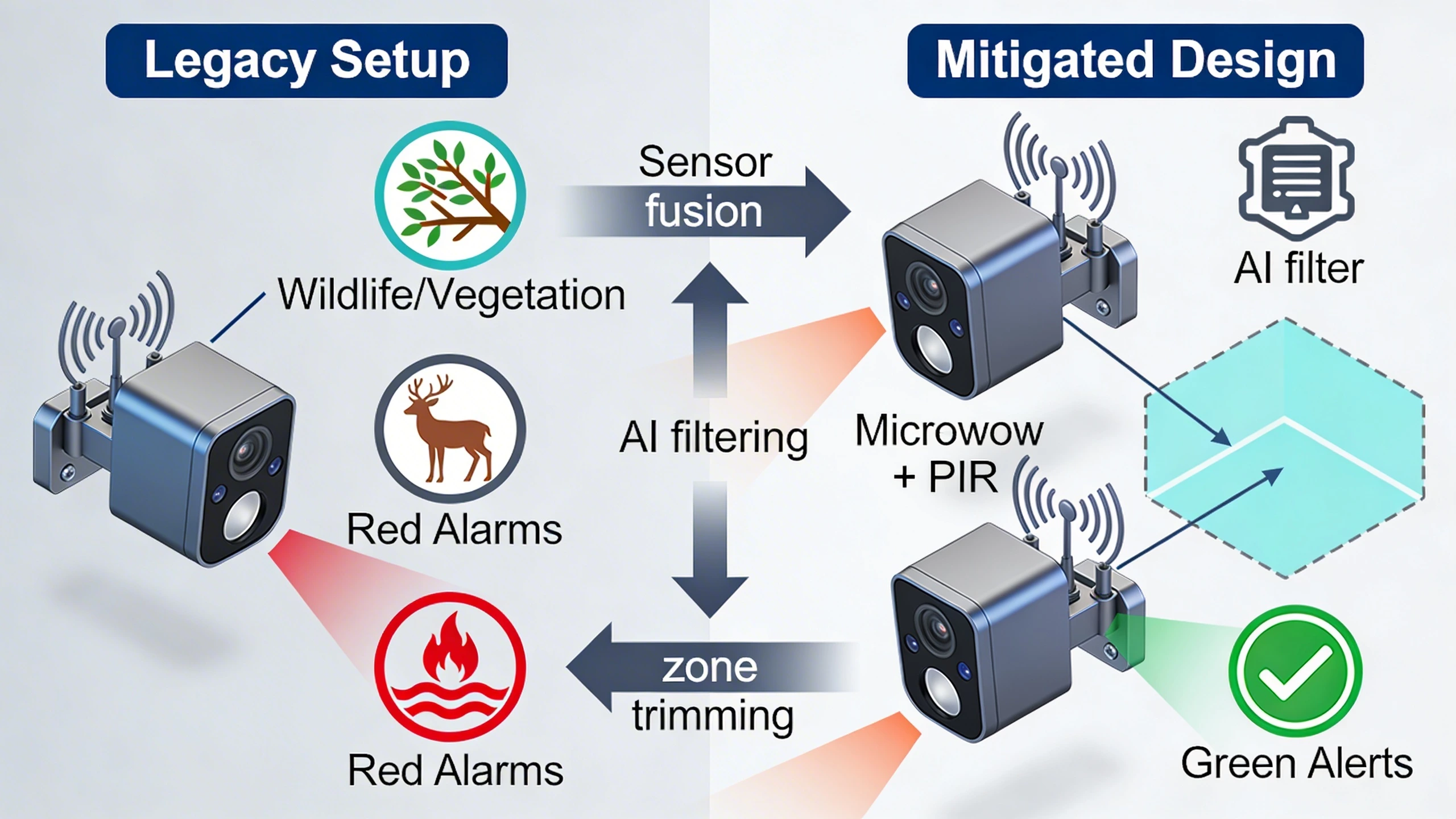
A proven approach starts with sensor fusion from the outset: pairing passive infrared (PIR) or microwave barriers with intelligent video analytics that classify motion based on size, speed, and trajectory. In a recent campus upgrade, this layered method restored operator trust by routing only high-confidence alerts to primary consoles, allowing secondary verification workflows for ambiguous events. Vegetation management integrates here too, as unchecked growth amplifies seismic or vibration sensor chatter, turning a minor oversight into chronic alarm fatigue.
Security managers facing these issues during site surveys must weigh environmental baselines against threat models. For instance, a coastal facility might prioritize salt-tolerant sensors less prone to corrosion-induced faults, while inland sites demand robust anti-masking for burrowing animals. This upfront assessment shapes the entire retrofit, ensuring the system adapts to local ecology without over-relying on manual patrols.
What the design decision looks like in practice
Picture a multi-kilometer fence line at an oil and gas processing plant, where legacy microwave links generate dozens of daily alerts from rabbits hopping through beams or ivy creepers swaying in gusts. The retrofit decision pivots to zoned detection: divide the perimeter into high-risk (human-access gates) and low-risk (remote wooded stretches) segments, applying stricter thresholds in the latter. Here, dual-technology sensors—vibration on the fence fabric combined with ground-based seismic—trigger only when both register above baseline, effectively ignoring isolated animal scrambles or leaf rustle.
Implementation unfolds in phases: first, baseline environmental data logging over weeks captures wildlife patterns, informing AI model training for anomaly detection. Operators then see a console view shift from chaotic pings to prioritized events, with overlaid camera feeds auto-queuing for review. In practice, this means field technicians calibrate sensitivity via handheld tools during dry runs, simulating animal crossings with props to fine-tune without live disruptions. The result is a system that scales to operational tempo, freeing SOC teams for strategic analysis rather than endless dismissals.
Vegetation-specific tactics include scheduled trimming tied to sensor zones, using GIS mapping to flag overgrowth hotspots before they trigger cascades. Teams that embed these practices early report smoother handovers to maintenance crews, as the design inherently anticipates seasonal changes like leaf fall or bird migrations.
System architecture and integration considerations
At the heart of effective nuisance mitigation sits a distributed architecture where edge processing handles initial classification, offloading central servers from raw data floods. Integrate PIR/microwave heads with onboard microcontrollers running lightweight ML models trained on wildlife datasets; these flag probable nuisances locally, forwarding only vetted events via fiber or secure wireless to a PSIM platform. For a utility campus retrofit, this means aligning sensor IP addresses with existing network segments, ensuring low-latency handoffs to video management systems (VMS) for cross-verification.
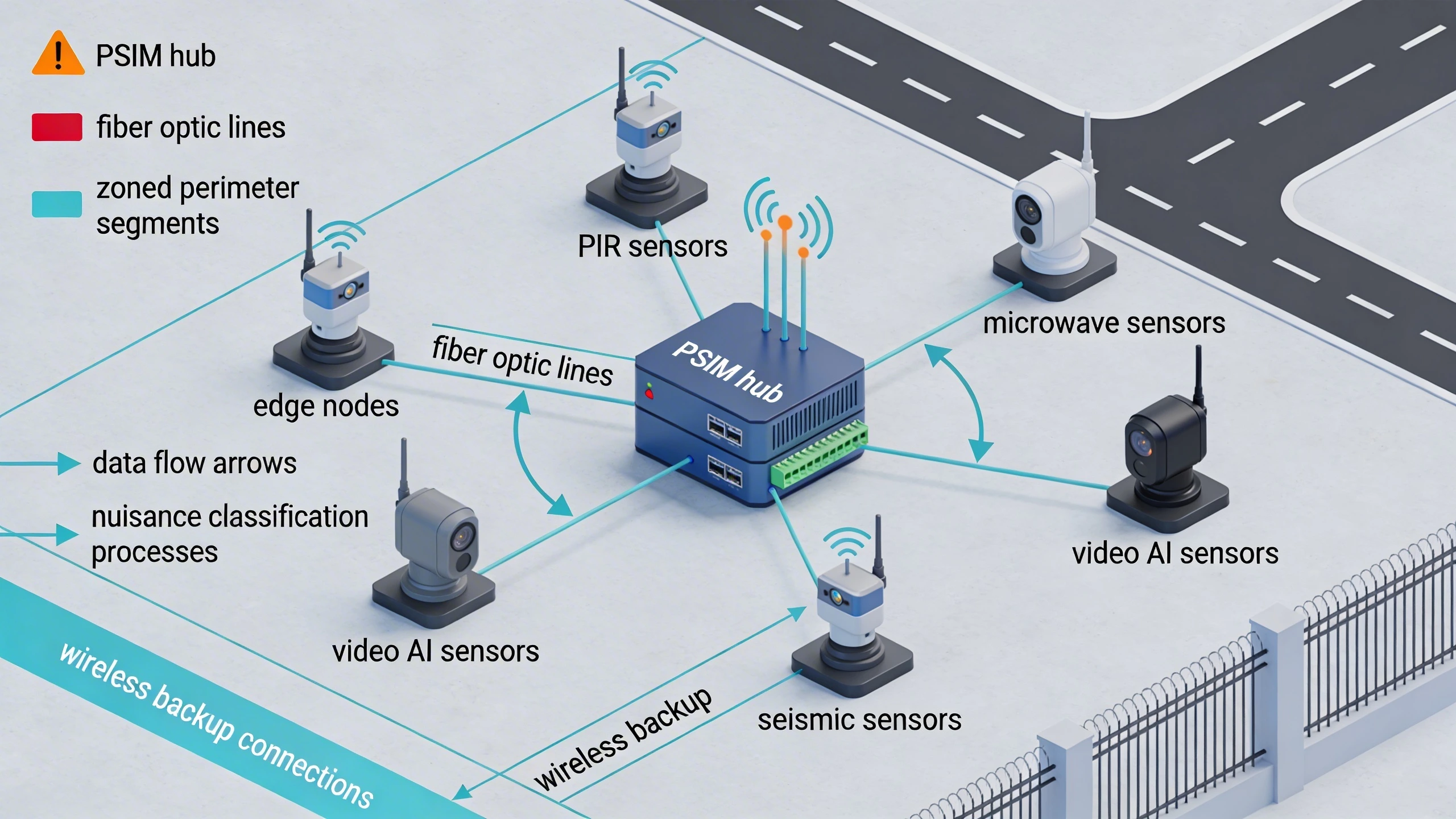
Key integration hinges on open protocols like ONVIF for cameras and Modbus for legacy sensors, allowing seamless fusion without proprietary lock-in. Consider power budgeting too: solar-augmented nodes in remote zones reduce cabling runs, but demand careful fusing to prevent wildlife-chewed lines from cascading failures. In layered designs, acoustic sensors complement visuals by detecting branch snaps or animal vocalizations, piped through edge gateways that apply rulesets like "ignore if below 50cm height and pre-dawn."
Scalability enters via modular heads: swap a nuisance-prone microwave for taut-wire in brushy areas without rewiring the backbone. This flexibility proves vital during phased rollouts, where IT managers coordinate with integrators to test API endpoints for alarm routing into SIEM tools, ensuring audit trails capture every triage decision.
Operational workflows and field constraints
Daily operations transform when nuisance alarms drop, but only if workflows adapt. SOC protocols shift to tiered verification: Level 1 auto-dismisses classified wildlife via AI scores above 90% confidence, escalating others to video review within 30 seconds. Field constraints loom large—technicians in rainy seasons battle mud-slicked access paths to recalibrate sensors, so designs incorporate weather-sealed enclosures and remote tuning apps that pull live diagnostics over LTE.
For vegetation, workflows embed proactive patrols using drone surveys to map growth, feeding data back to the PSIM for predictive alerts like "Zone 7 trimming due in 14 days." Constraints like restricted-access zones at nuclear sites necessitate non-intrusive methods, such as LiDAR scanning from perimeter roads to model canopy encroachment without breaching sterile areas. Operators train on these via simulated scenarios, building muscle memory for rapid nuisance triage amid night shifts.
Shift handovers benefit from persistent dashboards logging nuisance trends, helping managers spot patterns like fox runs at dusk. This closes the loop, turning raw field data into refined policies that evolve with site ecology.
Common failure points and design mistakes
Overlooking baseline environmental profiling dooms many retrofits; teams deploy uniform sensitivities across diverse terrains, only to drown in alerts from one swampy quadrant. Another pitfall: skimping on multi-sensor confirmation, leaving single-point failures where a bird flock overwhelms an IR beam unchecked. Vegetation ignores itself into oblivion when designs assume eternal trimming—overgrown fences detune vibration sensors, mimicking cable cuts.
Mistakes amplify in integration: mismatched polling rates between sensors and VMS create blind spots, or unencrypted wildlife data leaks expose site layouts. Field errors include improper mounting heights, placing ground sensors within rodent jump zones, or neglecting anti-vandalism grilles that inadvertently block small-mammal paths, skewing training data.
- Failure to segment zones leads to blanket retuning after every storm.
- Ignoring power redundancy strands remote nodes during animal-gnawed backups.
- Skipping operator dry-runs results in panic during first real wildlife surges.
What to verify before procurement
Before signing off, demand demonstrable performance in simulated wildlife environments—request vendor labs with enclosed test beds mimicking deer leaps or branch winds. Scrutinize sensor specs for environmental immunity ratings, confirming operation across your site's temperature swings and humidity without drift. Probe integration roadmaps: does the edge AI update over-the-air, and how does it interface with your PSIM?
Site-specific validation trumps brochures; stage a proof-of-concept with loaned gear, logging nuisance rejection over a month against your baseline. Verify vegetation tolerance through accelerated growth tests, ensuring optics stay clear and mechanicals unbind. Check support SLAs for field swaps, as downtime in critical perimeters cascades risks.
- Confirm ML models retrain on your footage, not generic datasets.
- Audit false alarm specs under load, not isolated triggers.
- Validate wireless spectrum compliance for dense deployments.
Where to go next
Explore FortSense 4 for advanced sensor fusion tailored to high-nuisance environments. For tailored advice, request a design review. Dive deeper into critical infrastructure security challenges or review PIDS glossary and PSIM glossary terms. See real-world examples in North America deployments.