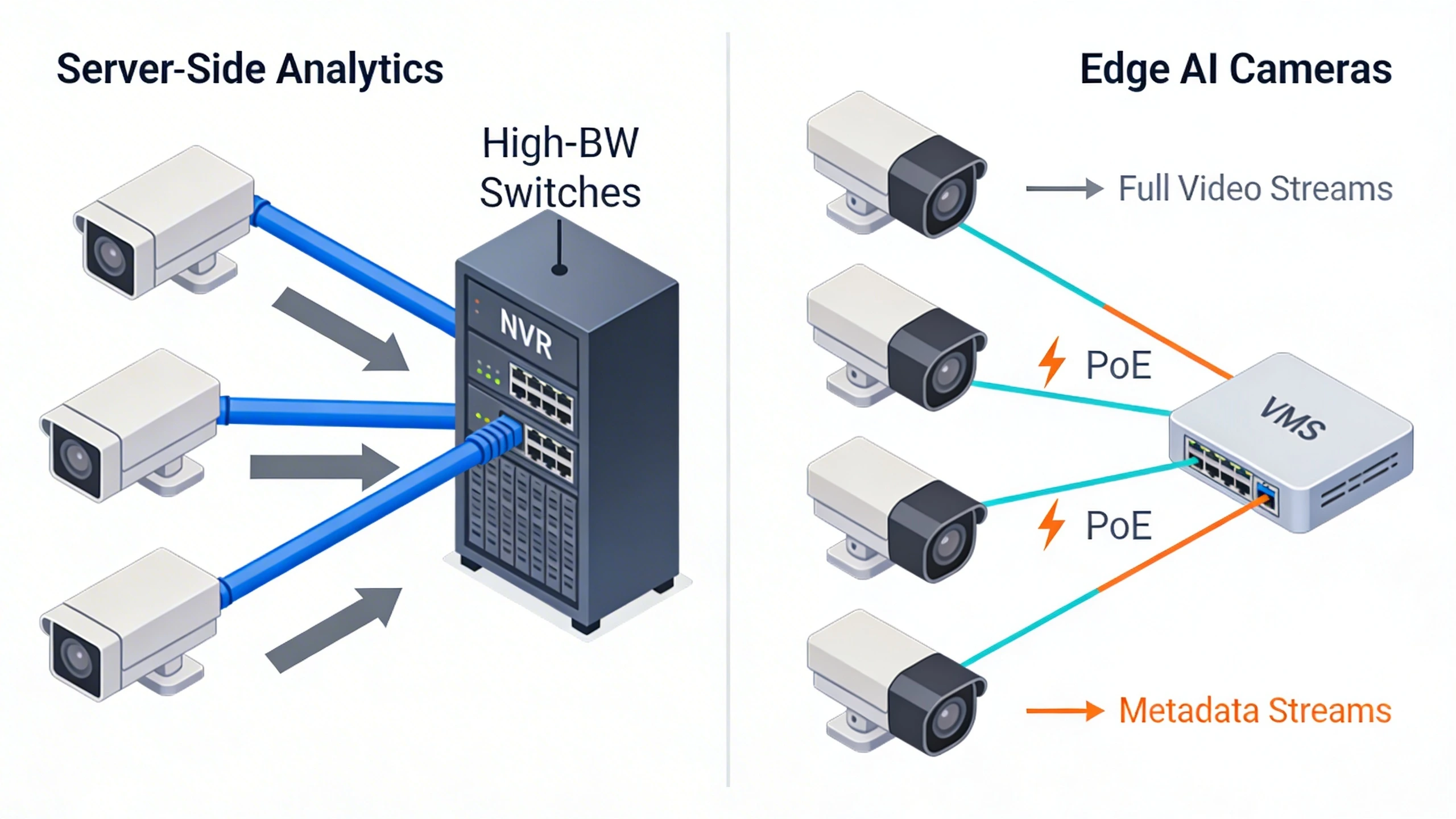
In a typical retrofit for a multi-building campus or remote utility substation, security teams face the choice between sticking with server-side analytics on centralized NVRs or shifting to edge AI cameras. Legacy setups often rely on streaming high-res video back to a server rack for object detection, facial recognition, or anomaly flagging, which works until bandwidth chokes during peak events or cabling costs skyrocket across sprawling sites. Edge AI flips this by embedding inference directly in the camera, delivering metadata streams instead of full video, slashing network loads and enabling decisions in milliseconds.
That core tradeoff—decentralized smarts versus centralized control—defines most upgrade decisions. For integrators handling critical infrastructure security, edge AI shines in low-connectivity zones like perimeter fences or offshore platforms, where server-side would demand fiber runs or microwave links. But in dense urban deployments with robust LANs, servers still consolidate analytics across hundreds of feeds efficiently. The shift isn't binary; hybrid paths often emerge during pilots, balancing upfront camera swaps against long-term ops savings.
Real-world pilots reveal edge AI pulling ahead on responsiveness for access control at multi-door facilities, where a door controller queries camera metadata instantly without VMS roundtrips. Server-side, meanwhile, excels at correlating events across cameras, like tracking a person through a site via unified AI models. Picking the winner hinges on your topology's constraints and tolerance for distributed firmware updates.
What changes in real deployments
Deploying edge AI cameras alters the video pipeline fundamentally: instead of raw H.265 streams flooding the network, cameras output compact JSON events or low-res clips tied to detections. In a warehouse retrofit, this means alarms trigger local relays for lights or gates without server dependency, cutting response times from seconds to under 100ms. Operators notice fewer false positives from motion-only triggers, as AI filters context like shadows or swaying foliage on-site.
Server-side keeps the heavy lifting in a rack room, where GPUs crunch unified models across all feeds. This setup thrives in control rooms needing forensic deep dives, pulling frames from any camera for re-analysis. But during network blips—common in expanding campuses—edge deployments stay functional for core tasks, while server analytics go dark. The operational rhythm shifts too: edge means configuring each camera's AI ruleset individually, versus server-side's one-dashboard tweaks propagating fleet-wide.
Teams migrating from server-centric VMS often underestimate the metadata handling overhaul. Legacy recorders store full video by default; edge requires rules for selective clips, freeing TBs but demanding precise event logic upfront. In practice, this leads to leaner archives, easier compliance audits, and less strain on North America deployments with variable ISP reliability.
Security and reliability differences
Edge AI disperses risk: no single server holds all inference keys or models, reducing breach blast radius. A compromised camera affects one zone, not site-wide analytics, and many models run air-gapped from the cloud. Reliability climbs in harsh environments—think solar-powered edge cams at solar farms surviving power flickers via onboard buffering, unlike servers needing UPS farms.
Server-side centralizes defenses: patch once, secure all. Firewalls, SIEM integration, and hardware security modules scale better for regulated sites demanding FIPS compliance. But that rack becomes a juicy target; DDoS or ransomware can blind every camera feed. Edge introduces per-device creds, amplifying attack surface if firmware lags—seen in outbreaks where unpatched cams leaked RTSP streams.
Balancing both demands layered controls: edge for zonal autonomy with server federation for oversight. Reliability testing in pilots uncovers edge's edge in uptime metrics during simulated outages, but servers win on model consistency, avoiding drift from disparate camera vendors.
Wiring, topology, and integration implications
Topology simplifies with edge AI: standard PoE (802.3af/at) suffices for most, as compute stays onboard—no need for 10G uplinks hauling 4K streams. In a campus spanning acres, this trims Cat6 runs and switch ports, routing metadata over existing Wi-Fi backhauls. Integrators retrofit legacy analog-to-IP hybrids easier, plugging edge cams into door controllers directly via ONVIF profiles.
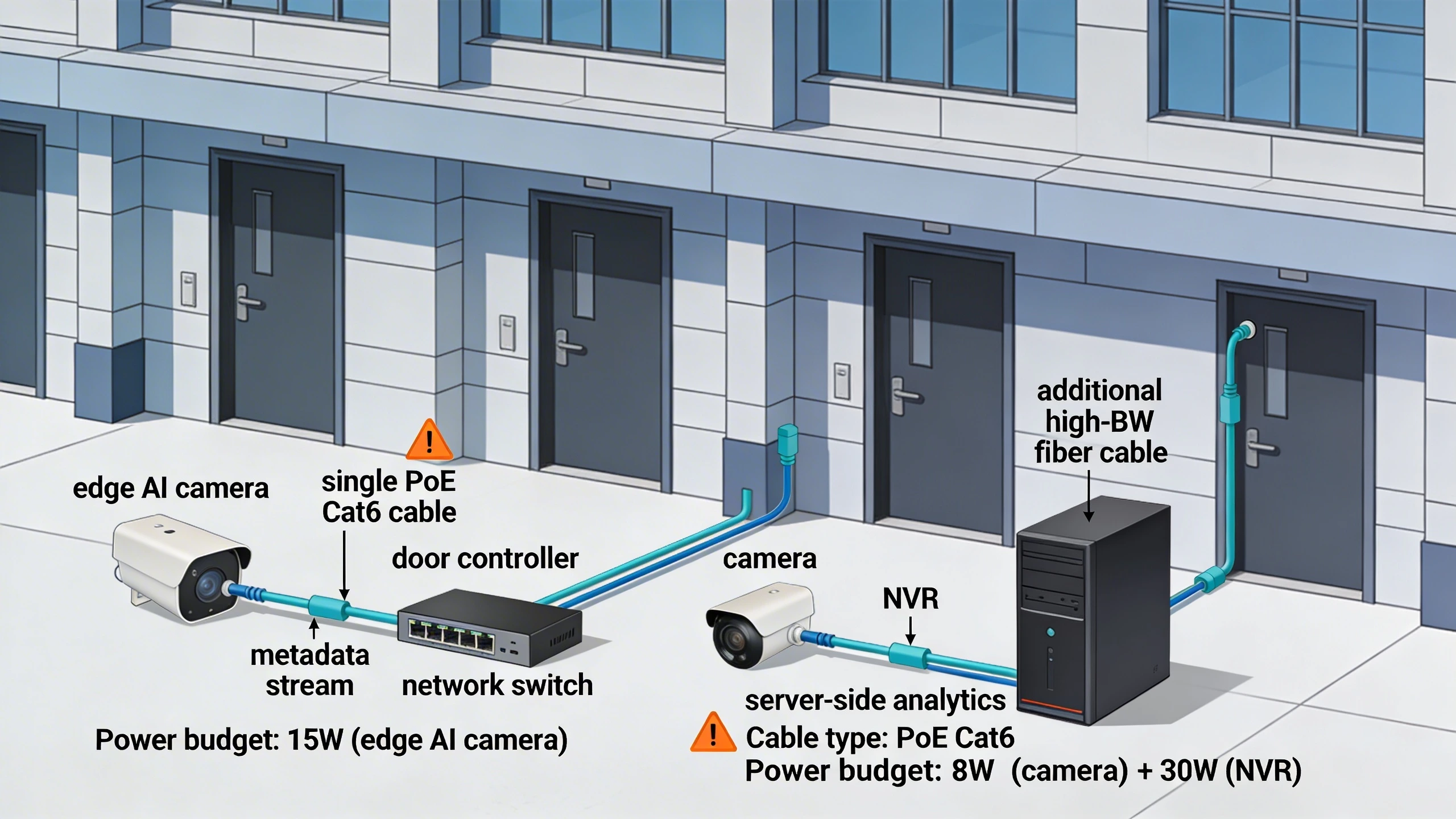
Server-side demands bandwidth budgeting: 20 4K cams at 15fps chew 200Mbps+, pushing fiber or bonded Ethernet. Topology funnels to NVR clusters, creating chokepoints vulnerable to switch failures. Integration leans on VMS plugins, but edge shifts to REST APIs for events, meshing with PSIMs or SCADA without video proxies.
Hybrid wiring pitfalls abound: mismatched PoE budgets fry edge cams on old injectors, while server topologies balk at edge metadata floods without QoS. Concrete wins emerge in brownfield sites, where edge reuses coax via baluns, dodging full rewires.
Migration planning and common failure points
Start migrations with zoned pilots: swap 10-20% of cams at high-value doors or perimeters, benchmarking latency and false alarm rates against baselines. Phased rollouts inventory server GPU headroom first—overloaded racks stall during cuts over. Firmware orchestration tools prevent brickings; sync edge models to server baselines for seamless failover.
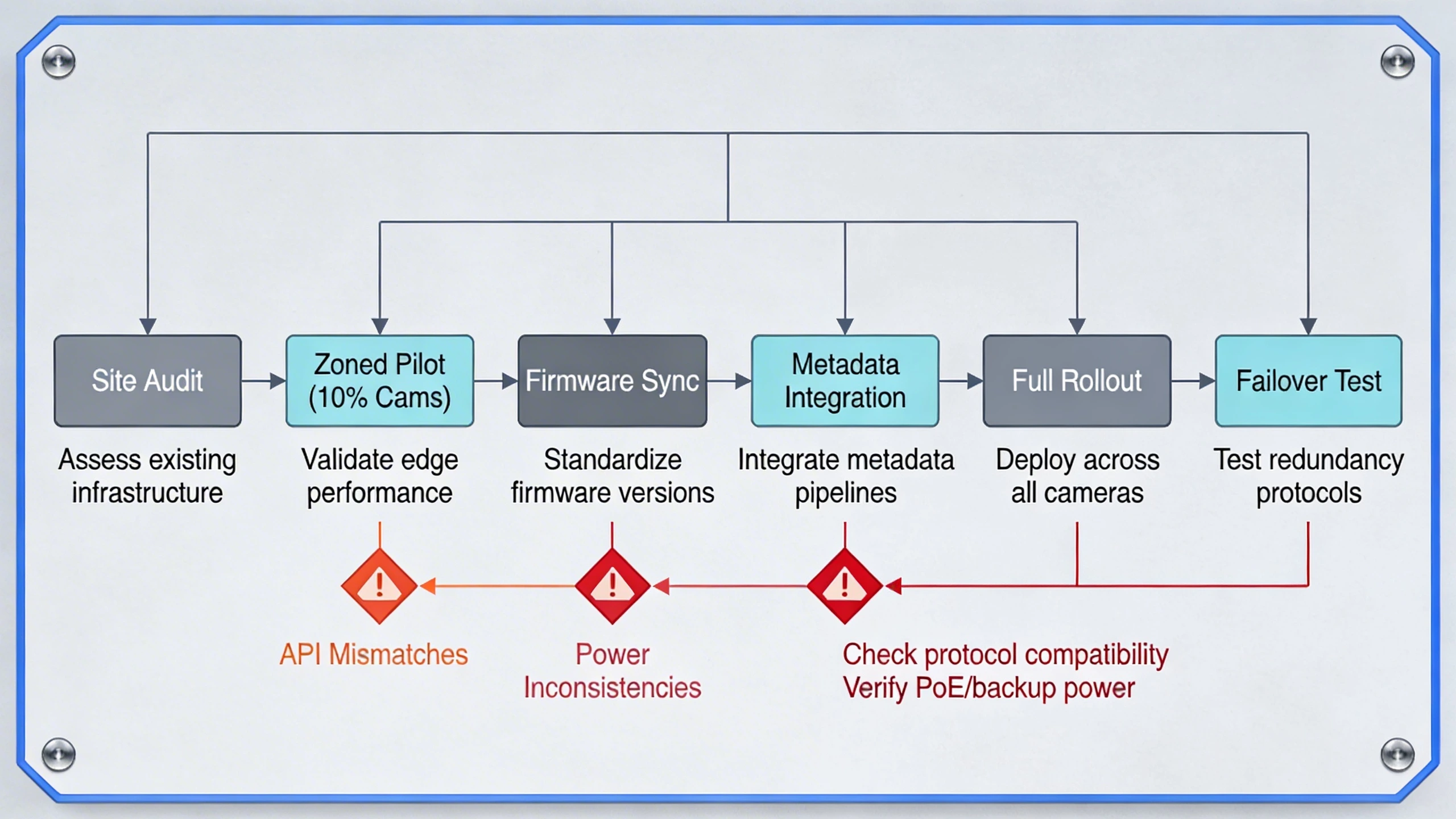
Failure points cluster around metadata silos: edge events ignored by legacy VMS without parsers, or servers overwhelmed by dual streams. Budget for API middleware, and test failover—edge-only sites drop holistic searches unless federated. Common stumbles include underestimating edge heat in enclosures, leading to thermal throttling, or skipping zonal power audits that leave remotes dark.
Success tracks via staged KPIs: network utilization drops 70-90% post-edge, but verify with Wireshark traces. Wrap with rollback playbooks, preserving server streams until edge confidence builds.
Where each approach still fits
Edge AI dominates remote or bandwidth-starved spots: utility poles, rail yards, or offshore rigs where Mbps cost thousands in sat links. It fits greenfield designs prioritizing low TCO via minimal infra, and scales for 1000+ cam fleets without rack sprawl. Pair with FortSense 4 for unified edge orchestration.
Server-side endures in analytics-heavy hubs like airports or data centers, where multi-stream fusion (e.g., crowd density + biometrics) demands GPU clusters. It suits retrofits with sunk cabling costs, leveraging existing NVRs for cost-effective scaling. Hybrids bridge: edge for fringes, servers for cores.
Selection boils to constraints: edge for resilience-first, servers for compute-rich uniformity.
Where to go next
Assess your site's topology against these tradeoffs with a tailored audit. Explore FortSense 4 for hybrid edge-server bridging, or dive into critical infrastructure security case studies. For North America deployments, request a design review to map your migration.