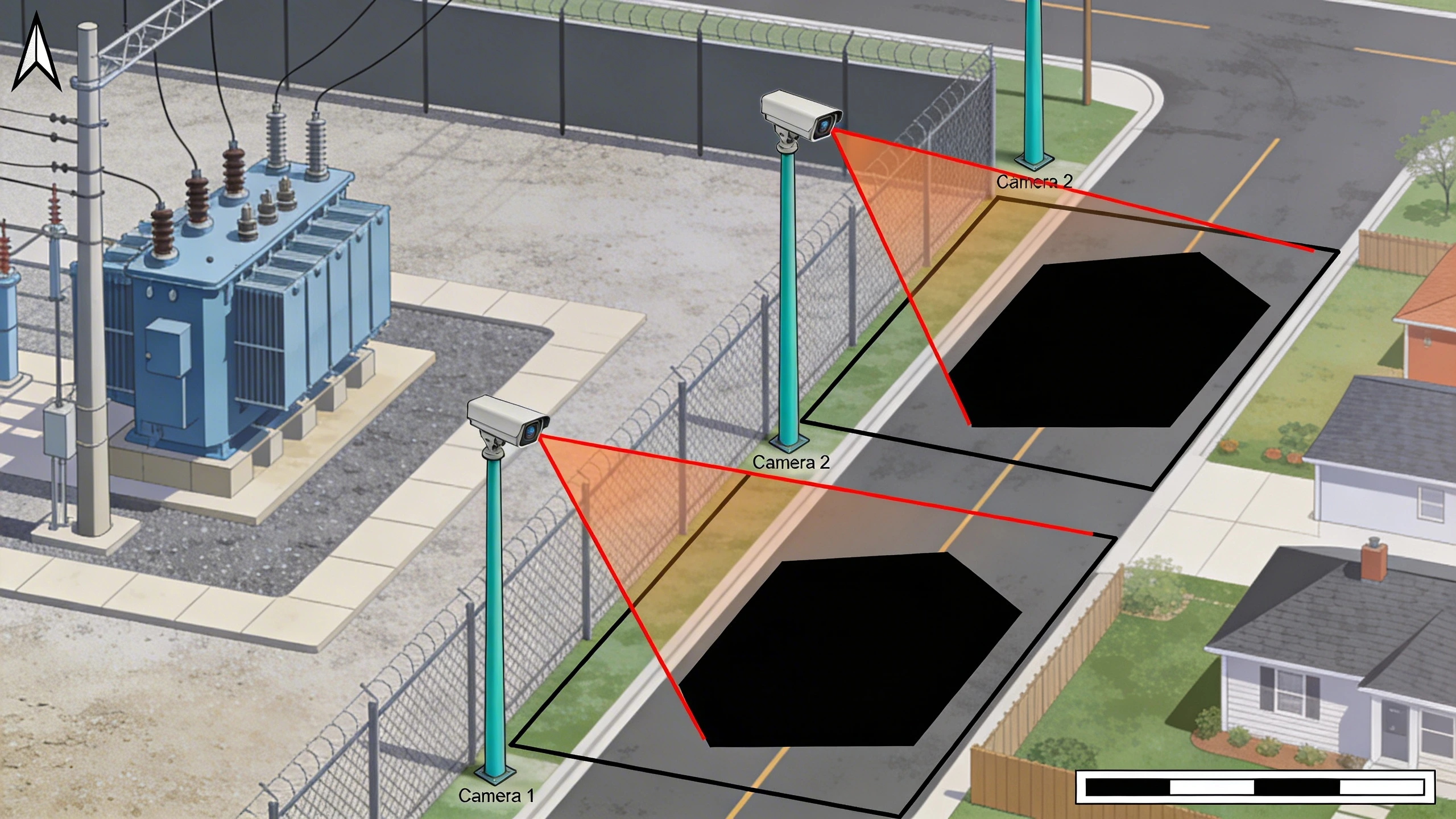
When retrofitting video surveillance at a utility substation bounded by public roads and neighboring industrial parcels, integrators often face the challenge of maintaining full perimeter coverage while adhering to privacy regulations. Existing fixed cameras mounted on 30-foot poles might capture clear views of the fence line but inadvertently include adjacent properties, risking non-compliance with local data protection laws or neighbor complaints. The decision to implement privacy masking here isn't just a checkbox for audits—it's a core design element that influences camera placement, field of view calculations, and long-term operational reliability.
Effective privacy masking at property boundaries starts with precise site surveys to map exact boundary lines against camera fields of view. Rather than blanket blackouts that erode usable footage, the most reliable approaches layer geometric masks with environmental cues, such as foliage or terrain, to minimize blind spots. For a multi-building campus retrofit, this might mean repositioning PTZ units to prioritize inward sweeps while applying dynamic masks that adjust for zoom levels, ensuring operators retain actionable intelligence without legal exposure.
In practice, teams succeed by prioritizing edge-based processing over centralized VMS masking, as it reduces latency and bandwidth demands during high-motion events like perimeter breaches. This upfront architecture choice pays dividends in field deployments, where network constraints and camera firmware dictate feasibility.
What the design decision looks like in practice
Picture a security manager at a fenced warehouse complex upgrading analog cameras to IP models along a shared property line with a residential area. The retrofit requires masking a 15-degree wedge of each camera's view to exclude neighboring driveways, achieved through polygon-based software tools calibrated during a daytime survey with laser rangefinders. Technicians mark boundary vectors on a site plan, import them into the camera's web interface, and test masks under varying lighting to confirm they hold without pixel bleed.
This hands-on process extends to PTZ deployments, where presets for patrol routes include pre-applied masks that scale with optical zoom. During commissioning, operators simulate night shifts to verify masks align with infrared illumination patterns, preventing overexposure artifacts that could reveal masked areas. The result is a system that delivers crisp, compliant footage for incident review, with masks becoming invisible to end-users in the VMS playback.
Documenting these configurations in as-built drawings is crucial, as seasonal changes like leaf drop can necessitate annual tweaks. Integrators who bake this into their SOPs report smoother handovers to operations teams, avoiding post-install callbacks.
System architecture and integration considerations
At the heart of robust privacy masking lies the choice between edge and server-side processing. Edge masking, handled directly in the camera firmware, excels in bandwidth-constrained environments like remote utility sites, where transmitting unmasked streams to a central VMS could overload links. Modern IP cameras support ONVIF Profile S with masking extensions, allowing seamless integration into multi-vendor NVRs without custom plugins.
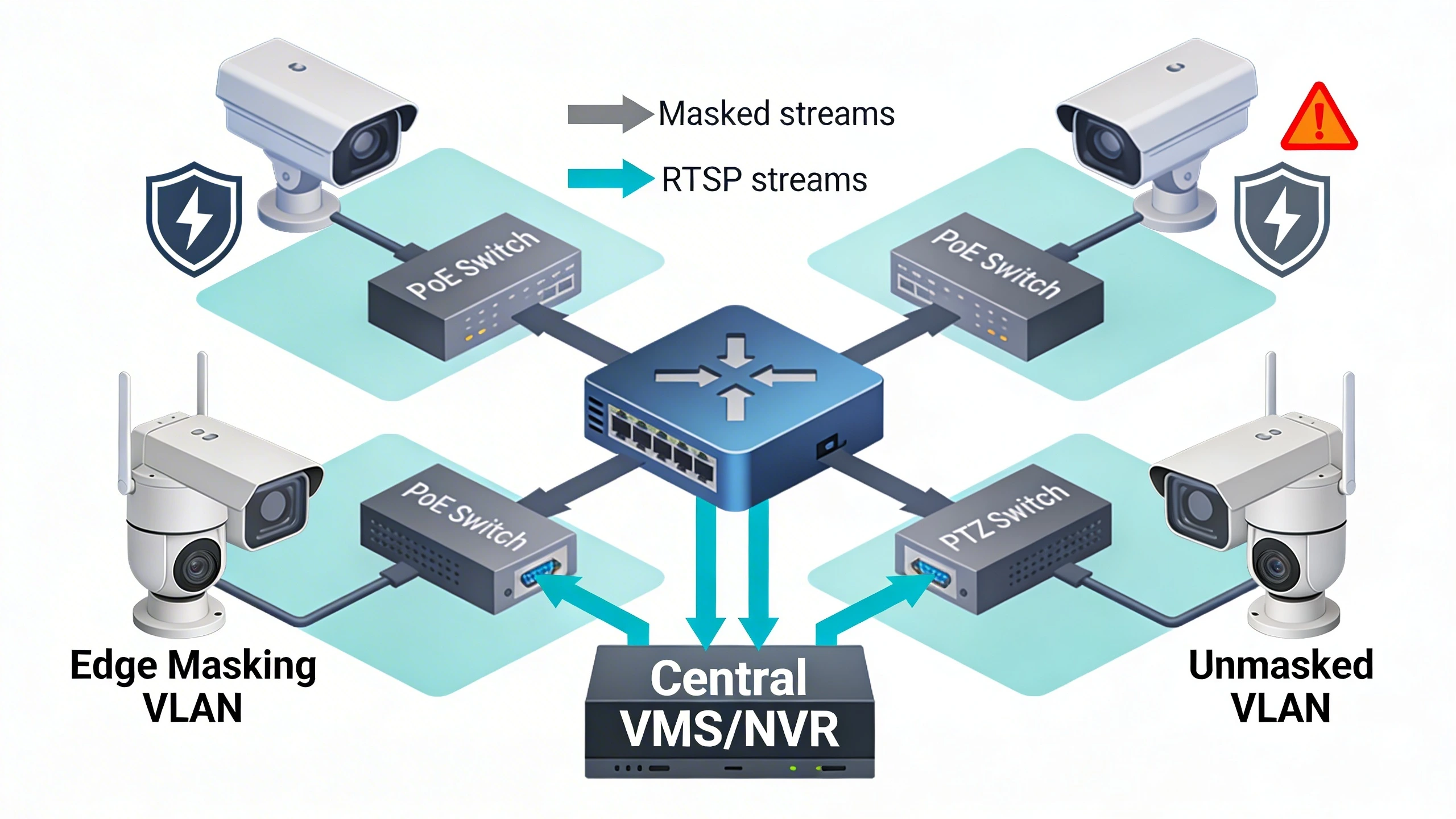
For larger campuses, hybrid architectures shine: edge devices apply coarse polygon masks, while VMS analytics refine them with AI-driven boundary detection. This layered approach accommodates legacy systems during phased migrations, where older cameras feed masked RTSP streams to new heads. Network segmentation further bolsters security, isolating masked video flows to prevent tampering attempts.
Integration pitfalls arise with mismatched firmware; always stage tests in a lab mirroring field conditions, including PoE switch latency and VLAN tagging. Such diligence ensures masks persist across reboots and firmware updates, maintaining compliance without operational disruptions.
Operational workflows and field constraints
Once deployed, privacy masking shapes daily workflows for security operators monitoring a corporate campus perimeter. Guards review incidents via VMS timelines where masked regions appear as uniform black overlays, preserving context like intruder paths up to the boundary. Maintenance involves quarterly audits: technicians climb poles or access scissor lifts to re-align cameras shifted by wind or vandalism, then recalibrate masks using smartphone apps tied to camera APIs.
Field constraints amplify these routines—think coastal utility sites where salt corrosion warps mounts, or urban campuses with drone threats requiring elevated PTZ domes. Operators mitigate by scripting mask exports for bulk updates across camera fleets, reducing truck rolls. Training emphasizes distinguishing masked voids from actual occlusions, like vehicle glare, to avoid false negatives in threat assessments.
Over time, these workflows evolve with regulatory shifts; teams that log mask adjustment histories in ticketing systems facilitate faster compliance reporting, turning a compliance burden into a operational asset.
Common failure points and design mistakes
A frequent misstep occurs when integrators apply static rectangular masks without accounting for lens distortion, leading to incomplete coverage of boundary curves in wide-angle lenses. At a multi-door distribution center retrofit, this resulted in partial views of adjacent loading docks persisting in footage, prompting legal reviews. The fix involved switching to bezier-curve polygons that conform to real-world topography.
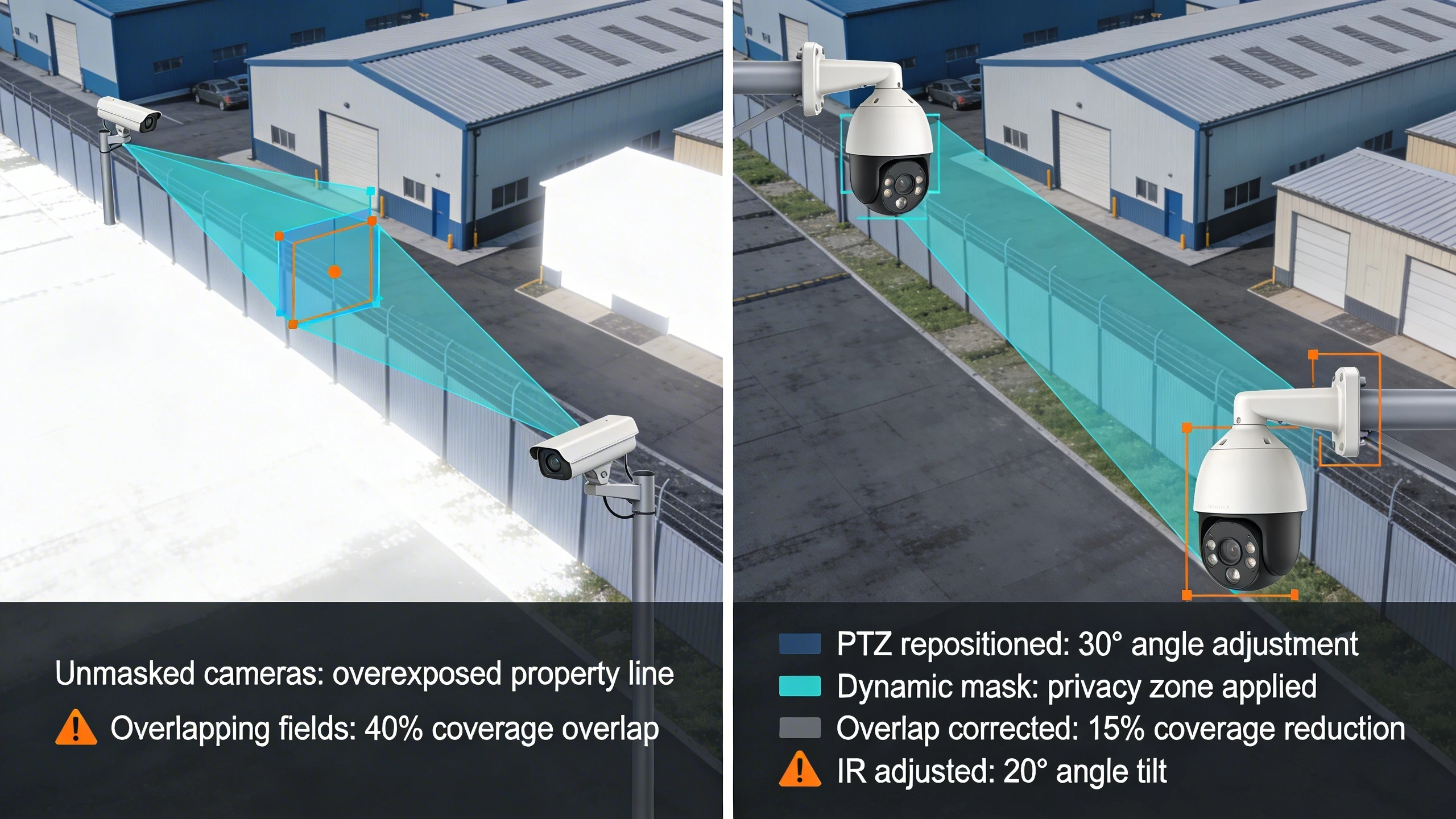
Another trap is neglecting PTZ zoom synchronization; masks that don't scale leave slivers of off-property detail exposed during operator pans. Environmental drift compounds this—growing hedges might encroach on masks, creating blind spots, or construction nearby alters sightlines. Teams sidestep these by embedding GNSS coordinates in camera metadata for automated mask regeneration.
- Underestimating IR spillover: Night masks must extend beyond visible boundaries to block illuminator reflections.
- Ignoring multi-camera overlaps: Adjacent fields require synchronized masks to prevent stitching artifacts in VMS mosaics.
- Skipping user access controls: Ensure only admins can edit masks, logged via audit trails.
What to verify before procurement
Before committing to cameras for a perimeter-heavy deployment, scrutinize firmware datasheets for masking granularity—favor models supporting at least 20 polygon vertices per mask for irregular boundaries. Test sample units for mask rendering at max zoom and in low light, confirming no edge artifacts or performance dips in FPS.
Probe vendor support for API extensibility, especially if integrating with third-party VMS like Milestone or Genetec. Confirm backward compatibility for hybrid fleets, and review update cadences to ensure masking features won't deprecate. Field trials should simulate worst-case scenarios, such as 50mph gusts shifting mounts, to validate mask stability.
Finally, assess total cost beyond hardware: factor in survey tools, training modules, and ongoing calibration labor. Procure with SLAs covering mask-related firmware bugs, safeguarding against deployment surprises.
Where to go next
Explore FortSense 4 for advanced edge analytics that complement privacy masking in high-stakes environments. For tailored advice on your site, request a design review. Dive deeper into critical infrastructure security challenges, or review regional case studies in North America deployments.