When retrofitting perimeter video at a utility substation, the engineering team faces a familiar challenge: daytime footage captures every detail along the fence line, but nights bring grainy shadows or complete washout under sodium vapor lights from nearby roads. The root issue often traces back to mismatched illumination, where cameras strain against low lux levels without targeted supplemental lighting. Deciding between infrared (IR) illuminators for covert monitoring and visible white light for color deterrence shapes the entire upgrade path, influencing power budgets, compliance with dark-sky regulations, and integration with existing FortSense 4 video management.
In practice, most perimeter designs lean toward IR for its stealth—emitting light invisible to the human eye while enabling monochrome imaging up to 100 meters or more with array-based illuminators. This avoids drawing attention to the site, a priority for critical infrastructure security. Yet hybrids emerge in high-risk zones, pairing IR with selective white light activation on motion triggers. The upfront design frames these choices against site topology, camera sensor specs, and field wiring constraints, ensuring footage supports analytics like intrusion detection without false alarms from uneven lighting.
Success hinges on modeling coverage early, using tools like illuminance calculators to map lux falloff across the perimeter. Teams that skip this step often end up with hot spots near illuminators and blind zones farther out, complicating operator reviews during incident investigations.
What the design decision looks like in practice
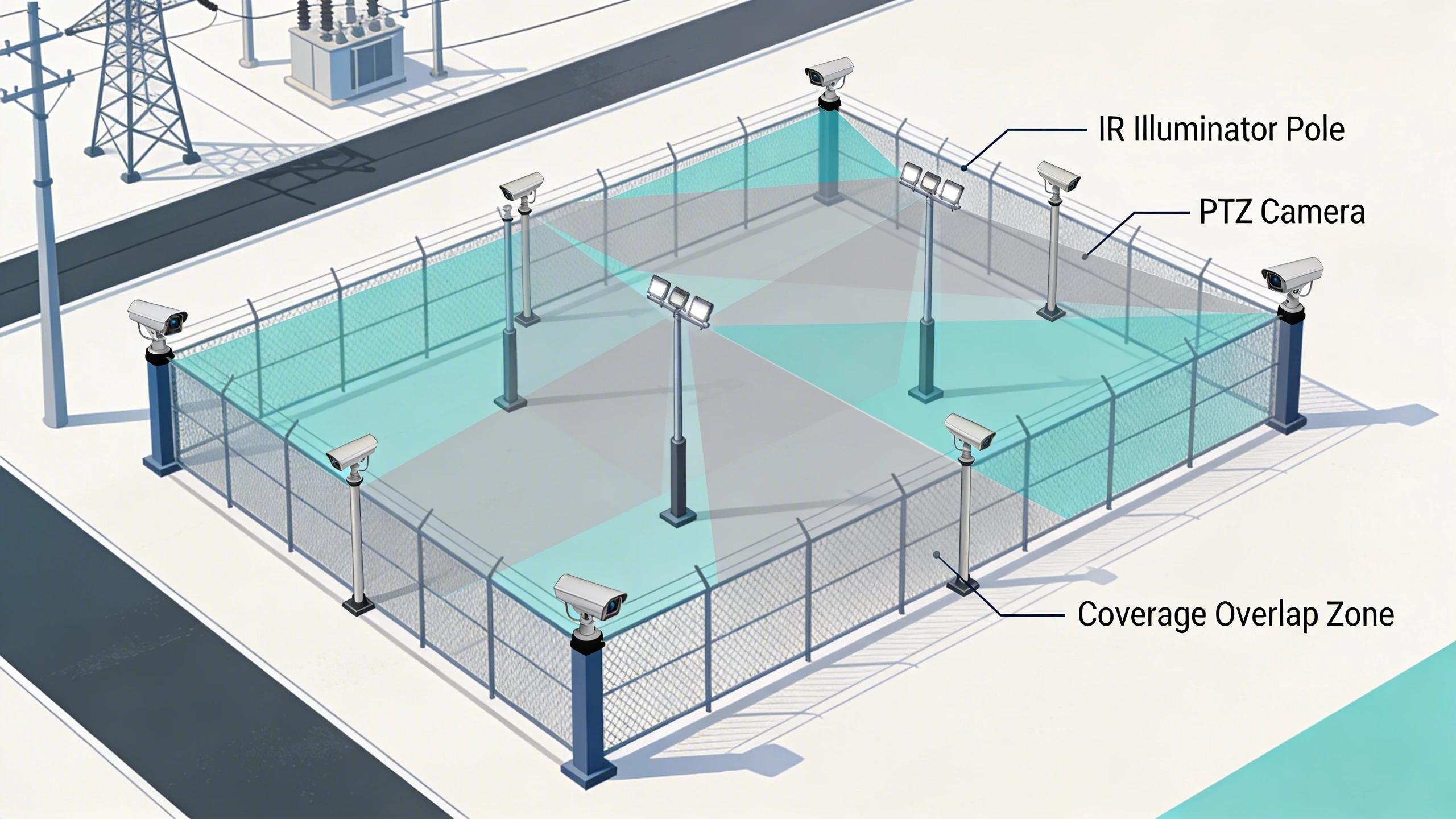
Picture a multi-acre campus perimeter retrofit: legacy analog cameras get swapped for IP models with low-light sensors, but without illumination redesign, night clips show little beyond vague shapes. The design process starts with a site survey, plotting fence heights, pole placements, and sightlines. IR flood arrays mount on adjacent poles, angled to overlap camera fields of view (FOVs), delivering 0.01 lux sensitivity where ambient light fails. White light alternatives, like LED spotters, suit gate areas for color ID of intruders, but their glare risks blooming on reflective surfaces like vehicle windshields.
Implementation unfolds in phases: prototype a single sector to validate lux uniformity via test footage, then scale. For a 500-meter fence, space 30-degree IR units every 20-30 meters, syncing activation with camera IR-cut filters. This setup transforms reactive patrols into proactive verification, where security managers review clear timestamps of events like fence climbs. Tradeoffs surface here—IR preserves night vision adaptation for guards, while white light aids human assessment but invites tampering attempts.
Real-world adjustments account for foliage or terrain; a utility site might elevate illuminators 4 meters to clear scrub, ensuring ground-level coverage without upward spill.
System architecture and integration considerations
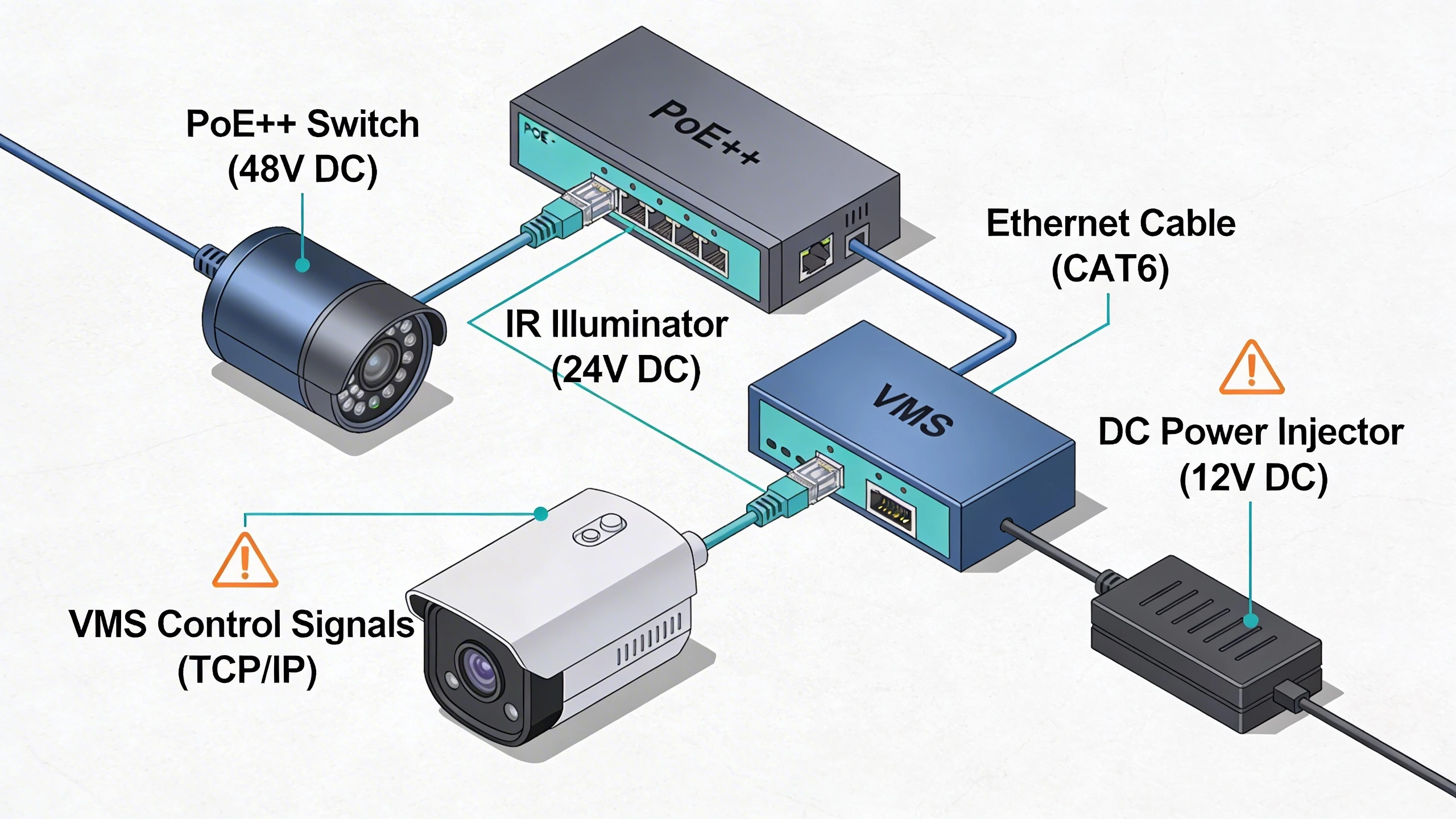
Perimeter illumination integrates as an extension of the video subsystem, sharing network switches for control but often requiring dedicated power circuits due to high draw from LED arrays. In a North America deployments context, PoE++ capable switches handle camera+illuminator combos up to 90W, simplifying cabling in buried conduit runs. Separate DC supplies prove reliable for remote poles, with photocell triggers or VMS software (like FortSense 4) orchestrating on/off based on ambient lux sensors. Architecture favors modular panels—850nm for range, 940nm for stealth—dimmable via PWM for energy tuning.
Camera pairing matters: sensors with superior quantum efficiency pair best with narrow-band IR, maximizing signal-to-noise at 850nm peaks. Integration pitfalls include mismatched beam angles; a 10-degree camera lens demands precisely matched illuminator optics to avoid vignette. For scalability, adopt ONVIF-compliant illuminators, allowing centralized scheduling that aligns with PTZ presets. This layered approach supports failover, where primary IR backs to white light during outages, maintaining baseline detection.
Operational workflows and field constraints
Field teams execute illumination designs under tight windows, often coordinating with live operations at industrial sites. Workflow begins with pole reinforcements if wind-loading exceeds specs, followed by conduit pulls for Cat6 and 48VDC lines. Constraints like frozen soil in northern climates dictate pre-winter installs, with temporary generators powering test patterns. Operators then calibrate via live view, adjusting angles until lux meters confirm 10+ lux minimum across FOVs—critical for analytics engines that falter below thresholds.
Daily ops shift with smart controls: illuminators pulse only on motion or scheduled sweeps, cutting power use and heat buildup in enclosures. Maintenance routes standardize checks for lens dust or diode degradation, using thermal cameras to spot hotspots. Constraints amplify in expansive perimeters; mobile teams prioritize sectors by risk, logging coverage maps in the VMS for audit trails. This operational rhythm ensures illumination supports 24/7 workflows without excessive downtime.
Common failure points and design mistakes
Overlooking environmental factors dooms many designs—rain scatters IR unevenly, creating puddles of light that confuse edge detection algorithms. Mistake number one: uniform spacing without lux modeling, leading to 50% coverage gaps at range ends. Another: ignoring heat dissipation; high-power arrays in sealed boxes throttle output or fail prematurely, stranding night coverage. Teams fix this by venting enclosures and selecting IP67-rated units with active cooling fins.
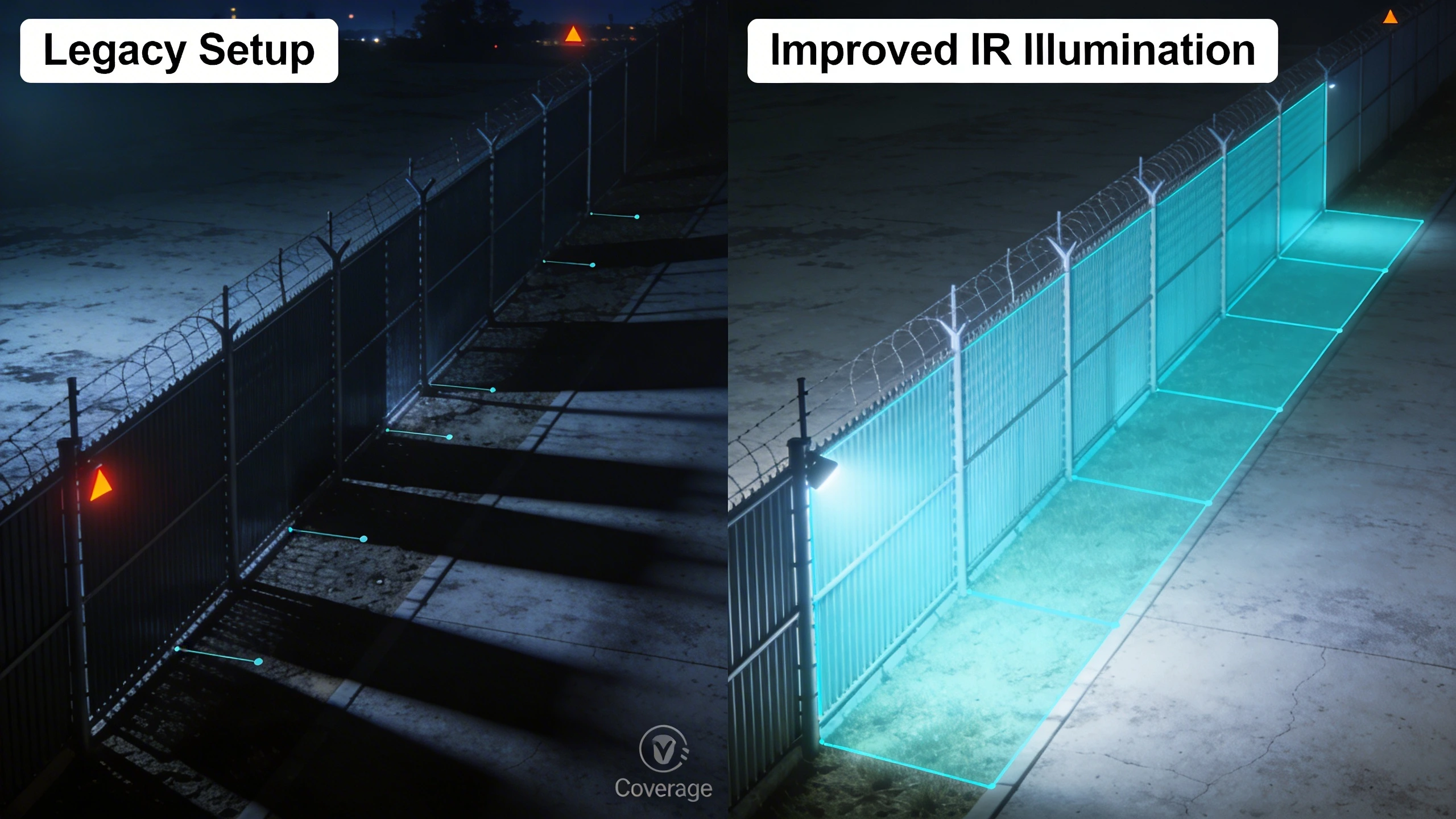
Vendor mismatches compound issues: cameras tuned for 940nm paired with 850nm floods yield dim images, forcing costly swaps. Design flaw in hybrids—ungated white light bleeds into IR channels, causing color cast artifacts. Field reports highlight glare bounce from gravel paths, mitigated by downward tilting and anti-reflective coatings. Skipping pilot tests reveals these early; a full rollout without reveals budget overruns from rework.
What to verify before procurement
Before specs lock in, validate illuminator datasheets against site metrics: beam width must exceed camera horizontal FOV by 20% for overlap, and wavelength aligns with camera peak response. Request beam pattern charts, not just max distance claims, and confirm dimming granularity for fine-tuning. Power calcs aggregate across zones—ensure PSU headroom for surges. Check certifications like UL for hazardous locations if near fuels.
Prototype compatibility: bench-test illuminator with target cameras under controlled dark, measuring SNR in footage. Verify control protocols; I2C or RS485 for precise sync beats basic relays. Supplier audits cover MTBF data and warranty on diodes, plus accessories like photocells. This diligence prevents integration snags, aligning procurement with operational realities.
Where to go next
Integrate these principles into your next perimeter upgrade with FortSense 4, optimized for low-light analytics. For tailored advice, request a design review. Explore broader contexts in critical infrastructure security or North America deployments. Reference the WDR glossary for handling light contrasts in mixed scenes.