When upgrading the perimeter defenses at a sprawling utility substation, security teams often confront the tension between overly sensitive alarms and undetected breaches. Legacy infrared or microwave sensors, while reliable in controlled tests, falter under real-world pressures like heavy rain, roaming wildlife, or deliberate masking attempts, leading to false negatives that expose assets to theft, vandalism, or worse. Integrators retrofitting these sites must weigh the cost of inaction—a single missed intrusion can cascade into operational shutdowns and compliance failures—against the burden of tuning systems that generate endless alerts.
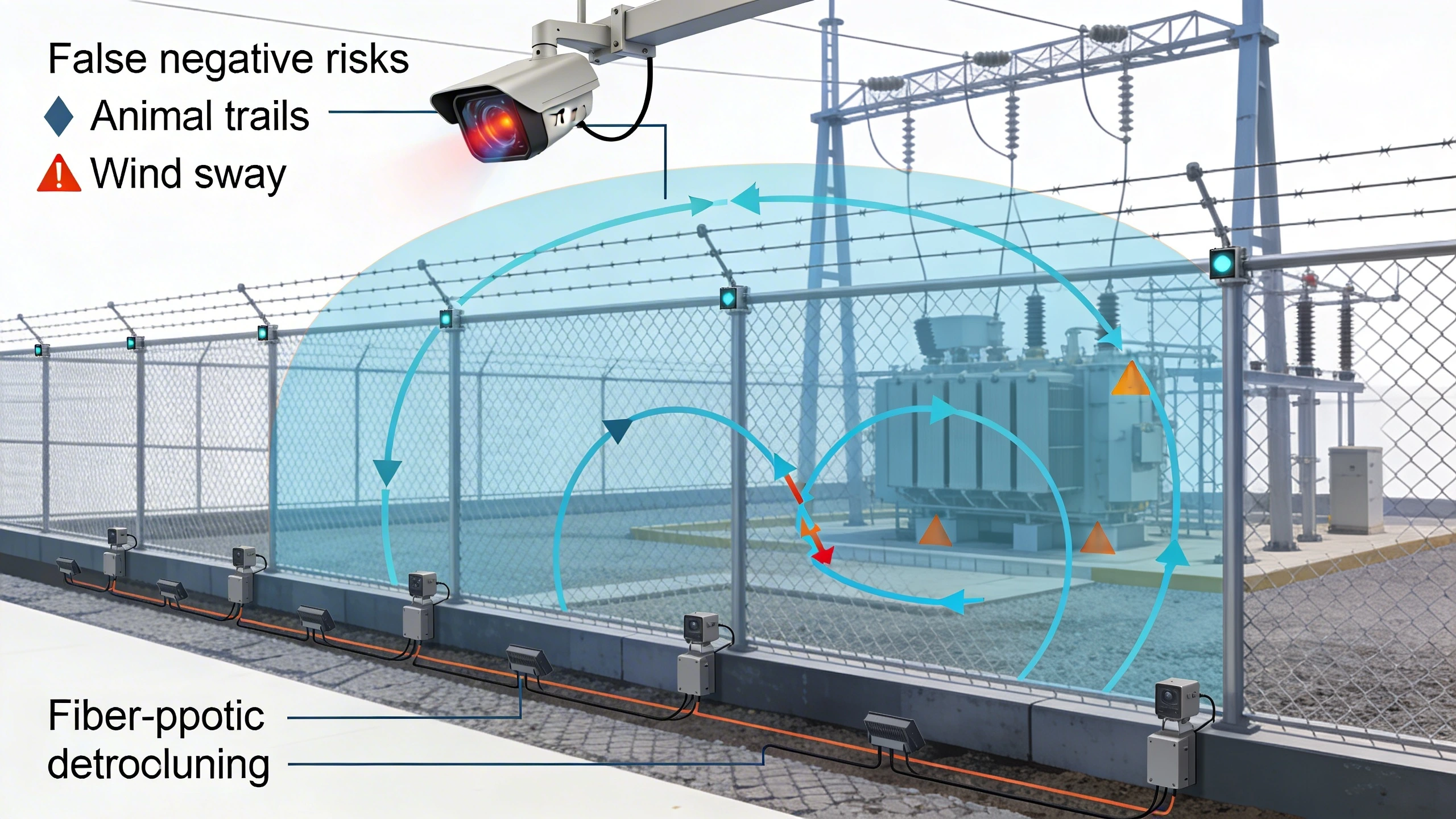
The core design pivot here centers on layered detection architectures that fuse multiple sensor modalities with automated verification, rather than tweaking a standalone system's sensitivity thresholds. This method inherently reduces false negatives by requiring corroboration across technologies, ensuring that environmental noise or evasion tactics rarely slip through unchallenged. In a campus environment, for example, combining fence-mounted vibration sensors with buried fiber-optic lines and PTZ cameras creates redundant coverage, where a potential climber on one segment triggers cross-checks from adjacent zones.
Security managers at high-stakes facilities, such as data centers or power plants, report that this layered strategy transforms retrofit projects from guesswork into predictable outcomes. It shifts the focus from reactive tuning to proactive overlap design, minimizing the risk that an intruder exploits a single point of failure while keeping operator workloads sustainable.
What the design decision looks like in practice
Picture a multi-acre industrial campus where the original perimeter relied on break-beam sensors across chain-link fencing. These worked adequately for daytime patrols but missed nighttime incursions masked by foliage sway or small-animal crossings, resulting in repeated post-incident reviews. The retrofit decision manifests as installing taut-wire overlays on the fence fabric, paired with coaxial vibration detectors buried along the base, and linking everything to overhead thermal imagers for automated clip generation on alerts.
This isn't about adding gadgets; it's engineering intentional redundancy. An attempted cut on the fence vibrates the wire and ground sensors simultaneously, prompting the thermal camera to slew and classify the event as human versus environmental. Teams implementing this at utility sites note that the upfront wiring complexity pays off in field reliability, as no single sensor type dominates the decision logic. Without this overlap, designers default to sensitivity hacks that either flood the console or leave gaps, eroding trust in the entire system.
In a retrofit timeline, the process starts with site surveys mapping wind corridors and animal paths, then prototyping sensor pairs on test spans before full deployment. The result is a perimeter where false negatives drop through probabilistic confirmation, not perfect isolation.
System architecture and integration considerations
At the heart of false negative mitigation lies a fused architecture where raw sensor data streams into a central processor before reaching the operator. Rather than siloed alerts from disparate devices, modern designs route infrared, microwave, and acoustic inputs through a correlation engine—often embedded in a PSIM platform—that applies rules like "vibration plus beam break equals priority escalation." This setup demands robust networking, with fiber backhauls preferred over wireless to avoid latency-induced misses during high-wind events.
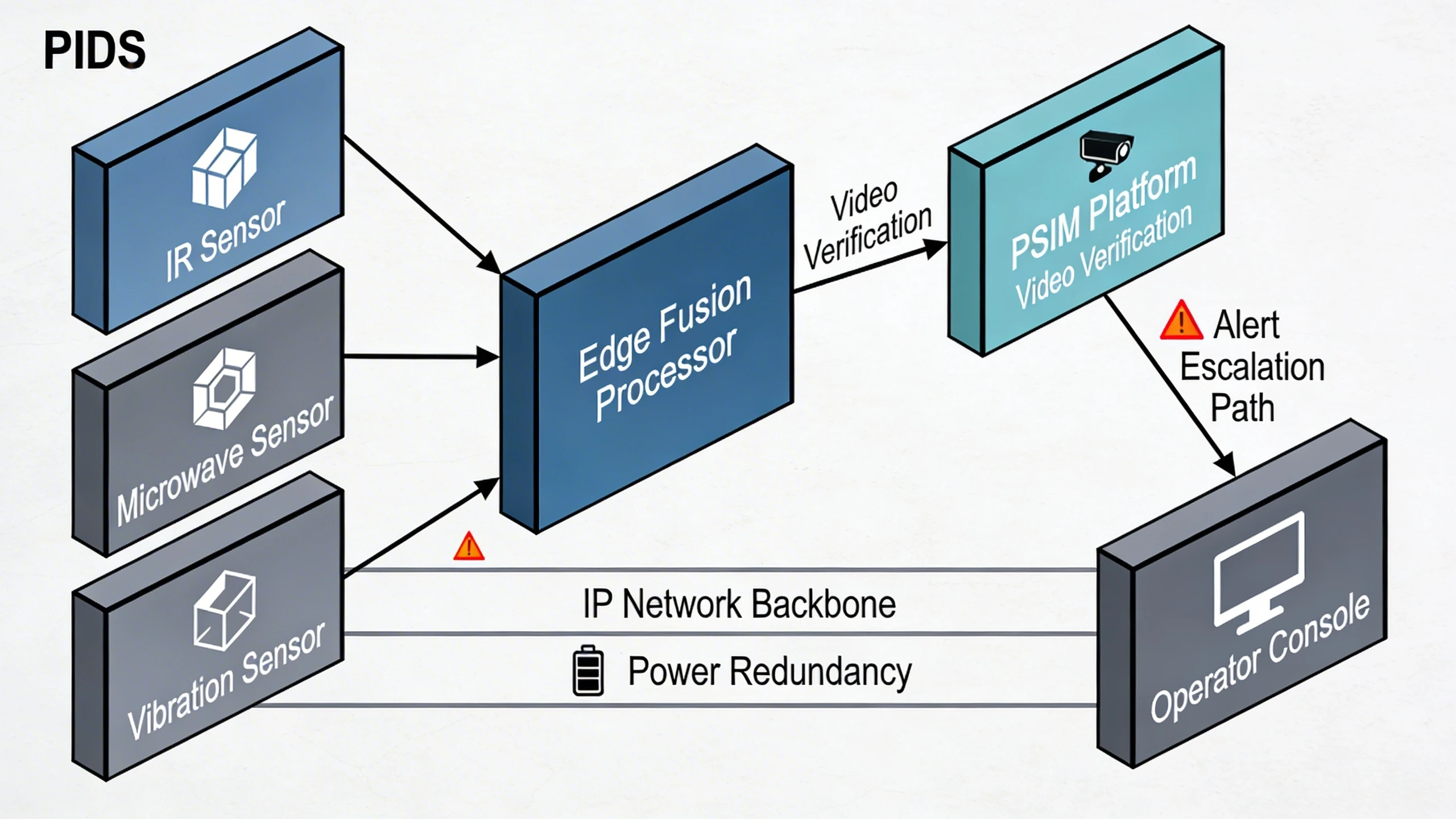
Integration pitfalls emerge when legacy head-ends can't handle multi-vendor protocols, forcing custom gateways that introduce single points of failure. Successful retrofits standardize on ONVIF-compliant endpoints and IP-based transmission, enabling seamless scaling from 1km to 10km perimeters. For IT managers, this means aligning PIDS with existing VMS and access control, ensuring that a perimeter event auto-zooms linked cameras without manual intervention. Get the architecture wrong, and correlated events fragment into isolated pings, overwhelming staff and masking true threats.
Power redundancy is non-negotiable; solar-backed edge processors keep fusion logic alive during grid faults, preventing total blind spots that legacy systems suffer.
Operational workflows and field constraints
Daily operations hinge on workflows that treat alerts as hypotheses, not facts, with layered PIDS feeding into tiered response protocols. Operators first review fused video snippets, then dispatch rovers only for confirmed escalations, freeing patrols for proactive sweeps. In rainy seasons at coastal facilities, this means pre-loading weather overlays into the analytics to deprioritize transient signals, maintaining focus on persistent anomalies like loitering figures.
Field constraints like uneven terrain or dense vegetation dictate sensor selection—fiber optics excel in buried runs under gravel paths, while ported coaxial handles rocky outcrops without false grounds. Maintenance crews must access calibration tools via mobile apps, adjusting for seasonal foliage without full shutdowns. Neglect these, and workflows bog down: technicians chase ghosts in mud, or worse, desensitize the system broadly, inviting real breaches. Effective designs bake in self-diagnostics, logging drift over time for predictive tweaks.
For shift-handover reliability, dashboards aggregate 24-hour event maps, highlighting zones with creeping false negative patterns for preemptive redesign.
Common failure points and design mistakes
One prevalent error is over-relying on line-of-sight sensors like IR beams in vegetated perimeters, where overhanging branches create dynamic shadows that mimic or hide intrusions. Installers compound this by skimping on ground-plane coverage, leaving ladder-assisted climbs undetected. The fallout? Repeated false negatives erode operator confidence, leading to ignored alerts and eventual system decommissioning.
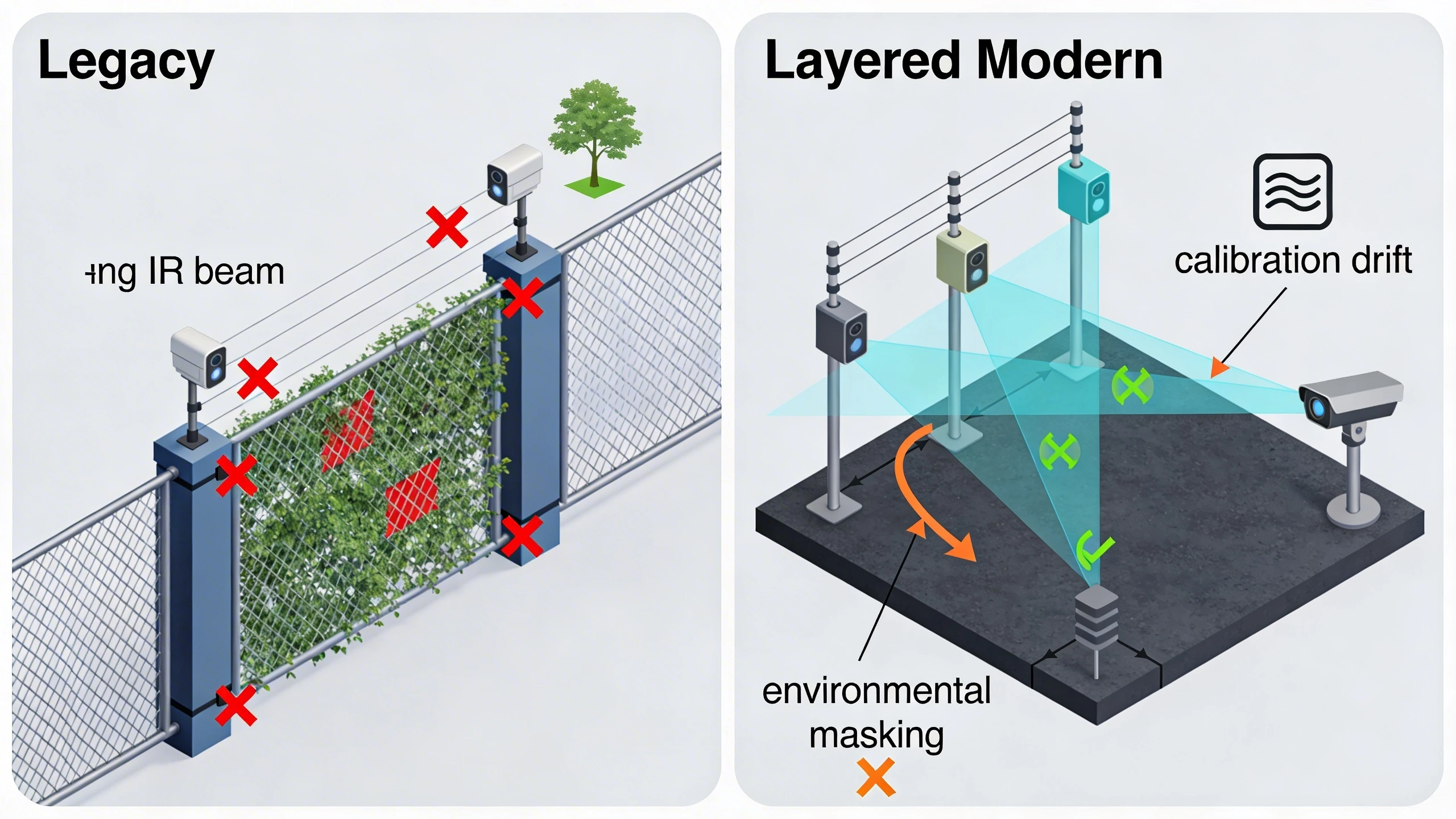
Calibration drift from thermal expansion or soil settling often goes unchecked, especially in expansive sites where quarterly walks miss subtle shifts. Designers also falter by ignoring upstream fusion logic, piping unfiltered data to consoles that drown in noise. In one campus retrofit, mismatched sensor ranges created coverage gaps at corners, allowing tailgating exploits until post-install audits revealed the oversight. These mistakes cascade: budget overruns for patches, strained vendor relations, and heightened vulnerability during the learning curve.
- Underestimating environmental baselines during site surveys.
- Skipping multi-sensor overlap in high-risk vectors like gates.
- Omitting video slew-to-cue for human verification.
What to verify before procurement
Before committing to a vendor, demand live demonstrations under simulated field conditions—wind, rain, and faux intrusions—to witness false negative handling firsthand. Probe the fusion algorithms: do they weight inputs dynamically, or apply static thresholds? Review interoperability certifications, ensuring seamless ties to your PSIM or VMS without proprietary lock-in.
Scrutinize the edge processing capabilities for low-bandwidth resilience, vital for remote sites. Ask for case studies from similar perimeters, focusing on long-term false negative trends rather than lab metrics. Installation support should include as-built diagrams and tuning guides tailored to your topography. Overlook these, and procurement locks you into rework cycles; verify rigorously to align the system with operational realities from day one.
- Request environmental stress test videos from the vendor.
- Confirm multi-year warranty on sensor calibration stability.
- Validate network failover in the proposed architecture.
Where to go next
Explore how FortSense 4 implements these layered strategies in real deployments. For tailored advice on your perimeter retrofit, request a design review.
Dive deeper into Perimeter Intrusion Detection System glossary terms, or review critical infrastructure security applications and North America deployments.