In securing critical infrastructure like utility substations or correctional campuses, gates and sally ports represent chokepoints where vehicle access must balance speed and scrutiny. Retrofitting these areas with License Plate Recognition (LPR) shifts manual inspections to automated plate reads, enabling real-time checks against dynamic watchlists. For a security manager overseeing a perimeter upgrade, the core decision revolves around camera placement that captures plates reliably across approach speeds and angles, while tying into existing barrier controls without introducing delays that bottleneck operations.
Consider a typical retrofit at a remote pumping station: outbound trucks during maintenance windows need quick clearance, but inbound visitors trigger secondary verification. A well-placed LPR setup here processes plates from 30 feet out, signaling gate operators or hydraulics directly, cutting dwell times that previously led to queues. This not only frees guards for exception handling but also logs entries for post-incident analysis. Integrators often find the upfront layout pays off in fewer false rejects during rain or low light, common at these exposed sites.
Success hinges on treating LPR not as a standalone camera but as a node in a layered access chain. Poor integration risks cascading failures, like a misread plate halting a sally port sequence. The sections below break down the hands-on choices, from topology to troubleshooting, drawn from field deployments where reliability under duress defines the system.
What the design decision looks like in practice
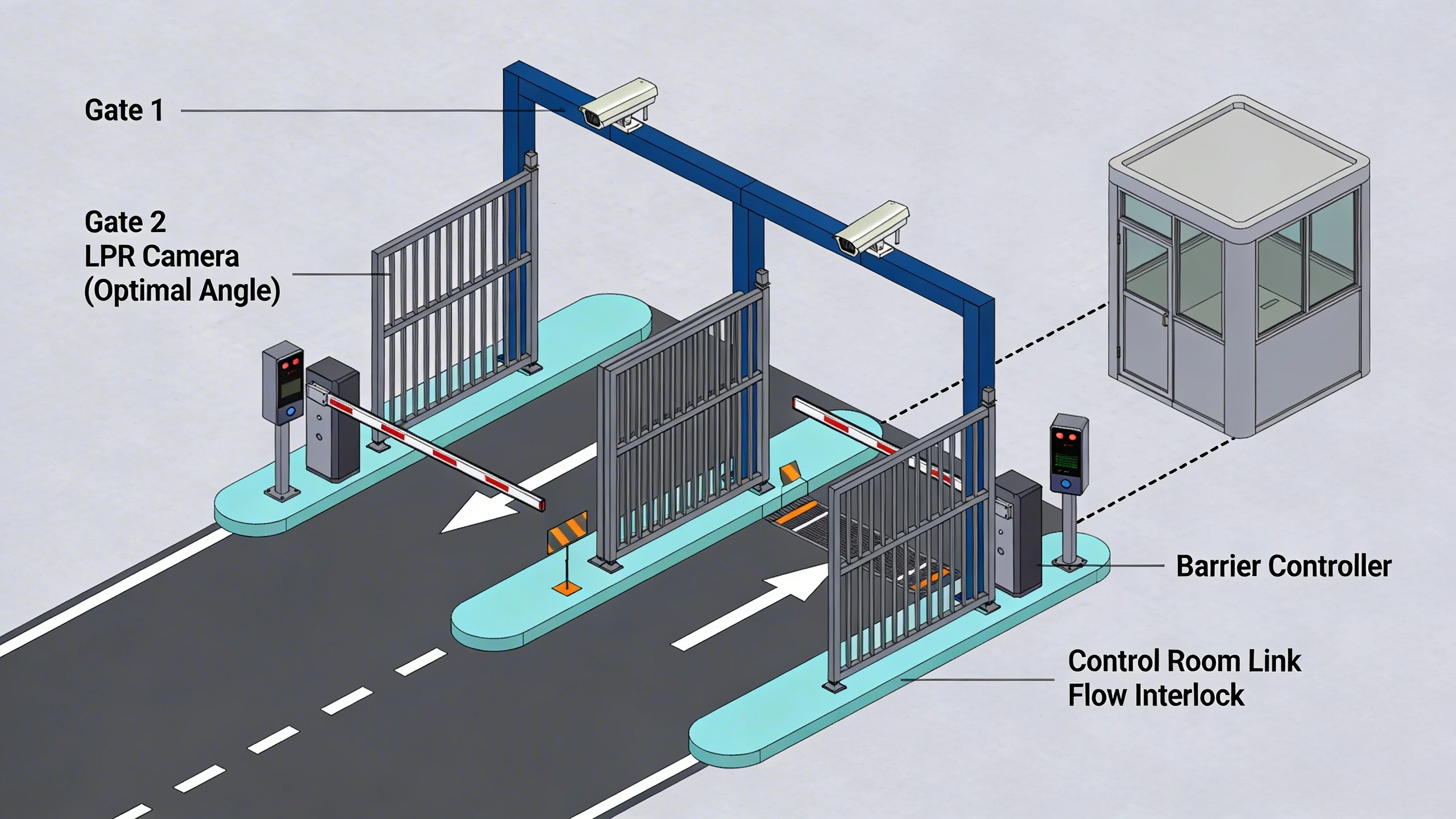
At a standard perimeter gate, LPR deployment starts with mounting cameras overhead on gantry or pole, angled 15-30 degrees downward to frame the plate squarely as vehicles decelerate. In practice, this means surveying approach lanes for occlusions—mirrors, hitches, or mud flaps that skew reads—and adjusting for bidirectional flow if the gate serves exits too. For a campus retrofit, teams might consolidate two legacy cameras into one high-res LPR unit, piping metadata to a central VMS for unified alerting.
Sally ports introduce tighter constraints, with dual barriers forming a vestibule roughly 40x20 feet. Here, LPR cameras cover both outer and inner gates, often in stereo pairs to triangulate plates from multiple angles and mitigate glare from headlights. During a prison expansion project, for instance, installers positioned one camera per gate plus a third for the holding area, ensuring the system verifies outbound vehicles against inmate transport manifests before releasing the inner barrier. This setup maintains interlock logic: no plate match, no sequence advance.
Operational tweaks refine the design. Thresholds for read confidence get tuned post-install via test runs with sample fleets, balancing false positives that annoy drivers against misses that summon guards. In multi-site rollouts, standardized mounts and PoE cabling speed deployment, but site-specific tweaks—like supplemental IR illuminators for night shifts—address local variances.
System architecture and integration considerations
Layering LPR into gate architectures demands compatibility with barrier controllers, often Modbus or relay-based relics from the 90s. Modern LPR heads output plate data via ONVIF profiles or REST APIs, bridging to access platforms like Lenel or Software House through middleware. For a utility site retrofit, this might involve a PLC aggregating LPR events with RFID readers, enforcing rules like 'plate match OR badge scan' before arming the gate motor. Edge processing on the camera minimizes latency, crucial when hydraulics cycle in under 10 seconds.
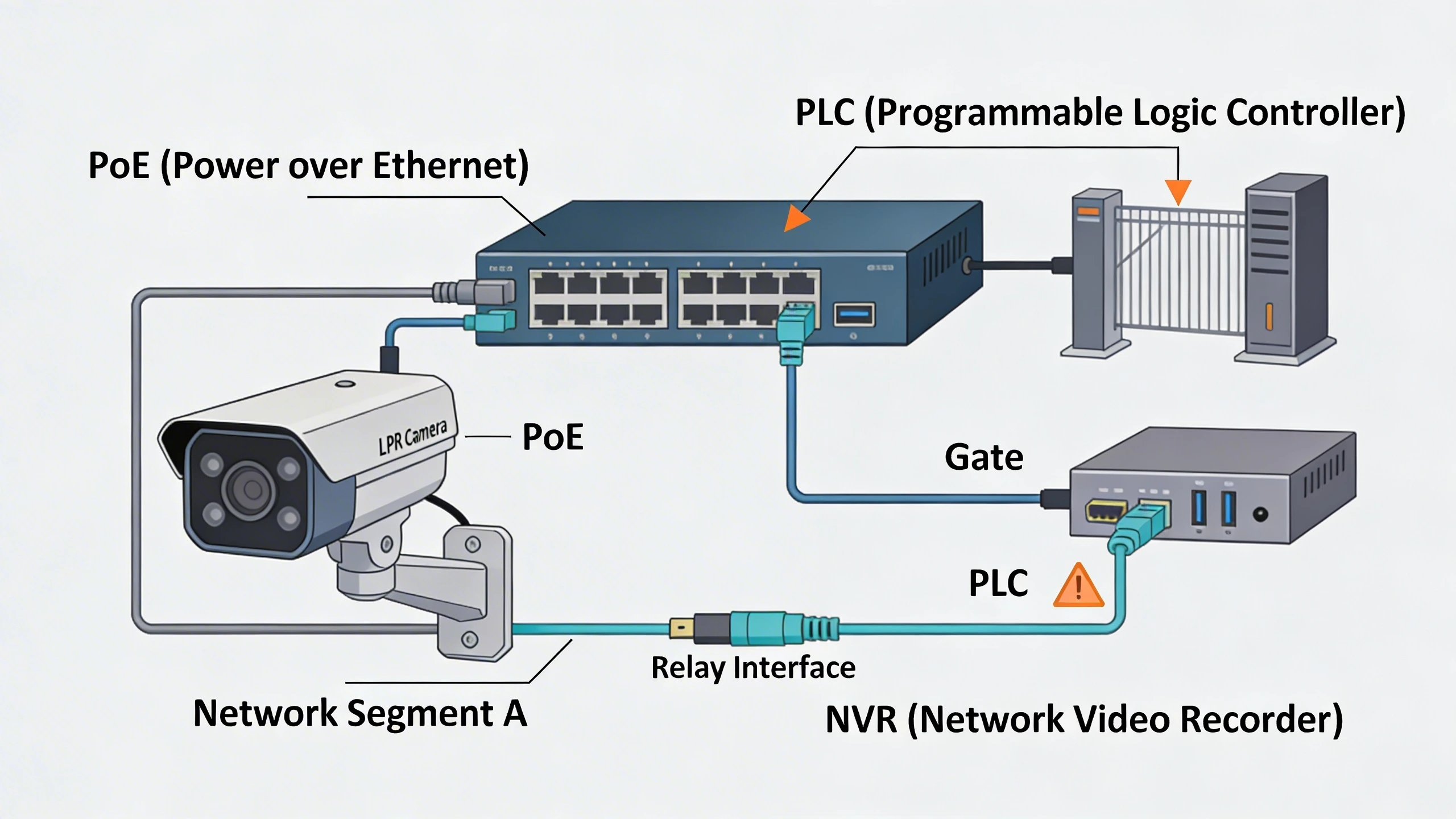
Networking poses its own hurdles: sally ports buried in concrete demand fiber runs or wireless bridges hardened against jamming. Power budgeting factors in heaters for cold climates, where frozen plates foil reads. Integrators favor NVRs with LPR plugins over cloud relays for air-gapped sites, ensuring metadata stays local until audited. In one federal deployment, segmenting LPR traffic on a dedicated VLAN prevented VMS overload during surge events, like contractor rushes.
Scalability enters via centralized watchlist management. Syncing plates across enterprise databases avoids siloed blacklists, but requires secure LDAP or SIEM hooks. Testing full chains—camera to controller to log—uncovers latency spikes from unoptimized streams.
Operational workflows and field constraints
Daily workflows pivot around inbound clearance: vehicle rolls up, LPR pings the database in 1-2 seconds, greenlights via light stack or TTS if approved. Sally ports extend this with phased verification—outer gate opens on whitelist hit, inner on secondary confirm like facial scan from a cab-forward camera. Guards intervene via intercom only on exceptions, logged with snapshots for chain-of-custody. At shift change on a factory campus, this automation prevents tailgating pileups, as sequenced releases keep spacing.
Field constraints shape adaptations. Weatherproofing cameras to IP67 handles washdowns, but snow-covered plates call for pre-gate defoggers or wipers. Variable speeds—crawling trucks versus speeding visitors—necessitate adjustable frame rates, often 30fps minimum. Maintenance windows factor downtime: PoE switches enable hot-swaps without full outages. In dusty industrial zones, compressed air blowers on lenses extend cleaning intervals.
Training operators on dashboards completes the loop. Custom alerts for low-confidence reads prompt visual checks, reducing nuisance calls. Audit trails from LPR feeds support compliance, tracing every transit.
Common failure points and design mistakes
Angle misalignment tops the list: cameras too high miss slanted plates on lifted trucks, too low clip on lowriders. Field fixes involve shims or PTZ backups, but pre-install simulations with mockups catch this. Lighting mismatches—overexposed days or dark nights—demand adaptive IR and WDR lenses; retrofits without illuminators fail 50% at dusk until supplemented.
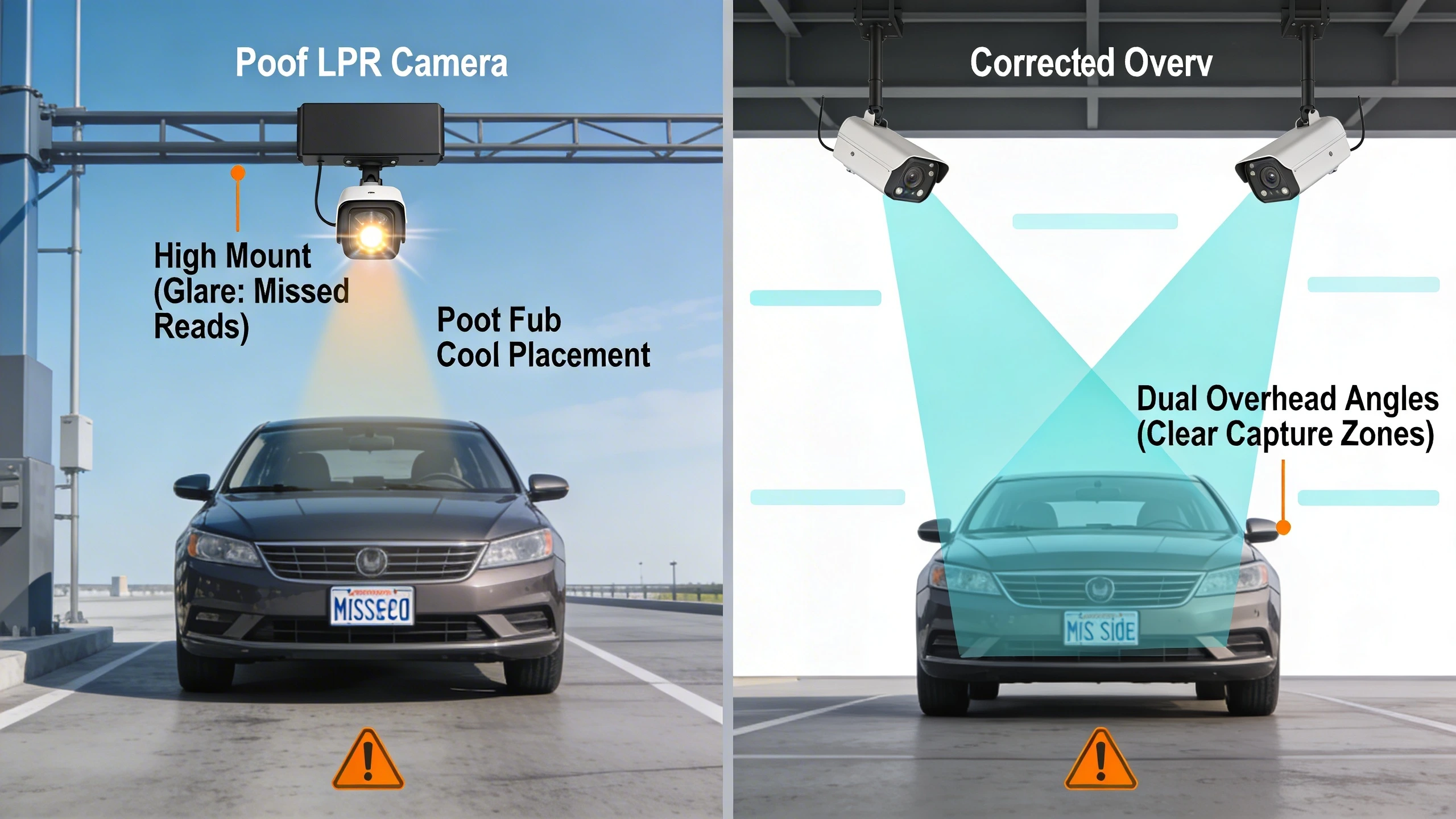
Integration oversights cascade: unhandled API timeouts freeze gates mid-cycle, stranding vehicles. Legacy controllers lacking heartbeat signals drop silent on LPR faults. In one retrofit, mismatched baud rates stalled Modbus polls, resolved by protocol converters. Over-reliance on single cameras invites spoofing; dual-angle verification counters fakes.
- Mount too far back: plates blur at speed.
- No edge analytics: server overloads choke VMS.
- Ignoring skew: tilted installs skew OCR.
What to verify before procurement
Scrutinize camera specs for plate read distances matching lane geometry—query min/max ranges under occlusion. Confirm ONVIF compliance and SDK access for custom rules. Ask for field-tested accuracy in adverse conditions, not lab benchmarks. Budget for mounts, not just heads; universal pole kits adapt to varied poles.
Probe vendor support for integrations: does their plugin play with your VMS? Request demo units for site mockups. Evaluate enclosure options—heated for freeze-prone areas. Lifecycle matters: firmware update paths ensure future-proofing against evolving plate fonts.
Finally, tally TCO: power draw, bandwidth, storage for snapshots. Pilot on one gate before fleet-wide commit.
Where to go next
Explore FortSense 4 for robust LPR handling in video surveillance pipelines. For tailored advice, request a design review. Dive deeper into LPR fundamentals or check critical infrastructure security case studies. See North America deployments for regional insights.