At a mid-sized utility substation, the security team discovers that legacy perimeter alarms from vibration sensors along the chain-link fence and magnetic contacts on access gates operate in isolation, triggering only local sirens and manual notifications. To elevate response times, the operations manager pushes for integration into the site's OT backbone, where SCADA controllers can initiate sequenced shutdowns or isolate segments during intrusions. This retrofit decision hinges on selecting gateways that bridge dry-contact relays or serial outputs from alarms to industrial protocols like Modbus or OPC UA, while preserving the air-gapped integrity of the OT network.
Similar challenges arise in campus environments, such as a manufacturing facility spanning multiple buildings, where perimeter detection must correlate with OT asset monitoring. Direct cabling risks cable runs spanning hundreds of meters across harsh weather exposure, prompting evaluation of wireless edge devices or fiber-optic repeaters. The optimal approach often favors protocol-agnostic aggregators that normalize alarm states into publish-subscribe models, enabling scalable ingestion without rewiring the entire OT ladder logic.
These integrations demand careful topology design to minimize latency under 500ms for time-critical alerts, ensuring alarms propagate without overwhelming OT historians or PLC scan cycles. Early scoping reveals that off-the-shelf IoT brokers can introduce single points of failure, underscoring the need for redundant paths tuned to field realities.
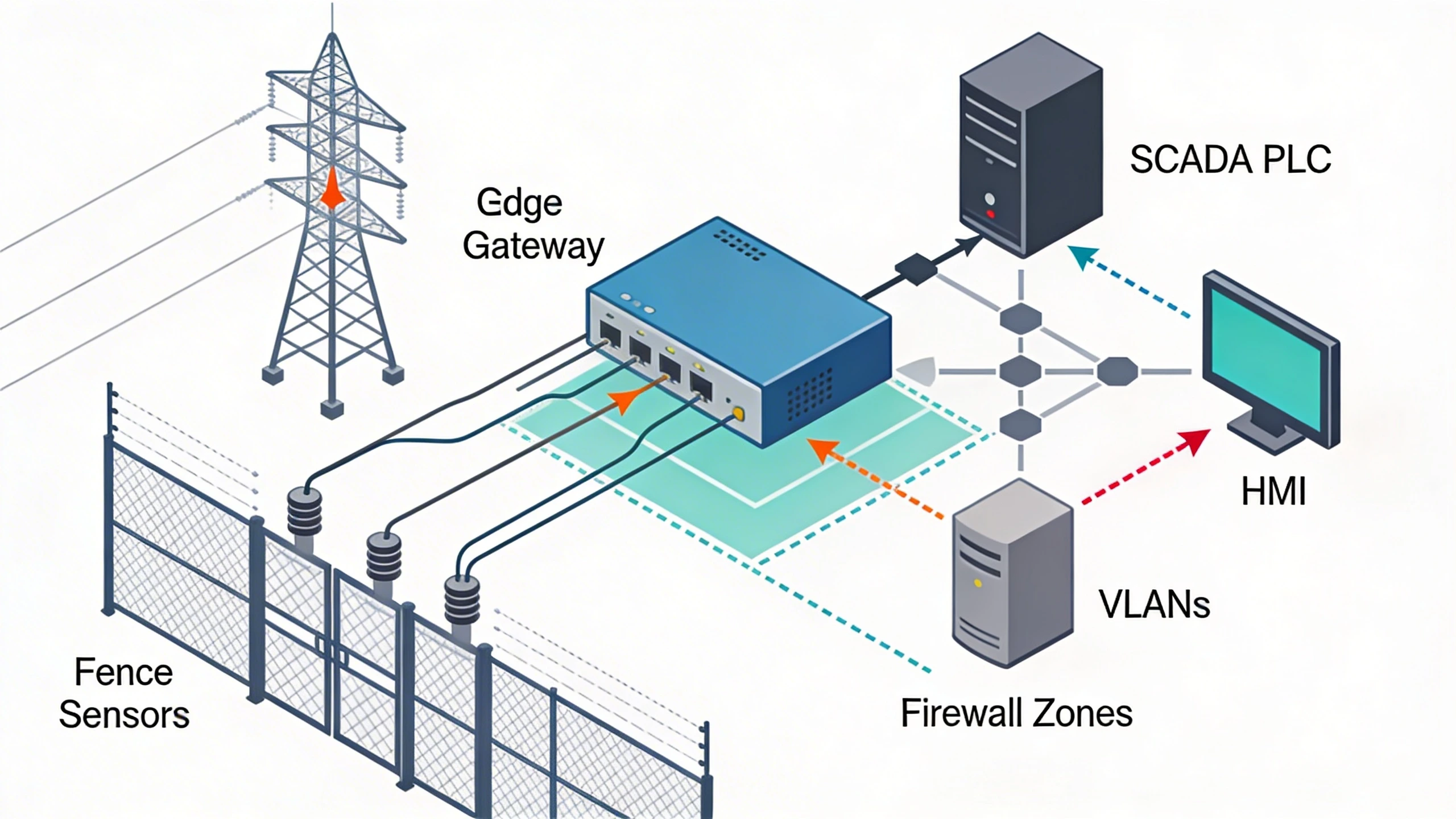
What the design decision looks like in practice
Picture a retrofit at an oil and gas pumping station: perimeter microwave barriers and taut-wire sensors output discrete alarm states via relay closures. The design team opts for a hardened edge gateway at each zone, converting these to Ethernet packets encapsulated in CIP Safety for ingestion by Allen-Bradley PLCs overseeing pump controls. Operators configure logic to map a confirmed perimeter breach to a safe state, like valve closures, tested during commissioning with simulated intrusions.
In a multi-building corporate campus securing OT labs, the integration manifests as virtualized alarm concentrators in a DMZ, polling Wiegand readers and PIR detectors over RS-485. These feed MQTT topics subscribed by a central OT historian, triggering dashboards and automated lockdowns. Field technicians verify end-to-end latency by timestamping events, adjusting poll rates to sidestep OT bus saturation during peak loads.
This hands-on execution contrasts with naive plug-and-play assumptions; real deployments involve mapping alarm priorities to OT severity levels, ensuring a low-level fence rattle doesn't cascade into full-site halts.
System architecture and integration considerations
Core to any perimeter-to-OT linkage is a layered architecture: sensors at layer 1 feed edge processors handling protocol translation, followed by a segmented network zone isolating security traffic from OT control loops. For instance, using EtherNet/IP with VLAN tagging prevents alarm floods from contending with cyclic I/O data. Gateways must support deterministic delivery, often via TSN extensions, to guarantee sub-second propagation in sprawling sites.
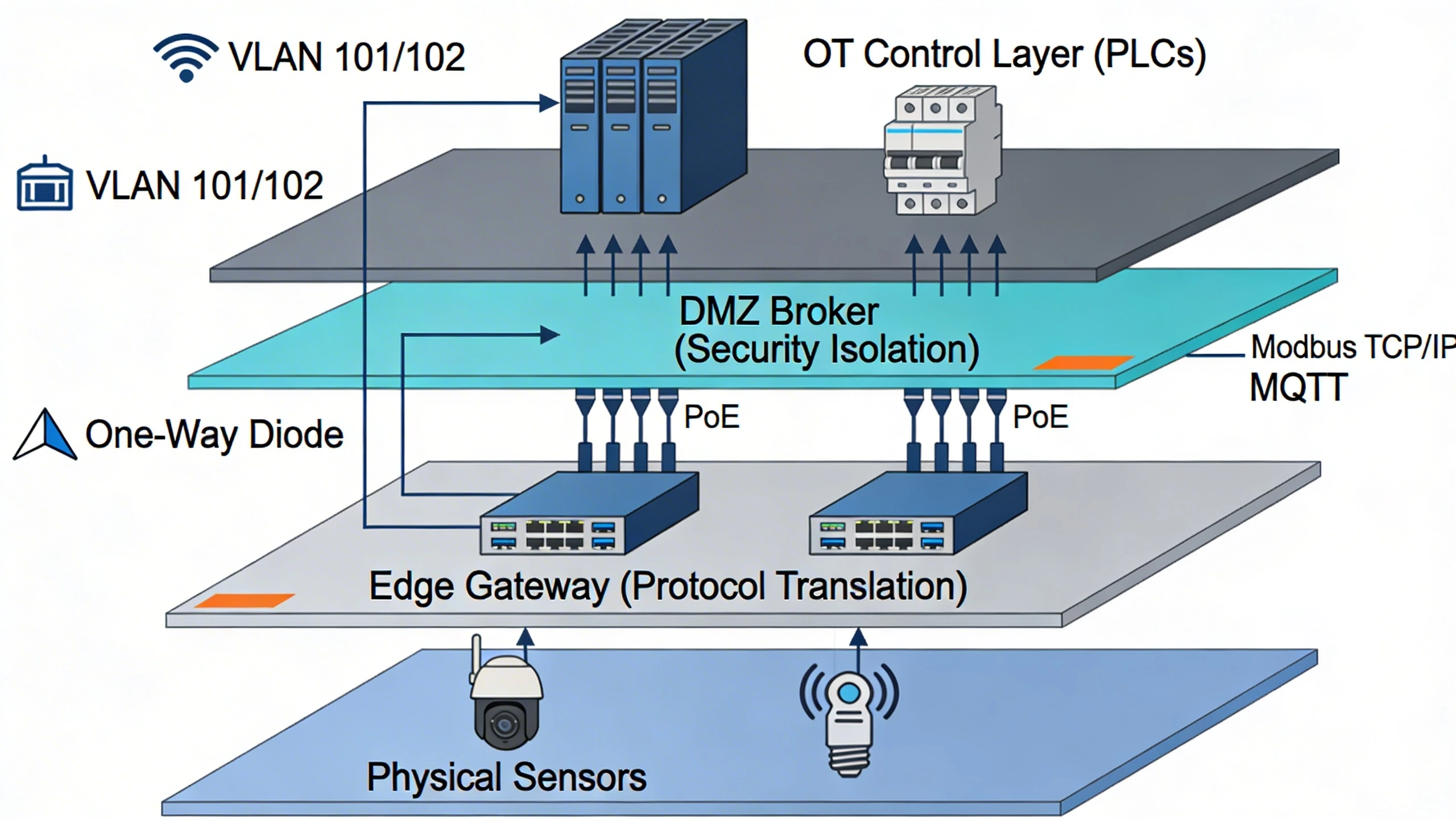
Scalability enters when expanding from 20 to 200 sensors; centralized brokers like those supporting OPC UA PubSub distribute load across redundant nodes, avoiding bottlenecks. Power budgeting looms large—solar-powered perimeter devices demand gateways with PoE++ passthrough, while fiber uplinks mitigate EMI in substations near high-voltage lines. Segmentation via firewalls enforcing one-way diodes ensures OT remains insulated, even if perimeter endpoints compromise.
Operational workflows and field constraints
Daily operations pivot around alarm triage workflows where perimeter events auto-populate OT shift logs, correlating with process anomalies like pressure spikes potentially tied to sabotage. Operators drill down via HMI screens showing geo-tagged breach points overlaid on site maps, dispatching response teams only after OT confirmation of no concurrent faults. Maintenance windows synchronize firmware updates across the chain, minimizing downtime through staged rollouts.
Field constraints shape workflows profoundly: in remote utility yards, cellular backhaul for edge gateways enables over-the-air diagnostics, but mandates dual-SIM failover against carrier outages. Harsh environments demand NEMA 4X enclosures for junctions, with conduit runs accounting for thermal expansion. Training emphasizes false-positive tuning, where environmental triggers like wind on fences get filtered via dual-sensor confirmation before OT escalation.
Common failure points and design mistakes
A frequent misstep occurs when teams undersize network bandwidth, leading to OT packet loss during sustained alarm barrages from coordinated probes. Without QoS prioritization, control traffic yields to security bursts, manifesting as erratic PLC behavior. Another pitfall: ignoring galvanic isolation, where ground loops from perimeter wiring induce noise into OT analog inputs, falsing process readings.
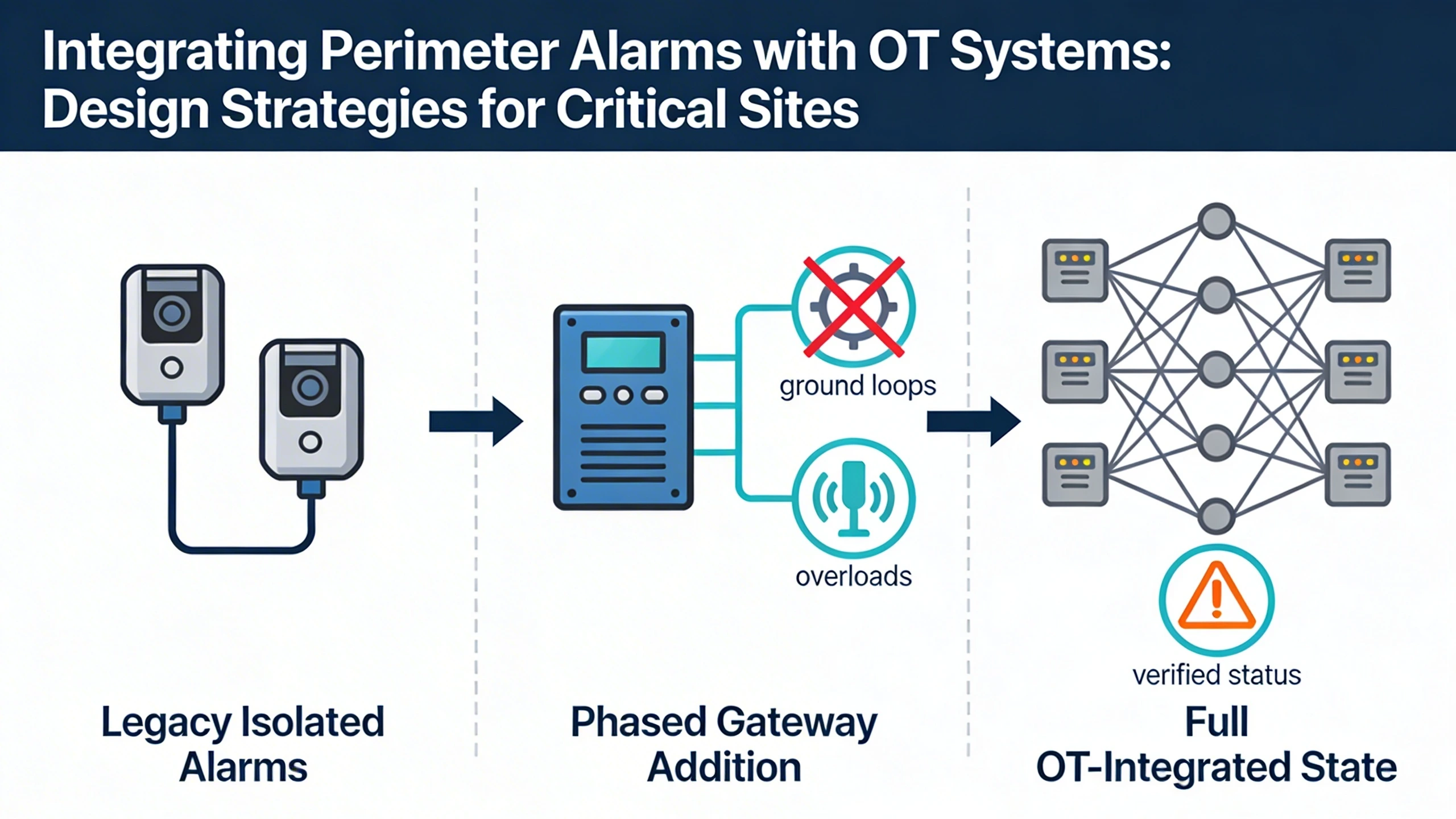
Over-reliance on cloud proxies introduces latency spikes unacceptable for OT, especially sans NTP synchronization exposing timestamp drifts in event reconstruction. Design flaws like single-threaded gateways collapse under sensor proliferation, while skipped redundancy testing leaves systems vulnerable to power blips. Post-mortems often trace root causes to unmodeled cable attenuation over kilometer runs, underscoring iterative modeling with tools like ETAP.
What to verify before procurement
Before committing, audit gateway interoperability via lab benches simulating full sensor payloads against target OT PLCs, confirming no dropped events under load. Scrutinize MTBF ratings for field-replaceable units, prioritizing those with hot-swap modules suited to 24/7 ops. Network stack robustness demands proof of handling malformed packets without OT disruption.
Procurement checklists should probe vendor support for ONVIF-like profiles if video ties in, alongside cybersecurity certifications like IEC 62443. Field trials validate environmental specs—IP67 for submersion, -40C operation—and integration APIs for custom ladder rungs. Budget for lifecycle costs, including remote attestation for endpoint integrity.
Where to go next
Explore FortSense 4 for hardened integration platforms tailored to these scenarios. For site-specific advice, request a design review. Dive deeper into critical infrastructure security practices or review North America deployments for peer insights.
Image Production Brief (Internal - Remove Before Publish)
Recommended image count: 3
- Placement: After the introduction
Insert After: Introduction
Purpose: Visually anchor the retrofit scenario with a high-level topology, helping readers grasp the integration flow early.
Prompt: Clean line diagram of a utility substation perimeter: fence sensors and gate contacts wired to edge gateway, uplinked via segmented network to SCADA PLC and HMI, showing VLANs and firewall zones. Use industrial icons, arrows for data flow, neutral colors.
Alt Text: Topology diagram of perimeter alarms integrating into OT SCADA system - Placement: After System architecture and integration considerations
Insert After: System architecture and integration considerations
Purpose: Illustrate layered architecture details, clarifying segmentation and protocol flow for technical readers.
Prompt: Layered architecture schematic: physical sensors at bottom, edge gateway translation layer, DMZ broker, OT control layer with PLCs. Include fiber uplinks, PoE, VLAN tags, and one-way diode icons. Professional blueprint style.
Alt Text: Layered system architecture for perimeter-to-OT integration - Placement: After Common failure points and design mistakes
Insert After: Common failure points and design mistakes
Purpose: Depict a migration diagram highlighting pitfalls like cable runs and redundancy, aiding avoidance in planning.
Prompt: Migration diagram sequence: legacy isolated alarms (left), phased gateway addition with redundant paths (middle), full OT-integrated state (right). Show before/after with failure icons like ground loops and overloads crossed out. Step-by-step arrows.
Alt Text: Migration diagram from legacy to integrated perimeter-OT system with common pitfalls