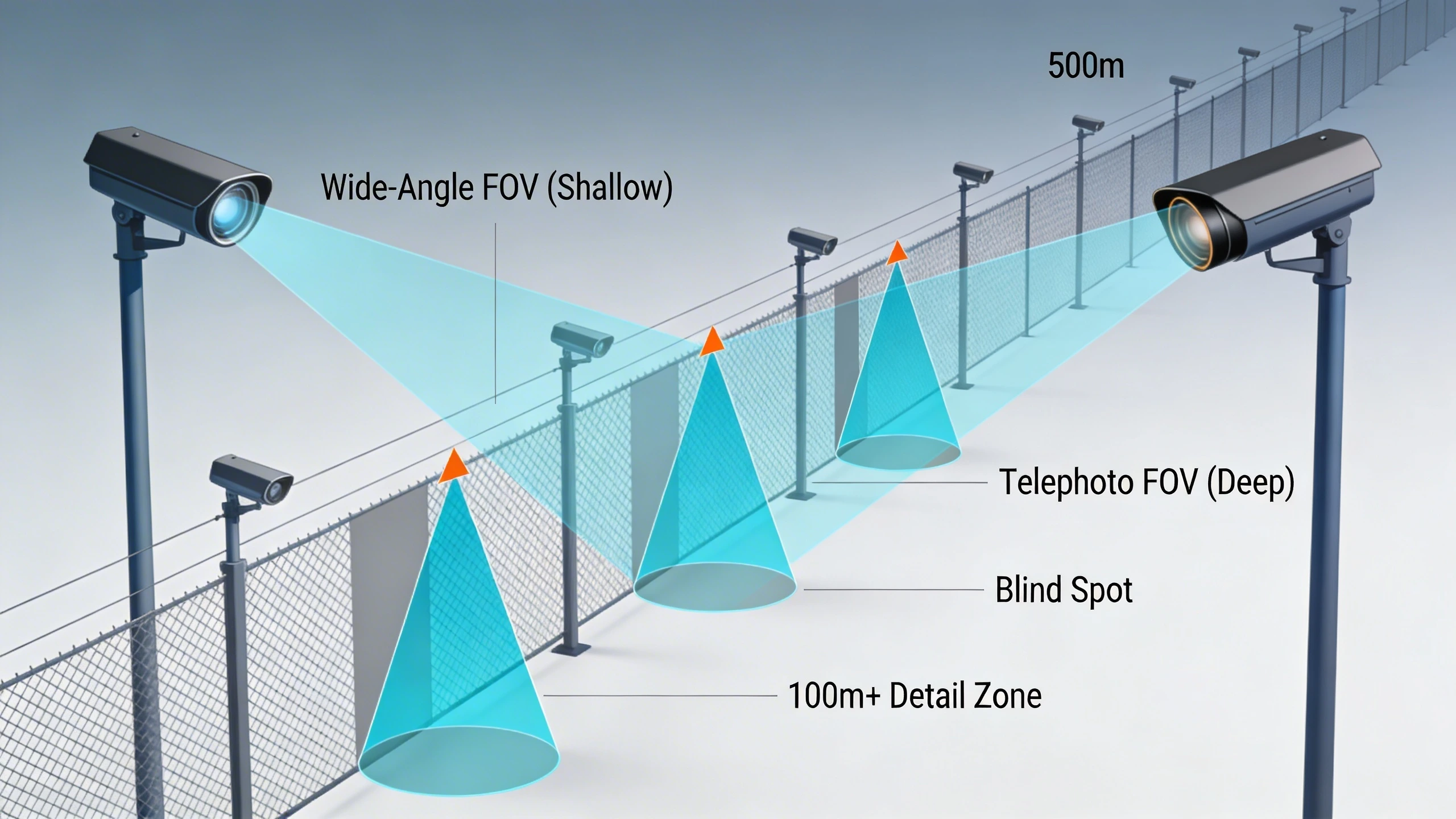
When retrofitting video surveillance along extended perimeter fences—such as those encircling substations, warehouses, or airport boundaries—lens selection emerges as a pivotal engineering decision. Legacy wide-angle setups often deliver broad overviews but falter on identifying details like climber silhouettes or vehicle plates at 100 meters or more. Teams must weigh fixed focal length lenses against varifocal options, prioritizing pixels-on-target for positive identification while minimizing blind spots and camera count.
In a typical upgrade at a critical infrastructure site, engineers map fence segments against camera elevations, typically 4-6 meters on poles, and environmental factors like foliage or glare. Varifocal lenses, adjustable from 2.8-12mm, offer on-site tuning to overlap fields of view (FOV) seamlessly across 200-300 meter runs, reducing the need for excessive PTZ units that drive up maintenance. This approach delivers reliable detection zones without overcommitting to ultra-telephoto glass that narrows coverage excessively.
Success hinges on aligning lens specs with analytics requirements, ensuring sufficient resolution for features like WDR handling of dawn-to-dusk contrasts along chain-link barriers. The upfront modeling pays dividends in fewer false alarms and streamlined VMS integration.
What the design decision looks like in practice
Picture a 1.5 km fence line around a data center campus where existing 2.8mm fisheye lenses provide perimeter awareness but zero actionable forensics beyond 50 meters. The retrofit team conducts a site survey, plotting pole positions every 50 meters and calculating required horizontal FOV based on fence height and intrusion paths. A 6-8mm varifocal lens per camera strikes the balance, yielding a 30-40 degree FOV that captures face or license plate details at the far edge while maintaining overlap with neighbors.
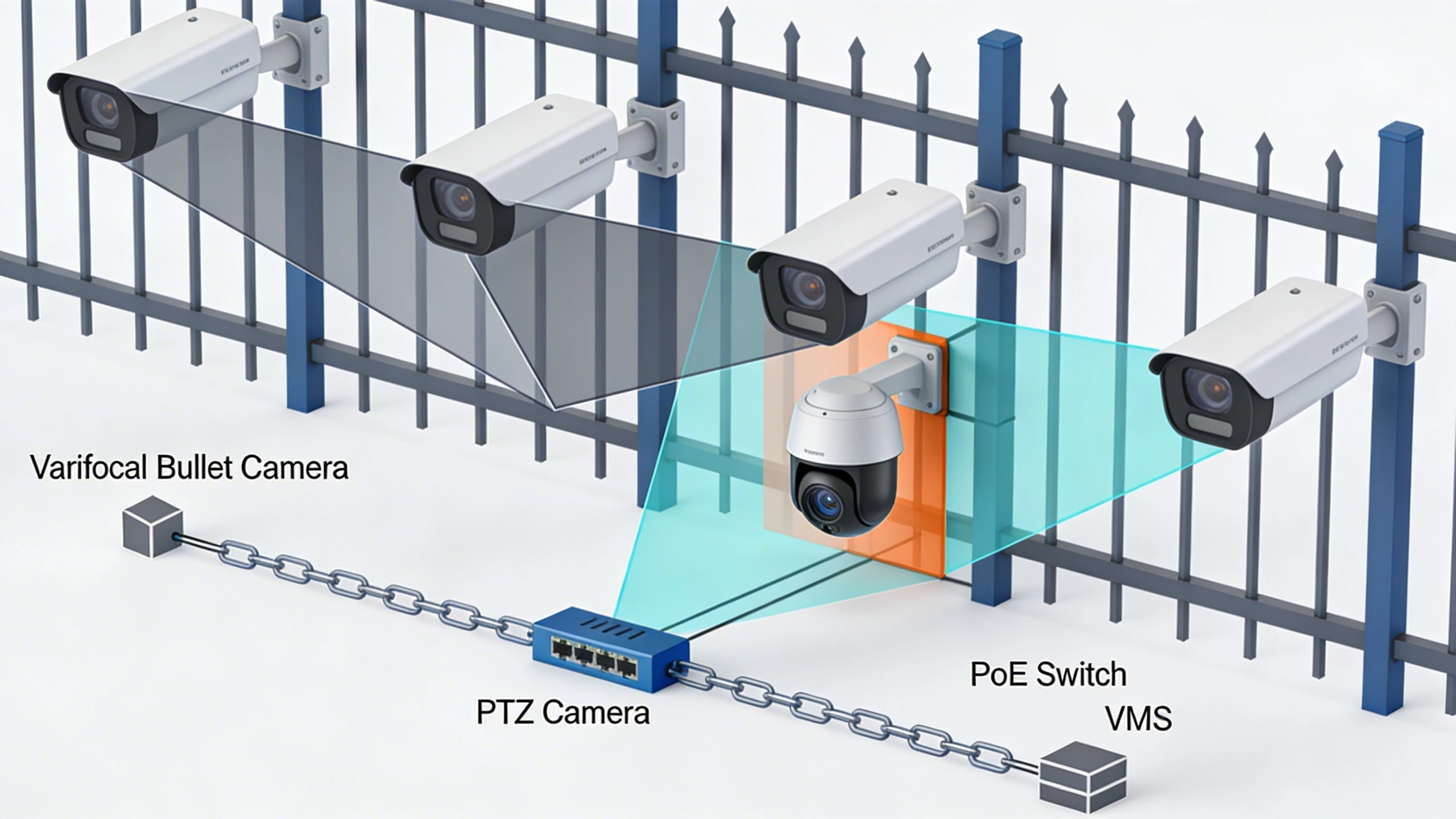
This decision manifests in the field as technicians mounting cameras with lens rings pre-set to mid-range, then fine-tuning via focus aids during commissioning. For segments with gates or access roads, pairing these with a single PTZ at junctions extends coverage dynamically. The result is a layered strategy: fixed lenses for persistent monitoring, PTZ for verification, all feeding into unified analytics that trigger on motion vectors parallel to the fence.
Comparisons arise during bidding when integrators evaluate fixed 4mm versus varifocal kits. Fixed options lock in predictability for uniform terrain but demand precise pre-install calcs; varifocals forgive minor pole misalignments, proving superior in phased rollouts where budget constraints limit full replacement.
System architecture and integration considerations
Integrating lenses into a broader architecture starts with encoder compatibility and bandwidth planning. Narrower FOV from longer focal lengths concentrates pixels on the target zone, easing MJPEG or H.265 streams for edge devices on FortSense 4 platforms. However, mismatched lenses across a fence run can fragment analytics performance, as rule engines expect consistent ground sampling distance (GSD).
Topology-wise, daisy-chain PoE switches along the fence backbone support dome or bullet cameras with interchangeable C/CS-mount lenses. Varifocals integrate via standard iris controls, but architects must spec weather-sealed housings to prevent fogging in humid perimeters. In multi-site deployments, central VMS dashboards visualize FOV polygons, aiding imbalance detection during health checks.
Tradeoffs intensify with IR illuminators: telephoto lenses demand longer-range LEDs to match their reach, potentially doubling power draw per pole. Balancing this requires hybrid architectures blending visible and thermal lenses for 24/7 efficacy without grid overloads.
Operational workflows and field constraints
Day-to-day operations pivot on lens stability post-install. Technicians revisit sites quarterly to re-focus varifocals loosened by vibration from nearby traffic or wind, a ritual that fixed lenses sidestep. Operators leverage VMS tools to overlay digital masks on FOV edges, suppressing fence sway alarms while prioritizing ground-level activity.
Field constraints like pole sway or seasonal vegetation growth dictate conservative FOV choices—opting for 10% overlap buffers. In North America deployments, winter ice buildup on housings shifts effective focal points, underscoring the need for auto-iris lenses that adapt to snow-glare without manual intervention.
Workflows extend to incident review: narrower lenses excel at exporting cropped stills for law enforcement handoff, but wide setups better contextualize events. Training guards on these nuances ensures they request PTZ slews judiciously, preserving fixed lens streams for archival integrity.
Common failure points and design mistakes
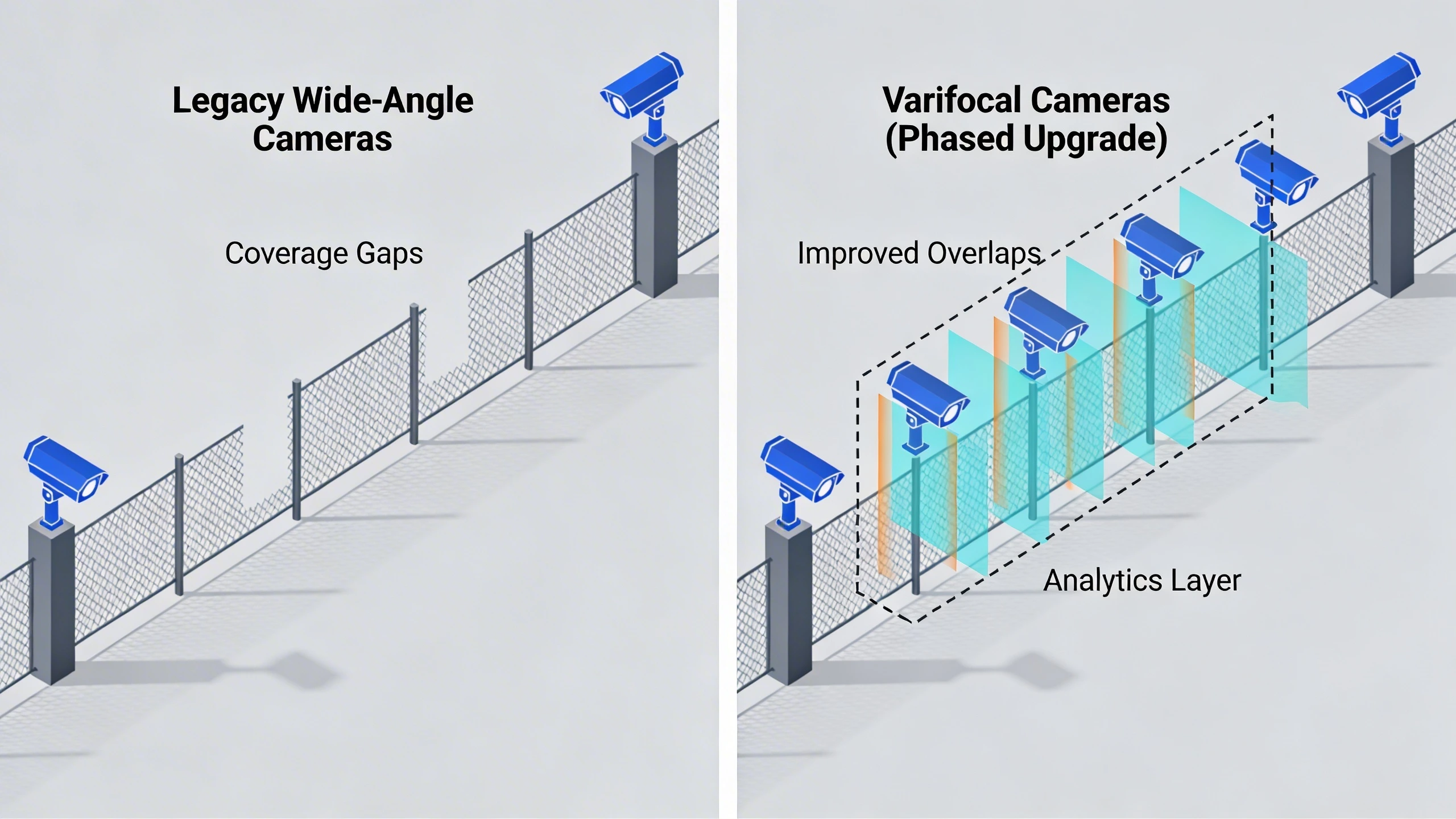
A frequent misstep occurs when teams default to wide-angle lenses for cost savings, only to discover inadequate GSD at distance leads to nuisance alerts from distant foliage. This cascades into operator fatigue and eroded trust in the system, prompting expensive overhauls.
Another pitfall: ignoring mount height variances. Low poles with telephoto lenses create ground shadows, blind to under-fence digging; high mounts with wide glass waste resolution on sky. Vibration from unsecured lens barrels further degrades focus, mimicking motion in analytics.
- Underestimating IR-lens pairing, resulting in dark zones beyond 50m.
- Skipping FOV overlap calcs, leaving 10-20m gaps exploitable by intruders.
- Procuring non-varifocal for irregular terrain, forcing camera additions mid-project.
What to verify before procurement
Before ordering, validate lens specs against camera sensor size—1/2.8-inch sensors pair best with 4-12mm for balanced distortion. Request MTF charts from manufacturers to confirm edge sharpness, crucial for fence-top detection.
Cross-check environmental ratings: IP67 minimum, with anti-condensation breathers for fog-prone areas. Simulate coverage in planning software using site LiDAR data, iterating focal lengths until analytics thresholds meet pixel-per-meter targets.
- Confirm C-mount compatibility and back-focus distance.
- Test sample lenses on demo cameras for real-world GSD.
- Review warranty on auto-iris mechanisms, prone to failure in dust.
Where to go next
Explore FortSense 4 for scalable perimeter solutions tailored to critical infrastructure security. For site-specific advice, request a design review to optimize your fence line deployment.