When upgrading perimeter security at a remote utility substation, the transition from daylight to darkness reveals the true limitations of many camera systems. Existing installations often rely on basic IR illumination paired with auto-exposure modes that either wash out details under artificial lights or drown footage in noise during moonless nights. For security managers overseeing critical infrastructure, the decision to invest in low-light tuning centers on balancing sensitivity with usable image quality—ensuring analytics can detect fence climbs or vehicle approaches without triggering on shadows or sensor artifacts.
This becomes especially pressing in retrofit scenarios, such as expanding a multi-building campus where legacy analog cameras are swapped for IP models with larger sensors. Teams quickly discover that out-of-box settings prioritize broad compatibility over perimeter-specific needs, like maintaining frame rates above 15 fps for motion tracking across 100-meter fields of view. Effective tuning starts with firmware-level adjustments to exposure controls, starting with conservative limits on gain and shutter speed to preserve detail in high-contrast scenes common around gates and access roads.
Integrators familiar with FortSense 4 deployments know that the real value emerges in field-tested configurations, where low-light performance directly impacts operational response times. Rather than chasing absolute lux ratings, the focus shifts to holistic optimization: pairing camera tweaks with illuminator placement and compression choices that sustain bandwidth during extended night shifts.
What the design decision looks like in practice
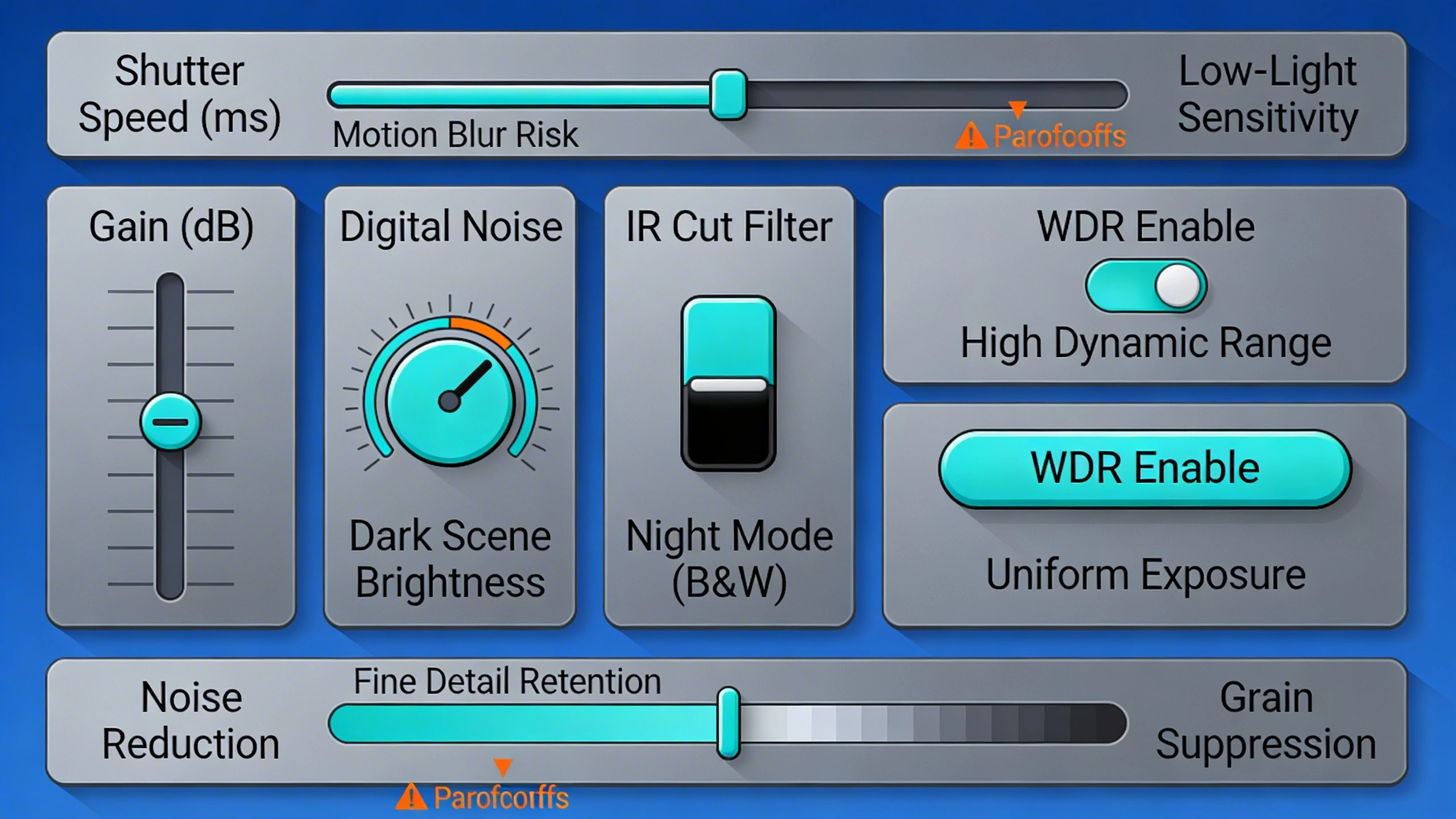
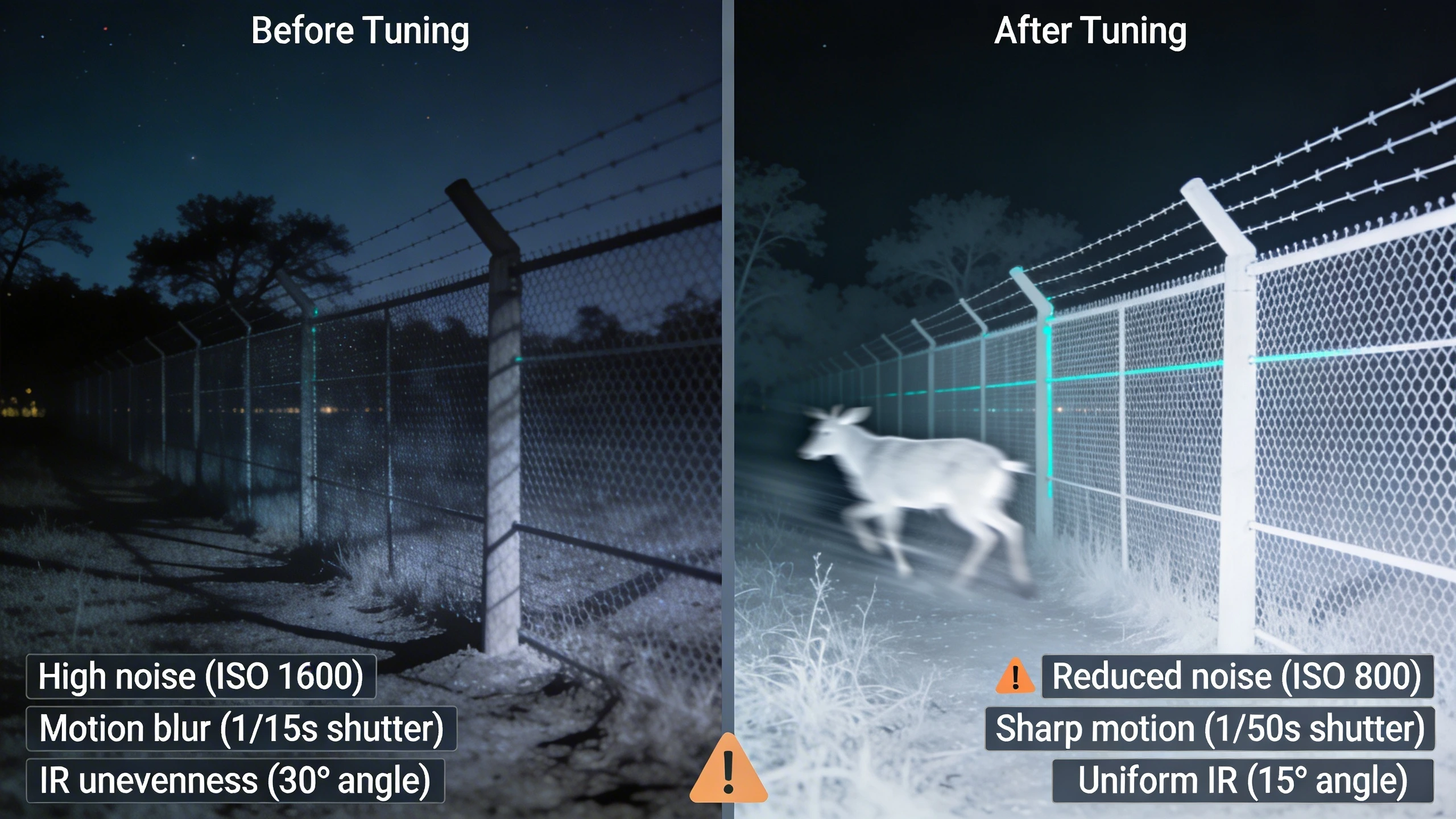
In a typical retrofit at an industrial campus, low-light tuning begins during commissioning with a nighttime site walk-through. Technicians access each camera's web interface or connect via the video management system (VMS) to baseline auto-exposure against real-world conditions—streetlights casting long shadows, fog rolling in from nearby water, or vehicle headlights flaring directly into lenses. The core adjustment involves setting manual overrides for shutter speed and gain: slower shutters capture more light but risk motion blur from wind-swayed foliage, while elevated gain amplifies weak signals at the cost of grainy noise that confuses edge-detection algorithms.
Practical workflows emphasize iterative testing. Start by enabling day/night switching based on lux thresholds around 10-20, then layer in WDR for backlit gates where perimeter lighting meets ambient dark. Smart IR modes adjust illuminator power dynamically to avoid hotspots, a critical step for uniform coverage along chain-link fences. For a 30-camera perimeter, teams document before-and-after clips, verifying that tuned settings maintain object classification accuracy in analytics overlays—such as distinguishing a person from a raccoon at 50 meters.
Seasonal variations demand ongoing refinement. In winter deployments with snow reflection, dial back gain to prevent overexposure; summer humidity might require noise reduction filters that soften but stabilize footage for long-term storage. This hands-on approach ensures the system performs consistently across shifts, turning a standard upgrade into a robust deterrent.
System architecture and integration considerations
Perimeter low-light tuning extends beyond individual cameras into the broader network fabric. Cameras positioned on 10-meter poles feed into PoE switches hardened for outdoor exposure, aggregating streams to an edge NVR before central VMS ingestion. Here, compression plays a pivotal role: H.264 or H.265 at variable bitrates accommodates the data spikes from noise-heavy low-light frames, but mismatched profiles can bottleneck 4K feeds from multiple units. Integrators must map illuminator zones to camera fields, often wiring auxiliary IR arrays in daisy-chain topologies to cover blind spots without piercing vegetation.
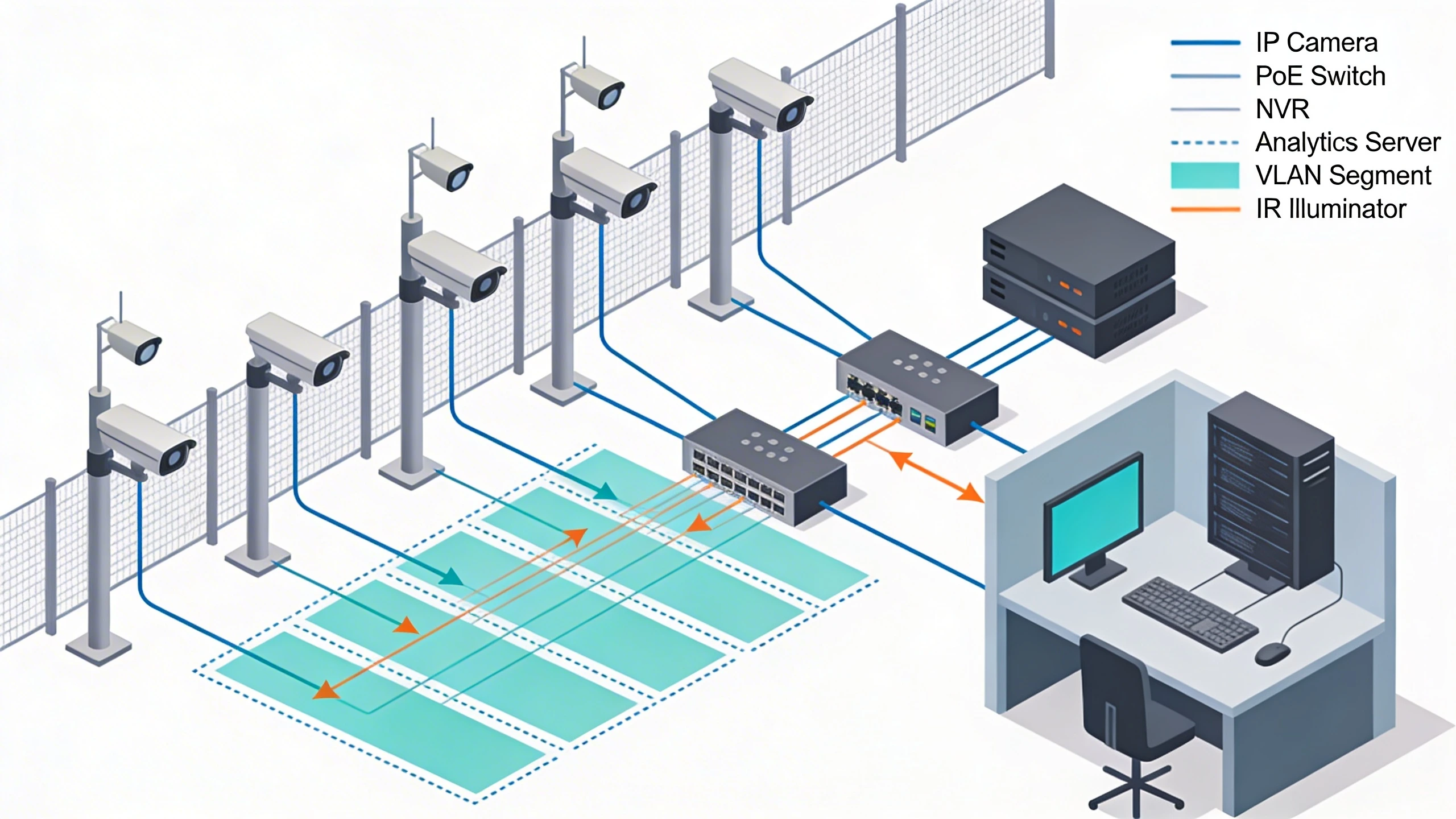
Integration with analytics servers introduces further layers. Low-light noise amplifies false positives in AI models trained on clean datasets, so tuning prioritizes frame stability over peak brightness—capping gain below levels that introduce color casts. For hybrid setups blending third-party cameras with proprietary VMS like FortSense, ensure API compatibility for bulk parameter pushes, avoiding per-camera logins during maintenance windows. Bandwidth planning is non-negotiable: a tuned 1080p stream at 6 Mbps per camera scales predictably across gigabit backhaul, sustaining real-time alerting to control rooms.
Power budgeting ties it together. PoE++ compliance supports IR-equipped cameras drawing up to 60W, but oversubscribed switches lead to voltage drops that desync exposure controls. In architecting for resilience, segment perimeter networks with VLANs to isolate video traffic, ensuring low-light streams reach forensic storage without interruption.
Operational workflows and field constraints
Day-to-day operations hinge on workflows that embed tuning into routine patrols. Security operators review nightly logs via VMS dashboards, flagging cameras where auto modes revert due to firmware glitches or environmental shifts—like leaf cover blocking IR paths. Field technicians carry tablets with remote access credentials, performing spot tunes during low-traffic hours, but ladder work at height adds risk, especially in wind-prone utility yards. Documentation via annotated screenshots standardizes handoffs between shifts, capturing lux meter readings alongside parameter sets.
Constraints amplify in remote or harsh sites. At offshore platforms, satellite latency hampers real-time tweaks, pushing reliance on edge processing with preset profiles switched via schedules. Training emphasizes qualitative assessments: does the tuned image resolve license plates at entry points, or does glare from dew obscure tripwire zones? Maintenance cycles align with bulb replacements on illuminators, where mismatched spectra (850nm vs. 940nm) alter color rendition in tuned modes.
For scaled operations, automate where possible—VMS scripts that poll environmental sensors to adjust gain preemptively. This reduces truck rolls, but requires validating changes against compliance footage retention, ensuring low-light clips remain evidentiary without compression artifacts.
Common failure points and design mistakes
One prevalent error stems from over-reliance on factory defaults, where aggressive auto-gain floods streams with noise, crippling analytics accuracy during false alarm peaks around dusk. Integrators deploying without site-specific lux mapping leave inner perimeters over-illuminated while outer zones fade to black, creating coverage gaps exploited in audits. Ignoring WDR in high-contrast setups leads to haloing around lights, masking intruders in silhouette.
Another pitfall hits during multi-vendor integrations: incompatible noise reduction algorithms between cameras and VMS decoders introduce banding in low-light playback. Bandwidth miscalculations compound this—untuned high-gain modes bloat bitrates, overwhelming NVR storage and delaying alerts. Field oversights, like mounting cameras behind reflective surfaces, scatter IR and defeat tuning efforts entirely.
Migration missteps include phased rollouts without baseline comparisons, where operators blame new hardware for persistent blur until legacy cabling is traced as the culprit. Firmware mismatches across camera batches lock out uniform tuning, fragmenting management. Addressing these demands pre-cutover simulations using temporary mounts to dial in parameters under load.
What to verify before procurement
Before committing to cameras, scrutinize firmware documentation for granular exposure controls—manual shutter/gain sliders, not just sliders with hidden heuristics. Request demo units for on-site night tests, confirming stable frame rates in your illuminance profile. Check PoE draw specs against switch capacities, and validate VMS plugin support for bulk tuning to sidestep scalability issues.
Probe sensor architecture: back-illuminated CMOS with micron-level pixels excel in low light, but pair this with IR sensitivity curves matching your illuminators. Ensure WDR implementation handles dynamic range beyond 120dB claims, via sample footage under mixed lighting. Network features like multicast for low-light multicasting reduce cabling needs in expansive perimeters.
Long-term viability matters: query update cadences for denoising algorithms and analytics compatibility. Certifications for temperature extremes and IP67 sealing prevent field failures that undo tuning gains. Finally, confirm remote access security—tuning endpoints must resist unauthorized tweaks in exposed deployments.
Where to go next
Explore FortSense 4 for advanced low-light analytics integration, or dive into critical infrastructure security case studies. For tailored advice on North America sites, see our North America deployments.
Request a design review to benchmark your perimeter setup.