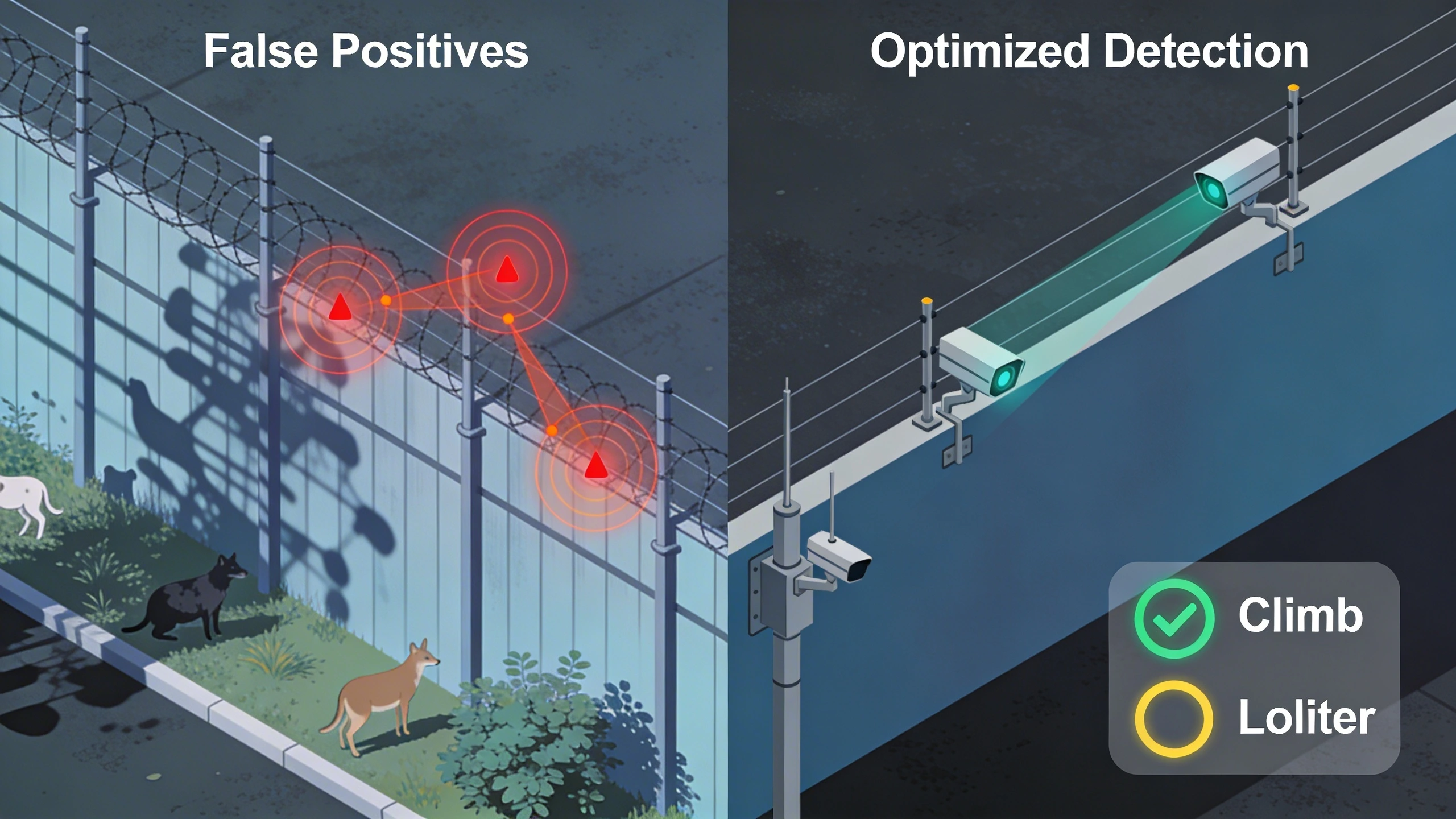
When retrofitting perimeter security at a remote utility substation, security managers frequently encounter a common pain point: video analytics systems overwhelmed by false positives. Wind-swayed foliage, small animals crossing under fences, or even shifting shadows from passing clouds can trigger dozens of alerts daily, eroding operator trust and diverting attention from genuine threats. The migration path forward involves not just swapping cameras but rethinking the entire detection chain—from precise hardware positioning to calibrated software rules.
In practice, the most effective reductions come from layered defenses: optimizing field of view to exclude non-threat zones, deploying consistent low-light performance across the array, and fine-tuning AI classifiers to distinguish human forms from environmental clutter. Teams upgrading from legacy motion detection to modern analytics at sites like data centers or power plants report sustained reliability after addressing these elements, allowing operators to focus on verified intrusions rather than chasing ghosts.
This approach mirrors deployments in high-stakes environments where downtime for false alarms isn't tolerable. By prioritizing site-specific calibration over out-of-box defaults, integrators can deliver systems that scale across multi-fence perimeters without proportional increases in alert volume.
What the design decision looks like in practice
Picture a 2km fence line around an industrial campus where initial video analytics installations relied on basic pixel-change detection. Nightly alerts spiked from infrared glow on vegetation or distant vehicle headlights, prompting operators to mute zones and effectively blind the system. The retrofit decision centered on repositioning cameras to 10-15 degree downward angles, ensuring the analytic zone hugs the fence base while ignoring overhead sway—a change that immediately cut environmental triggers by focusing detection on ground-level activity.
Further refinement involved segmenting the perimeter into analytics rulesets: urban-adjacent sections tuned for loitering detection with higher sensitivity to partial occlusions, while rural stretches emphasized climb-over classification with stricter height thresholds. Field teams documented these via annotated test footage, creating a baseline for ongoing tweaks. This granular zoning, combined with daily verification walks, transformed the system from alarm generator to reliable sentinel, with operators regaining confidence in escalated events.
Across similar retrofits, the decision manifests as a phased rollout: pilot one 200m segment, measure alert quality over two weeks, then replicate. This empirical method avoids overhauls that disrupt operations, ensuring each adjustment builds on validated gains.
System architecture and integration considerations
Fence-line analytics thrive in distributed edge architectures where cameras process initial classification locally, forwarding only high-confidence events to a central VMS. This reduces bandwidth strain on long perimeters, especially when integrating with existing PoE switches that may lack sufficient power budgeting for IR illuminators. Integrators must map camera spacing to overlap fields by 20-30% at minimum, accounting for lens distortion at edges to prevent blind spots in analytic coverage.
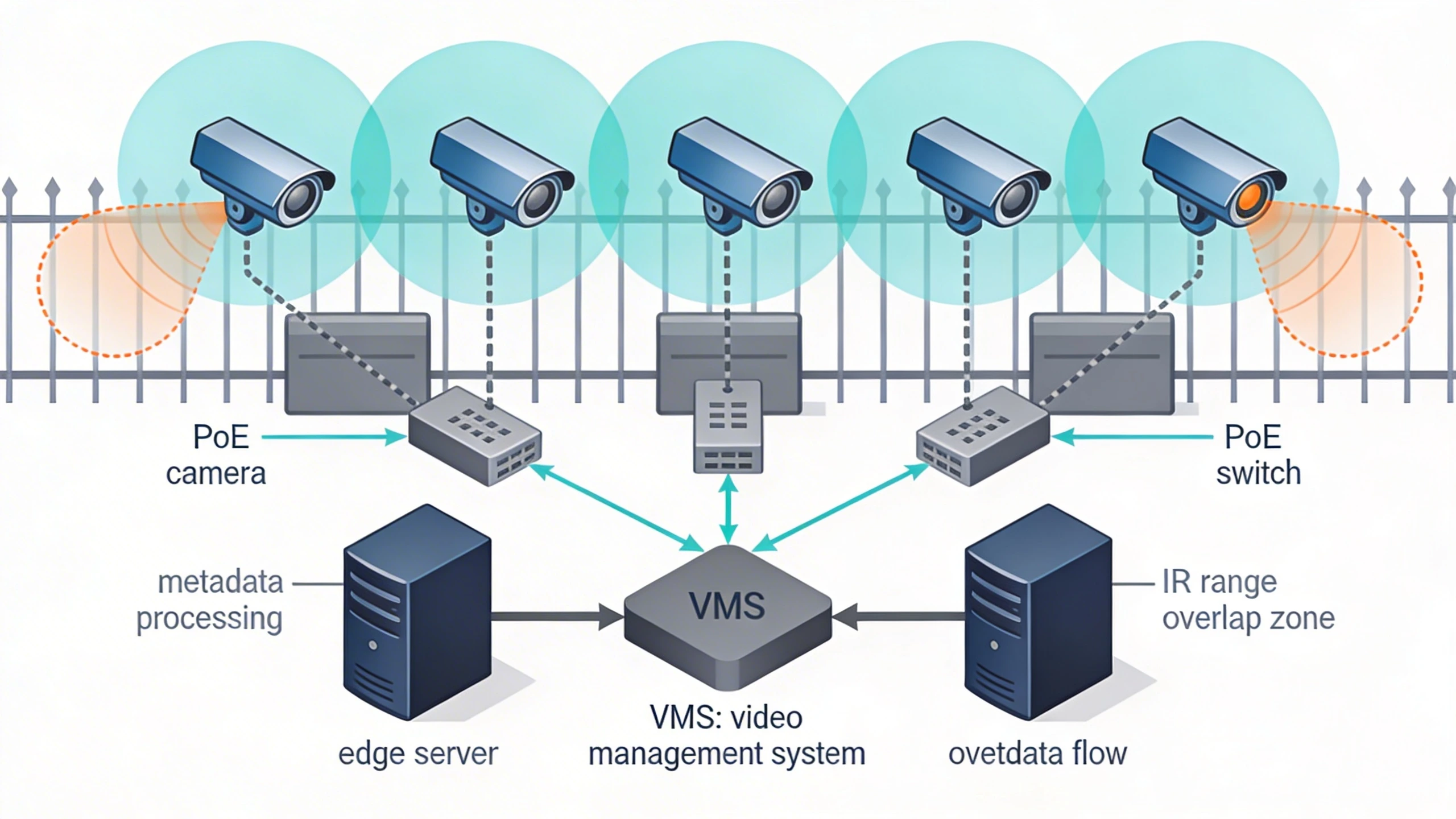
Integration hinges on API compatibility for rule synchronization—ensuring the analytics engine pulls metadata like timestamp and GPS from the camera stream without introducing latency. In hybrid setups with legacy analog feeds converted via encoders, prioritize MJPEG streams for their frame-accurate metadata over compressed formats that can smear motion boundaries. Edge servers running containerized models allow quick firmware updates without site visits, a boon for remote critical infrastructure.
- Validate PoE budgets early to support simultaneous IR and analytics compute.
- Use ONVIF profiles for seamless VMS handoff, testing event forwarding under load.
Operational workflows and field constraints
Daily operations demand workflows that balance automation with human oversight, starting with operator dashboards that cluster similar alerts for bulk dismissal—reducing fatigue from isolated false positives. Training emphasizes reviewing raw footage alongside analytic metadata, teaching staff to spot patterns like recurring shadow triggers from adjacent structures. Maintenance schedules incorporate lens cleaning quarterly, as dust accumulation mimics motion in low-contrast scenes.
Field constraints like extreme weather or vegetation growth necessitate adaptive rules: auto-adjusting sensitivity during high-wind forecasts or scheduling virtual masking updates post-trim. At utility sites, where fences border public roads, workflows include geofencing to suppress alerts from authorized vehicle paths. This proactive tuning keeps false positive rates manageable without constant manual intervention.
Shift handovers benefit from audit logs that highlight tuned zones, ensuring continuity. Over time, these practices foster a feedback loop where operators contribute clip libraries for model retraining, embedding operational wisdom into the system.
Common failure points and design mistakes
One prevalent pitfall is overlooking WDR performance in cameras, where uneven backlighting from fence posts creates persistent hot spots that the analytics misreads as figures. Installers often default to wide-angle lenses for coverage, but this dilutes resolution at the critical fence base, amplifying false climbs from birds or debris. Another oversight: ignoring network jitter in edge processing, where delayed frames cause 'ghosting' events that evade temporal filters.
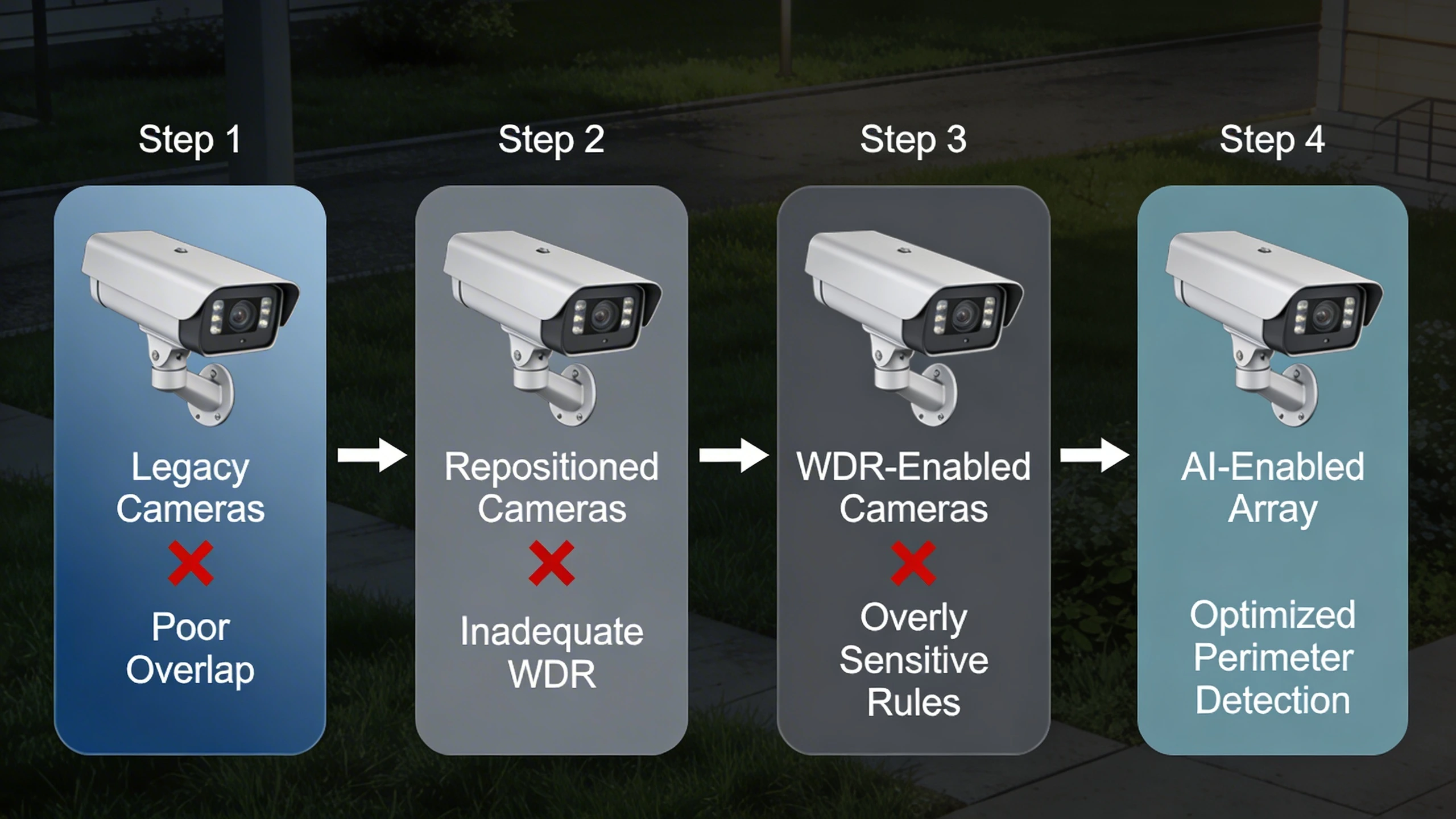
Mistakes compound in multi-vendor integrations, such as mismatched timestamp formats leading to uncoordinated rules across cameras. Over-reliance on default AI models without site-specific training results in poor generalization—urban classifiers falter on rural foliage, for instance. Budget shortfalls on IR uniformity leave dark patches prone to shadow alarms.
- Conduct pre-install lux mapping to expose lighting gaps.
- Avoid generic motion zones; define threat vectors explicitly.
What to verify before procurement
Before committing, request vendor demos using your site's test footage, not polished marketing clips—scrutinize classification accuracy under simulated wind or rain. Probe firmware update cadences and support for custom rule scripting, as off-the-shelf analytics rarely fit irregular fence geometries without tweaks. Confirm edge compute specs can handle concurrent streams without dropping to lower resolutions that blur detections.
Check integration matrices for your VMS version, focusing on metadata fidelity and alert deduplication. Field-test units for thermal stability, as overheating PTZ bases introduce vibration artifacts. Prioritize cameras with verifiable low-light SNR figures, ensuring claims hold across the full FOV.
- Insist on NDAA-compliant sourcing for critical infrastructure.
- Validate multi-camera synchronization in chained topologies.
Where to go next
Explore FortSense 4 for analytics-ready platforms tailored to perimeter challenges. For tailored advice, request a design review. See real-world applications in critical infrastructure security and North America deployments.