When upgrading video surveillance at a utility substation or multi-building campus, the choice between PTZ and fixed cameras directly impacts how quickly operators can verify sensor alarms—from tripped perimeter fences to unauthorized door access. In these high-assurance environments, dispatchers rely on clear, immediate video to distinguish false positives like wind-blown debris from real intrusions, often under tight response windows dictated by operational protocols.
Teams retrofitting legacy systems frequently discover that fixed cameras provide the edge in verification workflows. Their static fields of view align precisely with alarm zones, delivering footage in under two seconds without the mechanical delays inherent in PTZ slewing. PTZ units, while versatile for operator-directed sweeps, introduce latency and human dependency that can bottleneck verification during peak alarm volumes. This shift becomes evident in brownfield upgrades, where existing sensor placements dictate camera positioning.
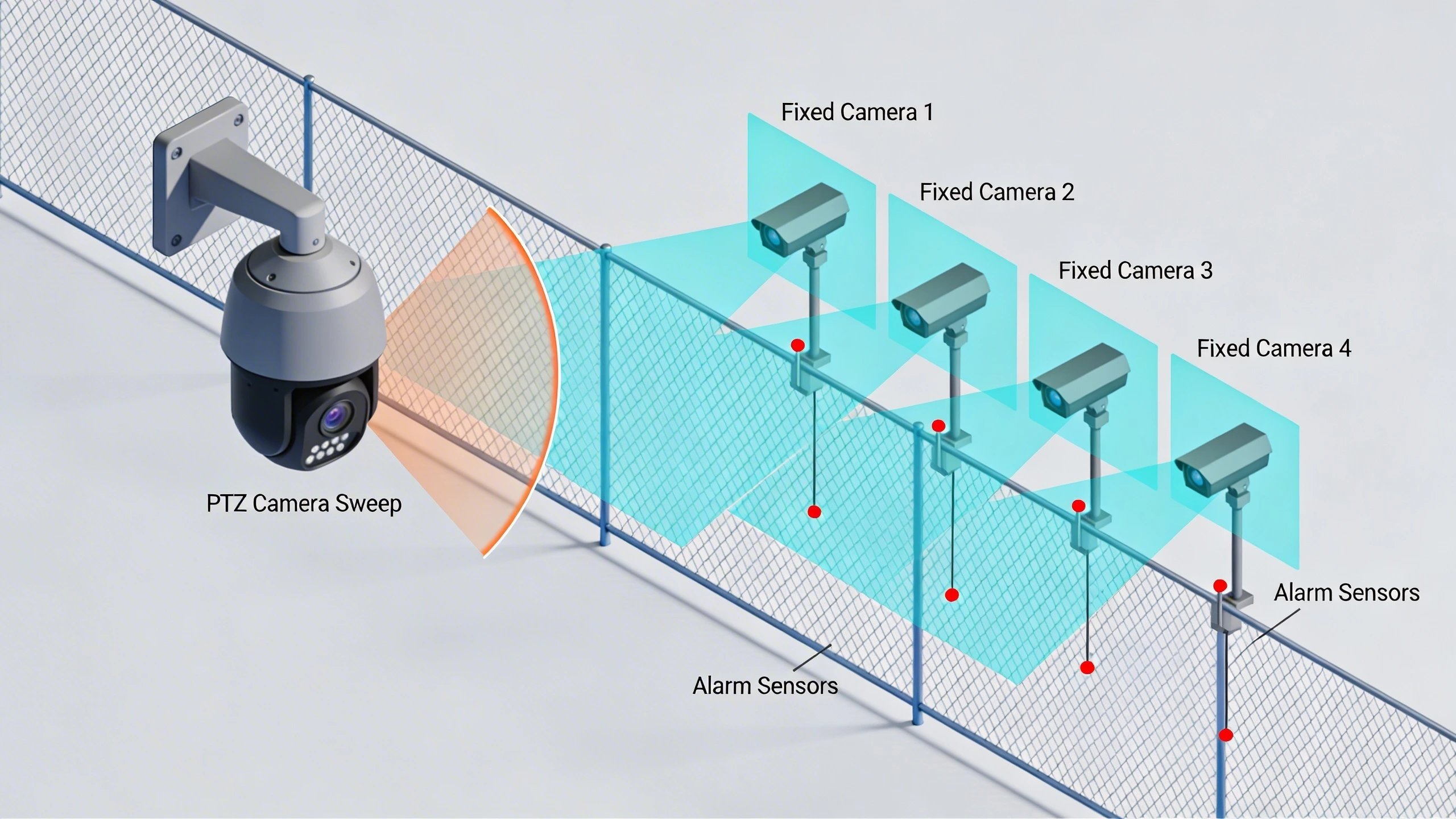
Consider a typical perimeter retrofit: sensors along a 500-meter fence line trigger on motion, feeding into a central VMS. Fixed cameras, deployed in overlapping arrays, ensure every zone is pre-framed, reducing verification time and operator fatigue. PTZ alternatives demand skilled intervention to pan and zoom accurately, a process prone to error under stress. These dynamics reshape not just response protocols but also integration with access control and analytics overlays.
What changes in real deployments
In operational retrofits, the most noticeable shift occurs in verification throughput. Fixed cameras eliminate the need for PTZ preset programming or manual control, allowing alarms to trigger pre-recorded clips or live streams instantly tied to specific sensors. At a warehouse campus, for instance, replacing PTZ with fixed units cut average verification from 15-30 seconds to near-instant, as operators no longer navigate joystick interfaces during multi-alarm events. This change cascades to staffing: fewer trained PTZ operators suffice, freeing resources for analytics tuning.
Deployment density also transforms site layouts. PTZ cameras cover broad areas with fewer units, suiting sparse utility sites initially, but fixed arrays demand more mounts—often 3-5 times as many for equivalent coverage. In practice, this means denser pole or wall placements, but with gains in redundancy; a single PTZ failure blinds wide swaths, while fixed setups maintain partial visibility. Teams overlook this until cable runs multiply, underscoring the need for upfront coverage modeling in tools like AutoCAD or VMS simulators.
Workflow integration sees subtler but critical evolutions. Alarm rules in modern VMS link fixed camera feeds directly to sensor events via metadata, enabling automated pop-ups or AI overlays. PTZ verification, conversely, often requires rule-based presets that drift over time due to environmental shifts, like foliage growth obscuring views. Field engineers report higher compliance with verification SLAs using fixed cameras, as they sidestep PTZ calibration drift.
Security and reliability differences
Fixed cameras bolster security through inherent tamper resistance; their static positioning resists subtle manipulations like gradual tilting common in unattended PTZ units. In exposed critical infrastructure, such as oil field gates, PTZ motors become attack vectors—jamming or overload exploits documented in vulnerability reports. Fixed lenses, sealed and lower-profile, endure harsh conditions better, with fewer moving parts prone to seizure from dust or ice buildup.
Reliability favors fixed in uptime metrics. PTZ mechanisms introduce single points of failure: pan-tilt gears wear under frequent use, and zoom optics fog internally. Retrofit audits at campuses reveal PTZ mean-time-between-failures lagging fixed by factors tied to duty cycles. Fixed PoE cameras, drawing steady power, integrate seamlessly with UPS backups, ensuring verification persists through outages. PTZ power surges during rapid movements strain supplies, occasionally tripping breakers mid-alarm.
Image quality consistency further differentiates them. Fixed cameras maintain steady WDR performance across their view, critical for low-light verifications where PTZ zooming amplifies noise. Operators confirm threats faster with undistorted fixed frames, avoiding PTZ artifacts like motion blur from servo lag.
Wiring, topology, and integration implications
Wiring diverges sharply: fixed cameras leverage standard PoE for simplified daisy-chains, minimizing conduit runs in retrofits. PTZ units often require auxiliary RS485 or proprietary control cables alongside Ethernet, complicating pulls through existing conduits at substations. This hybrid cabling elevates installation costs and failure risks, as control lines falter from EMI near high-voltage lines—a recurring issue in utility deployments.
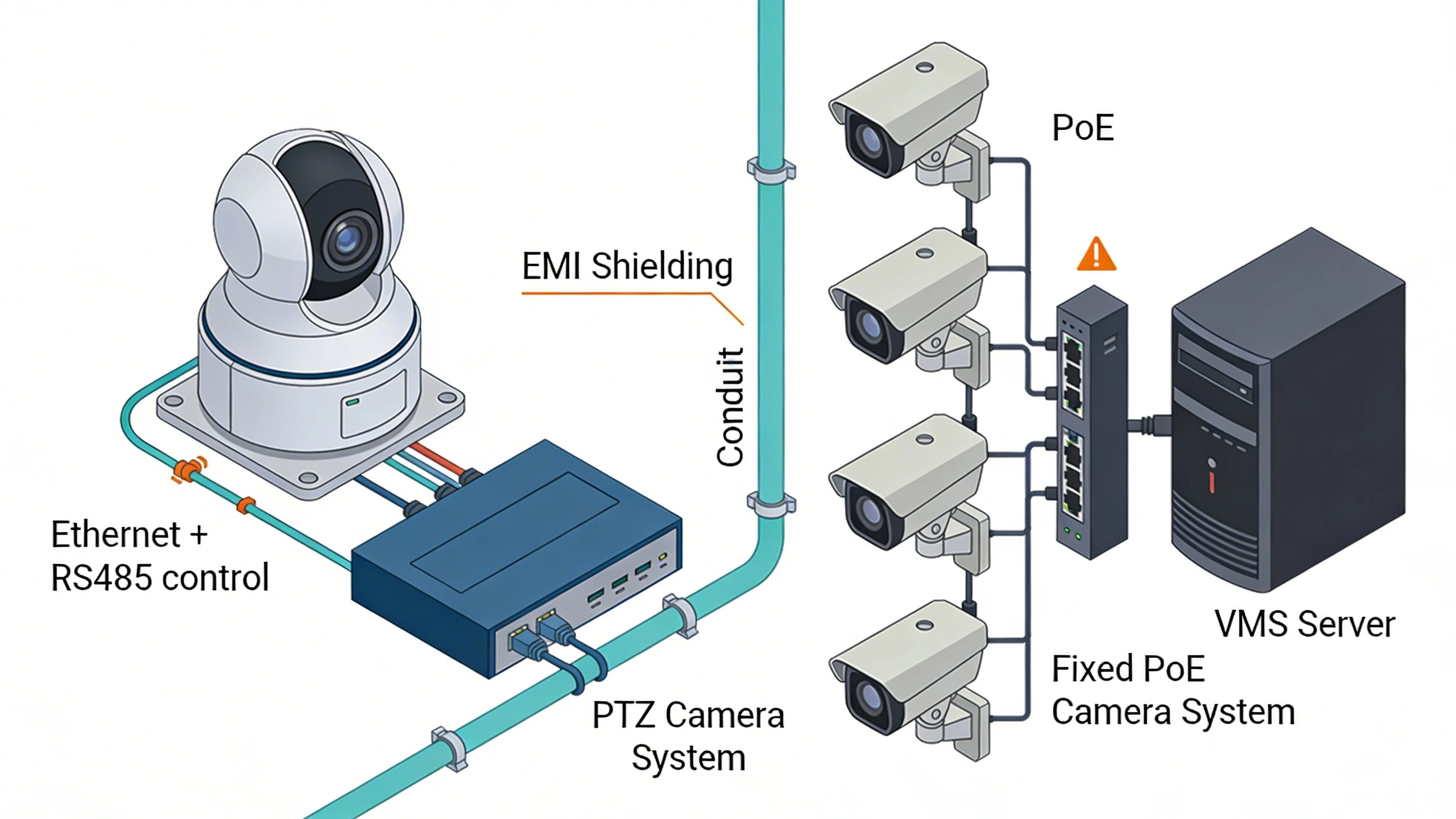
Topology-wise, fixed cameras support mesh or star networks with edge processing, distributing load from central VMS. PTZ topologies centralize control, creating chokepoints; a controller outage cascades to all units. In campus integrations, fixed arrays mesh with ONVIF-compliant switches, easing scalability. PTZ demands compatible dome drivers, often vendor-locked, hindering multi-supplier rollouts.
Integration with alarm panels amplifies these traits. Fixed cameras embed zone metadata natively, syncing with Modbus or BACnet sensors. PTZ requires middleware for preset mapping, prone to desyncs post-firmware updates. Integrators favor fixed for plug-and-play with platforms like FortSense 4, where verification rules auto-configure.
Migration planning and common failure points
Migration starts with sensor-camera mapping: audit existing alarms against coverage gaps using ray-tracing software. Phase PTZ to fixed by hybrid zones—prioritize high-traffic perimeters first. Common pitfalls include underestimating mount proliferation; teams double pole counts without structural checks, leading to delays. Budget for VMS rule rewrites, as PTZ presets convert poorly to fixed bookmarks.
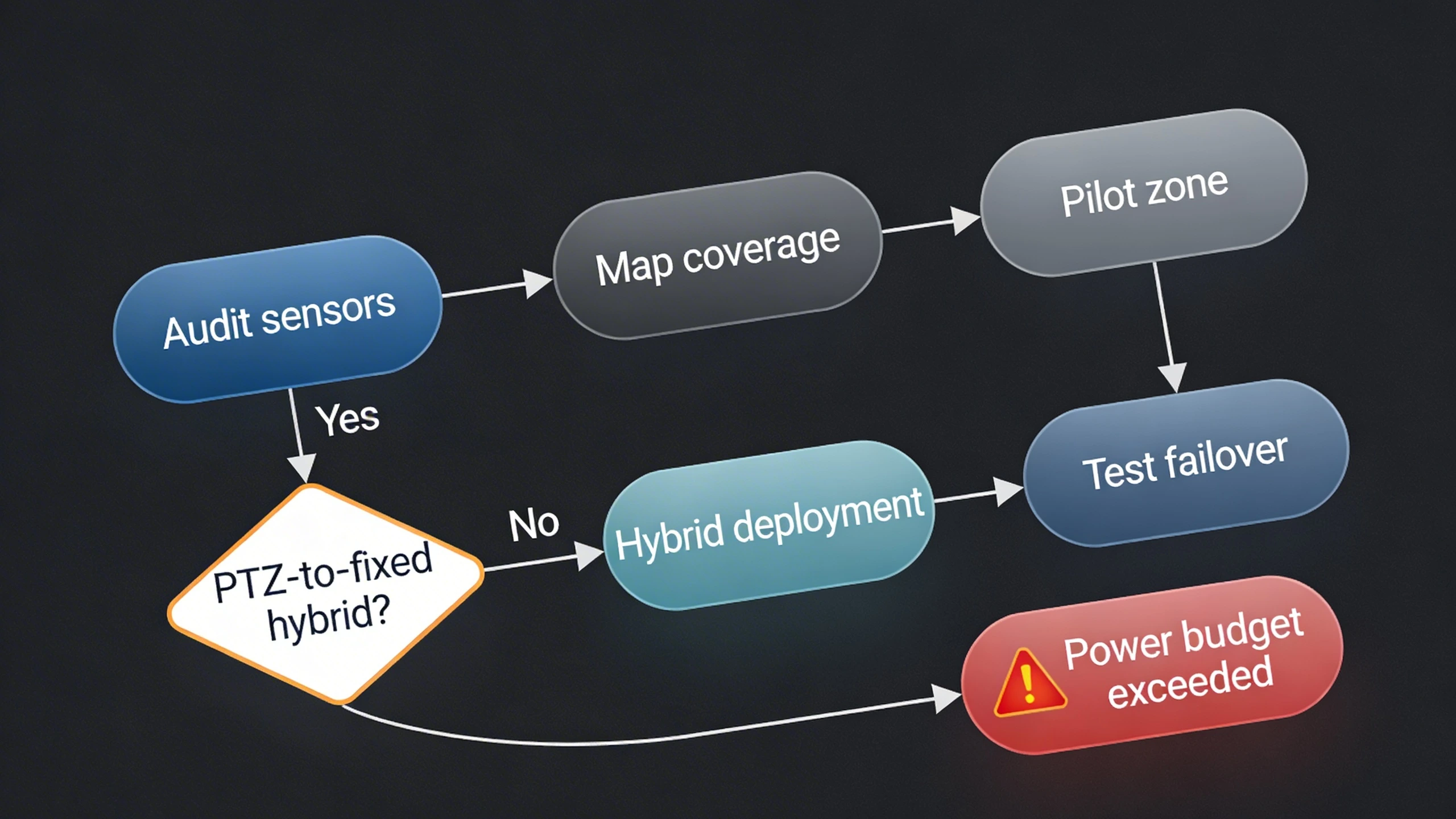
Failure points cluster around power budgeting: PTZ PoE++ spikes overload switches, while fixed stay within Class 3. Test failover rigorously—PTZ homing sequences fail silently post-brownout. In a Midwest campus upgrade, overlooked PTZ motor lubrication caused 20% downtime in winter; fixed avoided this entirely. Document baselines pre-migration to quantify gains in verification latency.
Stakeholder alignment averts overruns: security managers prioritize verification speed, IT focuses on topology. Pilot a single fence line to validate assumptions before full rollout.
Where each approach still fits
PTZ endures in low-alarm-density sites like remote pumping stations, where one unit sweeps vast, infrequently triggered zones. Operators value zoom for detail inspection post-verification, suiting investigator workflows over rapid dispatch. In expansive terrains, PTZ reduces upfront hardware, fitting capex-constrained projects.
Fixed cameras dominate dense, high-volume verifications—think multi-door facilities or urban campuses. Their predictability scales with analytics, overlaying bounding boxes on alarms without repositioning. Hybrid deployments blend both: fixed for primary zones, PTZ for operator override in ambiguous events.
Selection hinges on alarm cadence: under 10 daily favors PTZ economy; above demands fixed reliability. Always model against site specifics.
Where to go next
For tailored advice on FortSense 4 integrations blending PTZ and fixed for your alarms, explore our critical infrastructure security resources or North America deployments. Request a design review to map your retrofit.
Select fixed and PTZ candidates from field-tested visibility polygons using the geospatial alarm-to-camera mapping workflow before applying camera arbitration.