In a sprawling corporate campus or university grounds where multiple tenants share outer perimeter defenses, deciding how to zone intrusion detection systems demands careful forethought. Picture a retrofit project at a mid-sized tech park: legacy chain-link fencing surrounds shared parking lots and access roads, but now departments from different companies need tailored alert handling without compromising the collective boundary. A single-zone approach might simplify wiring and monitoring, yet it risks alert overload during routine disturbances like wind or animals crossing into tenant-specific areas. Instead, many teams land on a zoned perimeter strategy, segmenting the outer fence line into broader patrol zones while reserving finer inner divisions for individual stakeholders.
This design shines in practice because it aligns shared infrastructure costs with distinct response needs. For instance, the campus-wide outer layer uses distributed fiber-optic sensors or taut-wire detectors to flag major breaches early, feeding into a central PSIM for unified oversight. Inner zones, perhaps microwave barriers around building clusters, trigger tenant-specific notifications. The upfront migration involves mapping fence segments to tenant footprints, ensuring zones overlap just enough for redundancy without false cross-triggers. Teams upgrading from monolithic systems report smoother handoffs to security operations centers, as zoning logic filters noise at the edge.
Framing this as a migration choice underscores the stakes: ignore zoning granularity, and you'll drown responders in campus-wide pings from localized events; over-segment, and maintenance multiplies across tenants. Grounded in real-world constraints like shared utility corridors and varying threat models, the strategy prioritizes scalable integration over one-size-fits-all coverage.
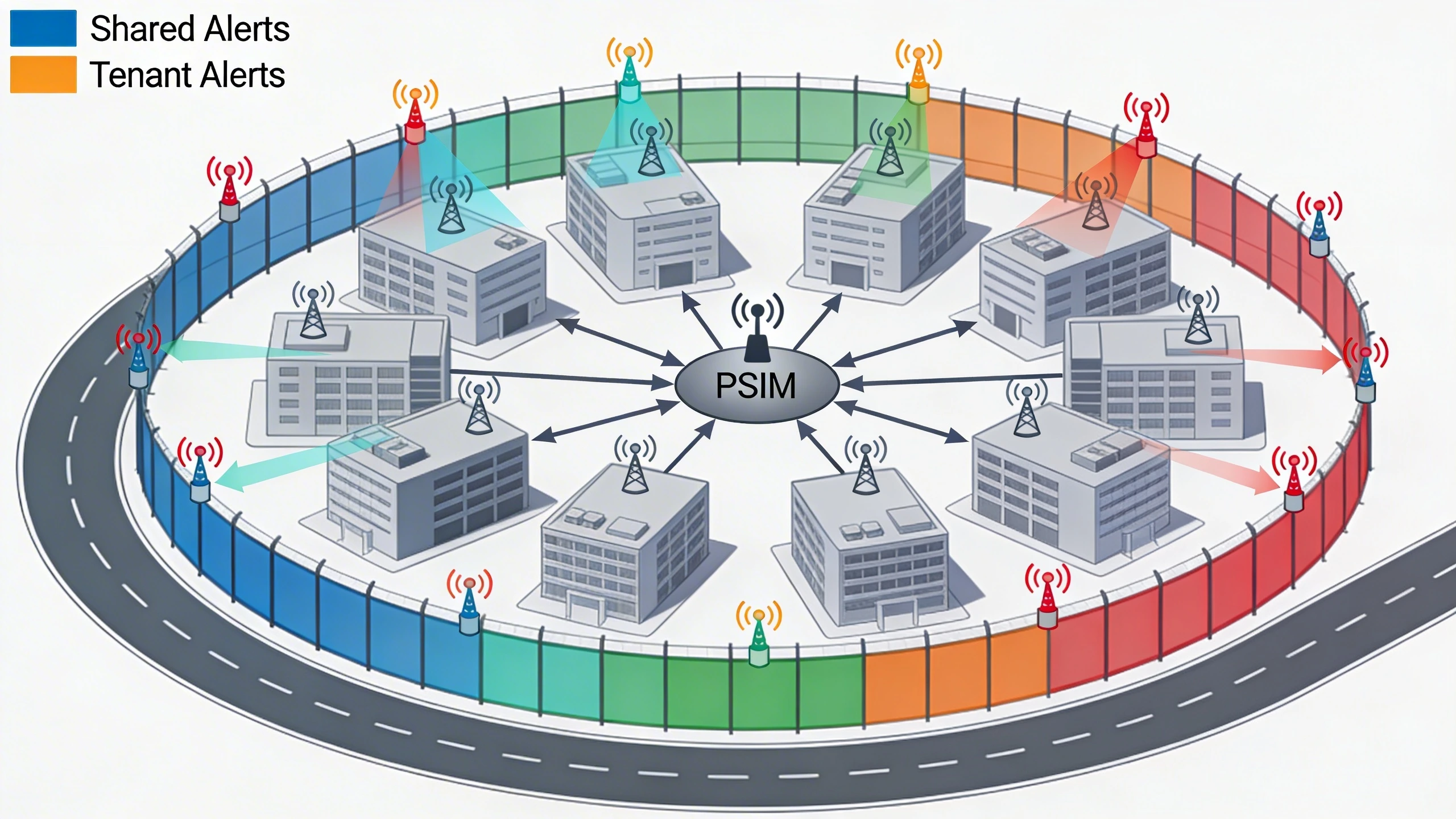
What the design decision looks like in practice
Deploying a shared campus perimeter zoning strategy starts with site mapping that respects physical and administrative boundaries. On a typical 50-acre campus with four tenant clusters, engineers divide the 2-mile outer fence into four primary zones aligned to road access points and natural barriers like ditches or tree lines. Each zone employs a mix of point sensors—vibration on gates, IR beams across gaps—and line sensors like video motion detection along fence fabric. The key decision: outer zones report to a shared dispatch console, while transitions to inner tenant areas activate segregated rulesets.
During a recent university retrofit, this manifested as phased cutovers: first, baseline the entire perimeter under temporary single-zone monitoring to capture nuisance patterns, then carve out zones based on event logs. Operators saw a drop in baseless escalations as inner microwave links handled vehicle backings near loading docks without pinging the full campus. Field teams wired return panels at zone junctions, allowing plug-and-play sensor swaps. This isn't theoretical; it's the hands-on evolution from flat detection to layered intelligence, where zoning scripts in platforms like FortSense 4 enforce rules like "zone A breach + video confirmation = armed response; zone B motion = camera PTZ slew only."
Practitioners adapt by scaling zone counts to tenant density—fewer for loose federations, more for high-security labs. The outcome: a living system where zoning evolves with occupancy changes, audited quarterly via walk-tests that simulate cross-zone propagations.
System architecture and integration considerations
At the core, architecture hinges on hierarchical data flows that prevent zone chatter from overwhelming upstream systems. Perimeter controllers aggregate sensor inputs per zone, applying edge filtering before pushing to a PSIM backbone. In shared setups, this means VLAN segregation for tenant data streams alongside a neutral campus feed, ensuring compliance with multi-party NDAs. Integration with existing CCTV or access control demands protocol bridges—think Modbus for legacy gates, ONVIF for IP cameras—mapped to zone metadata for contextual alarms.
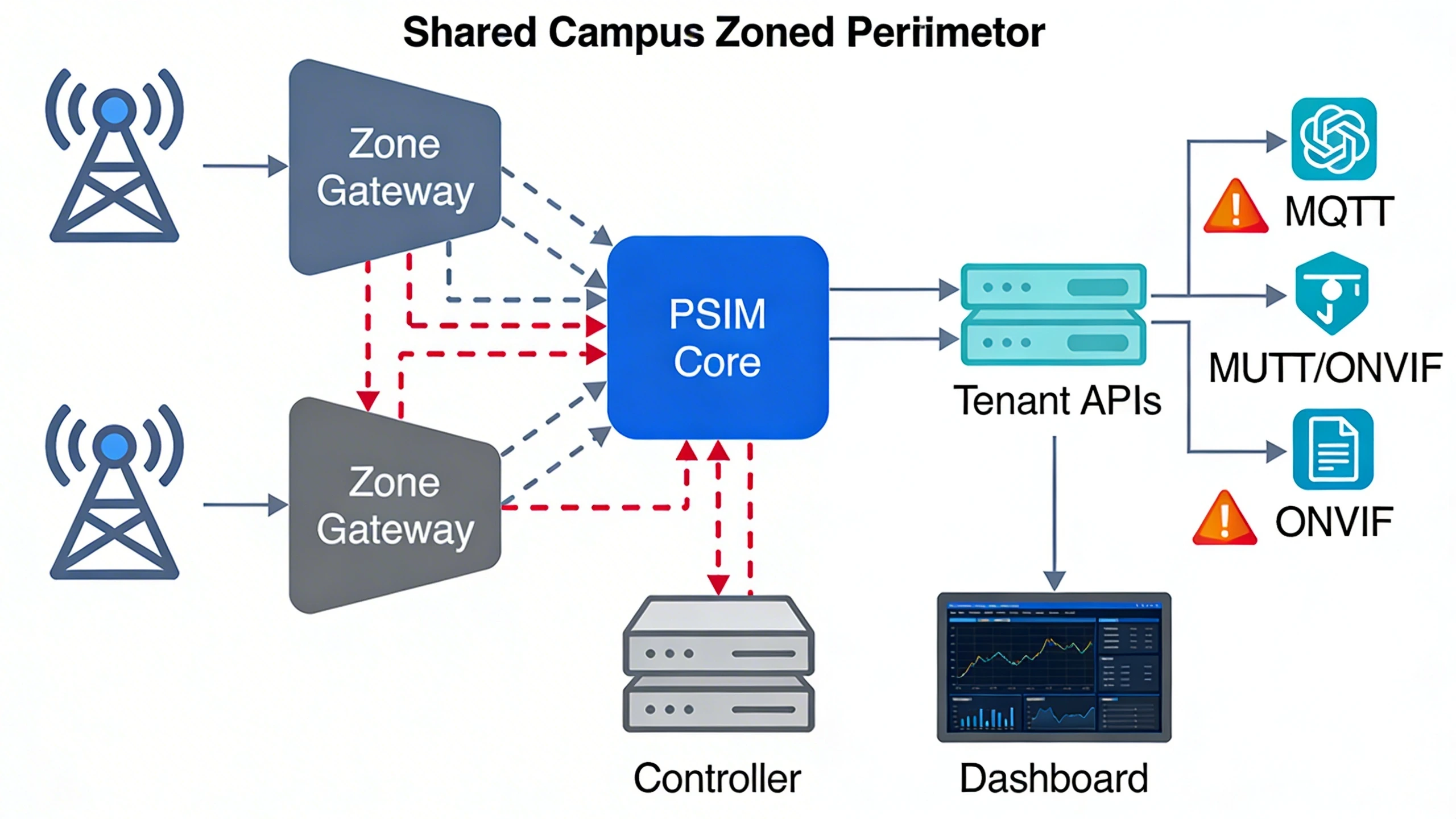
Consider a utility campus migration: outer IR towers feed zone gateways that normalize events into a common schema, then route via MQTT to a FortSense instance. Tenants pull their slices via API dashboards, while shared ops get a fused view. Tradeoffs emerge in bandwidth: dense zoning multiplies streams, so compression and multicast become non-negotiable. False positives drop when architecture incorporates AI classifiers tuned per zone—rain in open fields vs. loitering near offices. The build process? Start with a proof-of-zone on one segment, validate latency under load, then replicate with modular enclosures at fence posts for weatherproof scaling.
Long-term, this setup future-proofs against expansions; adding a fifth tenant triggers a zone split via software reprovisioning, not rewiring. Integrators prioritize gateways with expandable I/O to handle evolving sensor mixes without forklift upgrades.
Operational workflows and field constraints
Daily ops revolve around zoned escalation ladders that match response tiers to threat posture. A fence climb in a low-risk delivery zone might cue lights and voice prompts first, escalating only on persistence; high-stakes R&D zones jump straight to lockdown. In shared environments, workflows include tenant acknowledgment loops—dispatch confirms via app before clearing—and cross-zone patrols that respect access restrictions. Field constraints like shared gates force hybrid patrols: campus guards handle outer clears, tenants inner verifies.
Maintenance workflows adapt to multi-stakeholder realities: scheduled walk-tests rotate by zone to minimize downtime, logged centrally for SLA tracking. Weather extremes test resilience—snow on taut wires in zone 3 triggers auto-desensitize rules, sparing the rest. Operators drill on handover protocols, simulating tenant absences where campus teams assume fallback coverage. Constraints like buried utilities dictate non-invasive installs, favoring clamp-on accelerometers over trenched cable runs. The result: workflows that scale with campus rhythms, from peak visitor hours demanding preemptive zone quiets to nights relying on silent verification.
Common failure points and design mistakes
One frequent pitfall is zone bleed, where sensors in adjacent segments cross-trigger due to undersized guard bands or wind-propagated vibrations. Teams rushing site surveys overlook micro-terrain—like berms amplifying audio detectors—leading to chronic pairs of alerts that erode trust. Another: skimping on integration testing, where PSIM rules misfire on multi-zone events, like a vehicle breach spanning zones A and B registering as isolated nuisances.
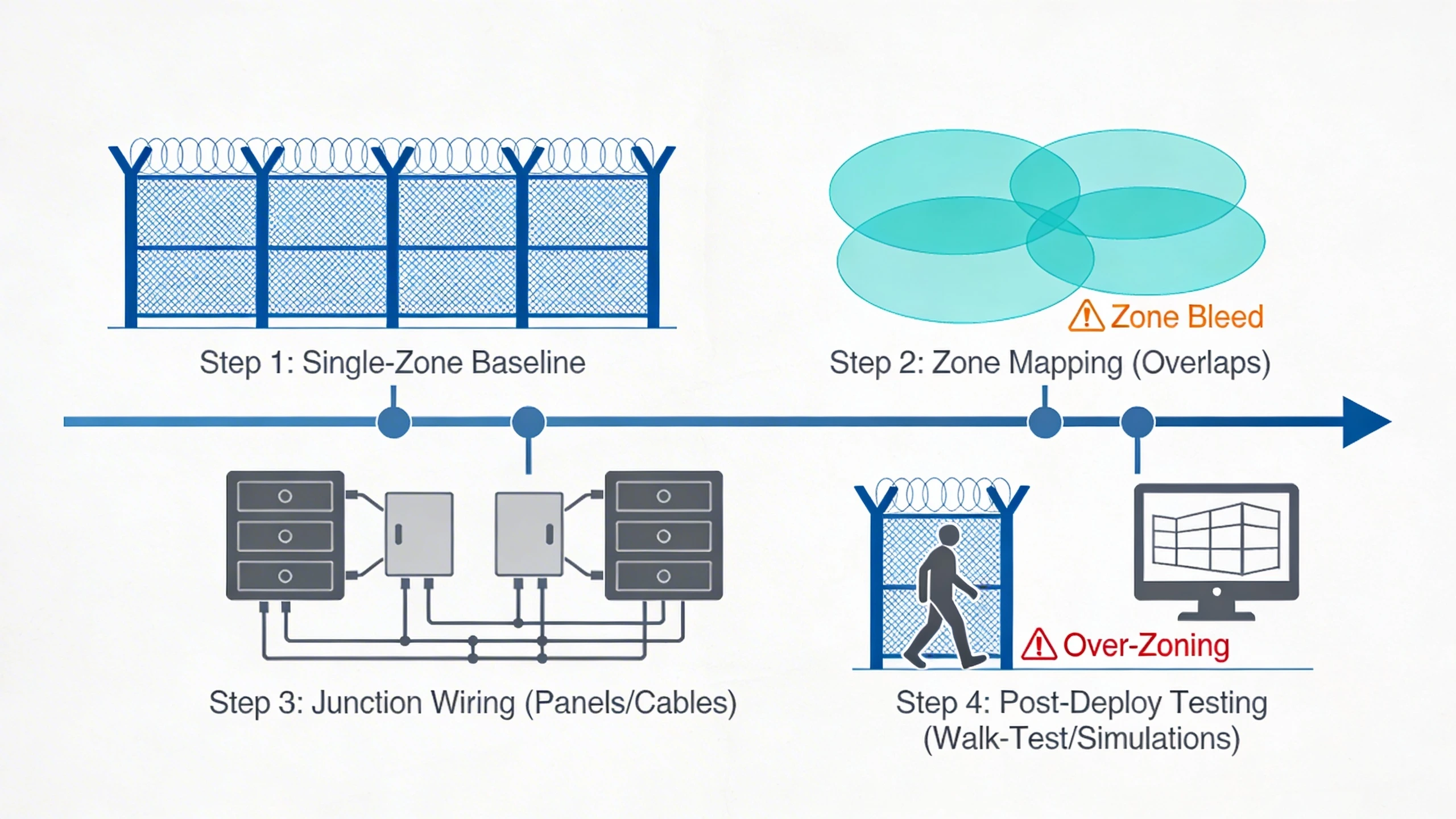
Over-zoning plagues ambitious designs, fragmenting coverage into 20+ micro-areas that balloon configuration complexity and alert fatigue. Field mistakes include mismatched sensor densities—IR beams fine for open spans but blind in foliage-heavy zones—or ignoring power sharing, where one tenant's outage cascades. Mitigation starts with simulation tools modeling propagations pre-deploy. Post-cutover, unmonitored drift creeps in: uncalibrated thresholds post-season change false-alarm spikes. Successful teams counter with zoned analytics dashboards tracking metrics like clear time per segment, catching issues early.
What to verify before procurement
Before committing, conduct a zone-feasible site survey documenting fence condition, tenant adjacencies, and nuisance sources via 72-hour passive logging. Scrutinize vendor platforms for zoning flexibility—does the engine support dynamic repartitioning without downtime? Confirm sensor interoperability via listed certifications, especially for hybrid deployments blending legacy and IP tech.
Probe operational fit: request workflow demos simulating shared dispatch, verifying alarm fan-out controls tenant silos. Budget for redundancy—dual gateways per critical zone—and scalability proofs from similar North America deployments. Engage stakeholders early on response SLAs to align zoning with contractual duties. Finally, audit the supplier's field support model; remote diagnostics save trips in expansive campuses.
Armed with this checklist, procurement shifts from spec-matching to risk-mitigated selection.
Where to go next
Explore FortSense 4 for advanced zoning engines tailored to perimeter challenges. For expert input on your campus layout, request a design review. Dive deeper into critical infrastructure security applications, and reference the Perimeter Intrusion Detection System glossary or PSIM glossary for foundational terms.