When retrofitting access control systems at a multi-site utility provider, security integrators often confront the limitations of legacy logging: fragmented event records stored on isolated controllers, lacking timestamps synced to NTP or details on failed attempts. This setup hampers incident reconstruction, especially during regulatory reviews or post-breach forensics. The decision to deploy comprehensive audit trails transforms this landscape, capturing granular data—who accessed what door at precisely when, alongside environmental sensor triggers and administrative changes—streamed reliably to a central repository.
In practice, the strongest designs favor centralized aggregation with edge redundancy over purely local storage, enabling correlation across video, intrusion detection, and badge readers. This approach not only satisfies compliance mandates but accelerates response times in high-stakes environments like campuses or substations, where a single overlooked tailgate could cascade into operational disruptions. Teams that embed syslog forwarding and SIEM hooks from day one avoid costly rewiring later, balancing storage costs against forensic depth.
Consider a campus-wide upgrade spanning dozens of buildings: mismatched log formats from vendor A doors and vendor B panels force manual reconciliation, eroding trust in the trail. By standardizing on protocols like Syslog RFC 5424 early, integrators ensure searchable, tamper-evident records that withstand scrutiny, setting the foundation for proactive alerting rather than reactive hunts.
What the design decision looks like in practice
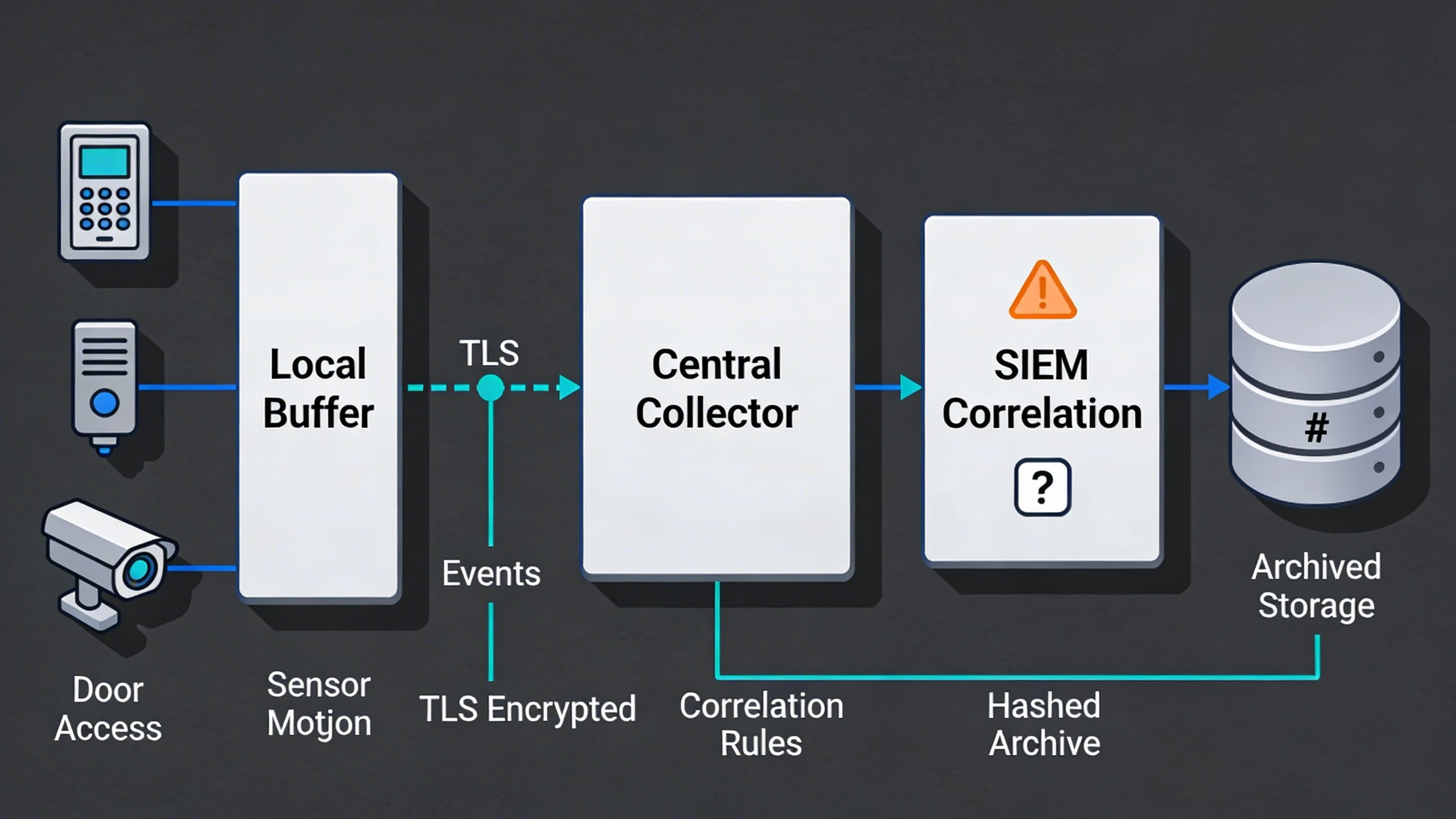
Picture a security manager overseeing a retrofit in a critical infrastructure facility: doors equipped with smart locks, perimeter sensors, and CCTV now generate events ranging from credential scans to tamper alerts. The design decision manifests as configuring each endpoint to emit structured logs—JSON or CEF formatted—detailing user ID, timestamp, outcome (grant/deny), and geolocation. These feed into a collector that timestamps arrivals, hashes payloads for integrity, and forwards to long-term storage.
In the field, this means wiring decisions like dual Ethernet drops per controller for failover logging paths, tested under simulated outages. During commissioning, integrators script queries to verify coverage: did the log capture a forced door alongside video metadata? When teams overlook this, investigations stall on incomplete chains, as seen in scenarios where admin overrides bypass logging entirely. Successful implementations layer user-level trails (access grants) with system-level ones (firmware updates), providing a holistic view without overwhelming operators.
Operationalizing the decision involves baseline testing: simulate 1,000 events per minute across a mock topology, confirming no drops. This upfront rigor pays dividends in audits, where auditors probe for chain-of-custody from sensor to archive.
System architecture and integration considerations
Architecture hinges on hybrid edge-core models: endpoints buffer logs locally on tamper-resistant flash during WAN blips, syncing bidirectionally once restored. Central servers—often syslog concentrators like rsyslog or Graylog—parse, normalize, and index for SIEM ingestion. Integration demands protocol harmony; mismatched versions lead to silent discards. For instance, pairing access controllers with video management systems requires API hooks to timestamp VMS clips with access events, creating fused trails.
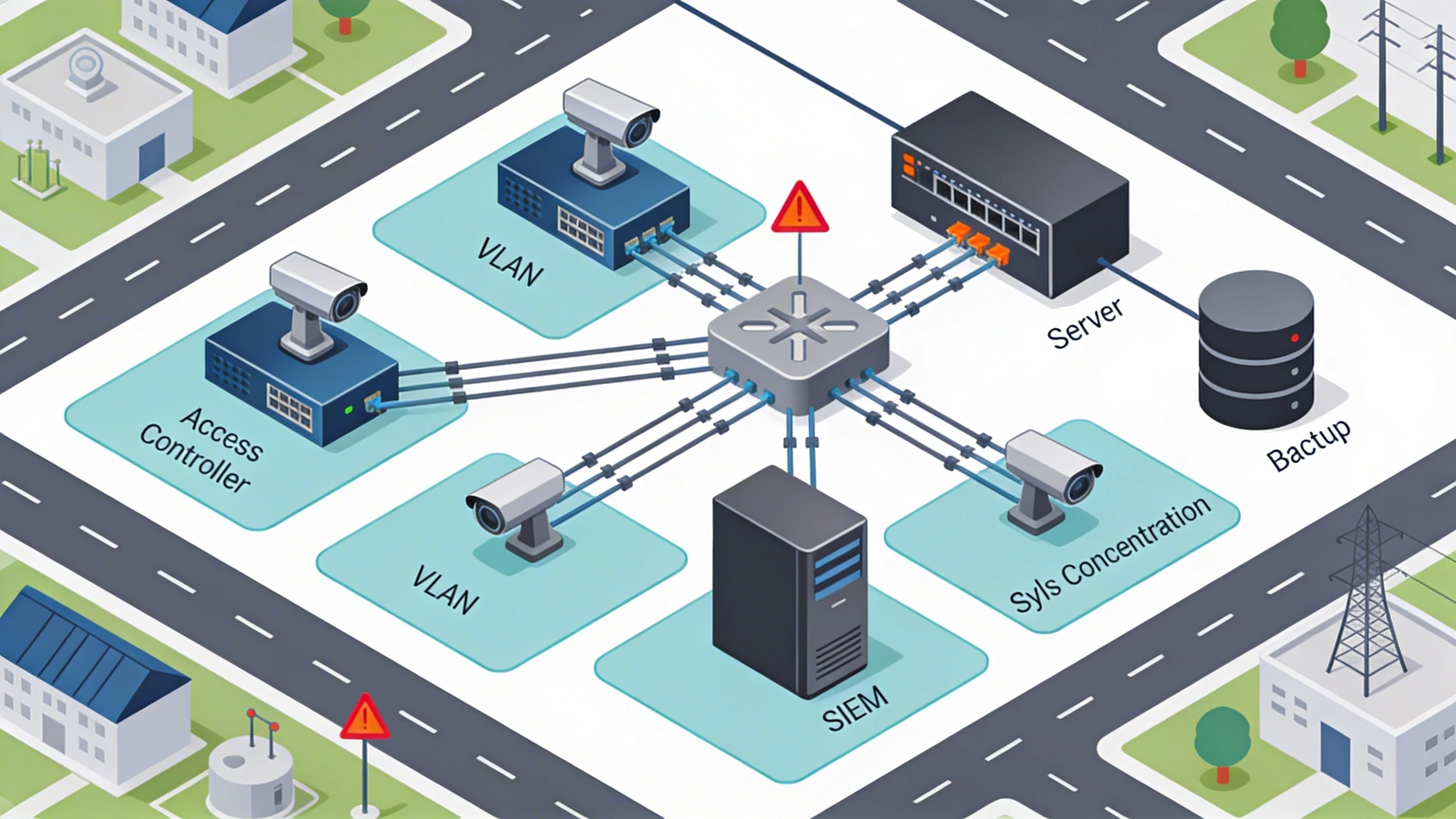
Scalability tradeoffs emerge in distributed setups: campus sprawl favors containerized collectors on Kubernetes for elasticity, while utility sites prioritize air-gapped redundancy with USB exports as fallback. IT managers must weigh bandwidth—compressed logs mitigate spikes—against latency, ensuring sub-second forwarding for real-time dashboards. Neglecting VLAN segregation risks log channels clogging operational traffic, a common oversight in converged networks.
Key is modularity: decouple logging from core functions so firmware upgrades don't wipe histories. This resilience shines in multi-vendor environments, where adapters bridge proprietary formats to open standards.
Operational workflows and field constraints
Daily workflows start with dashboard reviews: operators scan for anomalies like repeated denies at secure vaults, triggering video playback linked by event ID. Alerting rules escalate patterns—door ajar exceeding thresholds—to mobile apps, integrating with incident ticketing. Field constraints demand offline resilience; technicians at remote sites export subsets via secure tokens, merging seamlessly on reconnect.
Retention policies balance compliance with storage: tiered archives hold hot data (90 days) in fast search indices, colder tiers on object storage. Purge schedules automate, but manual holds flag suspicious periods. When workflows falter—say, unmonitored logs piling up—teams face alert fatigue or missed escalations, underscoring the need for role-based views: security sees access, IT audits configs.
In practice, training emphasizes query crafting: Boolean searches across fields pinpoint tailgating chains, far beyond basic filters.
Common failure points and design mistakes
One prevalent pitfall is siloed logging: doors log to one server, cameras to another, fracturing timelines during reconstructions. Without normalization, correlating a badge swipe with footage becomes manual drudgery. Another: ignoring integrity—unhashed logs invite tampering, invalidating audits. Overlooking NTP sync skews timestamps, undermining sequences in legal reviews.
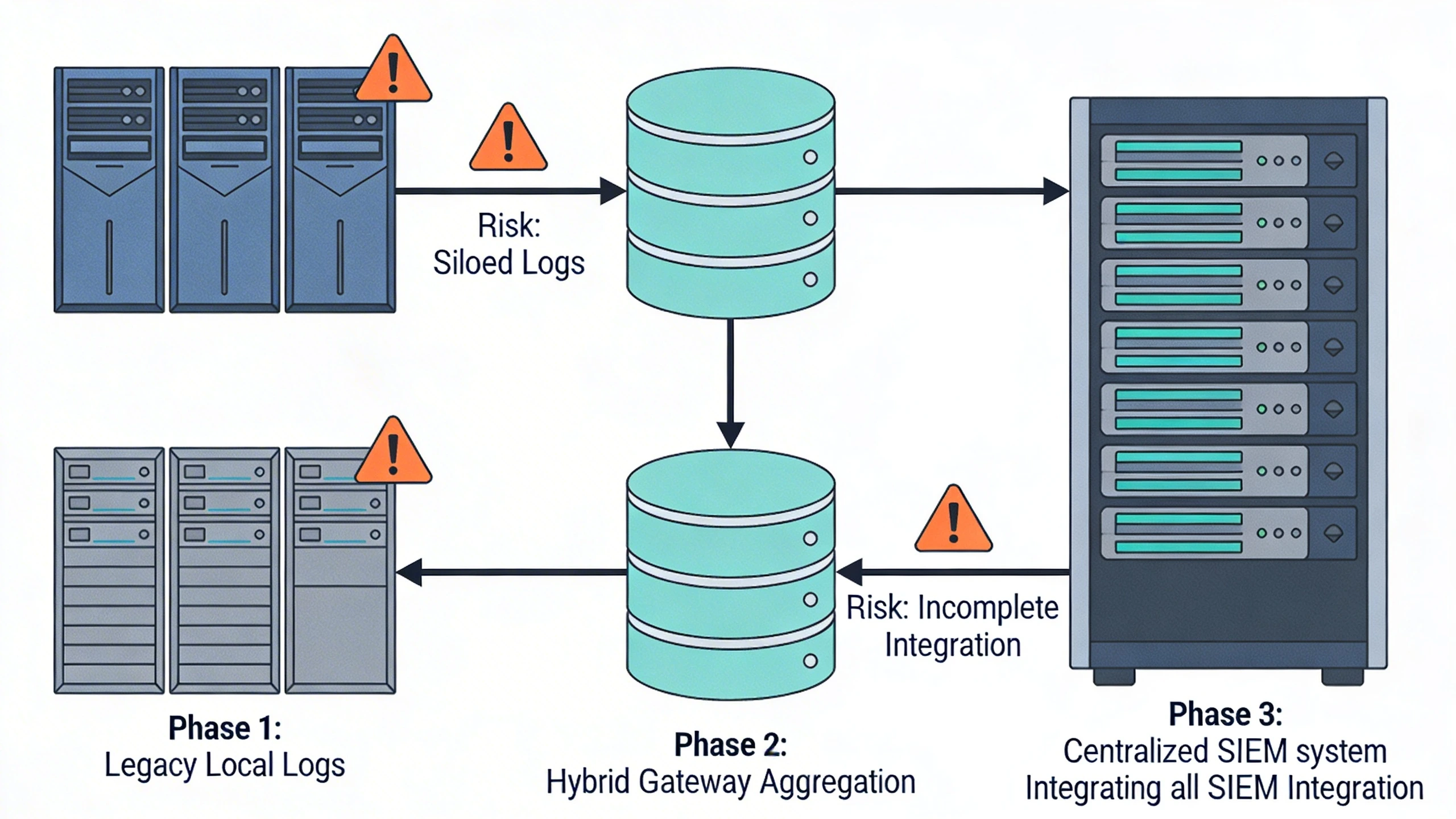
Bandwidth overload crashes forwarders during surges, like mass evacuations, dropping critical tails. Design mistakes amplify in retrofits: assuming legacy panels support syslog leads to dead ends, forcing rip-and-replace. Poor failover means site outages erase local buffers if power fails without UPS. Teams that skip load testing face production surprises, where query latencies balloon under real volumes.
Remediation starts with phased rollouts: pilot one building, measure ingest rates, tune parsers. Always bake in rotation and backups; single-point storage failures cascade losses.
What to verify before procurement
Procurement checklists must probe logging depth: does it capture anti-passback violations, duress codes, and service restarts? Request demo queries on sample data, confirming full-text search and export to CSV/PDF. Scrutinize protocols—Syslog over TLS mandatory—and retention APIs for automated compliance holds.
Stress uptime: simulate 48-hour disconnects, verifying buffer capacity and sync fidelity. Audit vendor roadmaps for SIEM plugins; generic REST beats none. Field-test integration with your NAC or VMS, watching for format mismatches. Finally, review admin trails: who deleted what log? Immutable append-only modes prevent backfills.
Insist on third-party attestations for log security, ensuring claims hold beyond marketing slides.
Where to go next
FortSense teams specialize in compliant audit trail deployments for demanding sites. Explore FortSense 4 capabilities tailored to these workflows.
For deeper compliance context, review the GDPR glossary and NDAA glossary. Serving North America deployments, we invite you to dive into critical infrastructure security.
Request a design review to align your retrofit plans.