When retrofitting a multi-building campus for a utility provider, the security team uncovers a harsh reality during a tabletop exercise: archived footage from the existing NVR proves useless in a simulated breach investigation because no one can prove it hasn't been altered. This scenario plays out too often in critical infrastructure, where video serves as the cornerstone of incident response and legal defense. The fix isn't just better cameras or storage; it's designing chain of custody into the system from the outset, creating an unbroken audit trail that verifies every frame's integrity from capture to export.
At its core, this design decision prioritizes cryptographic hashing, synchronized timestamps, and role-based access logging over simple file backups. Systems like FortSense 4 make this feasible by integrating these at the edge and core, but the principles apply across platforms. Integrators who get this right turn video into admissible evidence; those who don't risk dismissed claims or prolonged audits. In practice, it means shifting from passive recording to active provenance tracking, especially in environments demanding critical infrastructure security.
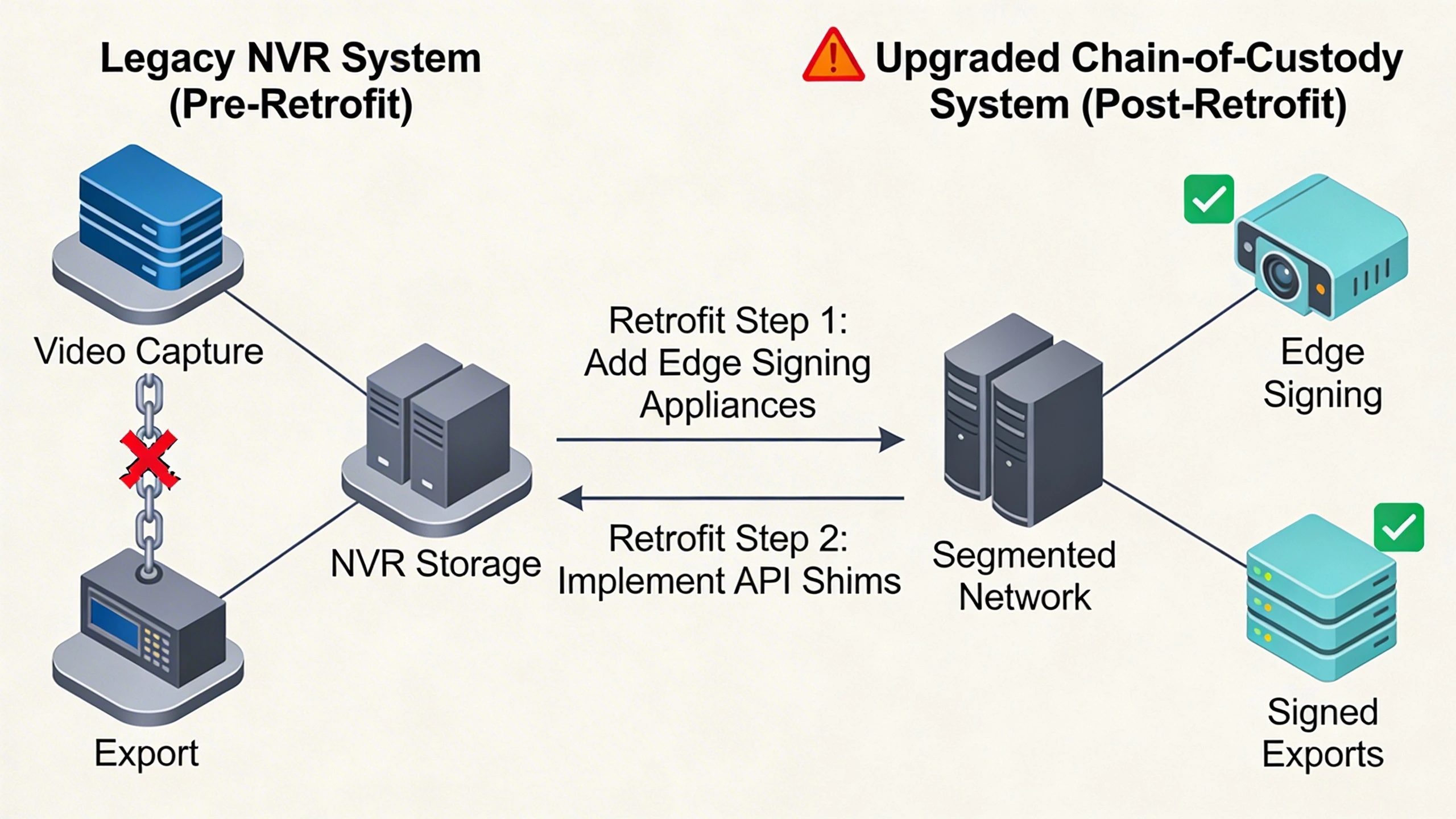
Consider a North American utility site spanning substations and control rooms: upgrading means wiring new edge appliances that sign metadata at the camera, feeding into a central vault with immutable ledgers. This retrofit not only complies with evidentiary standards but also streamlines operations, as investigators query tamper-proof clips without second-guessing authenticity.
What the design decision looks like in practice
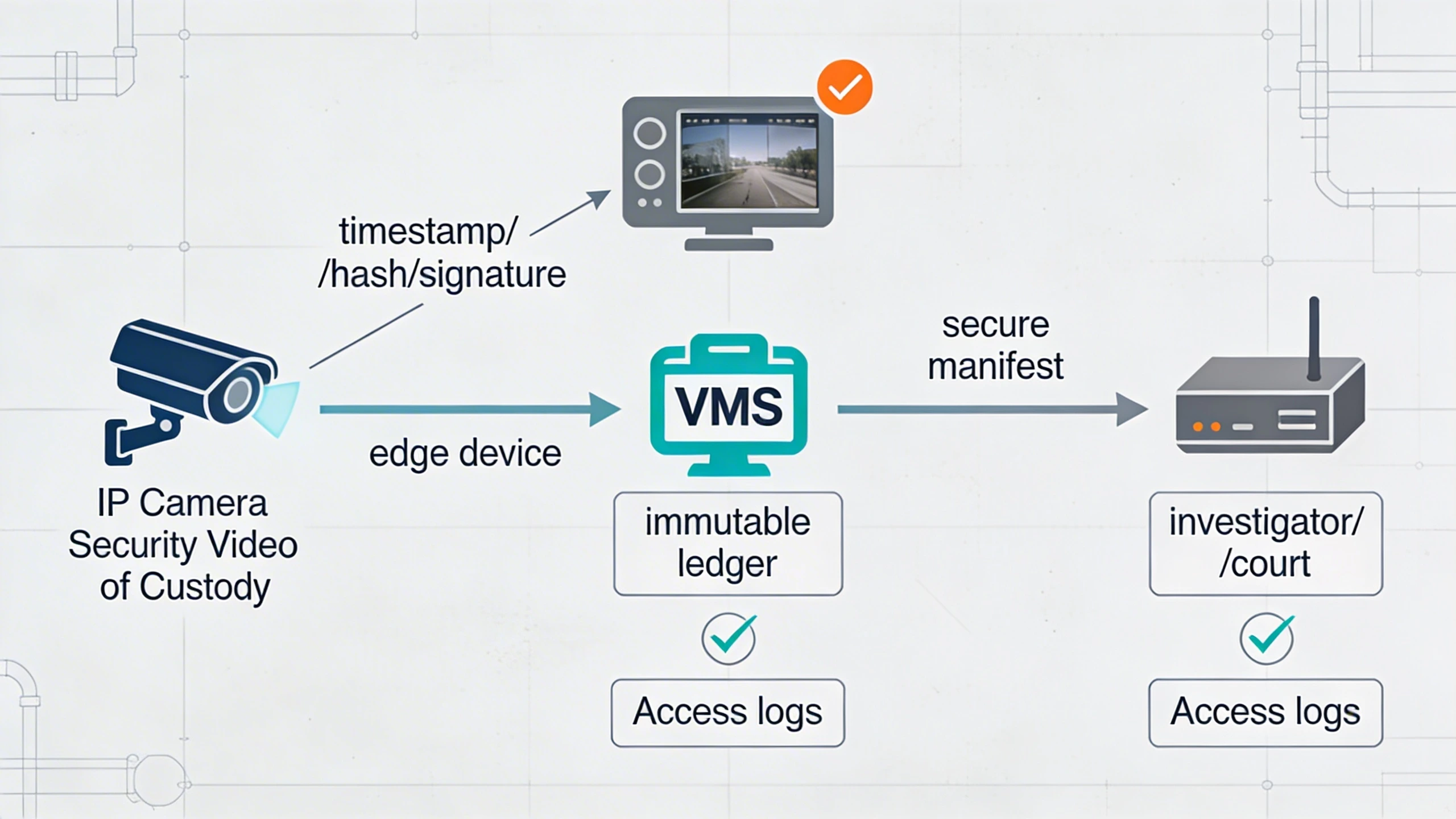
Implementing chain of custody starts with the video pipeline itself. Cameras capture frames, but the system immediately generates a cryptographic hash of the content plus metadata like GPS coordinates and device ID. This hash chains into a blockchain-like ledger on an edge device, ensuring even if the raw file moves, its provenance travels with it. In a campus retrofit, this might involve deploying ONVIF-compliant cameras that output signed RTSP streams to a local aggregator, which batches and timestamps sequences before uplinking.
Downstream, the NVR or VMS doesn't just store; it verifies incoming hashes against the chain and appends its own layer of signing. Exporting a clip for investigators triggers a manifest file that includes the full audit trail: who accessed what, when, and via which endpoint. For a utility operator, this means handing over a self-contained package to regulators, complete with verification tools that replay the chain without exposing the master archive. The operational payoff is immediate—reduced forensic timelines and higher confidence in deployments like North America deployments.
Teams often prototype this on a single door or gate first, confirming end-to-end integrity before scaling. The key shift is treating video as forensic artifacts from day one, not afterthoughts.
System architecture and integration considerations
A robust architecture layers security at every hop. Edge devices near cameras handle initial signing to minimize latency, using hardware security modules for key management. The core VMS then replicates these chains in a tamper-evident database, often with air-gapped backups for redundancy. Integration with existing systems requires mapping APIs for metadata passthrough—many legacy NVRs falter here, forcing a full replacement or middleware shim.
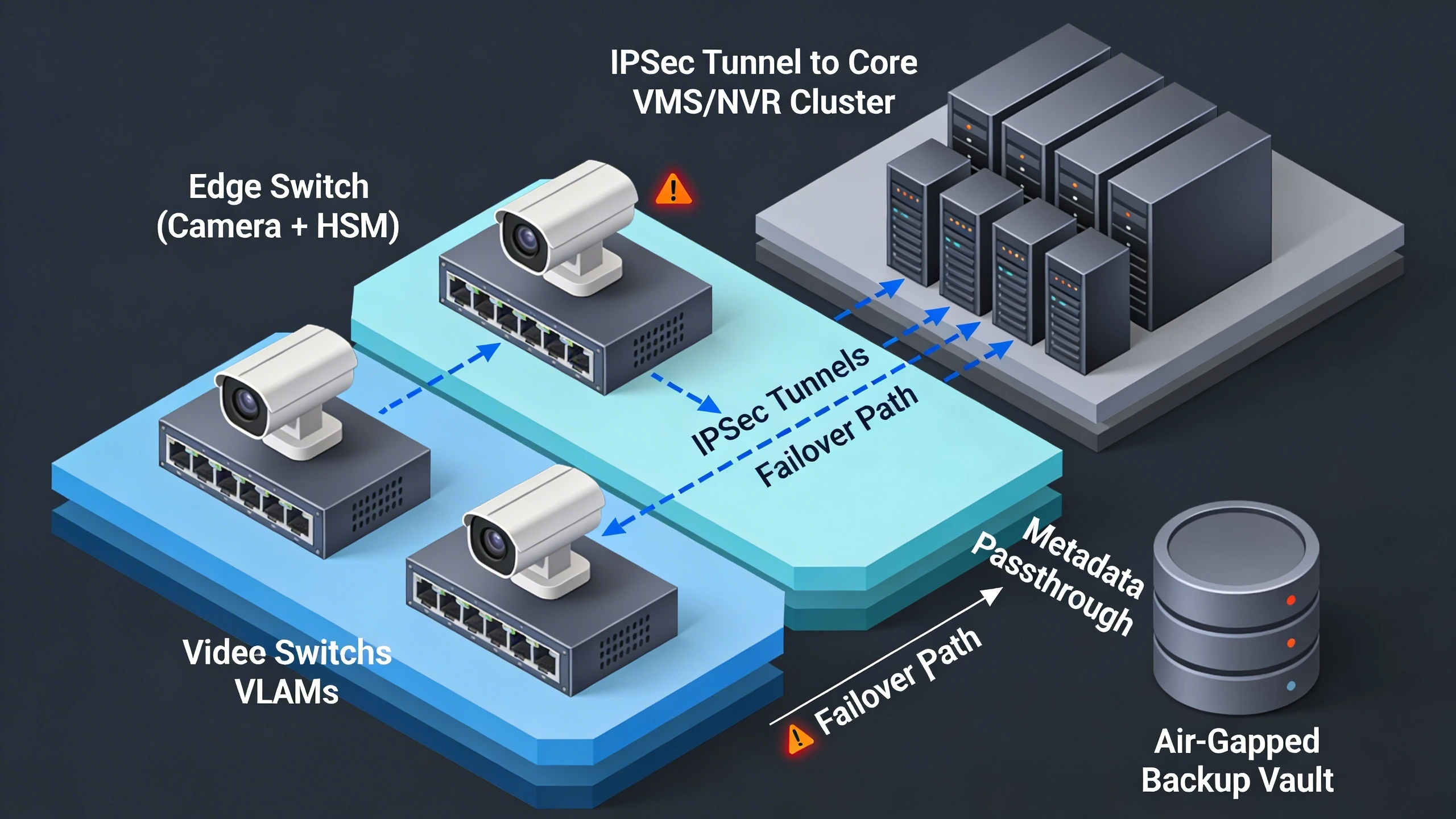
Network segmentation plays a critical role: isolate video flows on VLANs with IPSec tunnels, ensuring hashes can't be intercepted mid-transit. For hybrid setups, like a campus blending analog upgrades with IP, converters must inject timestamps compliant with standards like ISO 27037. Power and failover design matters too; UPS-backed edge nodes prevent chain breaks during outages. When teams overlook these, a single network flap can orphan footage, rendering hours of recording inadmissible.
Scalability demands distributed ledgers over centralized logs, as querying petabytes of metadata in real-time favors sharded storage. This setup future-proofs retrofits, accommodating AI analytics without compromising the chain.
Operational workflows and field constraints
In daily use, workflows revolve around least-privilege access: operators view live feeds freely, but archive queries require dual approval, logging every frame export. Field technicians, wiring a substation retrofit, must calibrate camera clocks to NTP stratum-1 sources on day one, as drift invalidates chains. Training emphasizes never bypassing the signed export path—even for quick shares—opting instead for viewer apps that attest integrity without copying files.
Constraints hit hardest in remote sites: limited bandwidth means compressing hashes, not video, and solar-powered edges need low-power crypto chips. Maintenance windows test the design; firmware updates must preserve chains via rollback verification. Operators who drill these workflows see fewer false alarms and faster incident closure, but skipping them invites procedural gaps that courts exploit.
Handover to legal teams includes training on chain verification tools, turning abstract compliance into courtroom-ready deliverables.
Common failure points and design mistakes
One prevalent error is relying on post-capture watermarks, which forensic tools strip easily. Instead, embed hashes in-band during encoding. Another pitfall: unsegmented networks where IT admins inadvertently reroute streams, breaking IPSec without alerts. In retrofits, mismatched camera clocks across vendors cause desyncs, invalidating multi-view correlations.
Overlooking export controls dooms many systems—generic USB rips bypass logging. Demand signed manifests for all outflows. Storage bloat from redundant chains wastes capacity; prune with retention policies tied to incident tags. Teams that prototype without load-testing fail when scaling, as hash computations spike CPU under burst traffic.
- Verify NTP sync across all nodes before go-live.
- Audit access logs weekly for anomalous patterns.
- Test chain integrity after every firmware push.
What to verify before procurement
Scrutinize vendor specs for hardware-accelerated signing and API openness. Confirm support for standards like CISA guidelines on evidence handling, ensuring hashes use SHA-256 or stronger. Probe integration: does the VMS ingest third-party metadata without re-encoding? Request a sandbox for chain export demos.
Assess operational fit—does the system handle your edge cases, like 4K at 60fps with analytics overlays? Check audit trail query speeds and viewer compatibility. Factor in total cost: edge appliances add upfront expense but slash forensic hours long-term. Engage references from similar critical infrastructure sites.
- Hash collision resistance and key rotation policies.
- Failover behavior during network partitions.
- Third-party forensic tool interoperability.
Where to go next
Explore FortSense 4 for turnkey chain of custody in demanding environments. For tailored advice, request a design review. Dive deeper into compliance with our NDAA glossary.
Image Production Brief (Internal - Remove Before Publish)
Recommended image count: 3
- Placement: After the introduction
Insert After: Introduction
Purpose: Visualizes the end-to-end chain of custody workflow early, grounding abstract concepts in a clear diagram for integrators planning retrofits.
Prompt: Clean line diagram of security video chain of custody: start with IP camera icon capturing footage, arrow to edge device adding timestamp/hash/signature, to central VMS storing immutable ledger, to secure export with manifest for investigator/court. Include icons for access logs and verification at each step. Technical blueprint style, neutral colors.
Alt Text: End-to-end chain of custody workflow for security video evidence - Placement: After System architecture section
Insert After: System architecture and integration considerations
Purpose: Depicts network topology and integration points, helping readers map their own campus or utility retrofit architectures.
Prompt: Network topology diagram showing segmented VLANs for video flows: cameras on edge switches with HSMs, IPSec tunnels to core VMS/NVR cluster, air-gapped backup vault. Include failover paths and metadata passthrough. Isometric or layered schematic, labels for key components.
Alt Text: System architecture topology for chain of custody in video security - Placement: After Common failure points section
Insert After: Common failure points and design mistakes
Purpose: Illustrates a migration diagram highlighting pitfalls, aiding in planning upgrades without common errors.
Prompt: Before-and-after migration diagram for utility site video system: left side legacy NVR with broken chain (red X on gaps), right side upgraded with edge signing, segmented network, signed exports (green checks). Arrows showing retrofit steps like adding appliances and API shims.
Alt Text: Migration diagram from legacy to chain-of-custody-enabled video system