When retrofitting CCTV at a multi-site utility operation, security teams confront a pressing reality: footage from perimeter cameras must support incident investigations without violating data protection rules. Legacy systems often loop recordings over after fixed intervals, but modern compliance demands configurable retention tied to event triggers, jurisdictional mandates, and audit trails. Integrators stepping into these projects must prioritize systems that embed retention logic from the outset, avoiding the scramble to bolt on storage expansions or policy overrides later.
This design tension plays out daily in critical infrastructure upgrades, where critical infrastructure security hinges on balancing evidentiary value against privacy risks. A substation manager might need 90 days of baseline footage for NERC audits, yet face GDPR-like limits on identifiable faces in public-view areas. The upfront choice—centralized VMS with policy engines versus edge-device buffering—shapes not just compliance posture but long-term operational costs and scalability.
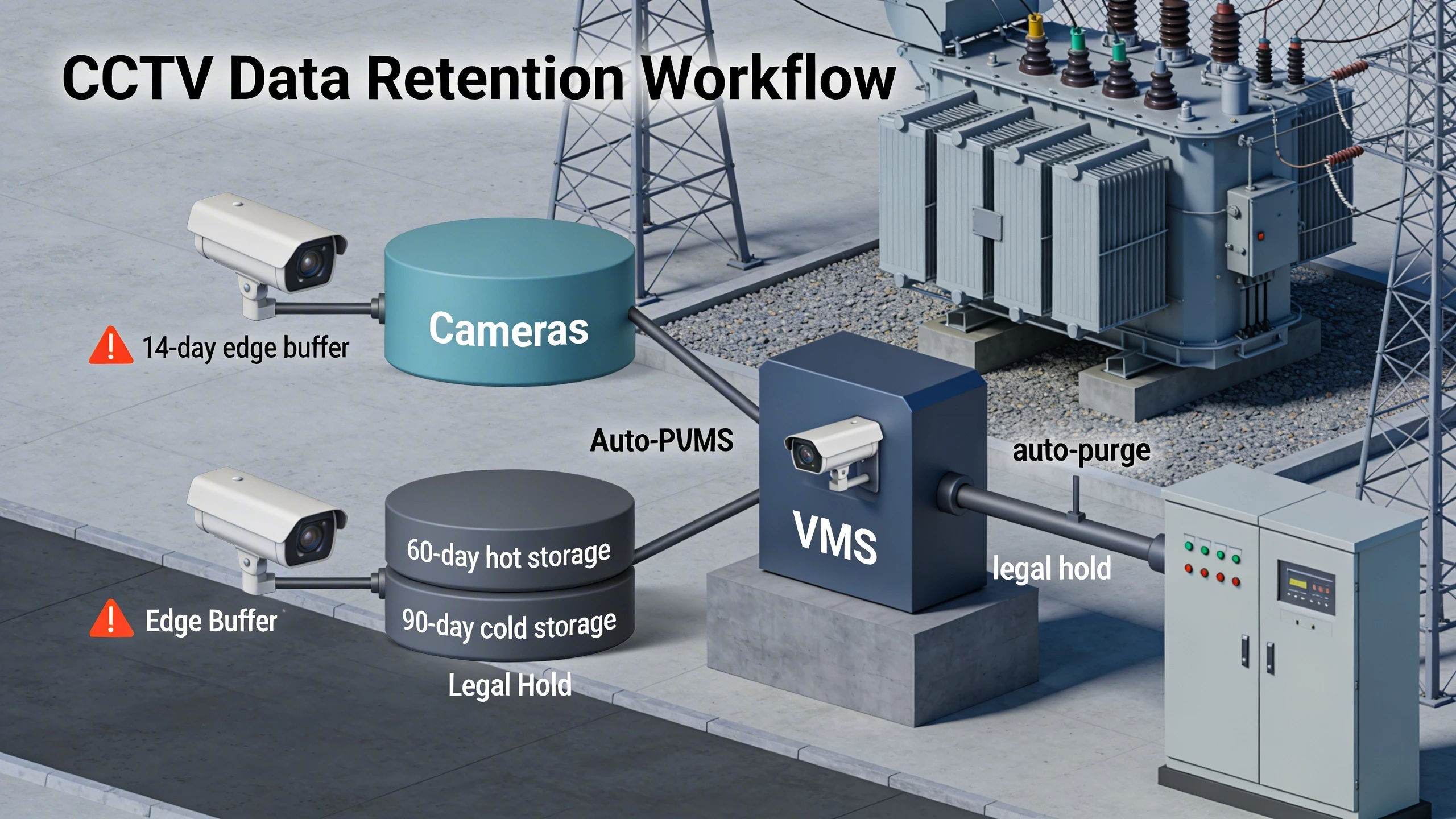
Effective designs start by mapping retention needs to storage tiers: hot access for recent clips, cold archives for legal holds, and automated deletion for routine overwrites. This layered approach ensures footage availability during inquiries while minimizing exposure to data breaches or regulatory scrutiny.
What the design decision looks like in practice
In a campus-wide CCTV refresh, the design decision manifests as a retention matrix tailored to camera zones. Perimeter feeds retain full-resolution video for 60 days to cover theft investigations, while lobby cameras downsample after 30 days to comply with privacy guidelines. Integrators implement this via VMS software rules that tag clips by motion events or AI-detected anomalies, extending holds only on export requests.
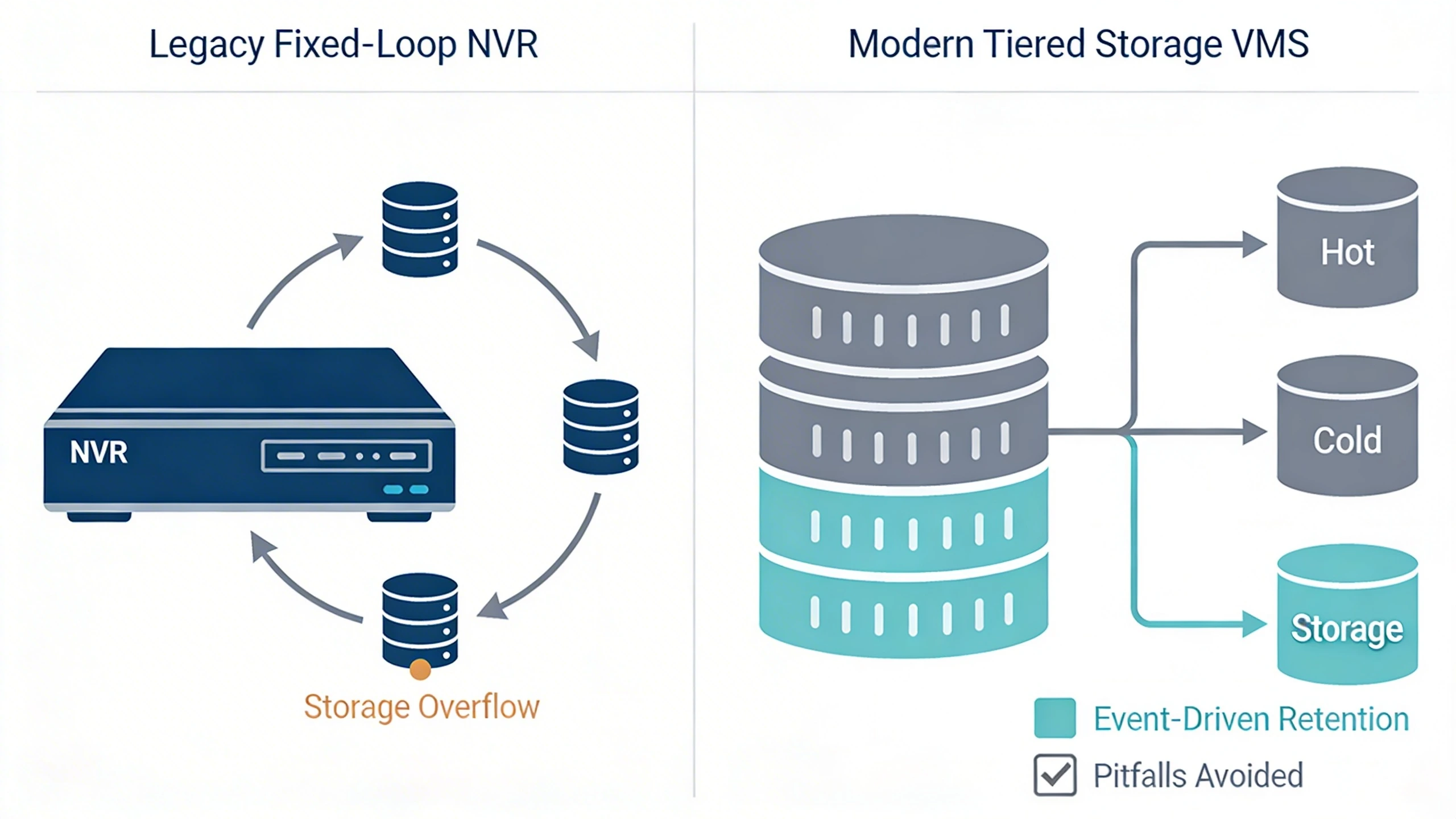
Consider a hospital annex retrofit: engineers configure dual pipelines, one for 7-day HIPAA-mandated access and another for 45-day premises security. Field teams test these by simulating export workflows, verifying that purge jobs run nightly without interrupting active searches. This granular control prevents the all-or-nothing pitfalls of fixed-loop NVRs, where uniform overwriting erases key evidence prematurely.
Real-world validation comes during commissioning walks, where stakeholders review sample timelines. A utility site might demo how a flagged intrusion clip migrates from edge storage to central archive, complete with chain-of-custody logs. Such practices ground abstract policies in tangible system behaviors, fostering buy-in from IT managers wary of compliance gaps.
System architecture and integration considerations
Architecture begins with storage hierarchies that support variable retention: SSD arrays for high-access recent footage, HDD tiers for mid-term holds, and optional cloud offload for indefinite legal archives. VMS platforms must expose APIs for retention scripting, allowing integration with SIEM tools that flag events for extended keeps. In hybrid setups, edge recorders buffer during network outages, syncing policies upon reconnection to maintain compliance continuity.
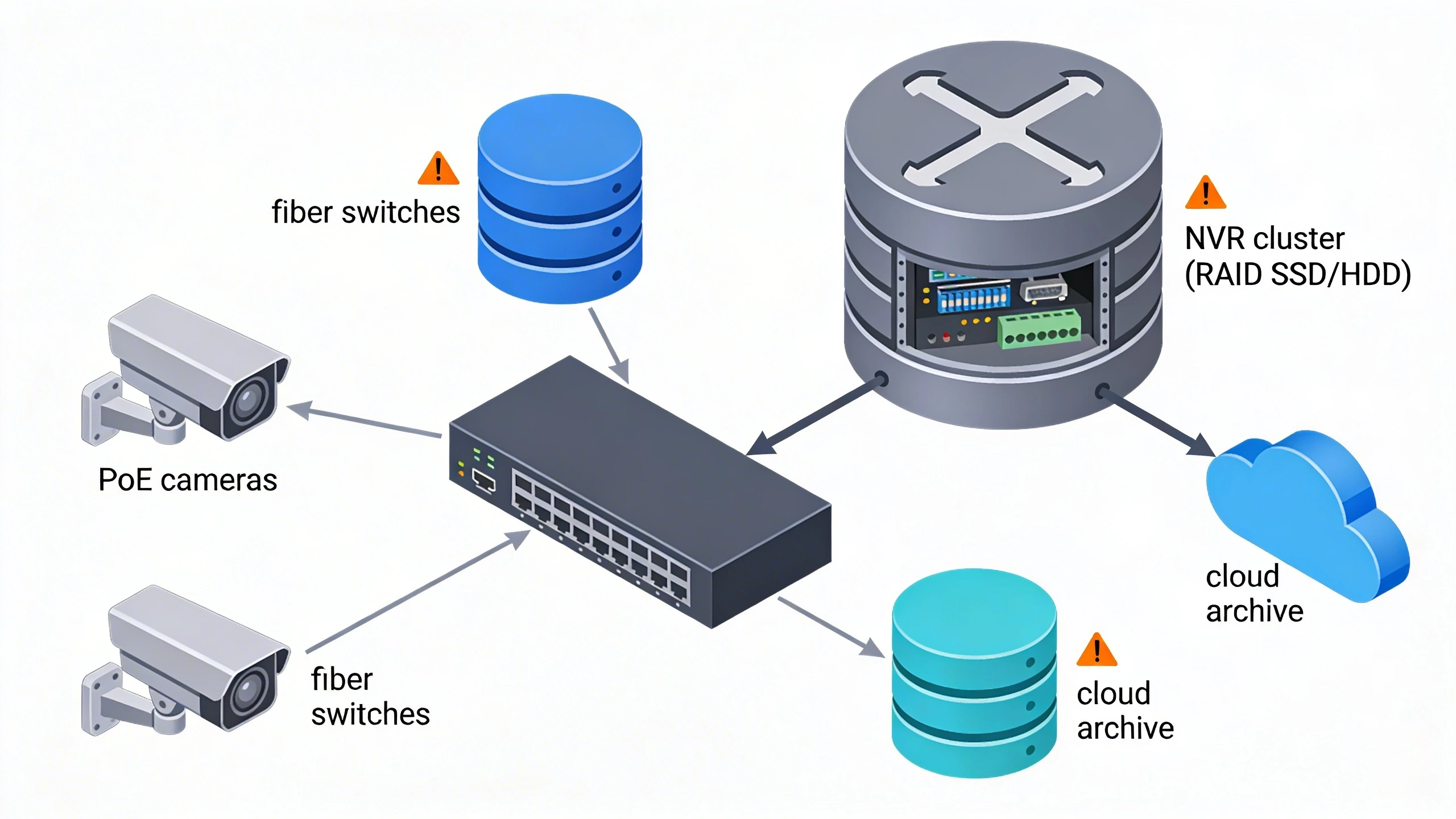
Integration challenges arise at scale, such as a 200-camera utility perimeter. Here, ONVIF-compliant heads feed a central NVR cluster with RAID redundancy, while metadata streams—timestamps, camera IDs, event scores—populate a separate SQL database for fast querying. Designers weigh fiber backbones against PoE switches, ensuring bandwidth reserves 20-30% headroom for 4K streams at peak retention loads. Encryption at rest and in transit becomes non-negotiable, layered with role-based access to audit who views what.
For multi-vendor environments, protocol bridges smooth data flows, but test thoroughly for timestamp fidelity. A mismatched clock can invalidate footage chains, turning compliant designs into evidentiary liabilities.
Operational workflows and field constraints
Daily operations demand workflows that enforce retention without manual intervention. Operators schedule purge windows during off-peak hours, using VMS dashboards to monitor fill rates and project overflow risks. Training emphasizes legal hold procedures: right-click export with watermarking, notifying compliance officers before deletion overrides.
Field constraints hit hardest in remote sites, like solar farms with intermittent power. Here, solar-powered edge units retain 14 days locally, bursting to central servers on satellite links. Technicians carry mobile apps for on-site verification, confirming policy syncs before departing. Bandwidth throttling prioritizes events over baselines, preserving compliance under constrained pipes.
Audit prep involves quarterly reports: storage utilization curves, access logs, purge confirmations. Teams that automate these escape the drudgery of manual audits, freeing focus for proactive threat hunting.
Common failure points and design mistakes
Overlooking scalable storage dooms many retrofits; a 50-camera build starts fine at 30 days but chokes at 90 when resolution upgrades. Designers fix this by forecasting petabyte growth, opting for modular NAS over fixed NVRs. Another pitfall: ignoring privacy zones, where public paths retain blurred proxies while secure areas keep full detail—misconfigure, and fines follow.
Event detection false positives trigger needless extensions, bloating archives. Tune AI thresholds post-install, validating against site-specific baselines. Neglected backups surface during ransomware hits; dual-site mirroring with immutability flags averts total loss.
Procurement shortcuts amplify risks: cheap heads lacking secure boot invite tampering, undermining retention integrity. Field swaps for non-compliant gear cascade into re-certification nightmares.
What to verify before procurement
Scrutinize VMS feature matrices for native retention engines: policy templates, event-based extensions, auto-purge scheduling. Request demos of chain-of-custody exports, ensuring metadata embeds without alteration. Probe storage APIs for custom integrations, confirming scalability benchmarks match your camera count and framerates.
Hardware checklists cover encryption standards, failover clustering, and power-loss recovery. Vendor audits reveal real-world MTBF; dismiss puffery for third-party validations. Compliance mappings—GDPR storage limits, regional variances—must align without custom hacks.
Finally, simulate load tests: populate archives, trigger purges, query under stress. Weak performers expose themselves early, saving retrofit regrets.
Where to go next
Explore FortSense 4 for built-in retention management in compliant deployments. For tailored advice, request a design review. See case studies in critical infrastructure security and North America deployments.