Retrofitting security systems at a sprawling utility site or multi-building campus often boils down to one pivotal architecture choice: handle events at the edge, on the devices themselves, or funnel them all to a central processor. Integrators tackling these projects in bandwidth-constrained environments, like those with legacy Cat6 runs or wireless backhaul, quickly realize edge processing lightens the load by filtering irrelevant motion or door ajar alerts locally. Meanwhile, central processing shines when you need a single pane for correlating camera feeds with access logs across the site.
Consider a typical upgrade scenario: a North American critical infrastructure deployment with dozens of doors and IP cameras. Edge setups let controllers deny access based on local rules before pinging the headend, slashing network chatter during peak hours. Central approaches demand robust uplinks to avoid bottlenecks, but they enable advanced analytics like behavioral baselines drawn from the full dataset. The migration path isn't binary—many sites evolve toward hybrid models, starting with edge for reliability and layering central oversight as infrastructure matures.
This comparison draws from hands-on experience with systems like FortSense 4, where edge reduces latency for time-sensitive responses, yet central processing unifies compliance reporting. What follows unpacks the shifts you'll encounter, grounded in retrofit realities rather than lab benchmarks.
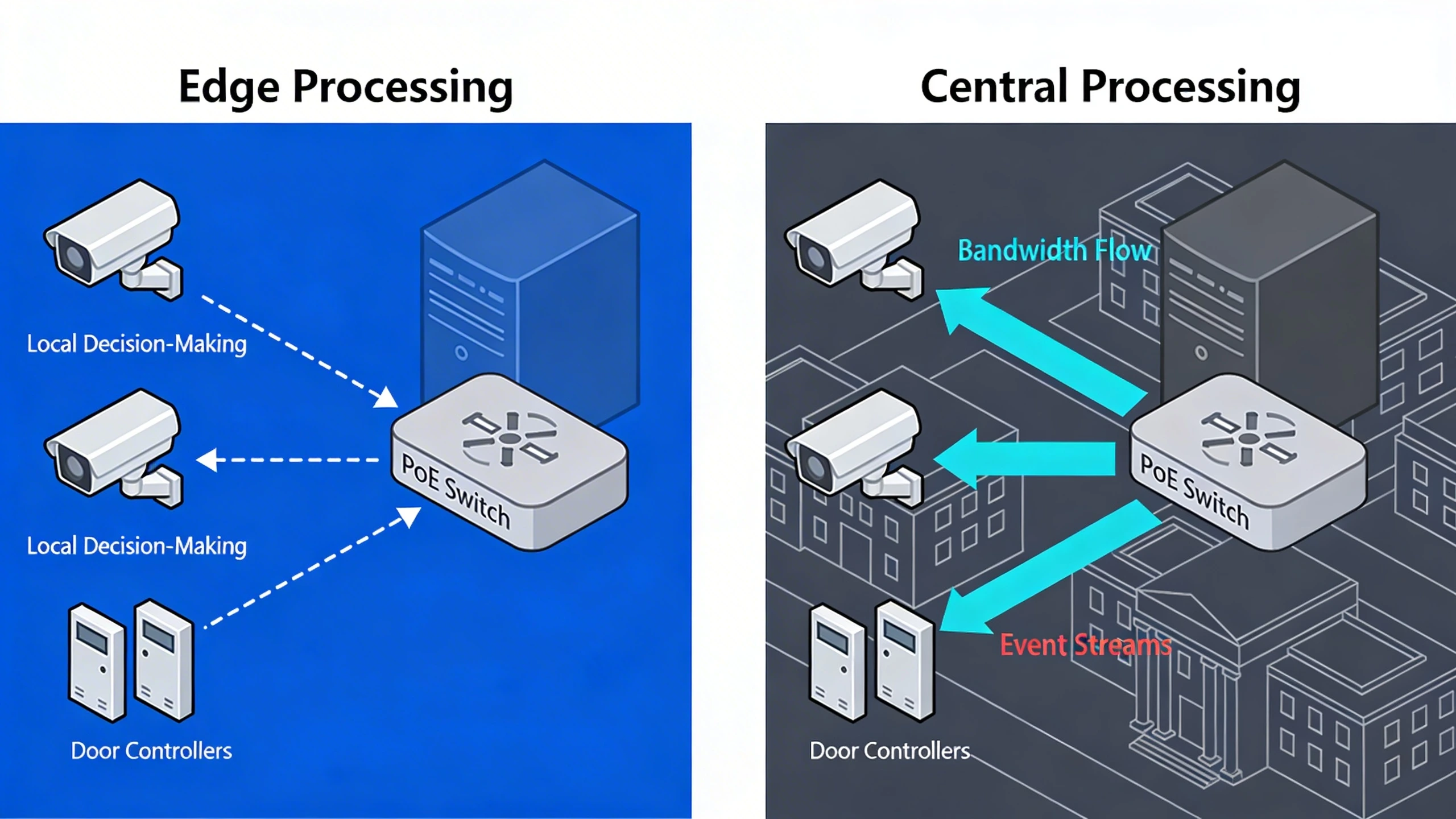
What changes in real deployments
Shifting from central to edge processing transforms daily operations at sites like manufacturing plants or data centers, where event volume spikes unpredictably. In a central model, every sensor ping—door opens, motion detected—travels the full network path, taxing switches and inviting delays if a segment flakes. Edge flips this: devices preprocess, discarding 90% of noise via onboard logic, so only verified threats hit the wire. Teams retrofitting older campuses report smoother scaling, as edge distributes compute away from a single point of overload.
Deployment workflows adjust too. Provisioning edge means firmware updates per device, coordinated via tools like ONVIF profiles for cameras—check the ONVIF glossary for basics. Central setups centralize config pushes, easing mass changes but amplifying downtime risks during server maintenance. In practice, edge deployments demand upfront validation of device IQ, ensuring consistent local rules without drift. A utility retrofit I led saw event logs drop from gigabytes to megabytes daily, freeing storage for forensic deep dives.
Operational cadence evolves: monitoring shifts from server CPU graphs to distributed health checks. Integrators must train ops teams on edge diagnostics, like querying a door controller's local cache, versus central's unified dashboard. Get this wrong, and siloed troubleshooting drags response times.
Security and reliability differences
Security postures diverge sharply between edge and central, especially in high-stakes critical infrastructure security environments. Edge processing embeds decisions in tamper-resistant hardware, enforcing policies like geofence alerts even if the network drops. This air-gapped resilience thwarts man-in-the-middle attacks on event streams, but introduces risks if a compromised device goes rogue—local rules must sync securely via encrypted bootstraps. Central models consolidate defenses at the headend, applying uniform encryption and anomaly detection across feeds, though they expose more surface area to DDoS or uplink sabotage.
Reliability plays out in failover: edge survives WAN outages by logging locally and batch-uploading later, critical for remote substations. Central demands redundant paths, like dual NICs or SD-WAN, to maintain quorum. Timing precision factors in—edge might drift without NTP syncing, misaligning multi-device events, while central enforces site-wide clocks. Real-world audits reveal edge cuts false positives in noisy areas, boosting alert fatigue resistance, but central's holistic view catches subtle patterns like insider threats spanning zones.
Balancing both requires hardening: edge with signed firmware, central with zero-trust segmentation. Missteps, like unpatched edge devices, cascade failures; overlooked central redundancy leaves sites blind.
Wiring, topology, and integration implications
Wiring legacies dictate feasibility—edge thrives on star topologies with PoE switches feeding endpoints, minimizing backbone traffic. A multi-door building retrofit might reuse existing runs for edge, as controllers handle analytics over 100Mbps links without choking. Central demands gigabit uplinks end-to-end, often requiring fiber pulls or VLAN rejigs, escalating costs in spread-out campuses. Integration with third-party panels simplifies on edge via local protocols, avoiding chatty polling.
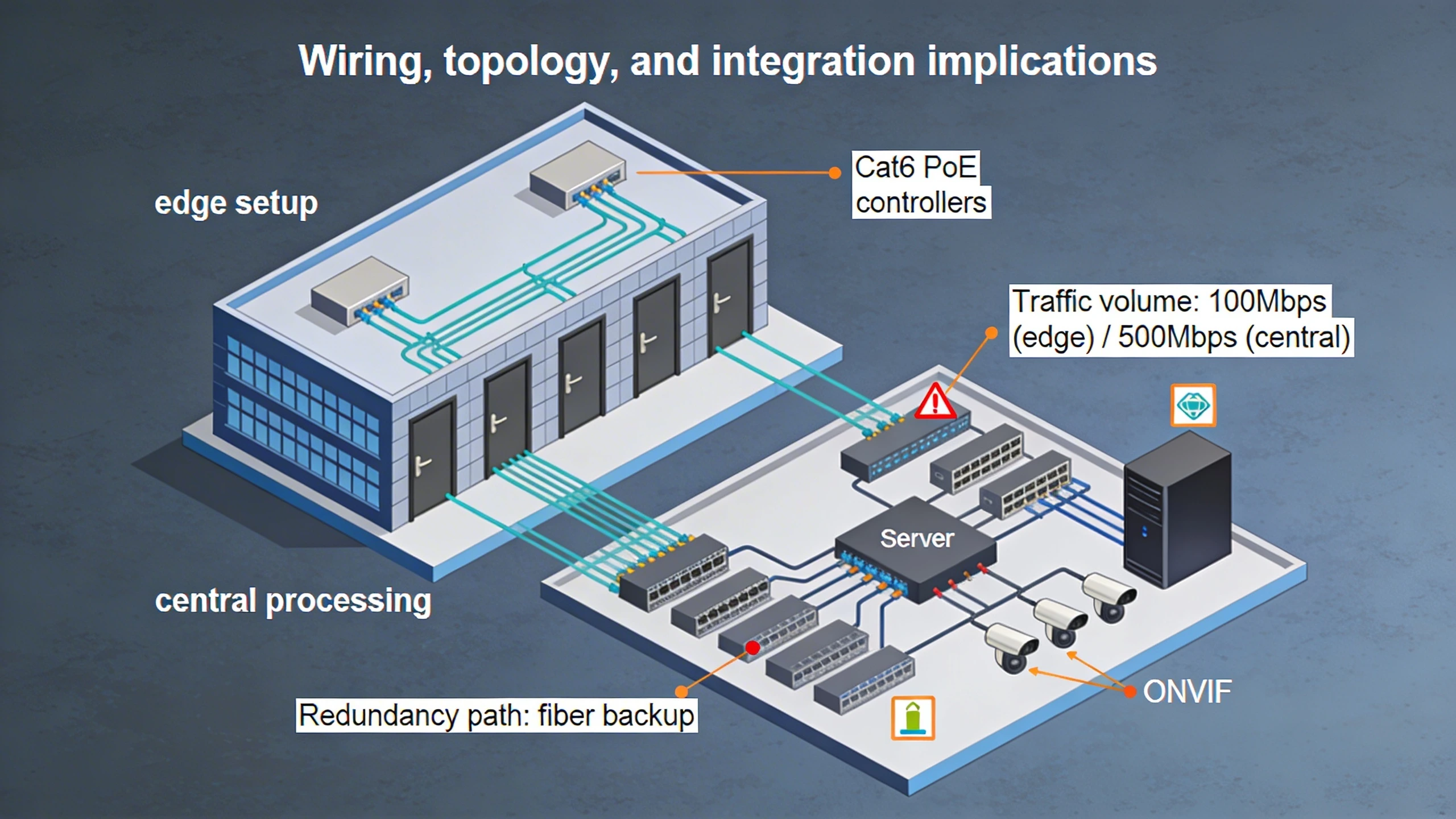
Topology shifts favor mesh-like edge for redundancy: devices peer for heartbeats, bypassing a downed switch. Central relies on hierarchical spines, vulnerable to core failures. For ONVIF cameras, edge offloads metadata extraction, easing SIP trunking to VMS. Teams overlook PoE budgeting at their peril—edge's onboard compute draws more watts, straining injectors. In utility sites, edge's low-bandwidth profile suits microwave links, where central would saturate spectra.
Hybrid topologies emerge as best practice: edge for perimeter, central for fusion centers. Validation checklists ensure cabling meets spec—test loops for latency under load.
Migration planning and common failure points
Migrating demands phased rollouts: start with edge pilots on non-critical doors, benchmarking event throughput against baselines. Map dependencies—central users need export scripts for historical data, while edge requires rule porting tools. Common pitfalls include underestimating sync overhead; initial edge onboarding floods NTP servers, desyncing clocks. Budget for dual-mode firmware, allowing cutover without rip-and-replace.
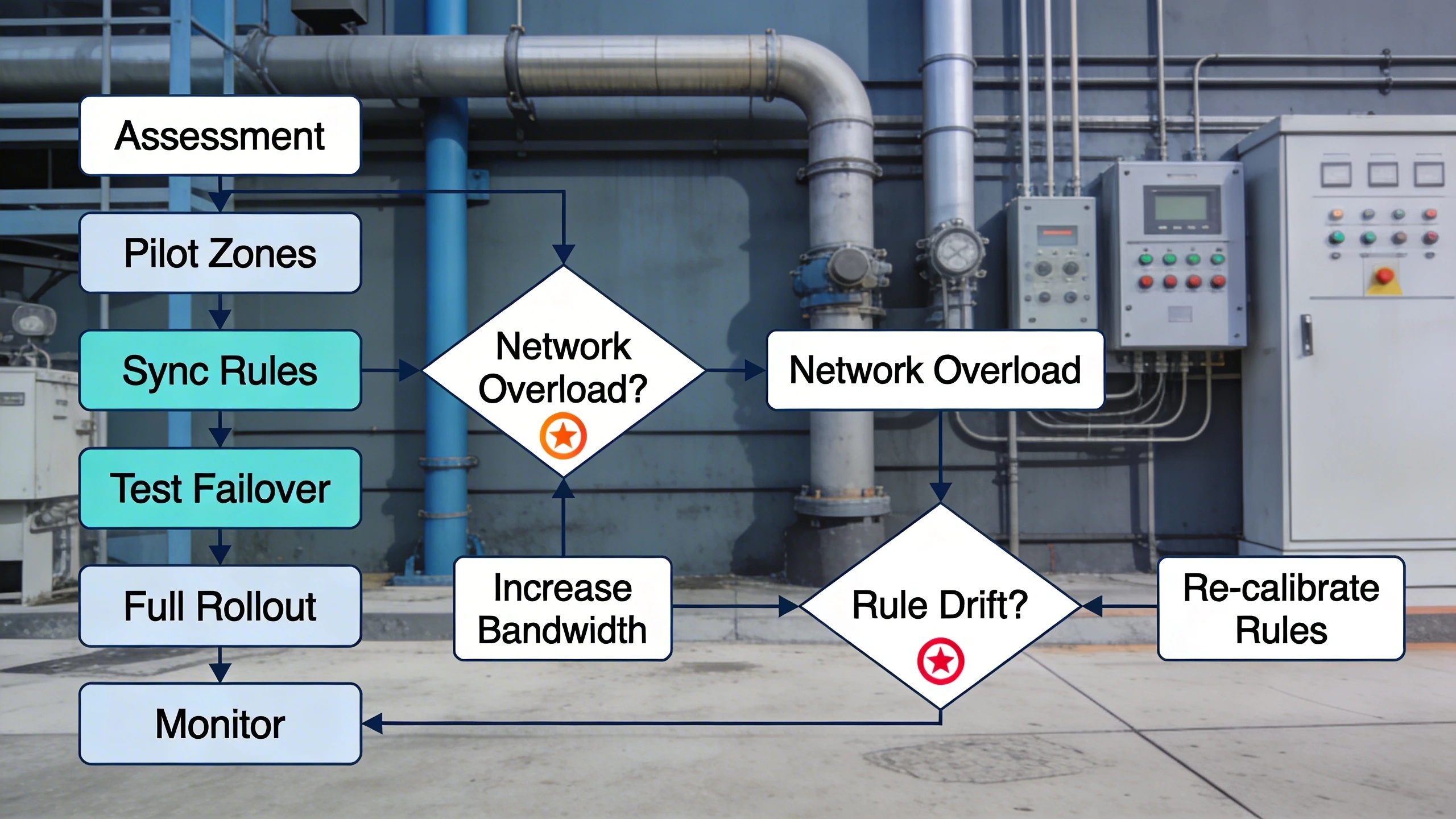
Failure points cluster around testing: simulate brownouts to verify edge autonomy, or spike tests for central scalability. Integrators falter by skipping rollback plans—staged by zone, with canary deployments. In a campus migration, mismatched device capabilities stranded legacy controllers, forcing hybrid patches. Document variances early, aligning vendor roadmaps.
Post-migration, monitor drift: edge rules diverge without auto-sync, eroding policy fidelity. Success metrics focus on MTTR and bandwidth headroom, not just uptime.
Where each approach still fits
Edge dominates latency-bound scenarios, like perimeter gates or remote sensors, where sub-100ms responses prevent breaches. It fits brownfield retrofits with constrained pipes, distributing risk across endpoints. Utilities lean edge for offline resilience, pairing with cellular failover.
Central endures in fusion-heavy ops, correlating disparate sources for SIEM feeds or regulatory logs. Greenfields with fiber embrace it for AI-driven insights. Hybrids bridge: edge preprocesses, central orchestrates.
Selection pivots on threat model—edge for isolated resilience, central for correlated intelligence.
Where to go next
Evaluate your site's topology against these patterns with FortSense 4 simulations. For tailored advice on critical infrastructure security, request a design review. Explore North America deployments for case parallels.
Image Production Brief (Internal - Remove Before Publish)
Recommended image count: 3
- Placement: After the introduction
Insert After: Introduction
Purpose: Visually contrasts basic topologies early, reinforcing the intro's retrofit framing and helping readers grasp core differences before diving into sections.
Prompt: Create a clean technical diagram side-by-side: left panel shows edge processing topology with cameras and door controllers making local decisions, minimal arrows to central server; right panel shows central processing with heavy event streams from all devices to server. Include PoE switches, campus layout, labels for bandwidth flow. Blue tones for edge, red for central.
Alt Text: Side-by-side topology diagram: edge vs. central processing - Placement: After the wiring section's second paragraph
Insert After: Wiring, topology, and integration implications
Purpose: Illustrates wiring and topology implications concretely, aiding integrators visualizing retrofit changes in cabling and switch configs.
Prompt: Detailed wiring diagram for a multi-door building: top half edge setup with PoE runs to local controllers, sparse backbone; bottom half central with gigabit uplinks and VLANs to server. Show cable types (Cat6, fiber), switch ports, integration points for ONVIF cameras. Annotations for traffic volume and redundancy paths.
Alt Text: Wiring and topology comparison for edge vs. central in a building retrofit - Placement: After the migration section
Insert After: Migration planning and common failure points
Purpose: Provides a step-by-step visual for migration planning, highlighting phases and pitfalls to guide practical execution.
Prompt: Flowchart for migrating from central to edge processing: start with assessment, pilot zones, sync rules, test failover, full rollout, monitor. Include branches for pitfalls like 'network overload' or 'rule drift' with mitigation icons. Utility site background, technical style with decision diamonds.
Alt Text: Migration flowchart from central to edge processing with common failure points