When retrofitting perimeter security at a sprawling utility substation, the existing chain-link fence often presents the first hurdle. Years of weathering have left it sagging in places, with loose mesh and corroded posts that undermine even the most advanced sensors. Vibration-based detectors, for instance, register excessive false alarms from wind rattling the fabric, while taut-wire systems fail to maintain consistent tension. Integrators quickly learn that sensor performance hinges not just on the technology itself, but on the fence's structural integrity.
This mismatch becomes evident during site surveys for high-stakes deployments, such as campus expansions or industrial parks. A poorly conditioned fence amplifies nuisance alerts, erodes operator trust, and inflates maintenance costs. Conversely, addressing fence condition upfront—through tensioning, reinforcement, or outright replacement—unlocks the full detection accuracy of modern sensors. The primary takeaway for security managers: prioritize a fence audit as the foundation of any sensor upgrade, ensuring the physical substrate supports reliable intrusion detection without constant tuning.
Design teams face a spectrum of options, from minimally invasive fabric tightening to full mesh overhauls. Selecting the right balance depends on the site's threat model, budget constraints, and operational downtime tolerance. What follows is a field-tested framework drawn from real-world integrations, focusing on how to align fence condition with sensor demands for sustained performance.
What the design decision looks like in practice
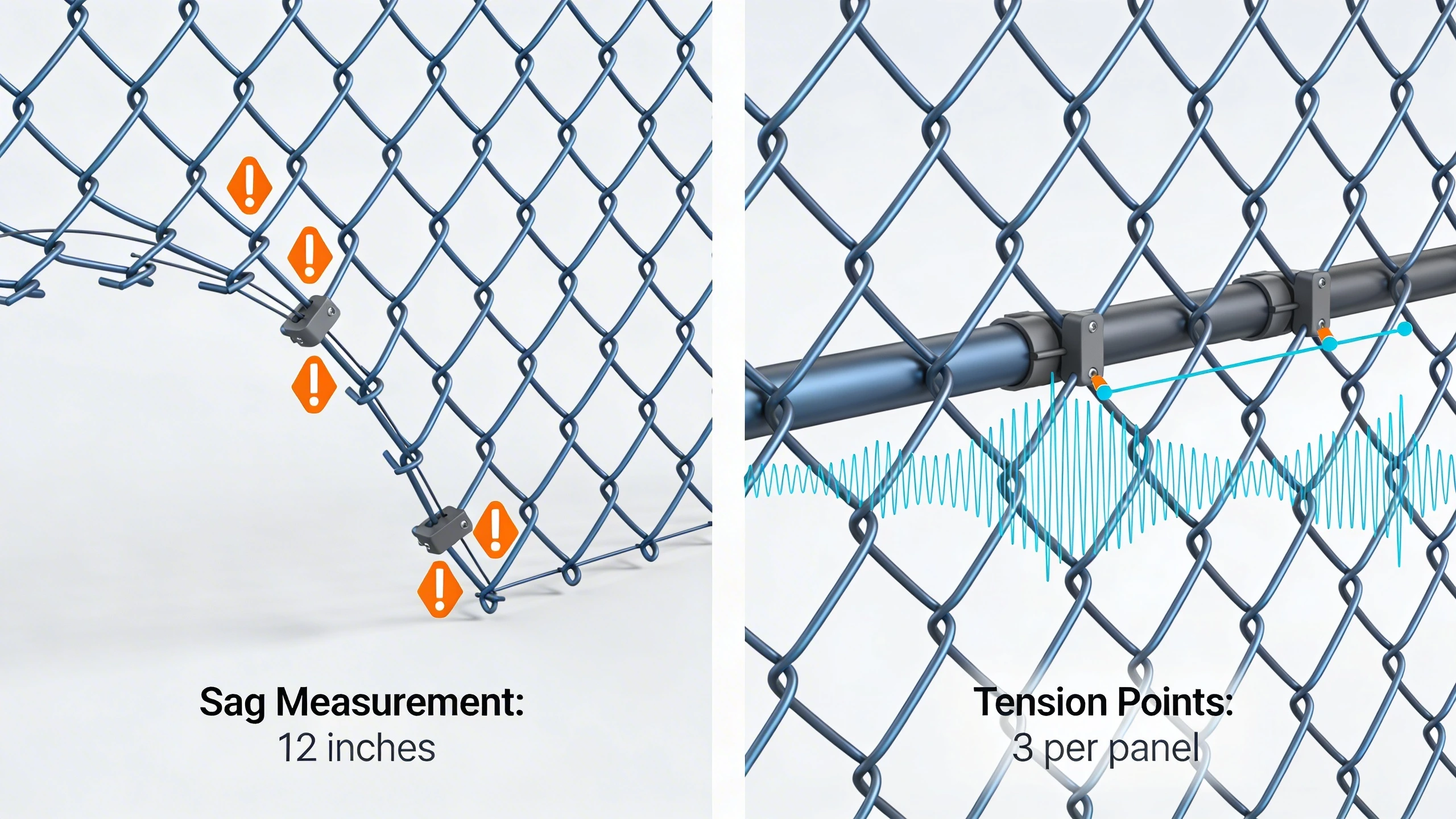
In a typical retrofit at a North American energy facility, the process starts with climbing the fence line—literally—to assess sag, mesh integrity, and post alignment. A fence in good condition, with taut fabric under 5% deflection under load, pairs seamlessly with piezoelectric vibration sensors, delivering precise climb and cut detection. Degraded fences, however, demand preconditioning: workers tension the mesh using come-alongs or replace sections with climbing-resistant fabric, transforming erratic sensor outputs into stable baselines.
Consider a multi-phase campus perimeter upgrade. Phase one targets high-risk gates with rigid panel fences suited for fiber-optic distributed acoustic sensing (DAS), where uniform tension ensures signal clarity. Later phases extend to chain-link spans, requiring intermediate bracing to mimic that rigidity. This staged approach minimizes disruption while scaling performance. Field engineers report that such decisions cut false alarm rates dramatically, though the real win lies in predictive maintenance: sensors now flag fence degradation before it impacts detection.
Documenting these changes via pre- and post-install photos establishes a performance baseline. Operators then monitor via integrated dashboards, correlating environmental data like wind speed with alert patterns to refine thresholds over time.
System architecture and integration considerations
At the architectural level, fence condition dictates sensor topology. For expansive sites, a hybrid setup might combine point sensors on braced fence sections with continuous line-sensing along taut spans. Integration with central management platforms requires processors that compensate for fabric variances—advanced signal analytics filter out sag-induced noise, but only if the fence baseline is calibrated post-tensioning. Poorly integrated systems overlook this, leading to fragmented data flows where gate sensors outperform field spans.
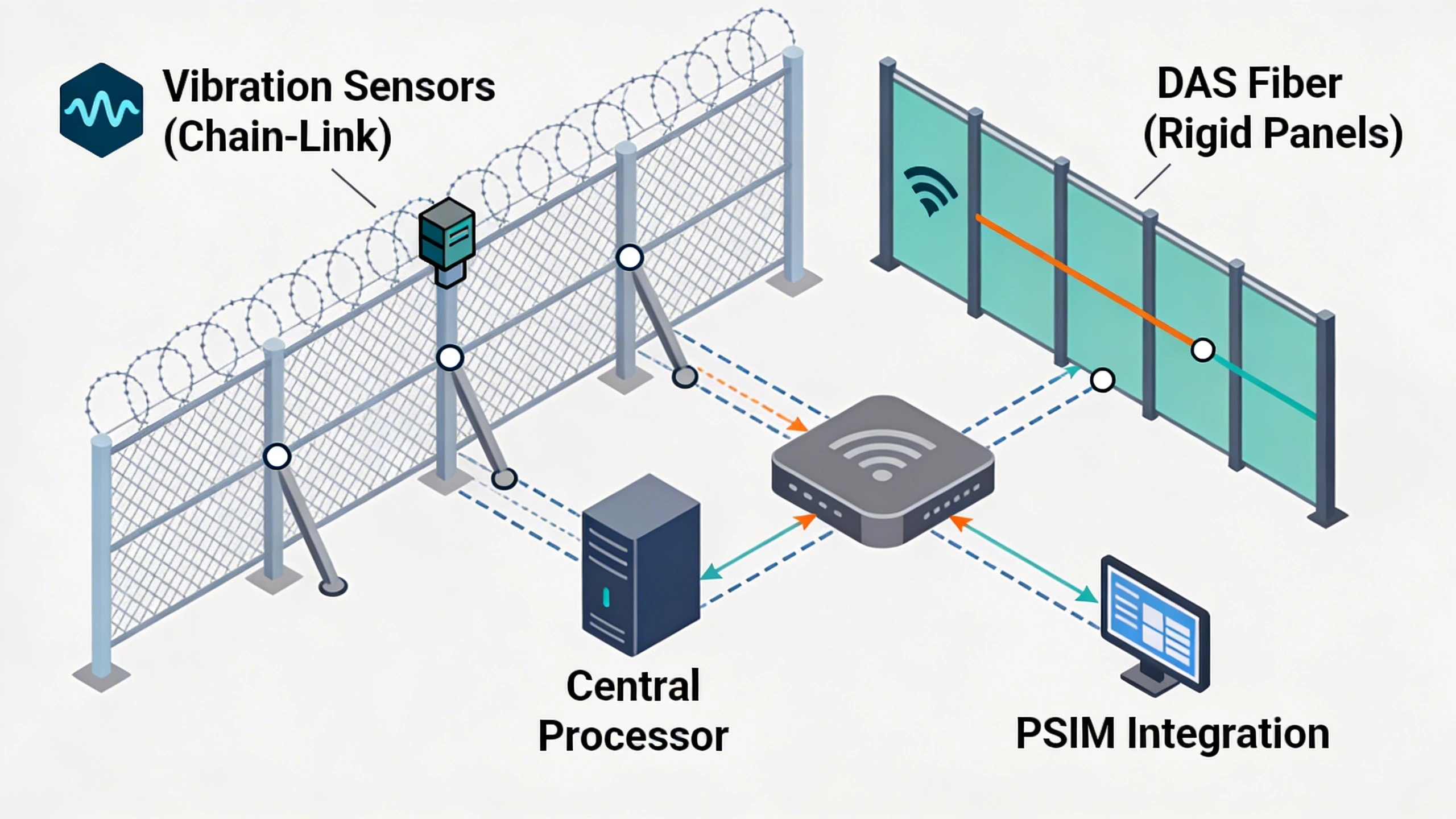
Wiring runs add another layer: sensors on flexible fences need strain-relief conduits to handle sway, while rigid topologies allow direct burial. When tying into broader PSIM environments, ensure APIs handle condition metadata, such as real-time tension readings from embedded gauges. This enables dynamic alerting, where a loosening post triggers preemptive alerts independent of intrusion events. In practice, overlooking these ties results in siloed operations, where fence maintenance lags behind sensor tuning.
- Map sensor zones to fence condition gradients, using GIS overlays for planning.
- Incorporate environmental sensors (anemometers, inclinometers) to normalize performance data.
- Test integration under load: simulate climbs on conditioned vs. unconditioned sections.
Operational workflows and field constraints
Daily operations reveal how fence condition shapes workflows. Maintenance crews must routinely inspect tension via plumbs or laser levels, a task simplified on modular fences but arduous on legacy chain-link. During storms, loose fabric generates alert storms, forcing operators to cross-reference video feeds—assuming RTSP streams are stable. Well-conditioned fences reduce this cognitive load, allowing focus on verified threats.
Field constraints like terrain amplify challenges: sloped sites exacerbate sag, necessitating terraced bracing. Seasonal vegetation growth can mimic intrusions on untensioned mesh, so workflows include quarterly fabric clears. Training emphasizes this interplay—technicians learn to adjust sensor sensitivity post-maintenance, ensuring performance consistency. Neglect here leads to alert fatigue, where operators mute zones entirely.
Scalable workflows leverage mobile apps for tension logging, feeding into analytics for trend prediction. At remote utility perimeters, solar-powered nodes automate much of this, but initial fence prep remains manual and critical.
Common failure points and design mistakes
One prevalent mistake is deploying high-sensitivity sensors on subpar fences without preconditioning. Wind-whipped chain-link overwhelms vibration detectors, flooding systems with false positives that erode confidence. Another pitfall: ignoring post-install settling, where initial tension fades, silently degrading performance until a breach exposes the gap.
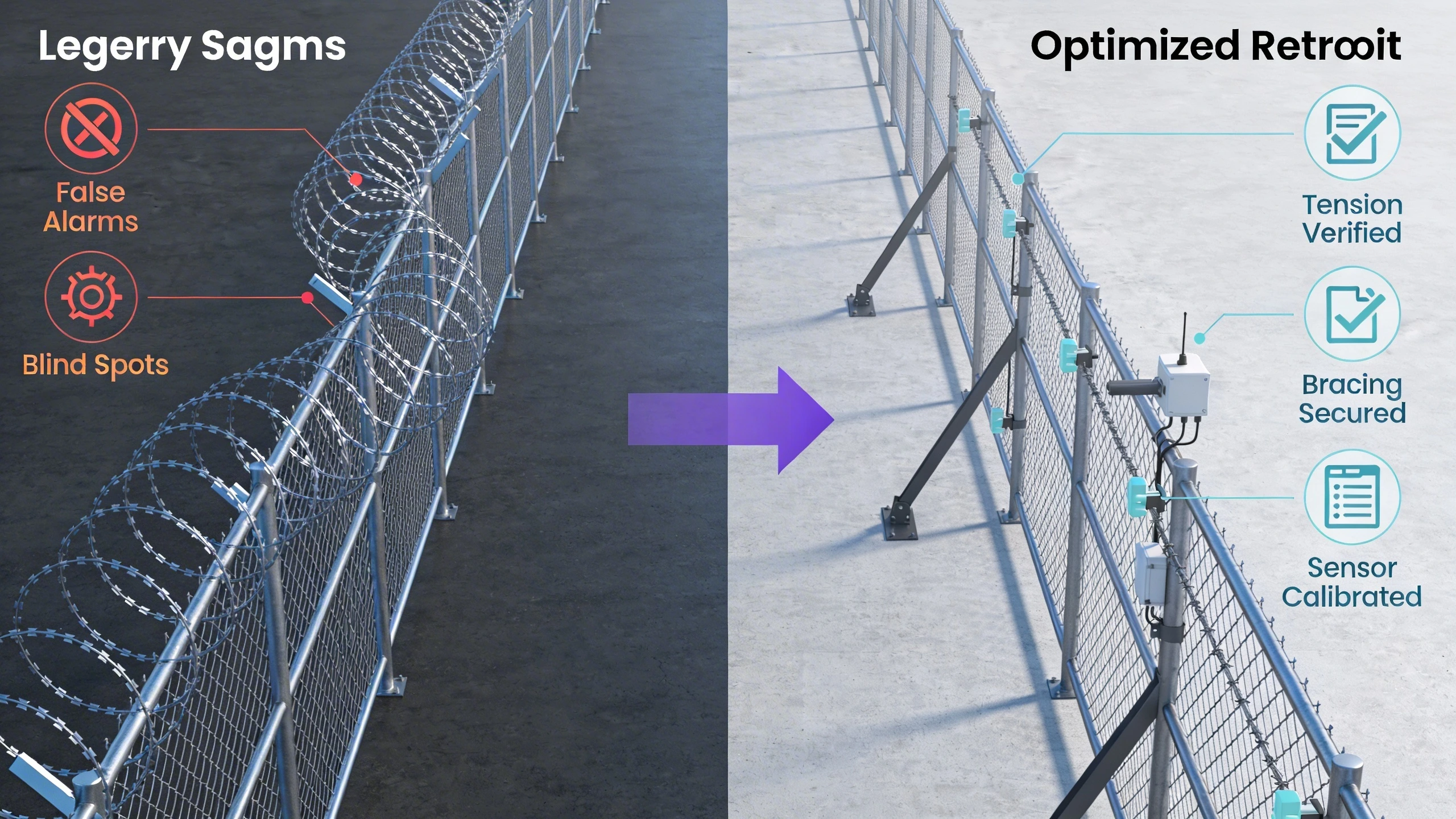
Design oversights include mismatched topologies—applying linear fiber to corrugated fencing distorts signals, while uneven bracing creates blind spots. Procurement teams sometimes chase specs on paper, skipping field mocks that reveal fabric-sensor incompatibilities. In multi-vendor environments, mismatched calibration protocols compound issues, as one system's taut baseline clashes with another's.
- Failure to baseline pre-install: Always log deflection metrics.
- Overlooking galvanic corrosion: Mesh degradation alters vibration propagation.
- Inadequate load testing: Simulate 50 mph gusts during commissioning.
What to verify before procurement
Before committing, conduct a fence condition survey using standardized metrics: measure sag at 10-foot intervals, inspect weld integrity, and test fabric stiffness under lateral force. Cross-reference against sensor datasheets—vibration types demand under 2-inch deflection, while inertial systems tolerate more. Vendor demos should include your fence samples to validate claims.
Review integration roadmaps: Does the solution expose condition telemetry? Probe scalability for phased rollouts and compatibility with existing cabling. Site-specific factors like soil type influence post stability, so geotech input is essential. Finally, audit service SLAs for ongoing tension maintenance, as sensor warranties often exclude fence-related failures.
Armed with this, procurement shifts from cost to total ownership, prioritizing systems that adapt to real-world fence dynamics.
Where to go next
Explore FortSense 4 for adaptive perimeter solutions that incorporate fence condition analytics. For tailored advice on your site, request a design review. Dive deeper into critical infrastructure security applications or review case studies from North America deployments.