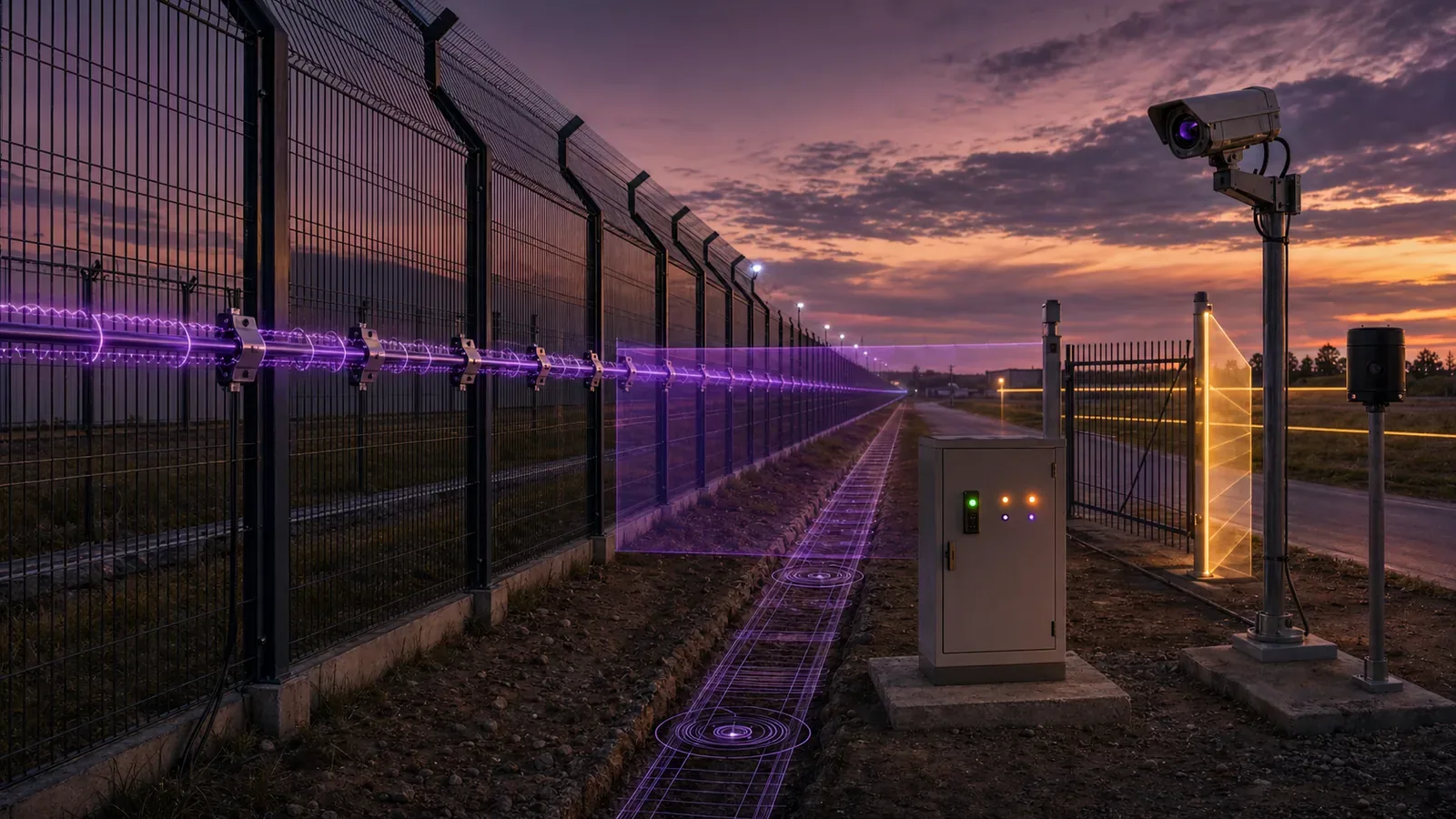
Perimeter protection is a first layer of security for sites like solar plants, industrial facilities, residential complexes, logistics centers, ports, and data centers. A fence is often the physical boundary—but without detection, it is also a silent boundary.
Fence sensors add detection to the fence line by turning physical activity (cutting, climbing, lifting, impacts, digging near the fence) into actionable alarms that can be verified and responded to in real time.
This article explains what fence sensors are, how they work, the main sensor types, and where each fits best —with a practical comparison you can use during system design.
What are fence sensors?
Fence sensors are perimeter security devices installed on or near a fence to detect intrusion attempts by measuring physical changes such as vibration, strain, displacement, or acoustic/mechanical activity.
Fence sensors are typically used to:
- Detect cutting, climbing, lifting, and impact events on the fence
- Identify abnormal vibration patterns versus normal fence movement (wind, rain, wildlife)
- Trigger alarms with zone-based or point-based location
- Integrate alarms into VMS, access control, intrusion panels, or automation platforms
How do fence sensors work? (step-by-step)
1. A sensing element is coupled to the fenceExamples: vibration modules, piezo elements, microphonic cables, or fiber optic cable mounted to the fence mesh/rails.
2. Fence activity creates a measurable physical signalCutting and climbing create distinct vibration/strain signatures; wind and rain create different, often lower-confidence patterns.
3. The sensor converts motion into an electrical/optical changeConventional sensors convert mechanical energy into electrical signals. Fiber systems detect changes in light behavior caused by vibration along the cable.
4. A controller acquires and digitizes the signalThe controller samples the signal over time and prepares it for analysis.
5. Signal processing extracts featuresTypical features include amplitude, frequency content, duration, repetition rate, and spatial correlation across sections of fence.
6. Classification separates intrusion from nuisanceAlgorithms compare patterns to known event classes (cut, climb, lift, impact) and suppress likely nuisance sources.
7. The system triggers an alarm with location dataDepending on technology, location is reported as a zone, a fence segment, or a meter-based position.
8. Integrations support verification and responseThe alarm can cue cameras, notify operators, activate lighting, lock gates, or raise alerts in SOC software.
Main types of fence sensors (with practical pros/cons)
1) Vibration sensors (discrete modules)
These are commonly used due to straightforward installation and lower entry cost. They detect vibration generated by cutting, climbing, or impacts.
Where they fit well
- Short-to-medium fence runs
- Lower-to-medium risk sites
- Projects where zoning can be coarse (segment-level)
Typical limitations
- Higher nuisance alarms in wind-heavy areas or where vegetation touches the fence
- Localization is often limited to the module/segment, not a precise point
- Performance depends heavily on tuning and fence mechanical properties
2) Piezoelectric sensors (cables or elements)
Piezoelectric systems generate electrical signals when mechanically deformed. When attached along a fence line, they can provide continuous sensing along the cable path.
Where they fit well
- Controlled environments
- Smaller perimeters
- Sites where fast response and sensitivity are priorities
Typical limitations
- Often requires power or electronics distributed along the perimeter
- Environmental nuisance can require sensitivity retuning
- Long-term maintenance can be higher depending on installation and cable exposure
3) Microphonic cables
Microphonic cables detect mechanical/acoustic disturbances along the cable length. They can be effective for fence-mounted disturbance detection and are frequently deployed in distributed layouts.
Where they fit well
- Perimeters needing continuous cable coverage
- Sites where uniform detection coverage matters
Typical limitations
- Susceptible to nuisance without strong filtering and installation discipline
- May require periodic reconfiguration as the fence ages, tension changes, or site conditions shift
4) Fiber optic intrusion detection (distributed sensing)
Fiber optic systems can treat the fiber as a continuous sensing line. In many deployments, a single cable run provides long-range coverage and supports zone or distance-based localization.
Where it fits well
- Long perimeters (utility-scale sites, logistics, industrial, airports)
- High electromagnetic environments (substations, heavy industry)
- Sites prioritizing low field maintenance and high uptime
Typical advantages
- No power/electronics on the fence line (depending on architecture)
- Immunity to EMI/RFI (useful near high-voltage or industrial equipment)
- Strong localization (zone-based and, in some systems, meter-based)
- Supports multi-event classification (cut, climb, lift, dig/approach—configuration dependent)
Real considerations (important for credibility)
- Up-front cost can be higher than basic vibration modules
- Installation quality matters: cable coupling, fence rigidity, and segment transitions affect results
- Controller placement, fiber routing, and splice/termination practices influence performance
Common applications of fence sensors (by environment)
- Solar power plants: long perimeters, wind exposure, remote operations → low nuisance + precise localization is valuable
- Industrial facilities: EMI-heavy areas, many vibration sources → filtering, zoning, and integration matter
- Logistics centers: frequent perimeter activity nearby → strong nuisance discrimination and fast camera call-up
- Residential complexes: privacy concerns + manageable perimeter lengths → zoning, aesthetics, and low maintenance
- Ports and airports: large-scale perimeters + high criticality → scalability, localization, integrations, uptime
Key advantages fence sensors provide (when designed correctly)
- Early detection at the boundary before an intruder reaches assets
- Faster response through location-aware alarms (zone/segment/meter)
- Reduced dependence on constant camera monitoring (cameras verify alarms instead of watching everything)
- Operational visibility (alarm history, hotspot analysis, maintenance insights)
- Privacy benefits vs. camera-only coverage in sensitive areas (sensor-first detection, camera-on-alarm strategy)
Technical comparison (quick decision view)
Coverage
- Vibration modules: segmented coverage
- Piezo/microphonic: cable-based coverage
- Fiber optic: long continuous coverage
False alarms (nuisance susceptibility)
- Vibration modules: medium to high (site dependent)
- Piezo/microphonic: medium (controller/filter dependent)
- Fiber optic: low to medium (strongly depends on analytics + installation)
Maintenance
- Vibration modules: periodic tuning, module checks
- Piezo/microphonic: tuning + cable condition checks
- Fiber optic: typically lower field maintenance; controller-centric upkeep
Privacy
- All: high, because they sense motion—not identity
- Best practice: camera verification only on alarm
Scalability
- Vibration modules: adds hardware per segment
- Piezo/microphonic: scalable but cable management grows
- Fiber optic: typically scales well for long perimeters
Operational cost (TCO)
- Vibration modules: low entry cost, potential higher tuning cost
- Piezo/microphonic: moderate, depends on environment
- Fiber optic: higher entry cost, often lower long-run maintenance in large deployments
Why the controller matters (for any fence sensor)
A fence sensor does not “decide” on its own. The controller determines the false-alarm rate and the usefulness of alarms by controlling:
- Sampling and filtering quality
- Event classification (cut vs. climb vs. nuisance)
- Zoning/localization logic
- Integration outputs (VMS, alarms, access control, automation)
- Health monitoring (fiber integrity, tamper states, device faults)
In practice, two systems with similar sensing elements can perform very differently because of controller analytics and setup discipline.
Example: what to look for in a fiber optic controller (and how FortSense 4 fits)
If you’re evaluating fiber optic intrusion detection controllers, useful technical criteria include:
- Event classification for common fence threats (cut, climb, lift/lean, impact; plus near-fence activity when supported)
- Robust nuisance filtering (wind, rain, wildlife, vegetation contact)
- Zone design tools (easy segmentation, consistent naming, map-based UI)
- Integrations (VMS, SOC platforms, alarm panels, access control, automation)
- Operational tooling (alarm replay, tuning workflow, health diagnostics)
FortSense 4® is an example of a controller designed for fiber optic perimeter intrusion detection. In technical terms, it emphasizes signal analysis, filtering, zoning, and integration features intended to reduce nuisance alarms while keeping detection sensitivity usable in complex environments.
Conclusion
Fence sensors are most effective when they are chosen based on environmental conditions, perimeter length, response workflows, and integration needs —not only on purchase cost.
Fiber optic sensing is often selected for large or complex perimeters because it can combine long-range coverage, strong localization, and EMI immunity , but performance still depends on controller analytics and installation quality .
A technical perimeter assessment helps define zoning strategy, nuisance sources, integration requirements, and the most cost-effective architecture for your specific site.
Recommended next steps
Use this article to shape requirements, then reviewFortSense 4to see how zone-based detection supports Agriculture environments and operational coverage in Latin America.
If you need a closer deployment reference, reviewAgricultureandLatin Americabefore locking your design assumptions.
You should also compare this guidance withFiber Optic vs Fence Sensors, What Is PIDS? Guide and Checklist, andFalse Alarms in Perimeter Securityso your scope covers design, operations, and procurement.