When retrofitting surveillance at a multi-building campus for critical infrastructure, such as a utility provider's control centers, teams often uncover legacy IP cameras exposed directly to corporate networks. These setups, common in early IP migrations, invite lateral movement by attackers who exploit default credentials or unpatched firmware to pivot into operational technology systems. The core design shift lies in treating surveillance as a hardened enclave: isolate it via dedicated VLANs, enforce least-privilege access, and layer device-level protections without disrupting 24/7 monitoring workflows.
This approach delivers resilience by minimizing the attack surface while maintaining high-fidelity video feeds essential for incident response. For instance, in a recent campus upgrade, engineers segmented cameras onto a firewall-protected VLAN, disabled unused protocols like UPnP, and implemented centralized firmware management—reducing potential breach vectors without adding latency to real-time streams. Such decisions balance cybersecurity imperatives with the practicalities of field deployments, where downtime costs mount quickly.29
Hardening succeeds when it integrates seamlessly with broader Zero Trust Architecture principles, verifying every access request regardless of origin. Integrators prioritizing this from the outset avoid the pitfalls of bolt-on fixes, ensuring the system evolves with emerging threats like ransomware targeting video storage.
What the design decision looks like in practice
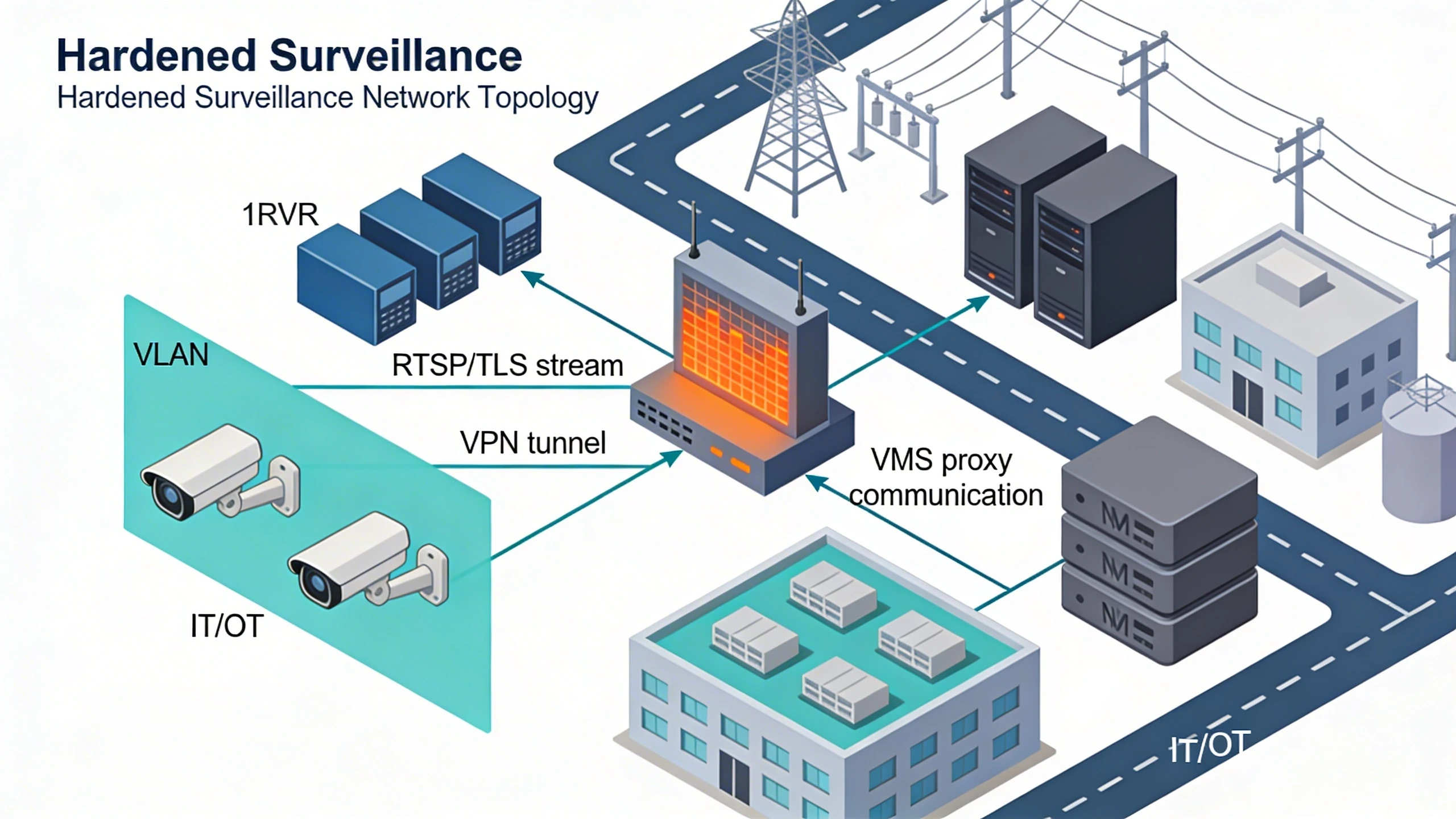
Picture a security integrator tasked with upgrading door access and perimeter monitoring at a distributed utility site spanning remote substations. The baseline is a mix of aging IP cameras feeding an on-premises NVR, with cabling routed alongside power lines and occasional remote viewing via port-forwarded VPNs. Hardening reframes this as a zoned architecture: cameras cluster on a management VLAN firewalled from IT and OT segments, NVR storage encrypted at rest, and access mediated through a video management system (VMS) proxy that authenticates users via enterprise directories.
In execution, technicians first inventory devices, scanning for open ports and default logins using tools like Nmap before applying baselines. Firmware updates roll out via a secure staging server, tested offline to prevent bricking field units. Operators then configure RTSP streams over TLS, ensuring encrypted transit even on local segments. This practice not only thwarts common exploits but also streamlines compliance audits, as logs capture every configuration change for traceability.30
Daily operations reflect these choices through role-based dashboards: guards view live feeds without direct camera access, while admins handle exports via audited sessions. When integrating with physical access controls, the hardened setup feeds metadata—timestamps, motion events—into SIEM tools without exposing raw video, preserving bandwidth and privacy.
System architecture and integration considerations
At the architectural core, surveillance hardening demands a segmented topology where IP cameras and the NVR reside on an isolated VLAN, bridged only through next-generation firewalls enforcing allow-lists for protocols like ONVIF or RTSP. This prevents attackers compromising a single camera from scanning the broader network, a frequent vector in industrial environments. Integration with existing PoE switches requires careful STP configuration to avoid loops during failover, and multicast pruning ensures video streams don't flood adjacent segments.
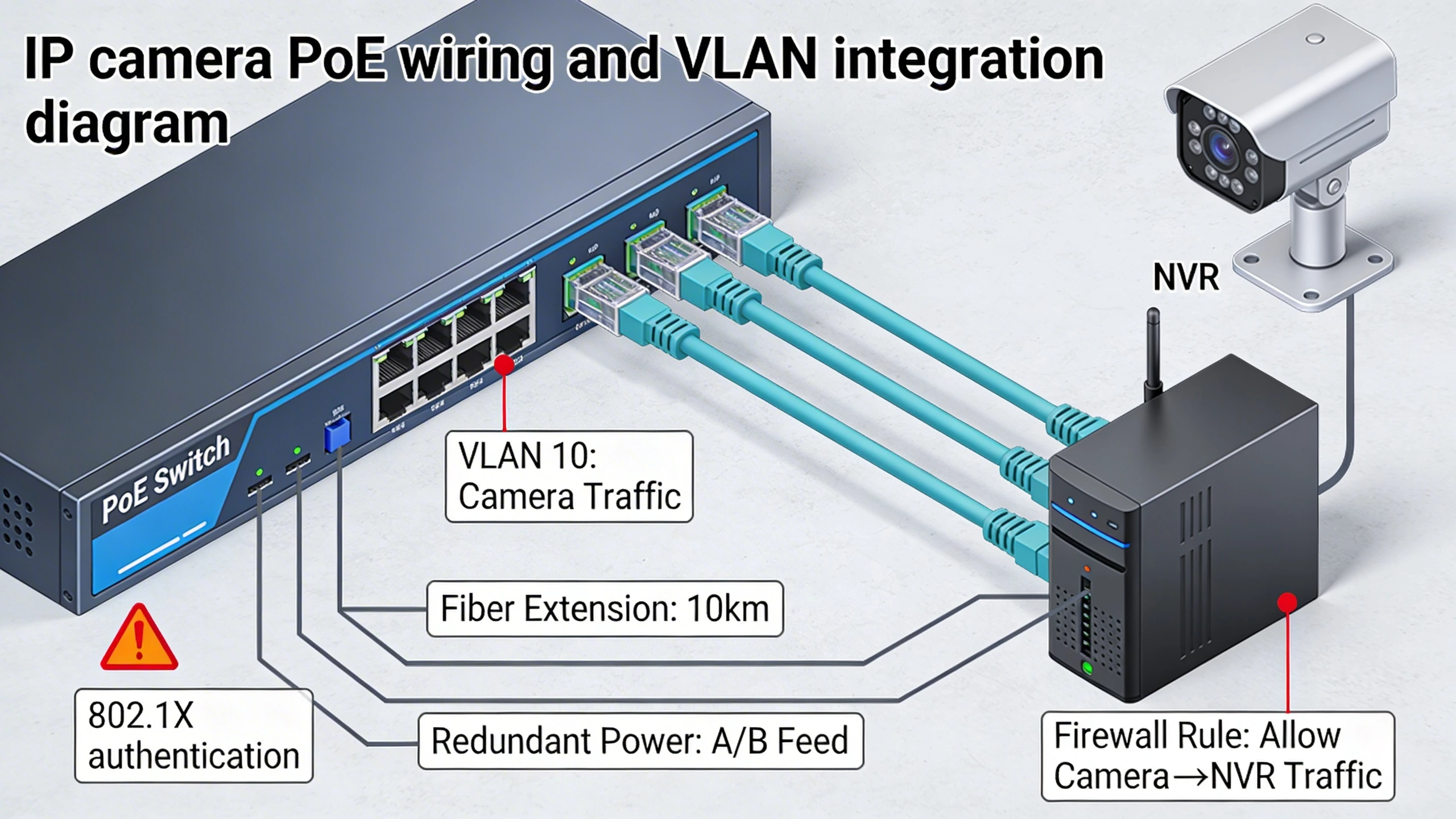
For NVR placement, colocate it near storage arrays in a locked rack with redundant power, using iSCSI over dedicated NICs for high-throughput recording. When merging with IT ecosystems, deploy a VMS as the single ingress point, proxying streams and enforcing certificate-based mutual TLS. This setup supports hybrid cloud archiving if needed, with data diode-like controls for one-way egress. Tradeoffs emerge in scale: smaller sites favor edge recording on cameras to reduce cabling, but larger deployments centralize at the NVR for unified analytics and faster searches.
Power over Ethernet (PoE) integrators must audit switch firmware for vulnerabilities, opting for models supporting 802.1X port authentication to block rogue devices. In fiber-extended topologies, harden media converters with VLAN tagging to maintain isolation across long hauls.
Operational workflows and field constraints
Field teams encounter constraints like harsh environments—dust, vibration at substations—that complicate hardening without specialized enclosures. Workflows start with pre-staged configurations: cameras ship with interim VLAN tags, activated on-site via a laptop on the management subnet. Technicians use mobile hotspots for initial firmware flashes, then switch to the isolated network, minimizing exposure time to under 30 minutes per device.
Maintenance cycles integrate patch Tuesdays with video blackout windows, coordinated via change management ticketing. Remote diagnostics leverage secure tunnels, with operators querying health metrics through the VMS without direct SSH. In multi-site ops, centralized logging aggregates syslog from NVRs into a SIEM, alerting on anomalies like repeated failed logins. Constraints like limited bandwidth at edge locations favor H.265 compression and motion-based recording, preserving hardening by offloading non-essential streams.
Training emphasizes password rotation via password managers and physical tamper detection, ensuring guards report anomalies promptly. This operational rigor turns hardening from a one-time project into sustained resilience.
Common failure points and design mistakes
A prevalent mistake is overlooking port exposure: teams enable UPnP for 'easy discovery,' unwittingly broadcasting services to the LAN. Attackers exploit this for DoS or pivots, as seen in advisories targeting popular camera lines. Another pitfall: uniform weak passwords across devices, amplifying credential stuffing risks despite multi-factor on the VMS.
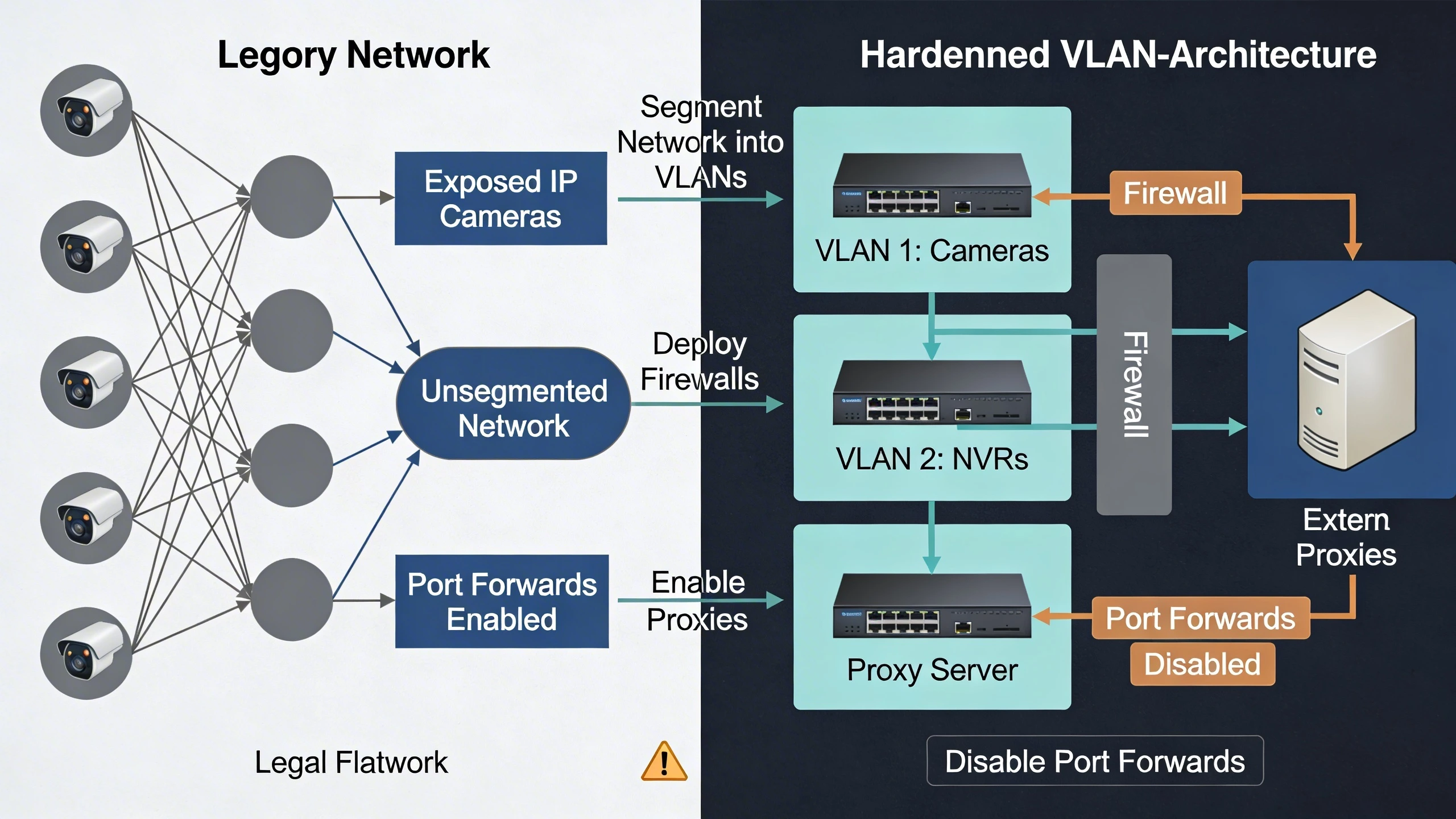
Firmware neglect compounds issues; unpatched NVRs leak metadata via HTTP endpoints, enabling reconnaissance. Design errors include flat networks where cameras share subnets with workstations, inviting lateral exploits. Migration missteps, like direct internet-facing port forwards for mobile apps, bypass firewalls entirely.
- Retain default SNMP communities, exposing metrics to sniffers.
- Skip VLAN pruning, causing multicast storms during failures.
- Ignore physical access, allowing USB-based extractions from NVRs.
What to verify before procurement
Before committing to vendors, audit support for open standards like ONVIF Profile S with security extensions, ensuring interoperability without proprietary lock-in. Confirm firmware update mechanisms—over-the-air (OTA) with integrity checks versus manual USB—and vendor patch cadences aligned to CVEs. Scrutinize hardware for secure boot and TPM modules to resist rootkits.
Request evidence of NDAA compliance if federal contracts apply, alongside penetration test reports. Evaluate management APIs for role-based access and audit logging depth. Field-test PoE budgets and thermal tolerances in simulated environments.
Procurement checklists should probe scalability: does the NVR handle 4K streams at scale with encryption overhead? Verify ecosystem integrations, like SIEM feeds, without custom scripting.
Where to go next
Explore FortSense 4 for integrated hardening in high-assurance environments, tailored to critical infrastructure security. For North America deployments, connect with our team via Request a design review to assess your surveillance architecture.
Image Production Brief (Internal - Remove Before Publish)
Recommended image count: 3
- Placement: After the introduction
Insert After: Introduction
Purpose: Visualize the primary hardened network topology to ground the retrofit scenario early.
Prompt: Diagram of a segmented network for IP cameras and NVR: show VLAN for cameras firewalled from IT/OT, VMS proxy, secure remote access via VPN, labeled flows for RTSP/TLS streams, in a utility campus layout.
Alt Text: Hardened surveillance network topology diagram - Placement: After System architecture section
Insert After: System architecture and integration considerations
Purpose: Illustrate PoE wiring and VLAN integration for practical integrator reference.
Prompt: Wiring diagram for IP camera deployment: PoE switches with 802.1X, VLAN tagging to NVR, fiber extension to remote sites, firewall rules, including redundant power paths.
Alt Text: IP camera PoE wiring and VLAN integration diagram - Placement: After Common failure points section
Insert After: Common failure points and design mistakes
Purpose: Depict a migration path from flat legacy network to hardened setup, highlighting pitfalls avoided.
Prompt: Before-and-after migration diagram: legacy flat network with exposed cameras vs. hardened VLAN-segmented architecture with firewalls and proxies, arrows showing changes like disabling port forwards.
Alt Text: Surveillance network migration from legacy to hardened diagram