Security integrators retrofitting perimeter defenses at utility sites or industrial campuses often encounter the same tension: legacy physical intrusion detection systems (PIDS) like microwave barriers and vibration sensors deliver proven reliability but stifle scalability and remote management. Introducing IP-connected alternatives—fiber-optic strain gauges, video analytics cameras, or smart taut-wire systems—unlocks advanced features such as environmental filtering and centralized alerting. Yet this shift exposes endpoints to cyber threats, where a compromised sensor could feed false negatives to operators or serve as a pivot into broader OT networks.
The core design pivot lies in treating PIDS not as isolated hardware but as cyber-physical extensions demanding Zero Trust principles from day one.31 Rather than bolting digital overlays onto analog setups, effective migrations establish network segmentation upfront, funneling sensor data through hardened gateways while preserving air-gapped controls for critical verification. This approach has proven essential in high-stakes environments, where cyber disruptions risk physical breaches, as highlighted in CISA guidance on converging physical and cyber defenses.30
Consider a typical substation upgrade: teams replace aging IR beams with PoE-enabled PTZ cameras and seismic cables, integrating outputs into a PSIM platform. Without cyber safeguards, exposed management ports invite exploits, potentially silencing alarms during an intrusion. By contrast, segmented deployments route telemetry via one-way diodes or data diodes, ensuring physical detection integrity even under digital assault.
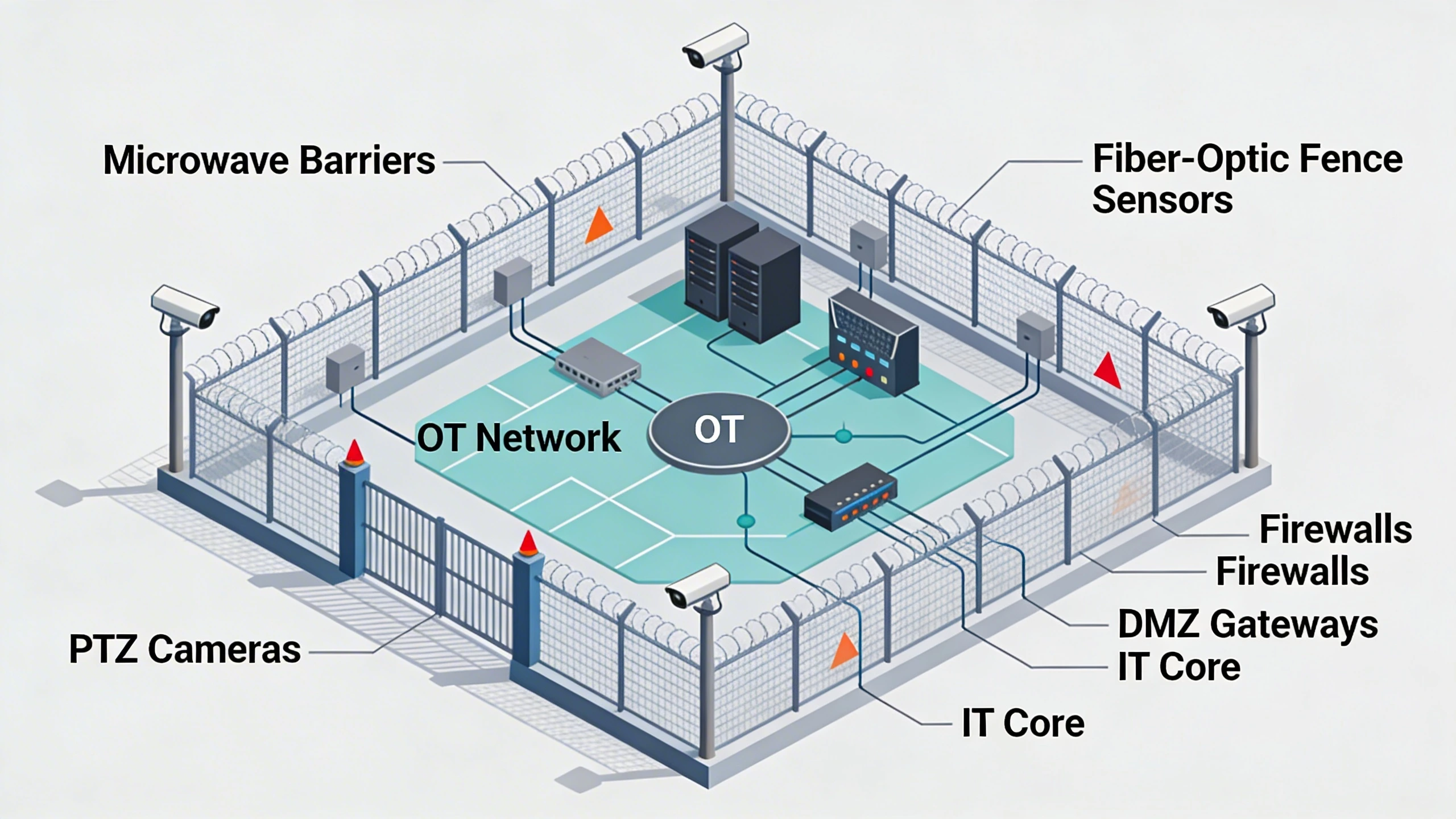
What the design decision looks like in practice
In the field, deciding on cyber-secure PIDS deployment boils down to scoping the upgrade against operational realities. For a multi-acre solar farm perimeter, integrators might retain buried geophone arrays for baseline detection while overlaying IP video towers for classification. The decision hinges on data flows: does sensor fusion demand real-time IT connectivity, or can edge processing suffice? Teams that succeed map threat models early, identifying how a DDoS on camera streams could mask climber activity on fences.
Practical execution involves phased pilots. Start with a single sector—say, 500 meters of fence line—wiring new microwave links to a DMZ switch isolated from SCADA. Monitor for latency in alert propagation and tune false alarm thresholds using historical data. This iterative validation reveals integration quirks, like firmware incompatibilities that force insecure protocols. Once proven, scale across the site, documenting deviations for compliance audits. Such methodical rollout minimizes downtime, a critical factor when perimeters protect live assets.
Real-world variance arises from site constraints. Urban campuses favor compact LiDAR sensors over sprawling IR fields, but their cloud management APIs demand VPN-enforced access. Integrators document these choices in as-built diagrams, ensuring future maintainers inherit cyber hygiene alongside physical layouts.
System architecture and integration considerations
Architecture for cyber-resilient PIDS centers on layered isolation, diverging sharply from flat networks common in legacy installs. Core to this is OT-IT segmentation: position sensors in a Purdue-level 1/2 zone, with gateways enforcing protocol translation (e.g., Modbus to MQTT) and anomaly detection. This prevents lateral movement—if a camera falls to credential stuffing, the blast radius stays contained.30
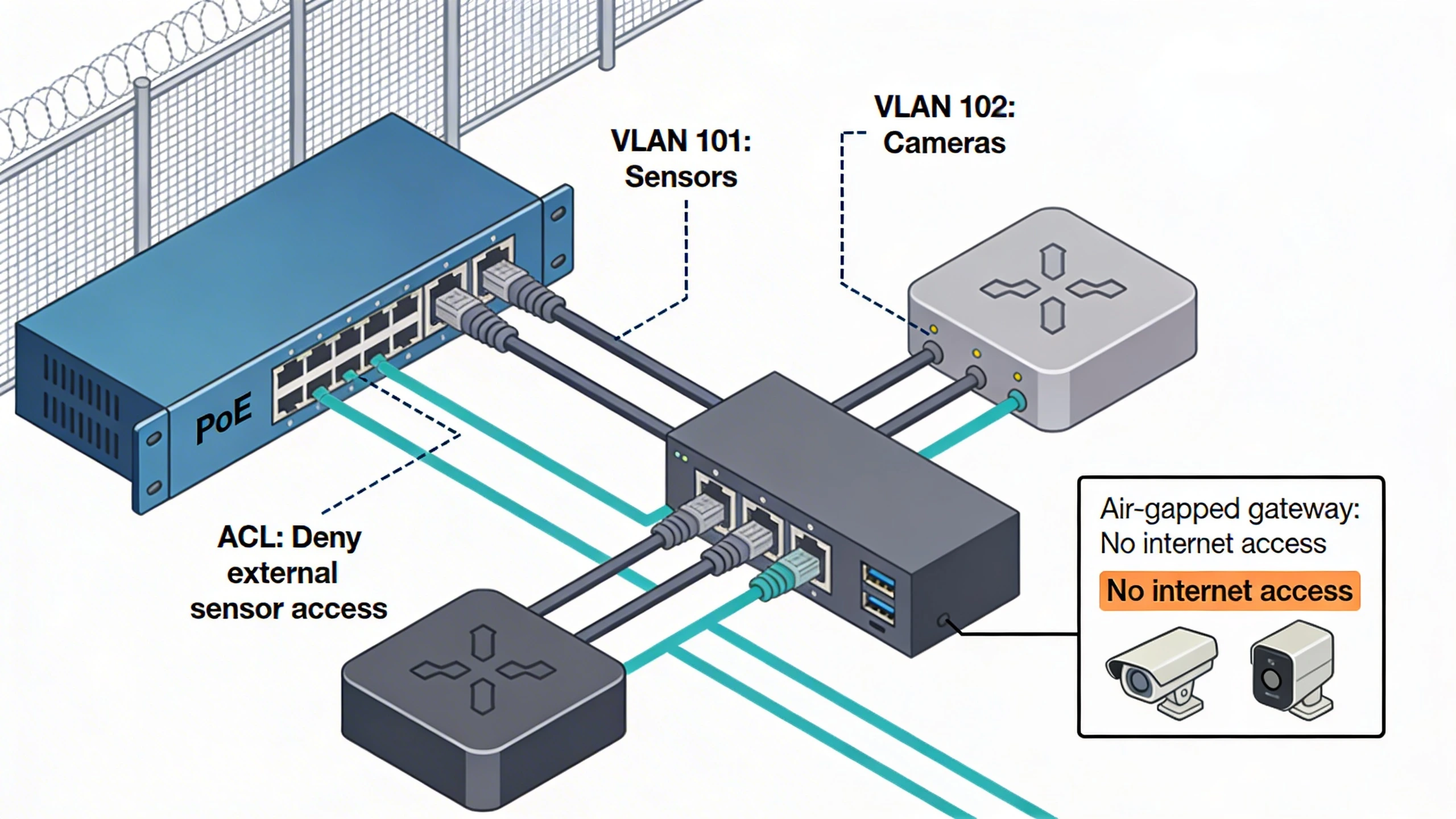
Integration pitfalls emerge at convergence points. PSIM platforms aggregating PIDS feeds often expose REST APIs; secure these with mTLS and rate limiting. For hybrid setups blending analog transceivers with digital endpoints, use protocol converters hardened against buffer overflows. Field experience shows that neglecting VLAN trunking on PoE switches invites VLAN hopping, underscoring the need for switch ACLs tuned to sensor MACs only.
Scalability demands foresight. As deployments grow to dozens of sensor nodes, centralized management via ONVIF-compliant NVRs tempts overexposure. Opt instead for federated edge controllers, each with local storage and failover syncing. This design weathers internet outages while complicating attacker reconnaissance.
Operational workflows and field constraints
Daily operations amplify cyber risks when maintenance workflows bypass safeguards. Technicians accessing sensor configs via laptops risk introducing malware if devices roam unsecured Wi-Fi. Mitigate by mandating USB-blocked, whitelisted endpoints with ephemeral credentials, renewed post-session. Incident response drills must simulate hybrid scenarios, like cyber-induced sensor blackout forcing manual patrols.
Field constraints—weather, terrain, power—interact unpredictably with cyber elements. Harsh coastal sites corrode cabling, prompting wireless bridges that expand RF attack surfaces. Design workflows around this: schedule firmware pushes during low-threat windows, using over-the-air updates segmented by zone. Operator training emphasizes verifying alerts against multiple modalities, guarding against spoofed video feeds.
Workflow evolution includes automation. Scripted health checks ping sensor heartbeats, escalating deviations to SOCs. Yet over-reliance falters without human oversight; balanced ops teams cross-train on Wireshark traces for protocol anomalies, blending fieldcraft with digital forensics.
Common failure points and design mistakes
Fresh deployments falter on overlooked defaults: factory credentials persist on 20% of initial configs, per industry audits, offering low-hanging footholds.31 Worse, integrators chain sensors directly to corporate LANs, ignoring that web UIs on perimeter gear invite SQLi exploits. A classic mistake cascades when unsegmented NVRs host VMS plugins, pivoting attackers to domain controllers.
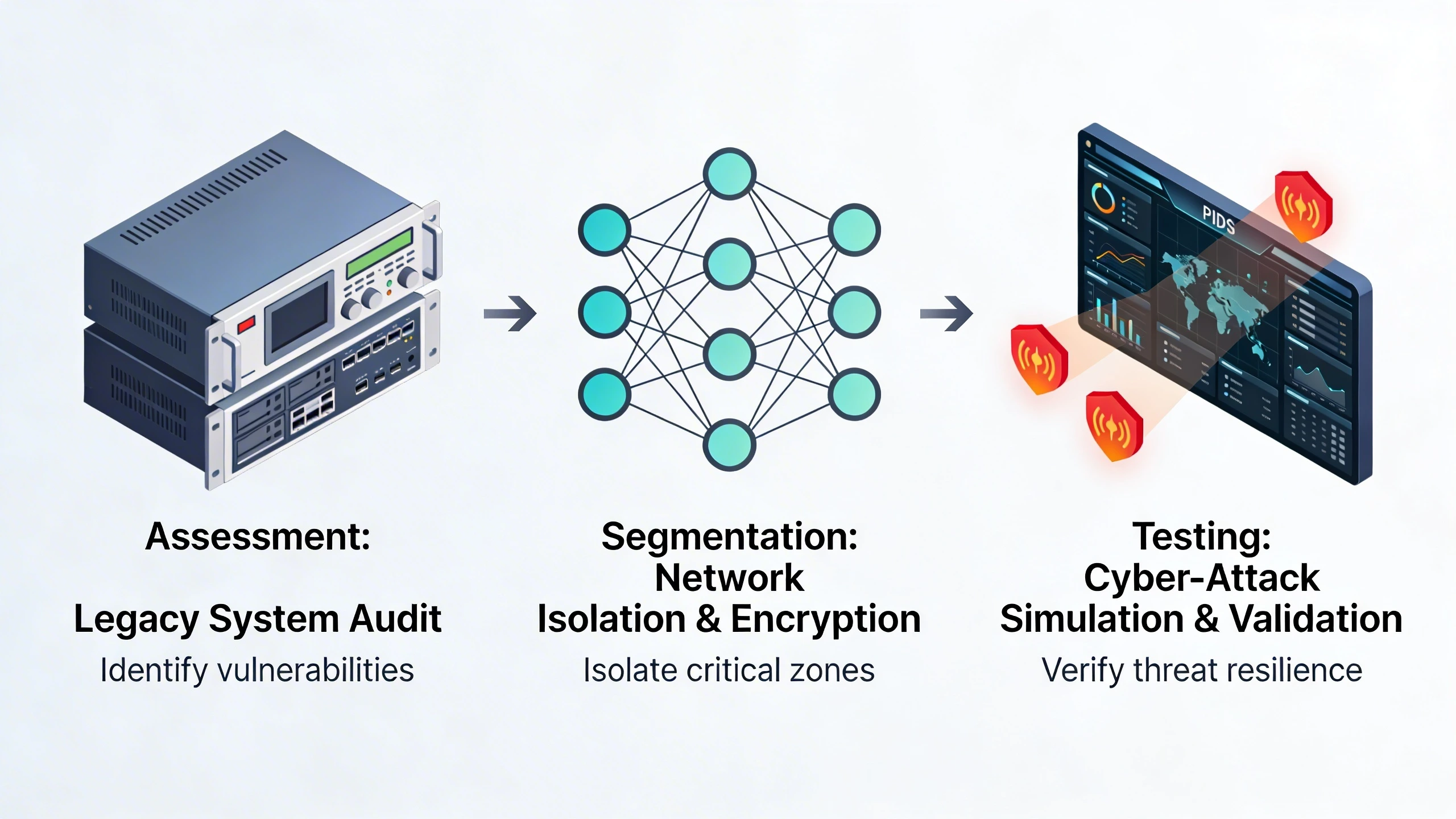
Environmental mismatches compound issues. Microwave sensors in vegetated zones generate alarm floods, straining bandwidth and inviting DoS tuning. Design errors like undersized gateways choke during surges, dropping legitimate events. Supply chain oversights—unvetted components—embed backdoors, evading perimeter firewalls entirely.
- Skipping penetration testing on management interfaces pre-go-live.
- Omitting data diodes for unidirectional telemetry.
- Ignoring patch cadences mismatched to vendor support cycles.
What to verify before procurement
Procurement gates must probe vendor maturity beyond datasheets. Demand evidence of secure-by-design: penetration test reports, SBOMs for firmware dependencies, and third-party attestations like NCSC alignments.31 Scrutinize NDAA compliance for supply chain integrity, especially in North America deployments.
Validate interoperability under stress: does the PIDS stack ONVIF Profile S with your PSIM? Request PoCs simulating 10k events/hour. Assess support SLAs—firmware deltas exceeding 90 days signal risk. Field teams verify physical hardening: IP67 enclosures, anti-tamper seals resisting brute force.
Holistic checks include lifecycle costs. Query end-of-support timelines and migration paths, avoiding vendor lock-in that forces insecure workarounds.
Where to go next
FortSense 4 platforms streamline secure PIDS integration with built-in segmentation. For tailored advice, critical infrastructure security experts recommend starting with a design review. Dive deeper into Zero Trust Architecture principles and NDAA requirements. Explore FortSense 4 capabilities or request a design review.
Image Production Brief (Internal - Remove Before Publish)
Recommended image count: 3
- Placement: After the introduction
Insert After: Introduction
Purpose: Visually introduce the core concept of segmented topologies in perimeter deployments to frame the retrofit decision.
Prompt: Technical diagram of a utility site perimeter showing PIDS sensors (microwave barriers, fiber-optic fence sensors, PTZ cameras) connected to a segmented OT network with firewalls, data diodes, and DMZ gateways separating from IT core.
Alt Text: Segmented perimeter detection network topology diagram - Placement: After System architecture and integration considerations
Insert After: System architecture and integration considerations
Purpose: Illustrate practical wiring for secure sensor integration, reinforcing architecture discussions with a concrete example.
Prompt: Detailed wiring schematic for PIDS: PoE switches connecting IR beams, seismic cables, and cameras to hardened gateways, showing VLANs, ACLs, and air-gapped controls in a campus perimeter.
Alt Text: Secure wiring diagram for PIDS sensor integration - Placement: After Common failure points and design mistakes
Insert After: Common failure points and design mistakes
Purpose: Depict a safe migration path to highlight avoiding pitfalls, aiding readers in planning upgrades.
Prompt: Step-by-step migration diagram from legacy analog PIDS to IP-enabled cyber-secure system, phases including assessment, segmentation, testing, with risk indicators fading across steps.
Alt Text: Phased migration diagram for cyber-secure perimeter detection upgrade