When retrofitting a multi-building campus or utility substation, converging legacy physical security systems like access controls and CCTV onto the enterprise IP network unlocks centralized management but exposes new vulnerabilities. A door controller compromise can now propagate laterally across the backbone, blending physical breaches with cyber intrusions. Integrators and security managers must design incident response (IR) processes that correlate events across domains, contain threats without disrupting operations, and restore safely.
Consider a typical upgrade at a North American critical infrastructure site: analog panels give way to IP endpoints sharing VLANs with operational technology (OT). Traditional IT-centric IR playbooks fall short here, as physical signals demand sub-second latency for lockdowns while IT forensics run in minutes. The key shift lies in unified orchestration: platforms that ingest door sensor telemetry alongside network logs, triggering automated responses like segment isolation paired with badge revocations. This approach minimizes downtime in high-stakes environments, where even brief outages cascade into safety risks.
Success hinges on treating convergence not as a network upgrade but as a cyber-physical fusion, demanding IR workflows that bridge silos. Teams that overlook this often see incidents escalate from a tampered reader to full-site compromise.
What the system does in practice
In a converged setup, incident response orchestrates detection, analysis, containment, eradication, recovery, and lessons learned across physical and digital layers. At a utility site, for instance, anomalous badge swipes at remote gates trigger immediate camera PTZ redirects and network micro-segmentation, preventing intruder progression while alerting SOC teams. This goes beyond siloed alerts: the system fuses physical telemetry—such as door ajar durations or video motion—with IT indicators like unusual protocol traffic, enabling proactive mitigation.
Operational reality tempers ideals. During a retrofit of a manufacturing campus, response times must account for physical inertia: relays actuating maglocks take milliseconds, but confirming clearance via endpoint verification adds variability. Effective systems prioritize containment velocity, using predefined playbooks to isolate compromised segments without halting core operations. Managers report smoother handoffs when physical events auto-populate IT tickets, reducing mean time to acknowledge from hours to under 10 minutes in tested drills.
Practitioners emphasize simulation: tabletop exercises reveal gaps, like overlooking failover for edge controllers during backbone flaps. In live deployments, the system shines by scaling to hundreds of endpoints, maintaining audit trails for compliance in critical infrastructure security.
Core components and signal flow
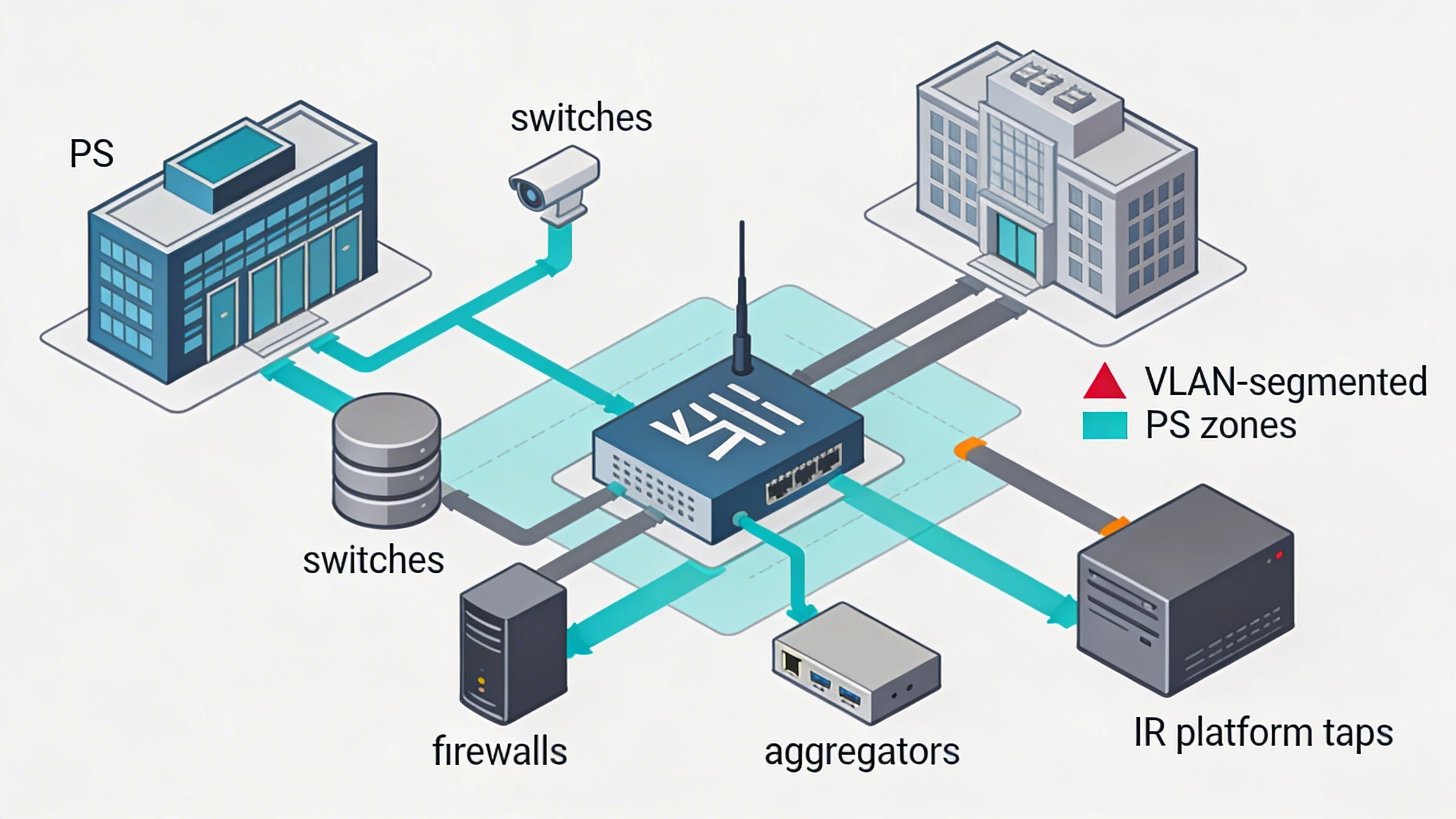
The backbone consists of edge devices (readers, cameras), aggregation controllers, network fabric with taps or SPAN ports, and a central IR platform. Signals flow from physical actuators—say, a door strike sensor—through PoE switches to controllers that normalize events into JSON payloads. These feed a correlation engine, often built on SIEM extensions, which cross-references with Zeek or Suricata logs for behavioral baselines.
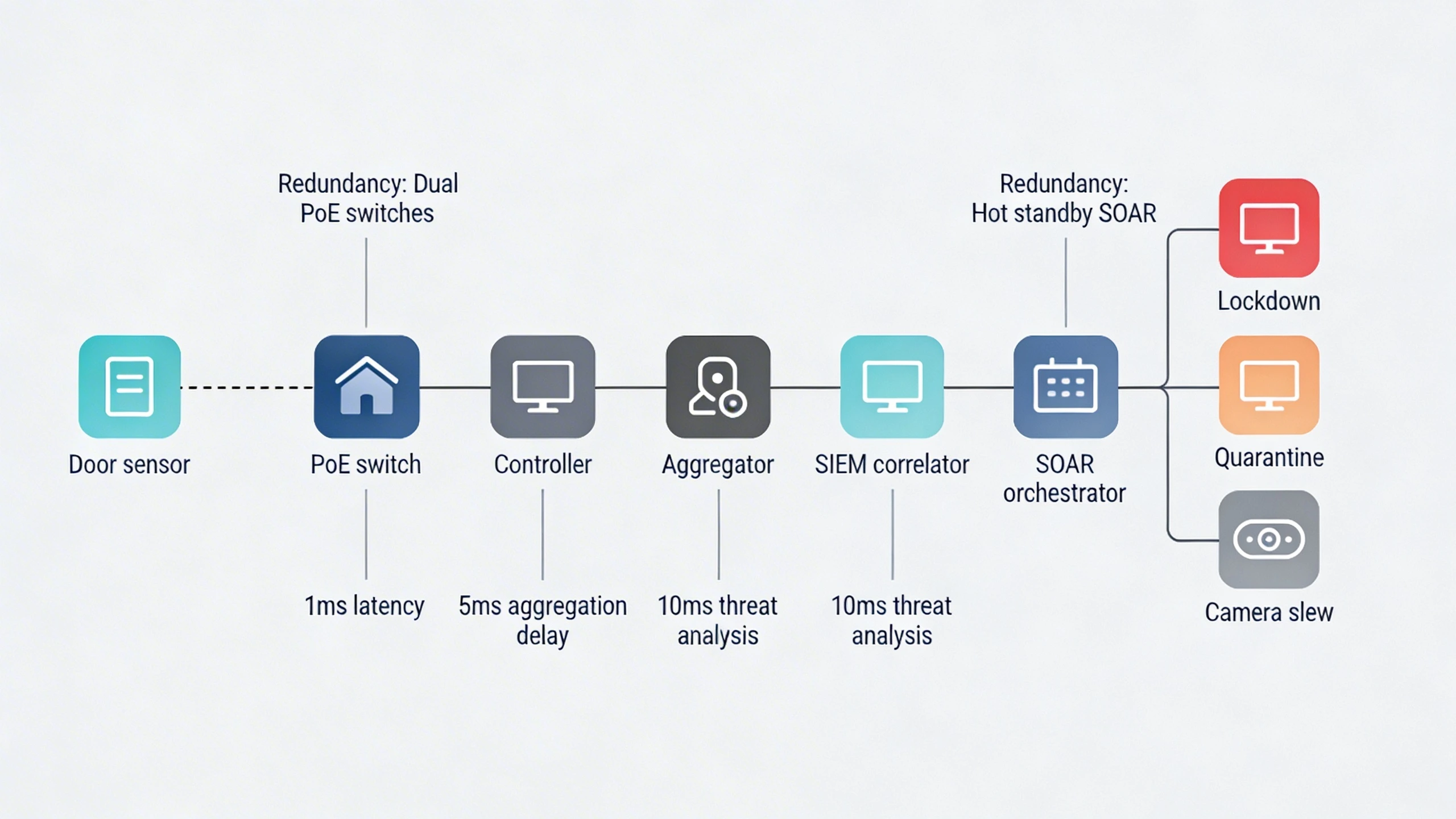
Flow dynamics matter: physical events hit aggregators in real-time via Modbus or ONVIF, while IT telemetry arrives batched. In a campus retrofit, this asymmetry demands buffering and prioritization—tailgating at entry 17 correlates with ARP spoofing only if timestamps align within seconds. Orchestrators like SOAR tools then fan out commands: revoke credentials via RADIUS, slew cameras via RTSP, and quarantine VLANs via API calls to switches.
Resilience builds in redundancy: dual-homed controllers ensure signal persistence during primary path failures. Integrators wire for this upfront, avoiding single points where a switch outage blinds half the site.
Deployment and integration considerations
Start with segmentation: map physical security (PS) zones onto the IT backbone using 802.1Q VLANs or overlay fabrics, enforcing Zero Trust Architecture principles at chokepoints. For a multi-door facility upgrade, isolate PS traffic behind firewalls with custom rules allowing only ONVIF/REST to aggregators. Power budgeting via PoE++ prevents brownouts during surges from simultaneous IR actions.
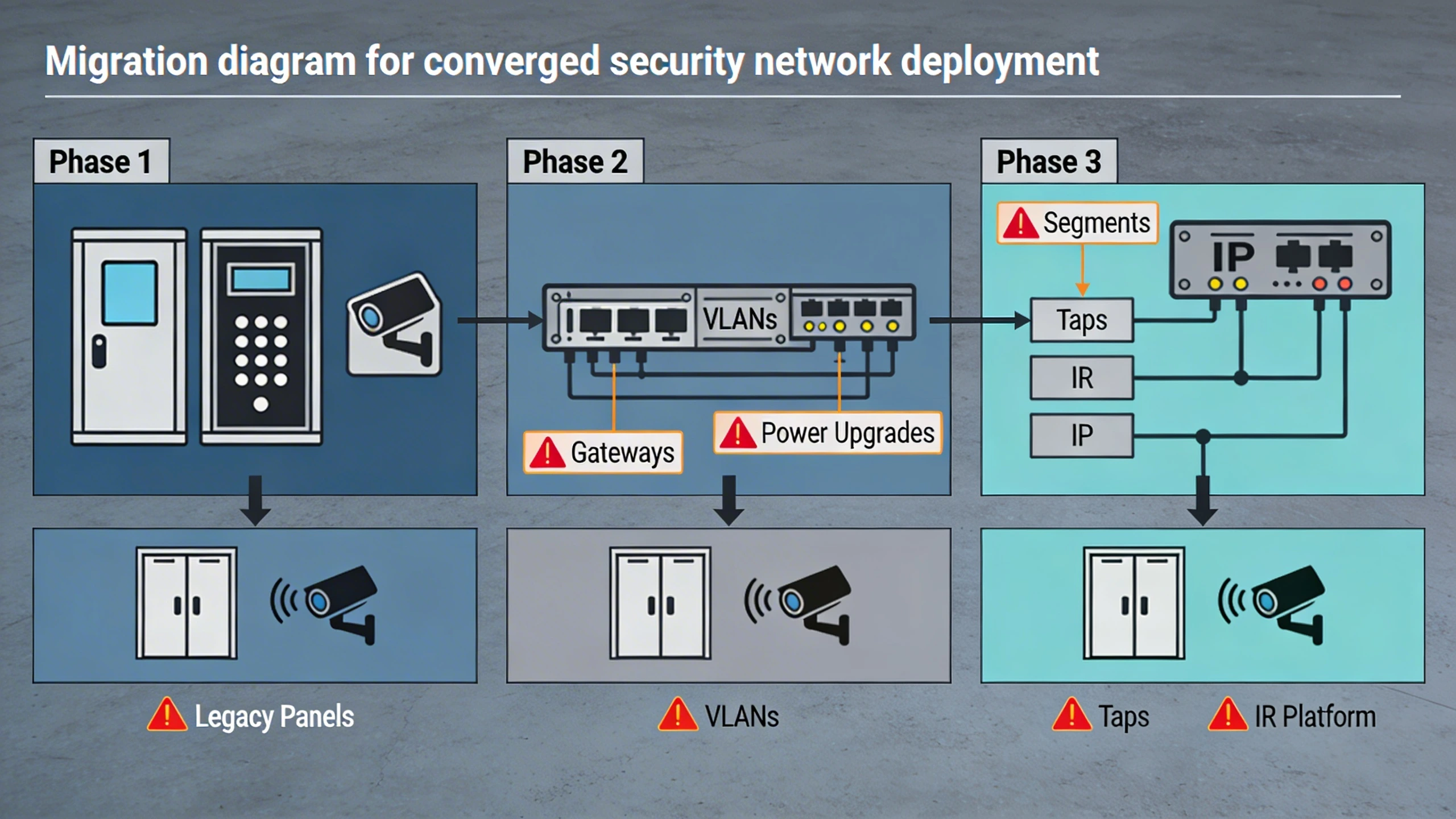
Integration pitfalls abound in brownfields: legacy panels require protocol gateways, introducing latency that IR must compensate for. Align with NDAA supply chain rules by vetting endpoints early. Cable runs demand shielded Cat6A for EMI-prone sites, with taps positioned post-aggregation to capture east-west chatter without performance hits.
Scale thoughtfully: pilot on one building, monitoring for bottlenecks before campus rollout. Budget for endpoint hardening—firmware pinning, mutual TLS—to fortify the converged fabric.
Operational workflows and tuning
Workflows center on playbooks tailored to scenarios: for credential stuffing, auto-lock doors and scan connected cameras; for DDoS-like floods, throttle PS bandwidth while logging baselines. Tuning involves baselining normalcy—peak badge swipes at shift change versus anomalies—using ML models on historical data. Operators run daily queries to refine thresholds, ensuring low false positives in noisy environments.
Handover protocols bridge shifts: dashboards visualize incident timelines, with physical status overlaid on network graphs. Drills simulate hybrids, like ransomware hitting controllers, practicing manual fallbacks. Tuning evolves: post-incident reviews adjust correlation rules, such as weighting video analytics higher in low-light zones.
Automation scales ops: API integrations push events to ITSM, freeing analysts for root cause. Regular audits verify playbook efficacy, adapting to evolving threats like AI-generated deepfakes at readers.
Common failure points and misconceptions
A prevalent misconception: IT IR tools "just work" for physical layers. Reality: SIEMs ingest PS logs poorly without parsers, leading to blind spots where a propped door evades detection amid network noise. Failures cascade when teams neglect physical containment—digital quarantines ignore intruders already onsite.
Over-reliance on cloud proxies ignores latency: edge decisions demand local compute for sub-100ms responses. Miswiring taps upstream captures junk, overwhelming analyzers. Brownfield migrations falter without inventory: unpatched readers become pivots.
Address via checklists: verify dual paths quarterly, simulate failures monthly. Misconceptions fade with cross-training—IT learns relay logic, security grasps NetFlow.
Where to go next
Explore FortSense 4 for converged orchestration. For tailored advice, request a design review. Dive deeper into critical infrastructure security or regional insights via North America deployments.
Image Production Brief (Internal - Remove Before Publish)
Recommended image count: 3
- Placement: After the introduction
Insert After: Introduction
Purpose: Visualizes a typical converged network topology to ground the retrofit scenario discussed, helping readers map concepts to their sites.
Prompt: Clean technical diagram of a multi-building campus converged security network: central IT backbone with VLAN-segmented PS zones for doors, cameras, controllers; taps to IR platform; color-coded flows for physical events and IT logs; labels for switches, firewalls, aggregators; professional engineering style, no people.
Alt Text: Topology diagram of converged security network on a campus - Placement: After core components section
Insert After: Core components and signal flow
Purpose: Illustrates signal flow from edge devices through aggregation to IR response, clarifying the dynamic flow described.
Prompt: Flowchart showing signal path in converged IR: door sensor -> PoE switch -> controller -> aggregator -> SIEM correlator -> SOAR orchestrator -> responses (lockdown, quarantine, camera slew); time annotations, redundancy paths; vector diagram in blue/green tones.
Alt Text: Signal flow diagram for incident response in converged networks - Placement: After deployment section
Insert After: Deployment and integration considerations
Purpose: Depicts a step-by-step migration from legacy to converged setup, highlighting segmentation and pitfalls for retrofit planning.
Prompt: Migration diagram for utility site retrofit: phased arrows from Phase 1 (legacy panels) to Phase 3 (converged IP with segments, taps, IR platform); before/after panels; callouts for VLANs, gateways, power upgrades; schematic style with icons for doors/CCTV.
Alt Text: Migration diagram for converged security network deployment