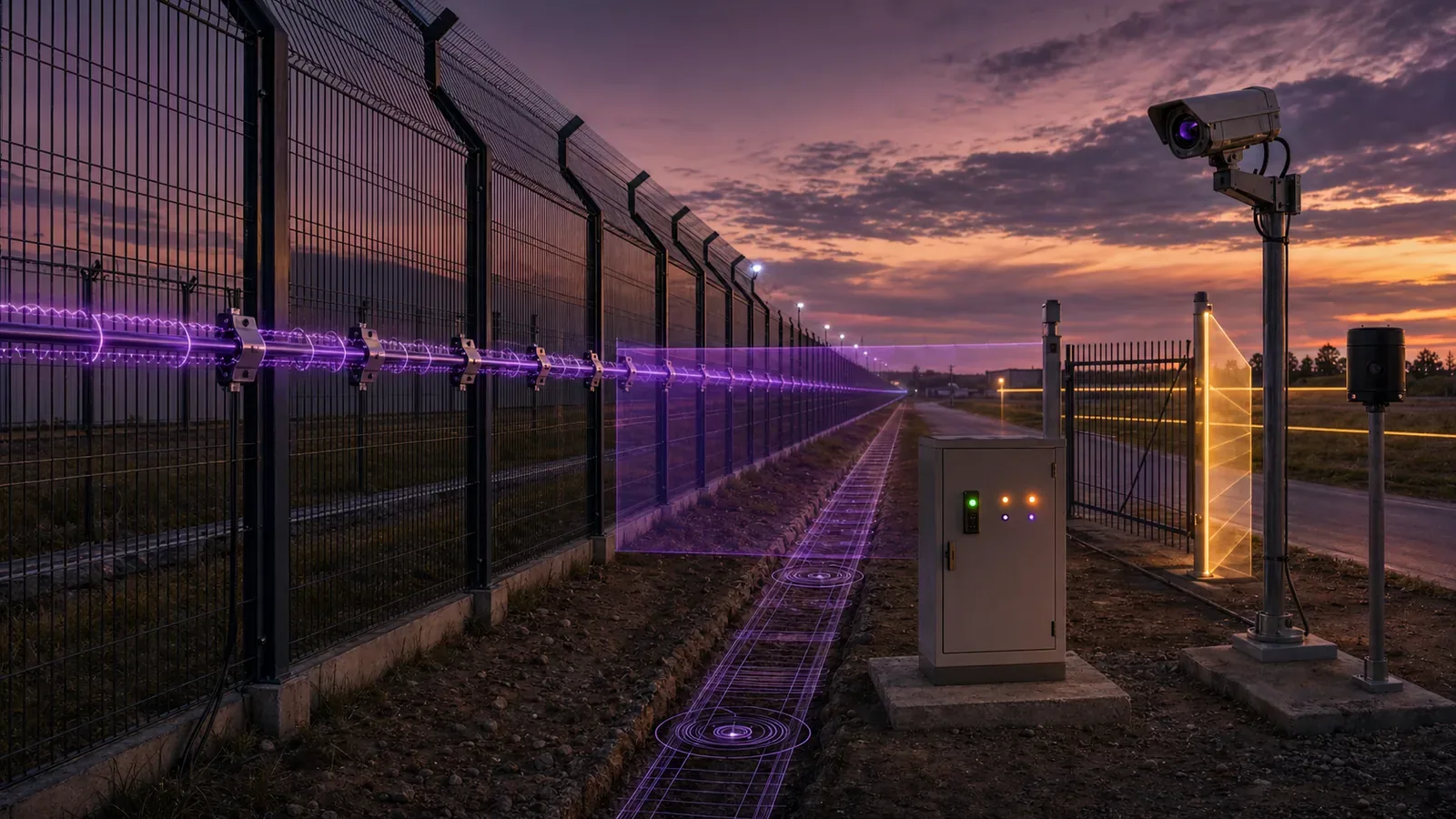
When retrofitting perimeter security at a utility substation or expanding protection around a corporate campus, the choice of Perimeter Intrusion Detection System (PIDS) often hinges on balancing upfront costs against long-term reliability and integration demands. Legacy chain-link fences topped with simple IR beams might have sufficed for basic deterrence, but modern threats require layered sensing that minimizes false alarms while alerting on actual breaches. Integrators frequently face the decision between low-cost vibration-based fence sensors, medium-investment microwave barriers, and higher-end distributed fiber optic lines, each with distinct impacts on cabling runs, power needs, and synergy with video surveillance.
For most brownfield upgrades, fence-mounted accelerometers emerge as the pragmatic starting point, offering detection ranges of 10-20 meters per zone at a fraction of the civil works required for buried options. They retrofit directly onto existing fences without excavation, cutting deployment time and disruption. However, sloped terrain or high-wind environments might push toward microwave or fiber alternatives, where costs escalate due to specialized mounting or trenching but deliver superior standoff detection. The key is mapping site-specific constraints early—vegetation density, fence height, and proximity to access roads—to avoid over-specifying and inflating budgets unnecessarily.
This guide draws from field deployments across substations, data centers, and industrial yards, highlighting how PIDS selection influences everything from alarm triage to compliance audits. By prioritizing modularity and open protocols, teams can future-proof investments amid evolving threats.
What the design decision looks like in practice
Picture a mid-sized power utility upgrading 2 km of fencing around a substation. The existing setup relies on aging taut-wire systems that trigger on minor vibrations from wind or wildlife, overwhelming operators with nuisance alarms. Here, the design team weighs fence-disturbance sensors—piezoelectric or geophone-based—against microwave Doppler units spanning 50-100 meters per link. The former clamps onto fence fabric for point detection every 3-5 meters, ideal for straight runs where climb attempts dominate threats. Microwave, by contrast, creates invisible volumetric barriers, excelling in open fields but faltering near foliage that attenuates signals.
In a campus retrofit, where aesthetics matter alongside security, integrators often blend types: IR/UV point-to-point beams for gate approaches paired with coaxial strain gauges along sports fields. Costs manifest differently—vibration sensors might run under $100 per meter installed, while fiber optic systems approach $300+ due to splicing and OTDR testing. The decision crystallizes during site walks: if civil disruption exceeds 20% of the perimeter, prioritize clip-on solutions. False alarm rates drop markedly with processor-equipped zones that filter environmental noise, turning reactive patrols into targeted responses.
Real-world shifts occur when scaling from pilot to full deployment. A single microwave link proves detection efficacy, but chaining 20 requires precise alignment tools and backup power, underscoring why hybrid designs—sensors plus video verification—dominate selections for sites over 1 km.
System architecture and integration considerations
PIDS architectures span standalone processors to fully networked heads interfacing with PSIM platforms. Vibration or capacitance sensors typically aggregate via RS-485 daisy chains into a head-end unit handling 128+ zones, supporting Modbus or ONVIF for camera cueing. Microwave and active IR units, often IP-native, embed analytics like motion directionality, easing integration into VLAN-segmented networks without proprietary gateways. Fiber optic distributed systems shine here, leveraging COTS OTDR interrogators for kilometer-scale sensing, but demand dark fiber pulls or leased lines, complicating IT handoffs.
Tradeoffs emerge in scalability and redundancy. Low-cost balanced modes in piezoelectric systems use dual processors per zone for fault-tolerant voting, reducing single-point failures common in legacy IR towers. For IT managers, SNMP traps and REST APIs enable dashboard fusion with access control, but mismatched baud rates or PoE budgets strand deployments. In practice, specifying MIL-STD-810 for enclosures ensures architecture survives EMI from nearby substations, while open standards prevent vendor lock-in during expansions.
Operational workflows and field constraints
Daily operations pivot on alarm velocity and verification speed. Fence accelerometers generate dry contacts for immediate PLC tie-ins, allowing guards to slew PTZ cameras within seconds via relay matrices. Microwave systems, with built-in classifiers distinguishing crawl from jump, streamline triage but require annual boresight recalibration to counter panel drift. Buried seismic arrays demand geophone burial depths tailored to soil—shallower in sand, deeper in clay—to avoid washout, imposing seasonal maintenance windows.
Field constraints like coastal salt spray or desert dust dictate enclosures and self-test intervals. Operators report 30% uptime gains from systems with remote diagnostics, polling battery health or fiber attenuation via apps. Workflow bottlenecks arise from poor zoning: oversized zones mask breach locations, forcing linear searches. Effective designs incorporate talk-back speakers or strobe syncs, enhancing deterrence without escalating guard counts.
Common failure points and design mistakes
Overlooking terrain gradients dooms many PIDS installs. Microwave lobes sag on uneven ground, creating blind spots exploited by dig-under attempts, while clip-on sensors loosen on sway fences lacking tensioners. A frequent error: skimping on ground planes for IR beams, inviting solar loading false triggers. Integration snags compound this—unbuffered RS-485 spurs exceeding 1.2 km introduce noise, dropping packets during storms.
Migration pitfalls include ignoring legacy voltage drops; retrofitting 24VDC sensors onto 48V fences requires DC-DC converters, bloating BOMs. Design teams err by chasing detection probability specs in labs without field tuning—95% lab rates plummet to 70% amid rain. Mitigation lies in phased rollouts: pilot 10% of perimeter, iterate filters, then scale. Neglecting arm/disarm scripting for maintenance gates invites self-disarms, eroding trust.
What to verify before procurement
Request live demos on surrogate fences mimicking your mesh gauge and height, stressing with climb, cut, and foil tools. Probe detection envelopes via polar plots, confirming 2-meter standoff without dead zones. Scrutinize environmental immunity claims through third-party certs like IEC 60950, not vendor videos. For fiber, validate interrogator refresh rates—under 1 Hz lags real-time response.
Audit integration docs: sample configs for BACnet or SIP, plus MTBF data from field logs. Confirm scalability via zone expansion cards and firmware update paths. Budget for spares kits calibrated to your topology, as lead times stretch during supply crunches. Finally, benchmark power draw under load; off-grid sites favor solar-compatible low-watt heads.
Where to go next
Explore FortSense 4 for modular PIDS integration tailored to high-stakes perimeters. For site-specific advice, request a design review from our engineering team. Dive deeper into critical infrastructure security solutions or review Perimeter Intrusion Detection System glossary terms. Check North America deployments for regional case studies.