A nuclear-facility PIDS is not a stronger version of a commercial fence alarm. It is a physical-protection subsystem that must support detection, assessment, delay, response, evidence, maintenance, and regulatory defensibility. The design has to help trained operators decide what happened, where it happened, whether it is credible, and what response path applies without exposing sensitive facility details.
This public guide stays at the architecture and commissioning level. Site-specific threat assumptions, response times, guard-force tactics, vital-area layouts, safeguards information, and protected details belong in controlled project documents, not public web content.
For generic PIDS selection, use the PIDS system cost, types, and selection guide. For nuclear and high-consequence facilities, the same technologies must be tied to protected-area logic, alarm-station workflow, and witnessable acceptance criteria.
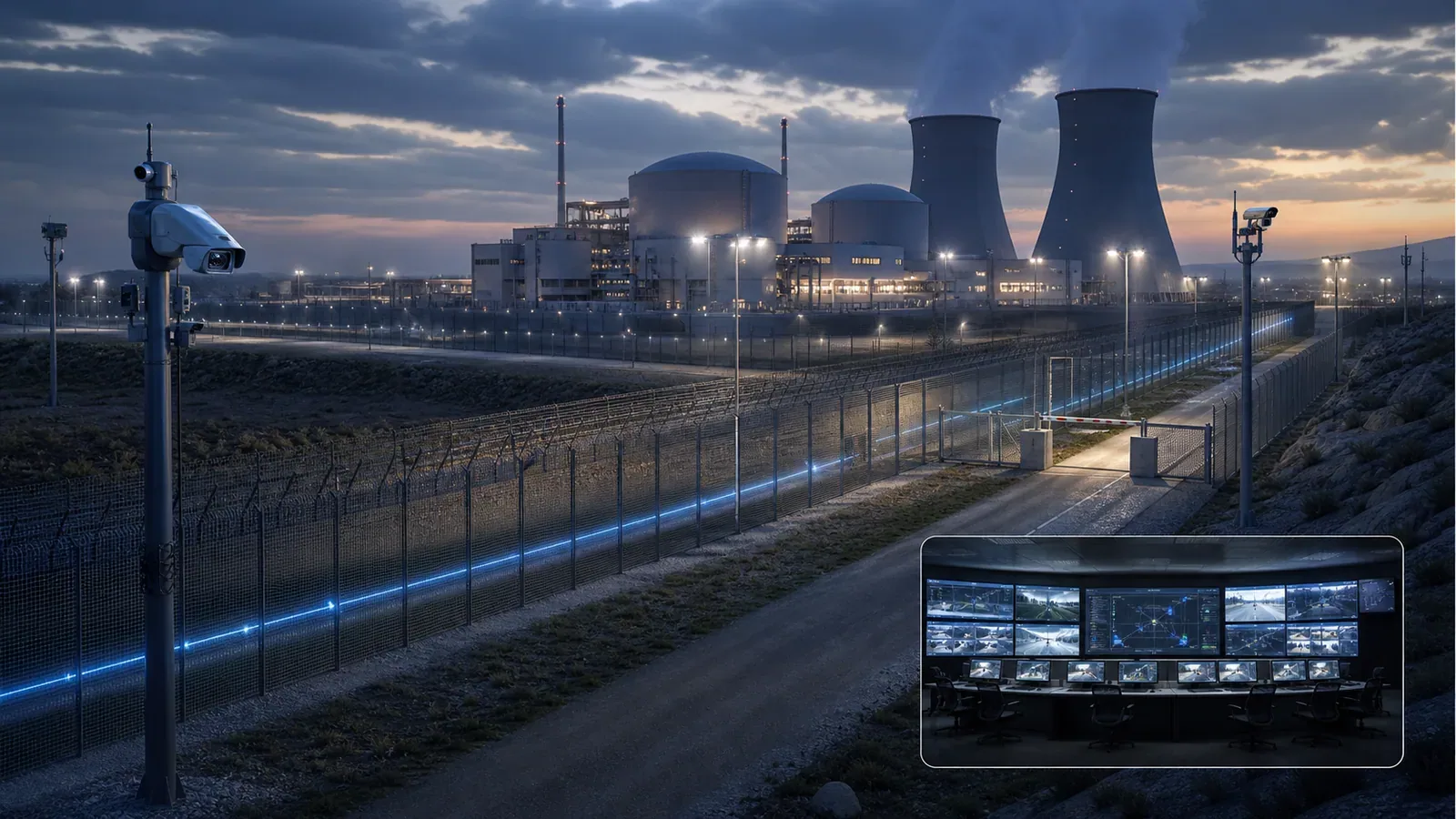
Start with the physical-protection function
The first design question is not which sensor to buy. It is what physical-protection function the perimeter must perform. A nuclear site normally needs a layered approach where detection gives the response organization enough assessed time to act before a protected or vital target is reached. PIDS therefore has to be designed together with delay barriers, lighting, camera assessment, alarm communications, central and secondary alarm stations, power resilience, and response procedures.
Define the protected-area boundary, clear zone, vehicle approaches, controlled access points, and any perimeter sectors that require special assessment coverage.
Define detection scenarios at a public-safe level: climb, cut, gate tamper, vehicle approach, digging near the route, nuisance activity, and sensor or cabinet tamper.
Define the assessment path for every credible alarm: fixed camera, thermal camera, PTZ preset, guard assessment, correlated sensor, or local patrol check.
Define alarm-station requirements: unique alarm identity, sector map, priority, health state, video evidence, acknowledgement, ownership, and escalation.
Define degraded states: loss of power, communications failure, camera unavailable, cabinet tamper, fiber fault, alarm storm, and maintenance bypass.
The regulatory language in 10 CFR 73.55 is a useful public anchor for protected areas, isolation zones, intrusion detection, assessment, alarm stations, and physical-protection program requirements. The IAEA Nuclear Security Recommendations on Physical Protection of Nuclear Material and Nuclear Facilities also reinforces the need to integrate detection, delay, and response instead of treating sensors as standalone devices.
Layered nuclear PIDS architecture
A defensible architecture uses overlapping layers so that one failed device, weather condition, nuisance source, or maintenance state does not remove awareness. The exact mix depends on the licensed site and local regulation, but the architecture pattern is stable: detect early, assess quickly, delay enough, communicate reliably, and prove the workflow during testing.
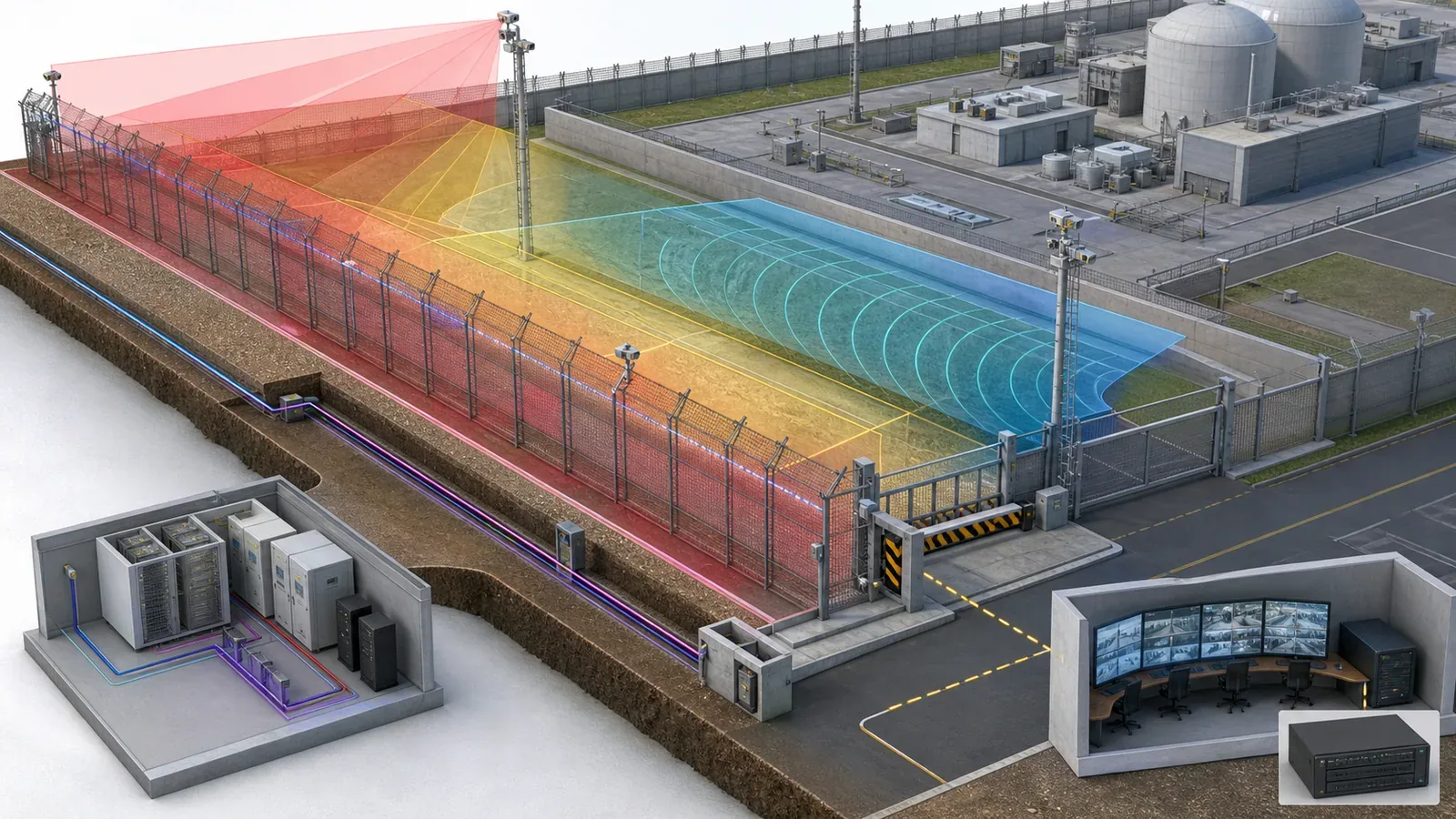
Fence sensing detects climb, cut, impact, and manipulation on the barrier itself.
Buried or standoff detection adds approach awareness in the isolation zone or near vehicle paths where appropriate.
Thermal and low-light cameras provide assessment views that match alarm sectors rather than decorative coverage.
Vehicle barriers and gate sensors are integrated as physical delay and alarm points, not only access-control devices.
Redundant cabinets, UPS, network paths, and health telemetry keep alarm visibility alive during local equipment problems.
Central and secondary alarm-station displays show intrusion, tamper, trouble, bypass, degraded, and stale-data states clearly.
For the camera-assessment layer, connect this design to thermal and PIDS layered detection design, thermal camera mounting height and standoff distance, and geospatial perimeter alarm-to-camera mapping.
Alarm assessment and station workflow
Nuclear PIDS fails when alarms arrive as generic device noise. Operators need a controlled display that distinguishes intrusion, tamper, trouble, supervisory, bypass, maintenance, and communication faults. Each alarm should map to an assessment camera or procedure, expose the current health state, and produce a durable record of acknowledgement and disposition.
Use stable zone names and event classes that match operating procedures and training materials.
Present camera assessment with pre-alarm and post-alarm evidence where policy allows.
Keep maintenance bypasses explicit, timed, authorized, logged, and visible to the alarm station.
Show device health and stale-data states as first-class operational conditions, not hidden IT telemetry.
Separate nuisance reduction from alarm suppression. A suppressed or bypassed alarm must remain visible as a controlled condition.
Use perimeter alarm health monitoring for the health layer and data diode integration for isolated perimeter security networks when nuclear security monitoring data must cross into an enterprise or remote SOC environment through a controlled one-way boundary.
Commissioning and witness testing
A nuclear-facility PIDS should be accepted through witnessed tests that prove detection, assessment, communication, health, bypass control, and response workflow. The point is not to publish sensitive attack playbooks. The point is to document that representative, approved scenarios are detected and handled in the way the facility claims.
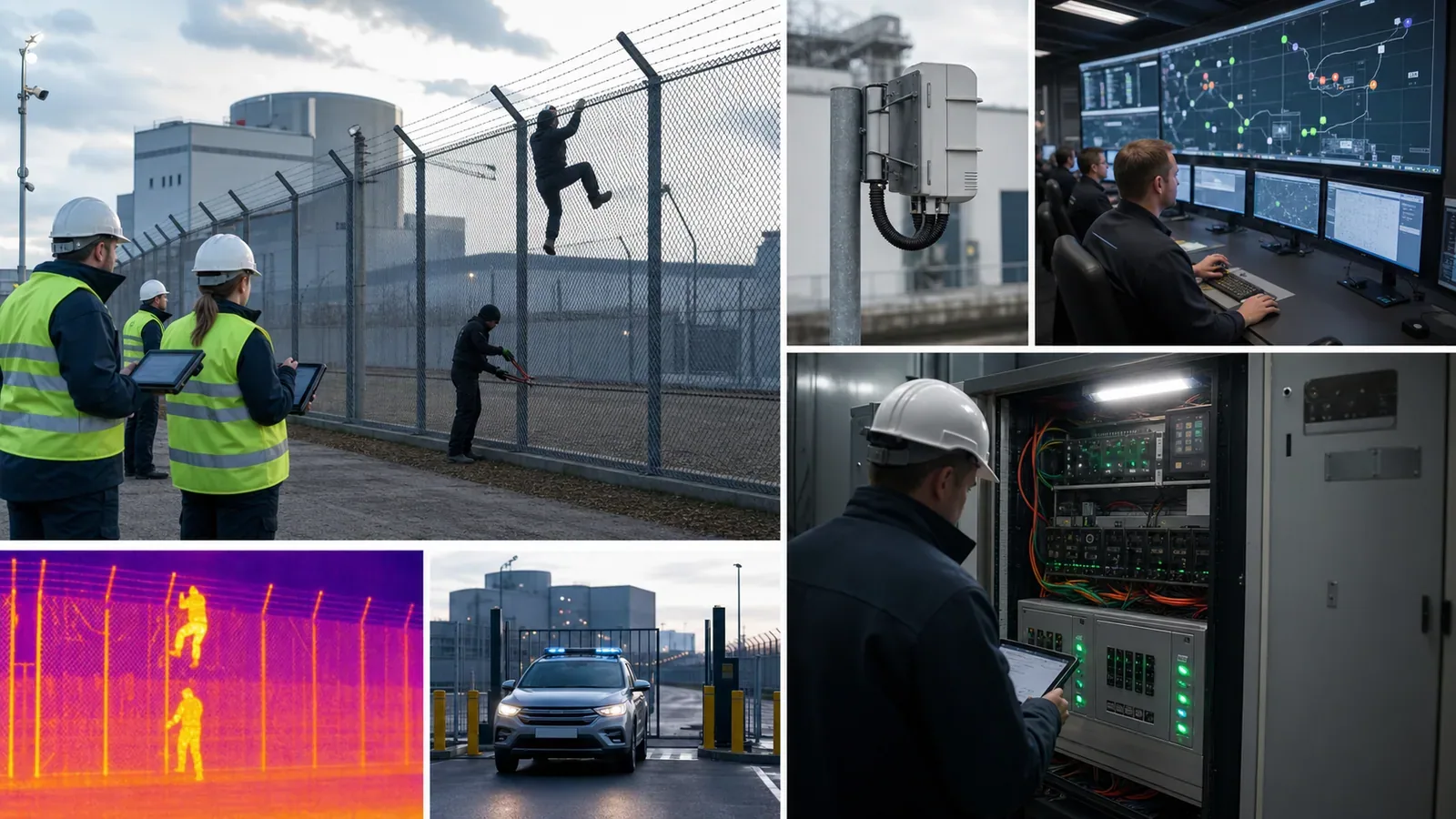
Precommission the route, cabinets, power, network paths, time sync, camera views, alarm-station mapping, and evidence retention before intrusion trials.
Run approved blind or semi-blind intrusion tests by perimeter sector and detection class, with results recorded by an independent witness where required.
Verify alarm assessment: correct map location, correct camera view, usable video, event class, priority, and operator procedure.
Test tamper, trouble, bypass, stale data, communications loss, power loss, cabinet fault, and restoration behavior.
Measure probability of detection, nuisance alarm rate, localization accuracy, operator action time, and unresolved-event review in a controlled evidence package.
Retest after fence work, sensor replacement, camera repositioning, major vegetation change, software change, or material route repair.
Use PIDS probability-of-detection sample-size planning, blind PIDS intrusion testing protocol, and perimeter detection acceptance testing and witness criteria as supporting methods.
Public-safe design checklist
The operating requirement defines the protected function, detection scenarios, assessment method, response owner, and acceptance criteria.
Every perimeter sector has a named detection layer, camera-assessment path, health state, and alarm-station procedure.
Fence, buried, microwave, radar, camera, gate, vehicle barrier, and cabinet alarms use consistent event classes and priorities.
Bypass and maintenance states are authorized, timed, logged, visible, and reviewed.
Power, communications, timing, and evidence retention are designed as security requirements, not afterthoughts.
Testing covers intrusion, nuisance, tamper, trouble, bypass, failover, restoration, and operator workflow.
Sensitive site layouts, response assumptions, and safeguards details remain in controlled documentation.
When to avoid over-specifying the public design
Nuclear security content must be useful without exposing defensive weak points. Public documentation should explain design principles, procurement questions, commissioning expectations, and high-level integration patterns. It should not publish sector weaknesses, response timing, exact camera blind spots, alarm-station procedures, or detailed adversary scenarios.
For a controlled project review, bring the operating requirement, current perimeter layers, alarm-station workflow, camera-assessment plan, maintenance controls, health monitoring, and commissioning evidence. FortSense can review architecture fit through FortSense 4, the critical infrastructure security page, or contact FortSense.