At a sprawling utility substation surrounded by chain-link fencing, the security team grapples with legacy vibration sensors that chime alarms for every stiff breeze or passing deer. These traditional fence alarms—typically accelerometers or strain gauges bolted to the mesh—excel at spotting direct fence attacks like cutting or climbing but overwhelm operators with nuisance events. Shifting to a Perimeter Intrusion Detection System (PIDS), such as fiber optic or coaxial cable sensors, reframes the perimeter as an intelligent boundary, delivering precise location data across zones without constant interruptions.11
This transition isn't merely technological; it's a retrofit decision that alters daily operations. For integrators handling multi-site campuses or industrial facilities, PIDS reduce verification time by pinpointing disturbances to within meters, allowing guards to respond surgically rather than patrolling entire segments. Traditional setups demand broader sweeps, tying up personnel and eroding confidence in the system. Yet, the upfront engineering for PIDS demands careful planning to avoid overpromising on stealth or scalability.
Concrete examples abound in critical infrastructure retrofits. A data center operator might layer PIDS along an existing fence to catch pre-climb approaches, while a warehouse manager sticks with enhanced traditional alarms for cost-controlled visibility. The core tradeoff surfaces early: PIDS prioritize low-maintenance intelligence over the tactile immediacy of fence-mounted detectors.11
What changes in real deployments
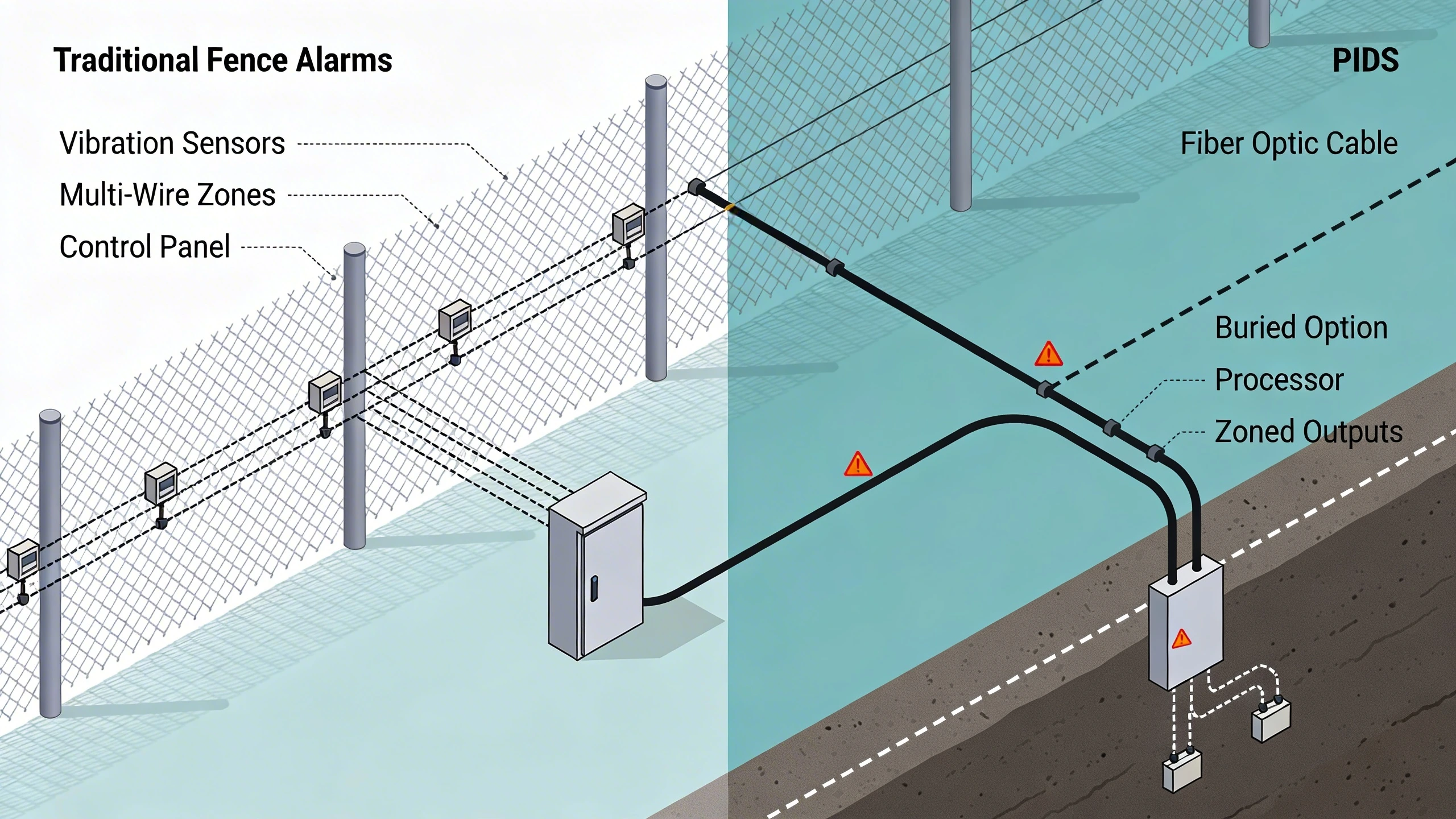
Deploying PIDS shifts the focus from reactive fence monitoring to proactive perimeter intelligence. Traditional fence alarms rely on physical disturbances propagating through the fence fabric, registering as vibrations or tension shifts at discrete sensor points. In a typical substation deployment, this means dozens of sensors spaced every few meters, each wired into zones that trigger broad alerts. Operators learn to filter wind-induced noise mentally, but scaling to kilometer-long boundaries amplifies the chaos. PIDS, by contrast, employ continuous sensing cables—fiber optic variants detect micro-vibrations via light scattering, while coaxial uses time-domain reflectometry for pinpoint accuracy. The result? A single cable run replaces sensor clusters, transforming operator workflows from alarm triage to targeted verification.11
Real-world adjustments ripple through maintenance routines. Traditional systems invite frequent sensor cleaning or recalibration after storms, as debris rattles the mesh. PIDS installations, often buried or fence-parallel, shrug off surface weather but require initial soil testing to prevent cable stress from ground shifts. Integrators report smoother handoffs to IT teams, as PIDS processors output IP-formatted events ripe for PSIM dashboards. Missteps occur when teams underestimate cable tensioning; loose fiber strands mimic intrusions, echoing the false-alarm fatigue of legacy gear.
Another deployment pivot involves assessment phases. Before PIDS rollout, site surveys map fence integrity and EMI sources—power lines can interfere with coaxial signals. Traditional upgrades skip such rigor, bolting sensors atop existing posts. This depth ensures PIDS longevity but extends timelines, a factor security managers weigh against immediate deterrence gains.
Security and reliability differences
Security postures diverge sharply between the two. Traditional fence alarms shine in overt deterrence: visible housings signal monitoring, discouraging casual probes while catching committed fence assaults. However, savvy intruders bypass them by tunneling under or using insulated tools to minimize vibrations. PIDS extend the detection envelope, with fiber optics sensing footsteps meters from the fence or digging attempts via ground-borne signals. This layered awareness suits high-stakes sites like airports, where early alerts cue PTZ cameras before breach attempts escalate.11
Reliability hinges on environmental resilience. Fence alarms falter in gales or hail, as unchecked oscillations swamp thresholds; animals scaling panels compound the issue. PIDS mitigate this through algorithmic filtering—fiber systems analyze vibration spectra to classify threats versus benign events like rain patter. Passive designs avoid power-hungry components, boosting uptime in remote deployments. Drawbacks emerge in vulnerability profiles: exposed fence sensors resist tampering better than surface-mounted PIDS cables, which demand anti-cut armoring.
Operational consequences favor PIDS for endurance testing. In prolonged exposure, traditional setups degrade from corrosion or fatigue, necessitating zonal takedowns. PIDS, once bedded in, operate autonomously, with diagnostics revealing cable integrity via signal loss metrics. Teams that overlook grounding in mixed deployments invite intermittent faults, underscoring the need for holistic reliability audits.
Wiring, topology, and integration implications
Wiring paradigms flip dramatically. Traditional fence alarms aggregate sensors into balanced zones—series loops for foil tape or parallel for accelerometers—requiring homerun cables from each post to a head-end panel. This multi-conductor sprawl suits short runs but balloons cabling in expansive topologies, exposing runs to damage during fence repairs. PIDS streamline to a twin-conductor affair: the sensing cable plus ancillary power/data lines, often PoE-enabled for IP variants. Topology decouples from fence rigidity; cables route buried, gate-straddling, or wall-mounted, enabling hybrid barriers like rock walls unfit for mesh sensors.

Integration amplifies these shifts. Legacy alarms feed dry contacts into analog panels, retrofittable but siloed from video analytics. PIDS natively support ONVIF or Modbus, piping geo-tagged events to PSIM platforms for correlation with IR beams or drones. Pitfalls lurk in legacy mismatches—unshielded traditional wiring induces crosstalk in co-located PIDS, demanding ferrite chokes or rerouting. For IT managers, PIDS cybersecurity edges ahead with encrypted channels, though firmware updates require staged outages absent in dumb-sensor arrays.11
Topology flexibility reshapes design. Traditional reliance on fence continuity falters at expansions or gates, spawning blind spots. PIDS zones adapt seamlessly, splicing cables for modular growth—a boon for phased campus rollouts.
Migration planning and common failure points
Migration begins with baseline audits: catalog existing alarm zones, false-event logs, and fence conditions to benchmark PIDS gains. Overlay strategies preserve traditional deterrence while phasing in sensing cables, minimizing downtime. Integrators sequence trenching parallel to fences during low-threat seasons, testing segments before full cutover. Failure points cluster around compatibility—mismatched grounding potentials spark phantom triggers, while uncalibrated PIDS overwhelm PSIM inputs with raw data volumes.

Common stumbles include underestimating burial specs; rocky soils crush fibers absent proper bedding, mimicking cuts. Power budgeting trips teams too: PIDS processors draw steadily, unlike intermittent traditional relays, straining remote solar setups. Successful paths incorporate pilot zones—deploy 100m trials to tune algorithms against site-specific nuisances like nearby rail vibrations. Post-migration, operator retraining bridges the gap, shifting focus from alarm silencing to event forensics.11
Budget for redundancy: hybrid phases reveal traditional alarms' role as fail-safes until PIDS maturity. Rushed integrations forfeit location precision, reverting to broad alerts.
Where each approach still fits
Traditional fence alarms endure where budgets constrain or fences already deter effectively. Short perimeters around warehouses or auxiliary gates benefit from quick sensor add-ons, maintaining visibility without excavation. Their tactile feedback suits low-tech SOCs, and retrofit simplicity accelerates compliance audits. In urban edges abutting public paths, overt sensors amplify psychological barriers absent in covert PIDS.
PIDS claim domains demanding precision and scale: long rural boundaries, underground vaults, or EMI-heavy industrial zones. Utilities favor them for fusing with SCADA alerts, while military sites layer them for graded responses. Hybrids prevail in transitions, blending fence alarms' immediacy with PIDS intelligence.
Selection hinges on threat models—opportunistic versus persistent—balanced against lifecycle costs. No panacea exists; astute engineers mix judiciously.
Where to go next
Integrate PIDS effectively with FortSense 4, our platform for unified perimeter management. Dive into critical infrastructure security applications or review North America deployments. For tailored advice, request a design review. Reference the Perimeter Intrusion Detection System glossary or PSIM glossary for foundational terms.