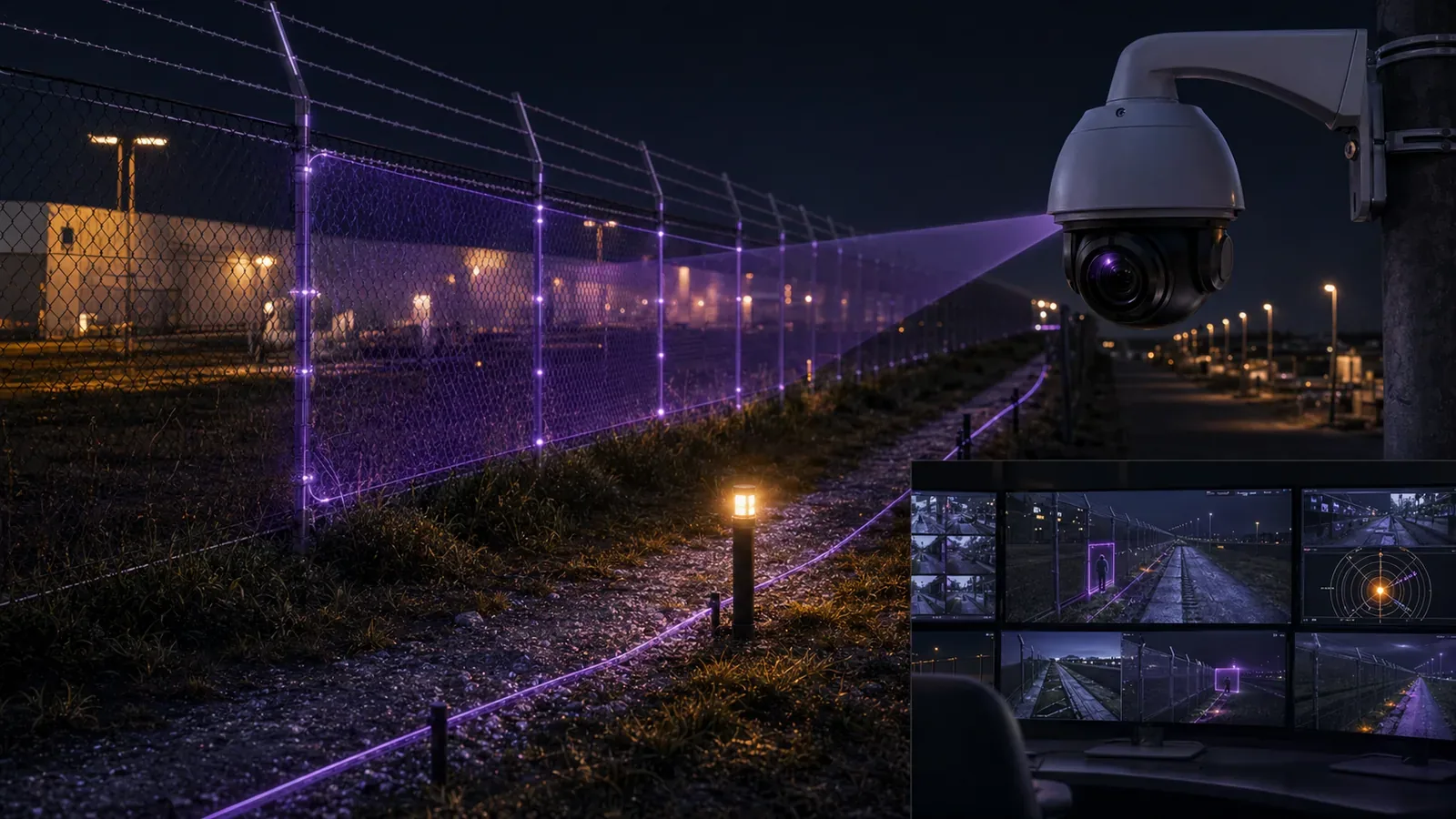
When retrofitting security at a remote utility substation, legacy perimeter sensors often flood operators with alerts from wind, rain, or animals brushing the fence. Without visual confirmation, security teams dispatch patrols unnecessarily, straining resources and delaying real threats. Pairing these alarms with strategically placed cameras changes that dynamic: a triggered sensor slews a PTZ camera to the exact zone, delivering a live view or snapshot for instant assessment.
This approach shines in environments demanding high assurance, such as campus perimeters or industrial sites where downtime costs mount quickly. Integrators upgrading from standalone Perimeter Intrusion Detection Systems (PIDS) find that camera verification not only filters false positives but also enriches incident logs with visual evidence for post-event analysis. The key lies in tight integration between alarm controllers and video management systems (VMS), ensuring sub-second response without overwhelming networks.
For security managers evaluating this upgrade, the decision hinges on site-specific factors like fence length, terrain, and existing infrastructure. A well-executed system transforms reactive monitoring into proactive defense, but rushed deployments lead to coverage gaps or integration headaches. This guide walks through practical steps drawn from field experience across North American critical infrastructure projects.
What the system does in practice
In daily operation at a multi-acre campus, an infrared beam sensor detects a breach attempt along a chain-link fence section. The alarm signal routes instantly to the VMS, which commands the nearest PTZ camera to preset position 5—pre-mapped to that 50-meter zone. Operators see a stabilized view overlaid with the alarm timestamp and sensor metadata, confirming if it's a person, vehicle, or false trigger like swaying vegetation.
This verification loop repeats across dozens of zones, with rules engine logic escalating unconfirmed alarms to mobile apps or dispatch. During night shifts at utility sites, thermal cameras handle low-light conditions, fusing IR alarm data with visual cues to distinguish intruders from wildlife. Operators rarely intervene manually; automation handles 80% of routine checks, freeing focus for anomalies like loitering or tool-carrying figures.
Post-verification, the system archives clips tagged by alarm ID, aiding investigations or compliance audits. In retrofit scenarios, this overlays seamlessly on existing PIDS without ripping out sensors, delivering ROI through reduced truck rolls and faster mean-time-to-respond.
Core components and signal flow
At the heart sits the PIDS field sensors—vibration fibers, taut wires, or IR beams—wired to a central controller that aggregates dry-contact relays or Modbus outputs. Cameras, typically PTZ with 30x optical zoom and analytics, connect via PoE switches to the VMS server. The VMS acts as the orchestrator, using plugins or APIs to map alarm inputs to camera actions like preset recalls or auto-tracking.
Signal flow starts at the sensor: detection triggers a relay closure, polled every 100ms by the controller. This pulses an input on the VMS I/O board or network endpoint, firing rules: "If zone 12 alarms, slew Cam3 to preset 12, stream to verification popup." Latency stays under 2 seconds in tuned setups, with overlays showing GPS coordinates or fence segment labels. For redundancy, dual-path signaling—IP plus relay—ensures failover if networks hiccup.
Scalability comes from zoned controllers handling 100+ sensors each, feeding enterprise VMS like those in FortSense 4. Integrators must spec components for environmental hardening: IP67 cameras, surge-protected I/O, and fiber runs for long perimeters.
Deployment and integration considerations
Site surveys dictate camera placement: position PTZ units every 100-150 meters atop 10-meter poles for 180-degree coverage, factoring occlusion from trees or structures. Retrofit existing PIDS by tapping controller outputs—avoid sensor-level mods to preserve warranties. Network design prioritizes QoS for video streams, segmenting alarm traffic on VLANs to prevent congestion during mass triggers like storms.
Power budgeting challenges arise in remote areas; hybrid solar/PoE setups work for off-grid zones, but verify PTZ slew torque against wind loads. Integration testing simulates breaches with dummies, confirming slew accuracy to within 2 meters. For campuses, blend with access control: door alarms cue hallway cameras, creating unified workflows.
Budget for enclosure upgrades if legacy PIDS lack IP outputs; protocol converters bridge serial to Ethernet economically. In North America deployments, comply with local codes for pole foundations and lightning protection.
Operational workflows and tuning
Operators monitor via VMS consoles showing a perimeter heatmap—red zones for active alarms, green for clear. A popup demands "Verify?" within 10 seconds; thumbs-up dismisses, thumbs-down escalates with clip export. Shift handovers include active verification queues, ensuring continuity.
Tuning involves baseline nuisance alarms: adjust PIDS sensitivity post-weather events, then map camera presets via laser rangefinders for pixel-perfect aiming. VMS rules filter by time/weather—ignore fence vibrations 2-4am if correlated with rain. Analytics add layers: tripwire on video confirms physical crossing beyond sensor ping.
Training emphasizes workflow discipline: always log verifications, review weekly false positives to refine rules. Mobile apps extend this to patrols, overlaying camera views on site maps.
Common failure points and misconceptions
Many assume cameras eliminate all false alarms; reality check—fog or glare fools optics just as sensors falter in gales. Obstructed presets from overgrowth create blind spots, undetected until a real breach slips through. Network latency from undersized switches delays slews, turning verification into guesswork.
Misconception: plug-and-play integration. Legacy PIDS controllers often need firmware flashes for reliable polling, and mismatched baud rates drop signals. Poor lighting leaves night verification reliant on IR illuminators with limited range. Over-reliance on auto-track ignores PTZ backlash, jerking views during pursuits.
Avoid by mandating quarterly site walks, cleaning domes, and firmware audits. Dual-camera overlaps mitigate singles-of-failure, while heartbeat monitoring flags silent VMS outages.
Camera cueing also depends on the sensor’s chainage map and location error. Validate those inputs with the fiber PIDS localization accuracy field-test method before approving PTZ presets or dispatch zones.
Where to go next
Explore FortSense 4 for scalable VMS handling complex perimeters. For tailored advice, request a design review. Dive deeper into critical infrastructure security solutions or reference the PIDS glossary and VMS glossary.
Validate the installed camera workflow during an unannounced blind PIDS intrusion trial so alarm presentation and operator assessment are tested without advance scenario details.
For analytics-driven camera association, define and validate the metadata lifecycle through the ONVIF Profile M perimeter-event contract.
For deterministic conversion from an alarm point, segment, zone, or chainage into tested camera views, use the geospatial alarm-to-camera mapping guide.