

Local service overview
Logistics & Rail Hub Security in Illinois
FortSense® fiber optic PIDS defending Illinois' massive intermodal yards, petroleum refineries, national laboratories, and the nation's busiest rail and logistics corridor from Chicago to Joliet.
Illinois generates a gross domestic product exceeding $1 trillion, ranking fifth among US states, with the Chicago metropolitan area alone producing economic output comparable to entire nations like Switzerland or Sweden. The state's economy is anchored by its incomparable logistics infrastructure: Chicago is North America's largest rail hub, where six Class I railroads, including BNSF, Union Pacific, Norfolk Southern, CSX, Canadian National, and Canadian Pacific Kansas City, converge, moving more freight by rail than any other city on the continent.
Approximately 25 percent of all US rail freight passes through the Chicago region, representing a throughput of over 37,500 rail cars daily. O'Hare International Airport ranks among the busiest cargo airports in the United States, handling over 1. 8 million metric tons of air cargo annually. The state hosts corporate headquarters or major operations for Caterpillar, Archer Daniels Midland in Chicago, Abbott Laboratories in Abbott Park, AbbVie in North Chicago, and Baxter International in Deerfield, creating an extraordinary concentration of pharmaceutical and agribusiness operations.
Walgreens Boots Alliance, McDonald's, Boeing's global headquarters, and Deere and Company's financial offices further establish Chicago's role as a Fortune 500 epicenter.
The intermodal logistics complex stretching from Joliet through Elwood in Will County is among the largest in the world and represents the physical backbone of American e-commerce fulfillment. CenterPoint Intermodal Center in Elwood and Joliet spans over 6,400 acres, housing BNSF's Logistics Park Chicago and Union Pacific's Global III intermodal yard, together processing millions of containers annually. The Global III facility alone can handle 1. 5 million container lifts per year.
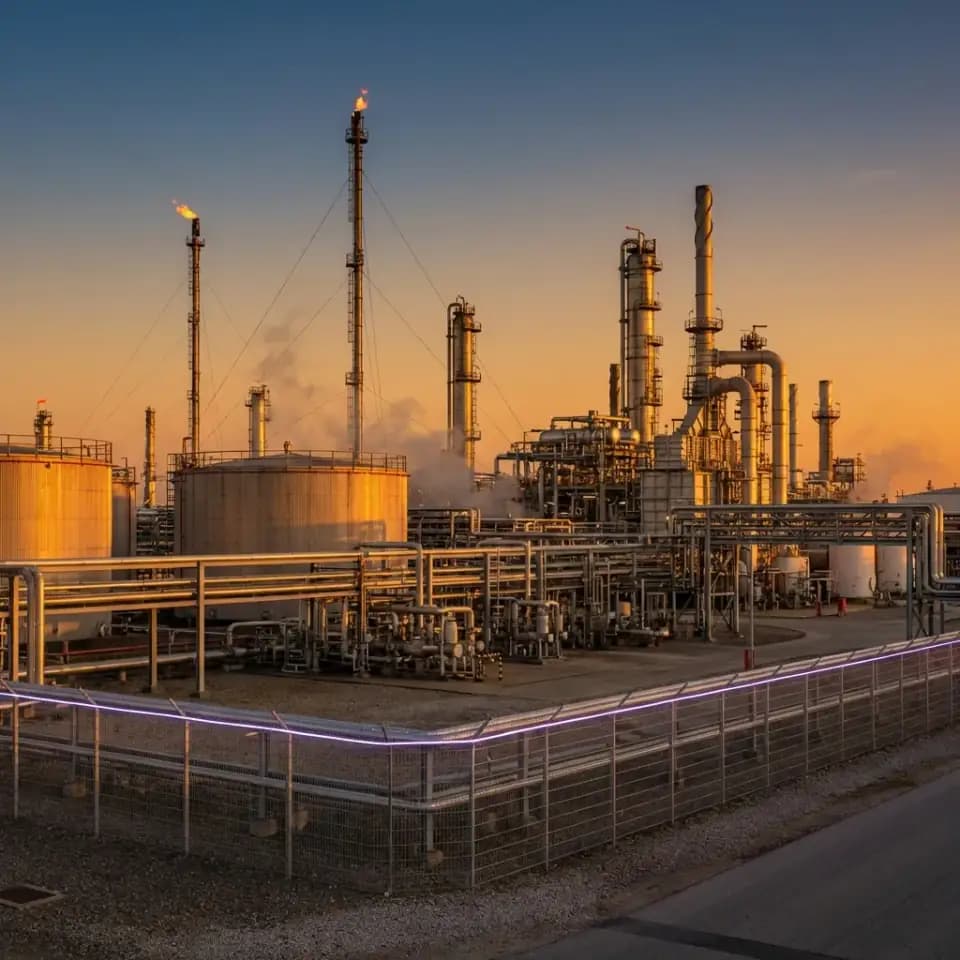
These yards connect directly to Will County's warehouse and distribution center corridor, where over 100 million square feet of logistics space has been developed since 2000, attracting tenants including Amazon, Walmart, Home Depot, and IKEA. The ExxonMobil Joliet refinery processes over 250,000 barrels per day, making it one of the Midwest's largest petroleum refineries, while the Citgo Lemont refinery adds 180,000 barrels per day of additional capacity. Together these facilities produce a significant portion of the gasoline and diesel consumed in the Chicago metropolitan area and the broader Midwest.
The Illinois Waterway system connects the Great Lakes to the Mississippi River through a series of locks and channels, enabling barge traffic to move bulk commodities like grain, coal, and petroleum products from Chicago to the Gulf of Mexico.
Illinois hosts two Department of Energy national laboratories with significant security requirements. Argonne National Laboratory in Lemont conducts research on nuclear energy, energy storage, advanced computing, and climate science, housing the Advanced Photon Source, one of the most powerful X-ray light sources in the world used by researchers from across the globe. Fermi National Accelerator Laboratory in Batavia operates high-energy particle physics experiments and the PIP-II particle accelerator project, the first accelerator built in the US with significant international contributions and partnerships.
Scott Air Force Base near Belleville serves as headquarters for US Transportation Command, which coordinates all military logistics globally, and the Air Mobility Command, giving the installation strategic significance far beyond its physical footprint in southwestern Illinois. Great Lakes Naval Station in North Chicago is the US Navy's only boot camp, training approximately 40,000 enlisted sailors annually. Rock Island Arsenal in the Quad Cities is the largest government-owned weapons manufacturing arsenal in the western world.
Meta, Microsoft, and Google operate hyperscale data centers in Chicago's western suburbs that require physical security commensurate with their role as critical digital infrastructure supporting millions of users.
Chicago's rail yards experience the highest cargo theft rates of any metropolitan area in the United States, a distinction driven by the sheer volume of intermodal containers being classified, switched, and staged in temporary holding areas that create windows of vulnerability for organized theft rings. The FBI and cargo theft task forces have documented sophisticated operations targeting electronics, pharmaceuticals, and consumer goods moving through the Joliet-Elwood corridor, with annual cargo theft losses in the Chicago region estimated in the hundreds of millions of dollars.
Will County logistics warehouses report regular break-in attempts targeting loading docks and staged trailers. Catalytic converter theft has reached epidemic proportions across the Chicago metro, prompting Illinois to pass specific legislation addressing the crime with enhanced penalties. Vehicle theft rates in Chicago consistently rank among the highest nationally, with Hyundai and Kia models disproportionately targeted.
Refinery perimeter security at the Joliet and Lemont facilities must account for the proximity of flammable materials and the potential for catastrophic environmental releases if infrastructure is breached by intruders.
The fiber optic PIDS solution is particularly advantageous in Illinois due to the state's extreme climate variability, ranging from polar vortex events driving wind chills below minus 50 degrees Fahrenheit, as occurred in January 2019 when Chicago recorded a wind chill of minus 52, to hot, humid summers exceeding 100 degrees Fahrenheit. Chicago receives over 36 inches of snow on average annually, and severe winter storms can disable camera-based and battery-dependent security systems for extended periods.
The tornado risk across central and southern Illinois during spring and summer months underscores the need for detection systems that remain operational after severe weather events. Severe thunderstorms produce lightning, damaging winds exceeding 80 miles per hour, and large hail that can destroy electronic sensors while fiber optic cables remain completely unaffected.
Mississippi and Illinois River flooding periodically inundates low-lying industrial areas, where fiber optic sensing cables maintain full functionality even when partially submerged, providing continuous detection during exactly the conditions when properties are most vulnerable to opportunistic theft and looting.
FortSense deployments in Illinois target the most theft-prone and security-critical facilities in the nation's logistics heartland. The CenterPoint Intermodal Center and BNSF Logistics Park Chicago require multi-mile perimeter monitoring that only fiber optic distributed sensing can provide cost-effectively across their vast 6,400-acre combined footprint. The ExxonMobil Joliet refinery and Citgo Lemont refinery demand intrinsically safe perimeter detection with no spark risk from electrical components in areas where flammable vapors may be present.
Argonne and Fermilab national laboratories require DOE-compliant perimeter security that detects cut, climb, and breach attempts across miles of fencing surrounding classified research facilities. Scott AFB needs detection technology suitable for a military installation coordinating global logistics operations. Pharmaceutical campuses in the Lake County corridor housing Abbott, AbbVie, and Baxter protect controlled substances and intellectual property worth billions. Data centers in the western suburbs require zero-electromagnetic-interference perimeter systems that will not affect sensitive computing equipment.
The convergence of these requirements makes Illinois one of the most compelling markets for advanced fiber optic perimeter detection in the United States.
Professional perimeter protection for distribution centers, manufacturing, and critical infrastructure in Illinois.
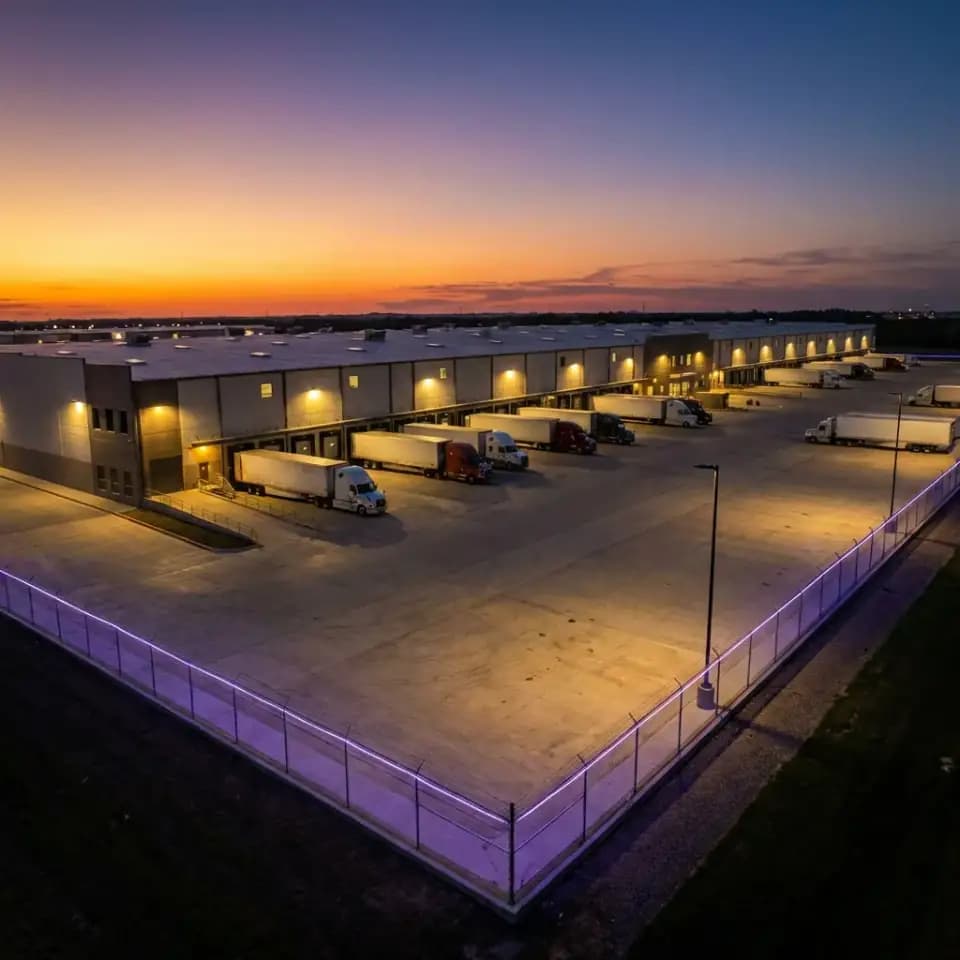
- Fleet Parking & Trailer Yard Protection
- Yard & Loading Dock Security (TAPA FSR)
- R&D Campus & IP Protection
- Rail Logistics Parks & Intermodal Terminals
Plan a FortSense assessment for this market
Share the perimeter length, fence type, and monitoring workflow. FortSense can help scope zones, integration points, and commissioning requirements for this location.
Services
Fleet Parking & Trailer Yard Protection
Overnight fleet parking and trailer yard security with cargo theft deterrence, real-time alarm zones, and integration with yard management systems.
Yard & Loading Dock Security (TAPA FSR)
TAPA FSR-compliant perimeter detection for logistics yards, loading docks, and cross-dock facilities with vehicle and pedestrian discrimination.
R&D Campus & IP Protection
High-security perimeter for R&D campuses, pharmaceutical plants, and IP-sensitive manufacturing facilities with tamper-proof fiber and encrypted alarm channels.
Deployment patterns for local sites
How FortSense Works in Illinois
Fiber optic perimeter security adapted to local conditions and requirements.
- Fiber installed. Passive fiber optic cable mounts on the existing fence or wall with minimal civil work.
- Vibration detected. Any contact creates vibration patterns in the fiber so climbing, cutting, or lifting attempts become visible immediately.
- AI/DSP verification. Algorithms filter out wind, animals, and environmental noise before an operator ever sees an alarm.
- Alarm if intrusion. Only real threats trigger zone-based alarms that can route into the monitoring workflow already used by the site team.
Adapted for Illinois. Our local partners understand Illinois's climate, terrain, and security challenges. The fiber optic system is configured to filter local environmental conditions while maintaining maximum sensitivity to real intrusion attempts.
Integration and security software fit
FortSense can feed alarms into the monitoring stack a site already uses, including VMS, PSIM, alarm panels, relay inputs, TCP/IP workflows, and camera verification.
- Zone-based alarms for operators and guard teams
- Camera and VMS workflows for visual verification
- Relay or network outputs for existing security systems
- Software-assisted filtering before dispatch decisions
Industries in this market
Relevant FortSense industry and use-case paths connected to this location.
- Rail Logistics Parks & Intermodal Terminals
- Petroleum Refinery Operations
- National Laboratories & Military Air Force Bases
- Distribution Center Perimeter Security
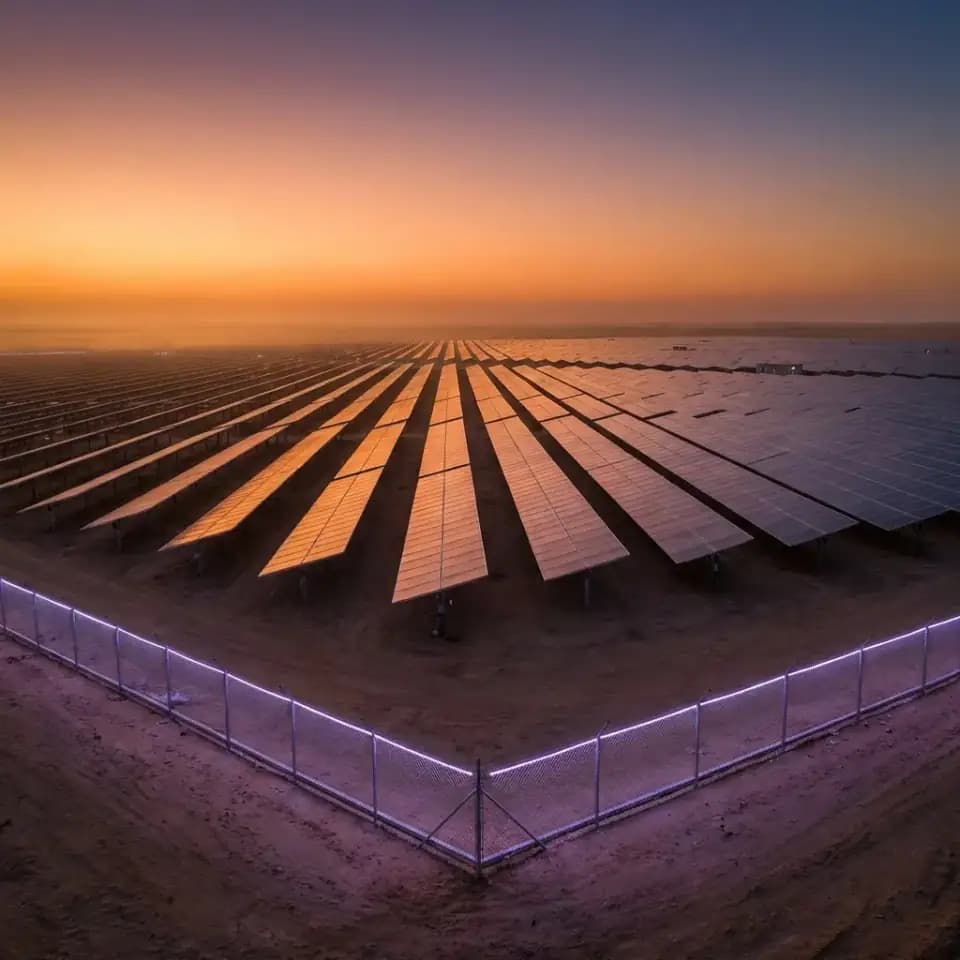
- Solar Farm Perimeter Security
- Perimeter Security for Critical Infrastructure
Why FortSense fits in Perimeter Security in Illinois
FortSense is designed for perimeter security work where false-alarm reduction, passive fiber sensing, and practical integration matter more than adding another camera-only layer.
- Passive fiber on existing fences, walls, or perimeter structures
- AI/DSP filtering for wind, vibration, and environmental noise
- Zone-level alerts that can match the site's response model
- Support for design, integration, commissioning, and handover
Market notes
Practical details that help this page stay specific to the market instead of drifting into generic copy.
- Rail Logistics Parks & Intermodal Terminals
- Petroleum Refinery Operations
- National Laboratories & Military Air Force Bases
- Fleet Parking & Trailer Yard Protection
Related FortSense paths
Related technical content and commercial guidance linked from this location page.


