

Local service overview
Fiber Optic Perimeter Security for West Virginia Energy & Chemical Operations
FortSense secures West Virginia's Kanawha Valley chemical plants, Mountain Valley Pipeline infrastructure, and FBI Criminal Justice Information Services Division with fiber optic perimeter detection.
## Economic & Industrial Landscape
West Virginia generates approximately $80 billion in gross domestic product, with an economy historically dominated by coal mining that is undergoing a significant transition toward natural gas, chemical manufacturing, and advanced defense operations. Coal production, while declining as utilities shift to natural gas and renewables, still makes West Virginia one of the top coal-producing states.
The Marcellus and Utica Shale formations underlying the state have transformed the energy landscape: EQT Corporation and Antero Resources operate major drilling programs that have made natural gas extraction an increasingly important economic driver. The Mountain Valley Pipeline, a 303-mile natural gas transmission line running from northwestern West Virginia to southern Virginia, represents billions of dollars in infrastructure investment crossing some of the most rugged terrain in the eastern United States.
The Kanawha Valley, stretching roughly 30 miles along the Kanawha River from Institute to South Charleston, is known as "Chemical Valley" and hosts one of the highest concentrations of chemical manufacturing facilities in the United States. Dow Chemical (at the former Union Carbide site in Institute), Chemours (formerly DuPont) at Washington Works near Parkersburg, Covestro in South Charleston and New Martinsville, and Braskem America in Kenova all operate major chemical production facilities.
Toyota Motor Manufacturing West Virginia in Buffalo produces engines and transmissions, representing the state's most significant automotive manufacturing operation. The state faces significant economic headwinds including population decline, an aging workforce, and the severe impacts of the opioid epidemic, which has given West Virginia among the highest drug overdose death rates in the nation.
## Critical Infrastructure
The FBI's Criminal Justice Information Services (CJIS) Division in Clarksburg is the largest division of the FBI and one of the most critical law enforcement data facilities in the nation. CJIS processes and maintains fingerprint records, criminal history data, the National Crime Information Center (NCIC) database, and the National Instant Criminal Background Check System (NICS) that supports firearms purchases.
The facility handles billions of transactions annually and contains the most comprehensive criminal justice database in the world, making its physical security a matter of national law enforcement capability.
West Virginia's power generation infrastructure includes some of the largest coal-fired plants in the eastern United States. The John Amos Power Plant near Winfield, the Harrison Power Station in Haywood, Mount Storm Power Station in Grant County, and the Mountaineer Power Plant in New Haven collectively generate thousands of megawatts of baseload electricity. The Longview Power Plant in Maidsville is one of the newest and most efficient coal plants in the country.
Appalachian Power, a subsidiary of American Electric Power, operates the transmission network that distributes electricity across the state's mountainous terrain. The natural gas gathering and transmission pipeline network spans thousands of miles across the state, with compressor stations and processing plants in remote Appalachian locations. CSX Transportation and Norfolk Southern operate major rail mainlines through the state, transporting coal to power plants and export terminals.
## Security Challenges
Chemical Valley presents one of the most complex industrial security environments in the United States. The chemical plants along the Kanawha River store and process hazardous materials including isocyanates, chlorine, and various petrochemical feedstocks, and the 1984 Union Carbide facility release in Institute (a less severe incident than the Bhopal disaster at the same company's Indian plant) demonstrated the potential consequences of security failures at chemical manufacturing sites.
Perimeter security must prevent unauthorized access to facilities where intrusion could trigger hazardous material releases affecting surrounding communities. The proximity of Chemical Valley facilities to residential areas in Charleston and surrounding communities adds urgency to perimeter protection.
Natural gas wellhead and compressor station security in the Marcellus Shale region is complicated by the remote, mountainous terrain of central and northern West Virginia, where access roads may be unpaved and cell phone coverage intermittent. The opioid crisis drives property crime rates that disproportionately affect rural areas, with copper theft from substations, communication towers, and industrial equipment being a persistent problem.
Pipeline right-of-way security for the Mountain Valley Pipeline and the extensive gathering system network requires monitoring across terrain that includes steep ridgelines, narrow valleys, and dense Appalachian forests. The FBI CJIS facility in Clarksburg demands perimeter security commensurate with its role as the repository of the nation's criminal justice records.
## Why Fiber Optic PIDS in West Virginia
West Virginia's highland climate and mountainous terrain create environmental conditions that challenge conventional security systems in ways that are distinct from flatland deployments. Flash flooding in the state's narrow valleys can be catastrophic, as demonstrated by the 2016 floods that killed 23 people and destroyed 1,500 homes. Heavy snowfall in mountain areas, with the Snowshoe region receiving over 150 inches annually, combined with ice storms and landslides on steep terrain, creates a threat environment where ground-based electronic sensors are vulnerable to physical damage and power failure.
Fiber optic sensing cables maintain detection capability through flooding, snow loading, and ice conditions because the passive glass fiber requires no electrical power at the sensing point and is unaffected by water infiltration.
The challenging topography of Appalachian terrain, where perimeters may follow ridgelines, traverse steep slopes, and cross stream valleys, makes fiber optic PIDS particularly valuable because the flexible cable can conform to irregular terrain without the mounting limitations of rigid electronic sensor systems. For Chemical Valley facilities, where the electromagnetic noise from chemical processing equipment and high-voltage electrical systems can interfere with electronic sensors, fiber optic detection provides interference-free perimeter monitoring.
The long detection ranges achievable with fiber optic technology are essential for pipeline corridor monitoring across the vast distances of West Virginia's natural gas infrastructure.
## Deployment Context
West Virginia's perimeter security requirements concentrate on Chemical Valley's hazardous materials facilities, the FBI CJIS national criminal justice data center, Marcellus Shale natural gas extraction and pipeline infrastructure, coal-fired power generation plants, and the strategic rail corridors that transport coal and industrial products through the Appalachian Mountains.
Fiber optic PIDS technology provides the flood resilience, terrain adaptability, and long-range detection capability required to protect these assets across West Virginia's challenging mountain landscape, where extreme weather, remote locations, and rugged terrain demand security technology that operates reliably without the infrastructure dependencies of conventional electronic systems.
Professional perimeter protection for distribution centers, manufacturing, and critical infrastructure in West Virginia.
- Remote Mining Camp Protection
- Open-Pit & Quarry Perimeter Security
- Wellhead & Pump Station Security
- Chemical Manufacturing & Hazardous Materials Facilities
Plan a FortSense assessment for this market
Share the perimeter length, fence type, and monitoring workflow. FortSense can help scope zones, integration points, and commissioning requirements for this location.
Services
Remote Mining Camp Protection
Securing remote worker camps, equipment yards, and explosive storage facilities in isolated locations with satellite-backhaul alarm reporting.
Open-Pit & Quarry Perimeter Security
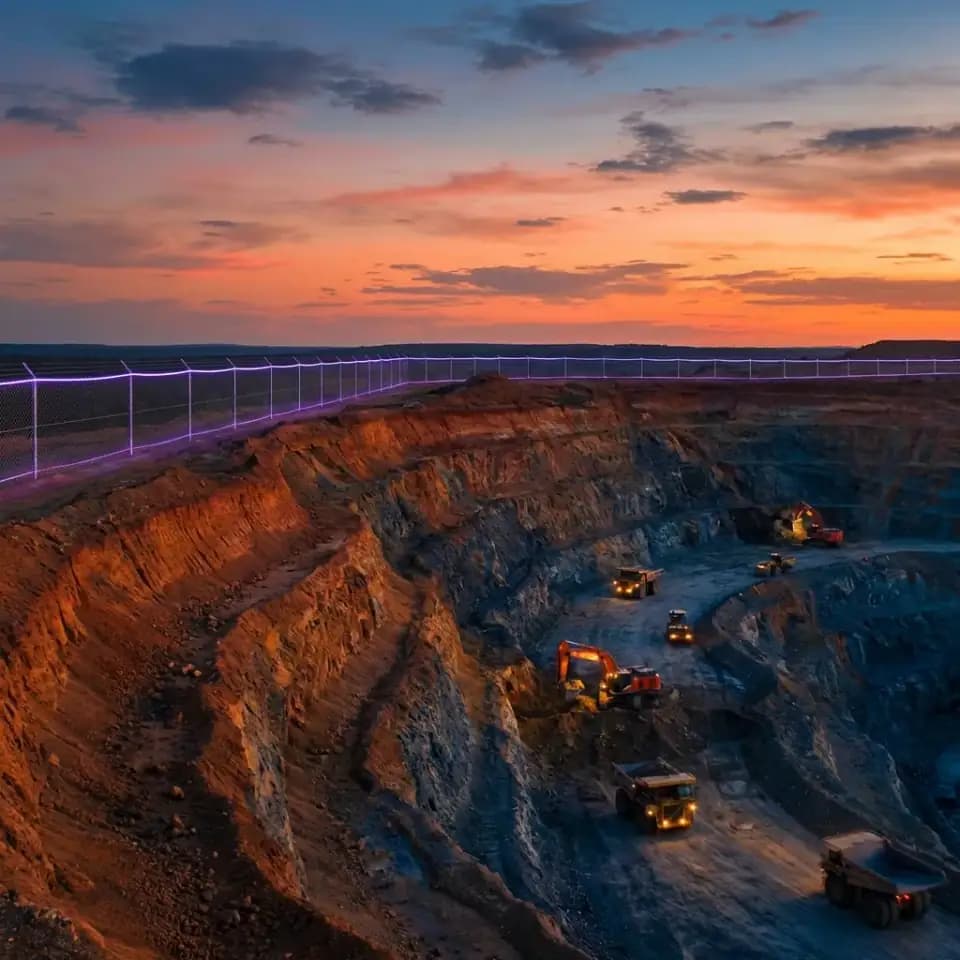
Blast-resistant fiber optic detection for open-pit mine boundaries, haul roads, and restricted blasting zones with vibration filtering for heavy equipment.
Wellhead & Pump Station Security
Remote wellhead perimeter monitoring across dispersed field operations with solar-powered relay nodes and SCADA integration.
Deployment patterns for local sites
How FortSense Works in West Virginia
Fiber optic perimeter security adapted to local conditions and requirements.
- Fiber installed. Passive fiber optic cable mounts on the existing fence or wall with minimal civil work.
- Vibration detected. Any contact creates vibration patterns in the fiber so climbing, cutting, or lifting attempts become visible immediately.
- AI/DSP verification. Algorithms filter out wind, animals, and environmental noise before an operator ever sees an alarm.
- Alarm if intrusion. Only real threats trigger zone-based alarms that can route into the monitoring workflow already used by the site team.
Adapted for West Virginia. Our local partners understand West Virginia's climate, terrain, and security challenges. The fiber optic system is configured to filter local environmental conditions while maintaining maximum sensitivity to real intrusion attempts.
Integration and security software fit
FortSense can feed alarms into the monitoring stack a site already uses, including VMS, PSIM, alarm panels, relay inputs, TCP/IP workflows, and camera verification.
- Zone-based alarms for operators and guard teams
- Camera and VMS workflows for visual verification
- Relay or network outputs for existing security systems
- Software-assisted filtering before dispatch decisions
Industries in this market
Relevant FortSense industry and use-case paths connected to this location.
- Chemical Manufacturing & Hazardous Materials Facilities
- Natural Gas Extraction & Pipeline Infrastructure
- Federal Law Enforcement & Data Centers
- Distribution Center Perimeter Security
- Solar Farm Perimeter Security
- Perimeter Security for Critical Infrastructure
Why FortSense fits in Perimeter Security in West Virginia
FortSense is designed for perimeter security work where false-alarm reduction, passive fiber sensing, and practical integration matter more than adding another camera-only layer.
- Passive fiber on existing fences, walls, or perimeter structures
- AI/DSP filtering for wind, vibration, and environmental noise
- Zone-level alerts that can match the site's response model
- Support for design, integration, commissioning, and handover
Market notes
Practical details that help this page stay specific to the market instead of drifting into generic copy.
- Chemical Manufacturing & Hazardous Materials Facilities
- Natural Gas Extraction & Pipeline Infrastructure
- Federal Law Enforcement & Data Centers
- Remote Mining Camp Protection
Related FortSense paths
Related technical content and commercial guidance linked from this location page.


