When upgrading access control across a multi-door corporate campus, integrators frequently grapple with securely integrating new IP-enabled controllers and cameras into an existing network fabric. Legacy setups often defaulted to static IPs and shared passwords, leaving openings for unauthorized access during onboarding. Secure device enrollment flips this model by enforcing cryptographic verification upfront, ensuring only attested hardware joins the security domain and reducing the window for man-in-the-middle exploits.
Consider a utility substation retrofit where dozens of sensors and edge gateways must connect without disrupting operations. Here, enrollment protocols like certificate-based authentication or device attestation tokens confirm firmware integrity and supply-chain provenance before network admission. This approach aligns physical security with Zero Trust Architecture glossary principles, segmenting enrollment traffic and automating key rotation to thwart persistent threats.
Teams succeeding with these methods report smoother migrations, as initial verification prevents downstream issues like policy misfires or compliance gaps under frameworks like NDAA. This explainer details the mechanics, tradeoffs, and workflows drawn from field deployments, helping IT and security managers navigate the shift.
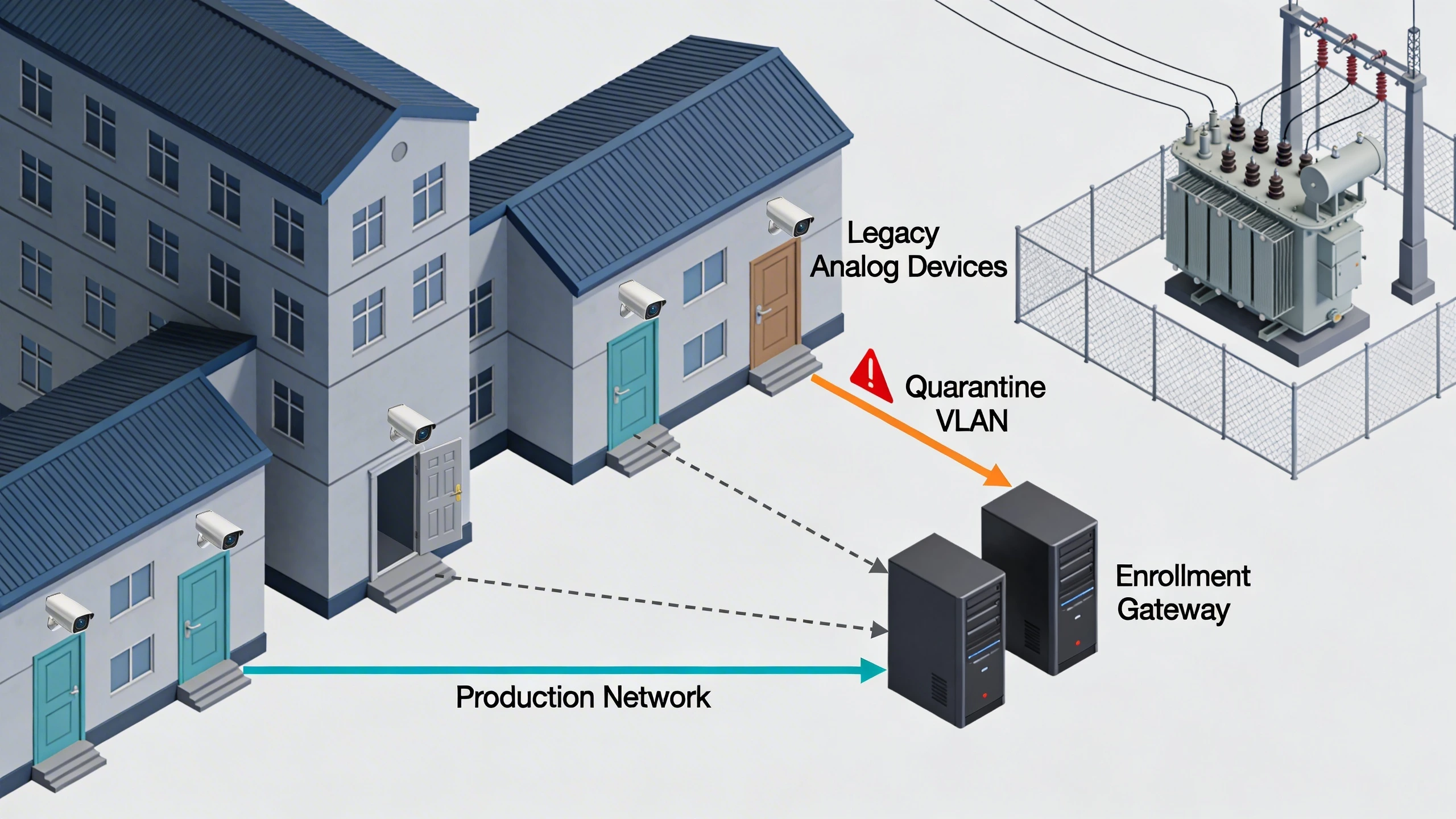
What the system does in practice
In a typical campus retrofit, secure device enrollment orchestrates the transition from untrusted factory states to production-ready network membership. Devices boot into a quarantine VLAN, where they present digital signatures or challenge-response proofs to an enrollment authority. Upon validation—often cross-checking against a manufacturer root of trust—the system issues short-lived credentials, granting access to operational segments. This process repeats for firmware updates, ensuring ongoing compliance without manual intervention.
For high-assurance sites like utility perimeters, the system shines in handling heterogeneous hardware: mixing door readers from different vendors under a unified policy. It matters because skipped steps lead to shadow devices evading NAC overlays, amplifying blast radius during breaches. Integrators who embed enrollment in deployment playbooks avoid these pitfalls, achieving consistent baselines across edge and core infrastructure.
Real-world example: During a North America deployments upgrade, teams used enrollment gateways to vet 200+ endpoints, isolating anomalies like tampered bootloaders before full integration. The result? A hardened network resistant to supply-chain compromises common in physical security gear.
Core components and signal flow
At its heart, the system revolves around three pillars: the device attestation module, enrollment server, and policy enforcer. The attestation module, embedded in device firmware, generates unique identifiers tied to hardware roots like TPMs or secure elements. The enrollment server acts as the gatekeeper, validating these against a certificate authority (CA) chain, while the policy enforcer applies VLAN assignments or ACLs post-approval.
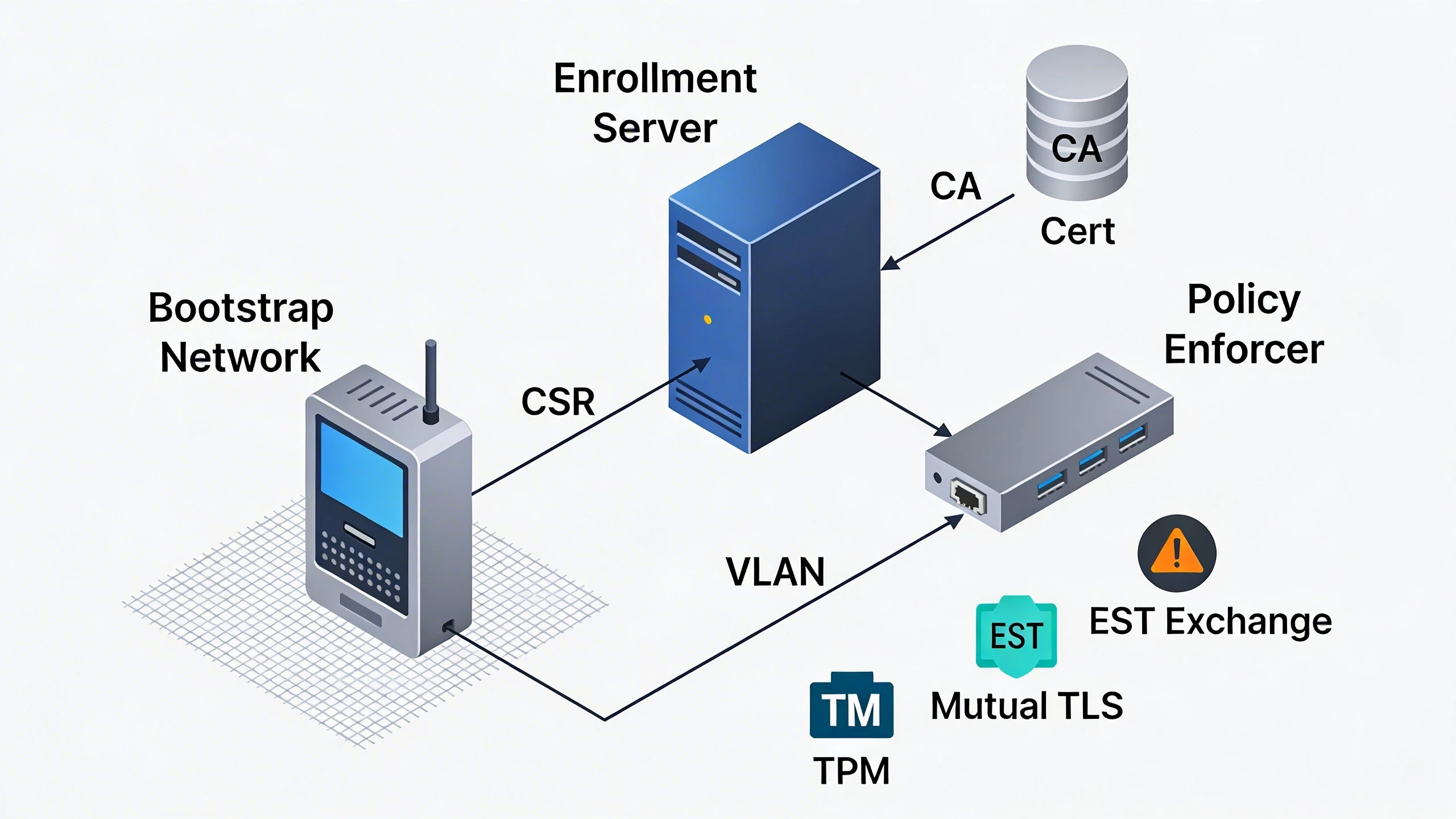
Signal flow starts with device DHCP discovery on a bootstrap network, triggering an EST (Enrollment over Secure Transport) or CMP (Certificate Management Protocol) exchange. The device submits its CSR (Certificate Signing Request), the server countersigns after revocation checks, and mutual TLS establishes the session. This closed loop prevents unauthorized provisioning, with logs feeding SIEM for audit trails.
Design tradeoff: Centralized servers scale well for campuses but introduce single points of failure; distributed edge proxies mitigate this at the cost of sync complexity. In practice, hybrid models balance resilience and manageability.
Deployment and integration considerations
Deployment begins with network segmentation: dedicate enrollment VLANs firewalled from production traffic, routing via dedicated gateways. Integration with existing NAC tools requires mapping device profiles to RADIUS or TACACS+ attributes, ensuring seamless handoff. For brownfield sites, phased rollouts—starting with non-critical doors—test interoperability without outages.
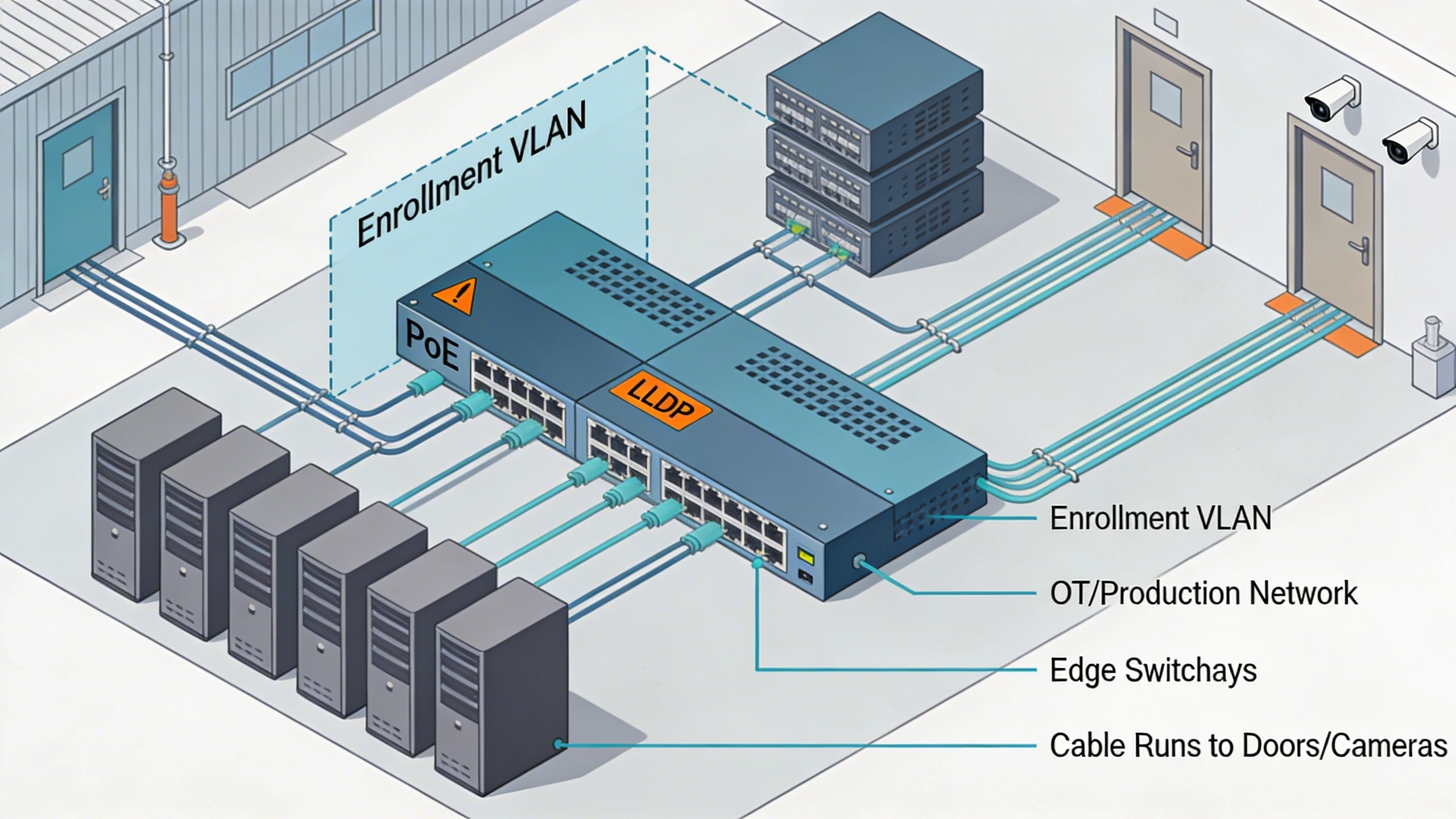
Key challenge: Vendor lock-in from proprietary attestation schemes. Opt for standards-based flows like IEEE 802.1AR to future-proof. Cable runs matter too; PoE switches must support LLDP-MED for auto-discovery, avoiding manual port configs that snag migrations. Budget for CA infrastructure if not leveraging cloud HSMs, as self-hosted roots demand HSM hardening.
In utility retrofits, align with NDAA glossary by prioritizing compliant hardware, verifying chains during enrollment to block gray-market risks.
Operational workflows and tuning
Day-to-day operations center on automated workflows: Devices re-enroll on lease expiry or posture changes, with dashboards flagging drifts like expired certs. Tuning involves threshold calibration—e.g., attestation score cutoffs—to balance false positives against security. Operators script bulk enrollments via APIs, integrating with CMDBs for inventory sync.
Scaling to hundreds of endpoints demands redundancy: Cluster enrollment servers with geo-redundancy for always-on access. Regular drills simulate failures, like CA outages, rotating to backups. Fine-tune revocation lists to expire rogue certs swiftly, minimizing exposure.
Pro tip: Embed health checks in monitoring stacks, alerting on enrollment latency spikes that signal misprovisioning.
Common failure points and misconceptions
A prevalent misconception: Treating enrollment as a one-time setup, ignoring recertification cycles. Devices with static creds bypass dynamism, inviting replay attacks. Another pitfall: Overlooking bootstrap security; unsecured DHCP exposes initial exchanges to eavesdroppers.
Failure often stems from incomplete segmentation—enrollment traffic leaking into OT zones—or ignoring firmware variances across models. Misconfigured CRLs (Certificate Revocation Lists) delay deprovisioning, prolonging insider threats. Teams falter by skipping mutual auth, trusting one-way device proofs vulnerable to cloning.
- Verify VLAN isolation pre-go-live with traffic mirrors.
- Audit CSR payloads for embedded secrets.
- Test failover in staging to catch sync gaps.
Where to go next
Deploy these strategies with FortSense 4, tailored for cyber-physical environments. For tailored advice, Request a design review.
Deepen your knowledge in Critical infrastructure security and explore North America deployments.
Image Production Brief (Internal - Remove Before Publish)
Recommended image count: 3
- Placement: After the introduction
Insert After: Introduction
Purpose: Visually frames the campus retrofit scenario, helping readers contextualize the enrollment challenge in a familiar physical security upgrade.
Prompt: Illustrated diagram of a multi-building campus security retrofit: show legacy analog doors and cameras transitioning to IP devices via an enrollment gateway, with arrows indicating quarantine VLAN to production flow, utility substation elements in background.
Alt Text: Campus retrofit diagram for secure device enrollment - Placement: After 'Core components and signal flow'
Insert After: Core components and signal flow
Purpose: Clarifies the technical signal flow, making abstract protocols concrete for engineers evaluating integration.
Prompt: Technical signal flow diagram: device on bootstrap network sends CSR to enrollment server, server validates with CA, issues cert, policy enforcer applies VLAN; include icons for TPM, EST exchange, mutual TLS.
Alt Text: Secure device enrollment signal flow diagram - Placement: After 'Deployment and integration considerations'
Insert After: Deployment and integration considerations
Purpose: Depicts wiring and topology for practical deployment planning, highlighting segmentation tradeoffs.
Prompt: Network topology and wiring diagram: enrollment VLAN firewalled from OT/production, PoE switches with LLDP, edge gateways clustered, showing cable runs to doors/cameras in a utility site layout.
Alt Text: Deployment topology diagram with wiring for enrollment