Distributed acoustic sensing is the wrong perimeter detection technology when the installed fiber cannot reliably capture the required threat events, the cable route does not represent the protected boundary, perimeter discontinuities dominate the risk, nuisance sources cannot be separated operationally, or the response workflow gains little from continuous localization. In those conditions, zone-based fiber, point fence sensors, buried detection, radar, video analytics, or a hybrid design may produce a more defensible system.
The decision is not anti-DAS. Continuous DAS can be a strong fit for long, physically continuous routes where strain transfer, optical condition, event signatures, localization, integration, and operations are validated. The mistake is choosing it from fiber availability or distance claims before testing the operational requirement.
NPSA PIDS guidance states that operational requirements and a thorough understanding of the site, environment, landscape, climate, integration, response, and maintenance should guide technology selection. It describes several PIDS categories with different strengths and weaknesses rather than one universal best technology.
Quick Verdict: Do Not Default to DAS When
The available fiber is mechanically isolated from the fence, soil, or structure that must transfer the event.
The fiber route diverges from the protected line or leaves critical access points and transitions unrepresented.
The perimeter is mostly short sections, gates, buildings, and crossings where continuous localization adds little.
Traffic, machinery, rail, vegetation, or site operations create signatures the proposed design has not separated.
The control room responds by fixed camera or patrol zones and cannot use continuous chainage effectively.
Fiber ownership, restoration, rerouting, or maintenance control conflicts with the security operating model.
A single interrogator or optical path creates an unacceptable common failure mode without a viable resilience design.
The vendor will not run a representative proof of concept with frozen settings and traceable evidence.
Use the DAS detection-range evaluation framework when distance is the sales argument. This page addresses whether continuous DAS belongs in the architecture at all.
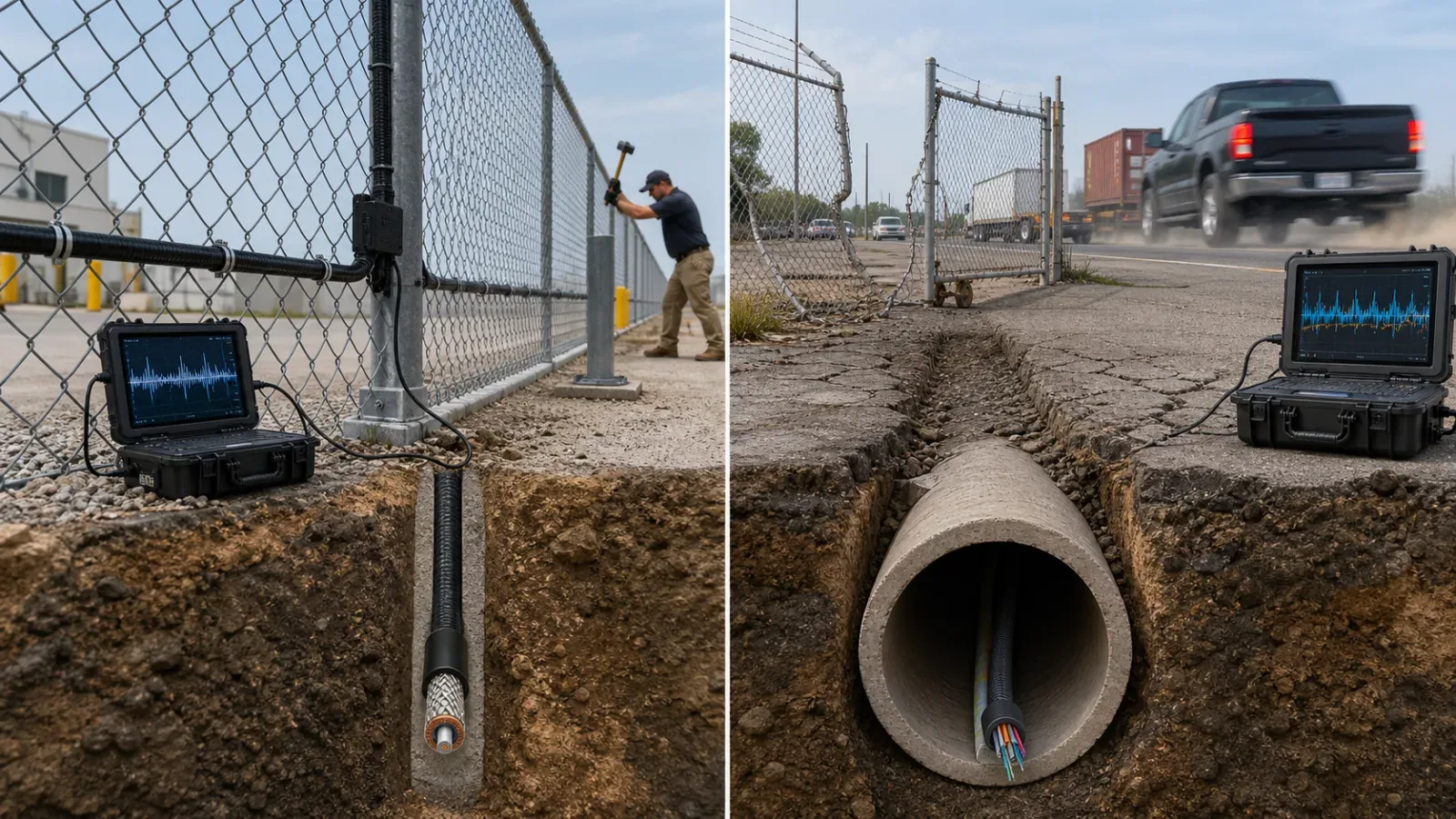
1. The Cable Cannot Transfer the Required Event
DAS measures distributed dynamic strain along the optical path. An optically healthy strand can still be a weak security sensor if the cable construction, attachment, conduit, backfill, or local structure prevents the target event from producing a useful strain signature in the fiber.
IEC 61757-3-2:2022 defines terminology, characteristic performance parameters, and related test methods for phase-sensitive coherent OTDR distributed acoustic and vibration interrogators. It does not certify that a particular installed fence, telecom duct, soil route, or cable construction will detect a site threat.
Primary research available through the NSF Public Access Repository reports measurement discrepancies associated with imperfect cable-to-earth coupling in an installed telecom route. The security implication is narrow but important: do not infer installed sensing suitability from optical continuity alone.
Reject or redesign the DAS option when representative climb, cut, lift, dig, vehicle, or tamper events cannot produce repeatable evidence at the required route sections. Better alternatives may include a fence-attached zone sensor, point sensor, purpose-installed buried cable, or hybrid coverage at the weak section.
2. The Fiber Route Does Not Represent the Security Boundary
A spare fiber is useful only where its physical route and access align with the detection requirement. A cable can pass near a site while bypassing gates, buildings, drainage features, corners, or the vulnerable side of the fence. Continuous chainage along the wrong route creates precise information about the wrong line.
Use the dedicated dark-fiber reuse feasibility process to confirm ownership, route, cable construction, optical condition, access, and coupling. If major threat paths require separate sensors anyway, compare the resulting hybrid honestly against a zone-led architecture.
3. Gates and Discontinuities Dominate the Risk
Continuous DAS is less compelling when most security decisions occur at sliding gates, swing gates, sally ports, wall transitions, buildings, road crossings, culverts, and short isolated fence runs. These features often need their own protected loops, transition details, auxiliary inputs, point sensors, video rules, or access-control state.
Where operators already respond to a small set of physical sectors, a zone-based fiber controller or point fence sensor can map more directly to the operating concept. Use the fiber optic versus fence sensor comparison for the broader technology tradeoff, and the buried versus fence-mounted guide when the installation medium remains undecided.
4. Nuisance Sources Cannot Be Separated Operationally
A sensitive distributed sensor can observe legitimate activity as well as threats. Nearby roads, rail, pumps, conveyors, generators, blasting, vegetation, drainage, maintenance, and wildlife can create signals that vary by location and condition. This does not automatically disqualify DAS, but unmeasured interference makes the procurement decision speculative.
NPSA perimeter intrusion detection guidance emphasizes balancing detection against false or unwanted alarms and verifying alarms through the security workflow. If the POC requires settings that suppress credible threats to control operational workload, the current DAS design is the wrong configuration for that site.
The alternative may be a better-coupled route, shorter supervised zones, a technology less exposed to the dominant source, or layered confirmation using radar, point sensing, and video. The required outcome is usable detection, not the largest volume of raw sensor data.
5. Continuous Localization Does Not Improve Response
Continuous chainage has value only when it improves verification and response. If every event is ultimately mapped to the same camera sector, guard route, or fixed alarm zone, higher localization granularity may add configuration and calibration work without changing the decision.
Start from how operators acknowledge, verify, dispatch, and close events. A zone-based sensor may be more appropriate when the physical response plan is zone-based. Radar may fit an open sterile area when tracking direction and movement matters. Video analytics may fit a scene with controlled views and lighting. A hybrid can use fiber for the long fence and another technology at gates or open areas.
Review FortSense 4 where passive fiber zones, relay or IP events, cameras, and response sectors need to be unified without forcing every perimeter section into continuous DAS.
6. Fiber Control and Maintenance Conflict With Security Operations
Security owners need reliable access to strand records, endpoints, closures, restoration decisions, change notices, and maintenance windows. A telecom owner may reroute, splice, reclaim, or restore fiber according to network priorities that do not preserve sensing chainage, coupling, configuration, or evidence.
Do not choose DAS on shared infrastructure unless responsibilities, notification, configuration control, repair evidence, and post-change retesting are contractually and operationally workable. If security cannot control the sensing asset, purpose-installed fiber or independent zone sensors may be the stronger architecture.
7. The Resilience Model Is Not Acceptable
A long optical path can concentrate coverage in one interrogator, power source, cabinet, network path, or cable route. That can be efficient, but efficiency is not resilience. A cut, cabinet failure, maintenance action, or software fault may degrade a large boundary section.
Reject the proposed architecture when its failure domain exceeds the operational requirement and the design has no acceptable bypass, redundant path, secondary channel, local zones, health monitoring, power backup, or response procedure. The alternative may still use fiber, but with smaller physical zones or diversified technologies.
8. The Supplier Will Not Prove the Site-Specific Case
A slide deck, laboratory result, demo reel, or prior deployment does not replace evidence from the intended route. The system should be disqualified or held when the supplier will not expose configuration state, run representative threat and nuisance events, preserve raw and alarm evidence, support blind trials, or document failures and retests.
Use the fiber PIDS proof-of-concept plan to separate training from blind acceptance, freeze the tested configuration, and produce an explicit proceed, conditional proceed, redesign, extend, or reject decision.
DAS No-Fit Decision Matrix
Poor physical coupling: DAS struggles because the threat does not create repeatable strain in the fiber. Consider purpose-installed sensing cable, fence-mounted zone sensors, or point sensors; require controlled field events and raw evidence.
Route-boundary mismatch: continuous data follows a route that misses the protected line. Consider a new route, mixed sensing paths, or another technology at gaps; require surveyed route and threat-path overlay.
Gate-heavy fragmented perimeter: transitions dominate design and response. Consider zone-based fiber, gate inputs, point sensors, and video; require an assembly-level coverage schedule.
Uncontrolled nuisance environment: events overlap with traffic, machinery, vegetation, or operations. Consider a better-coupled route, shorter zones, radar, point sensing, or hybrid verification; require an environmental baseline.
Zone-based response workflow: continuous chainage does not change dispatch or verification. Consider physical fiber zones or point sensors mapped directly to cameras and patrol sectors; require a response mapping exercise.
Shared-fiber control conflict: telecom changes can invalidate sensing assumptions. Consider purpose-installed fiber or independent sensors; require ownership, maintenance, restoration, and retest controls.
Excessive common failure domain: one cut or head-end fault removes too much coverage. Consider redundant paths, smaller zones, secondary technologies, and explicit degraded-mode response; require failure-mode testing.
No representative POC: performance remains an assertion. Hold procurement until the candidate passes a frozen, evidence-led field trial.
Choose the Alternative by Operational Job
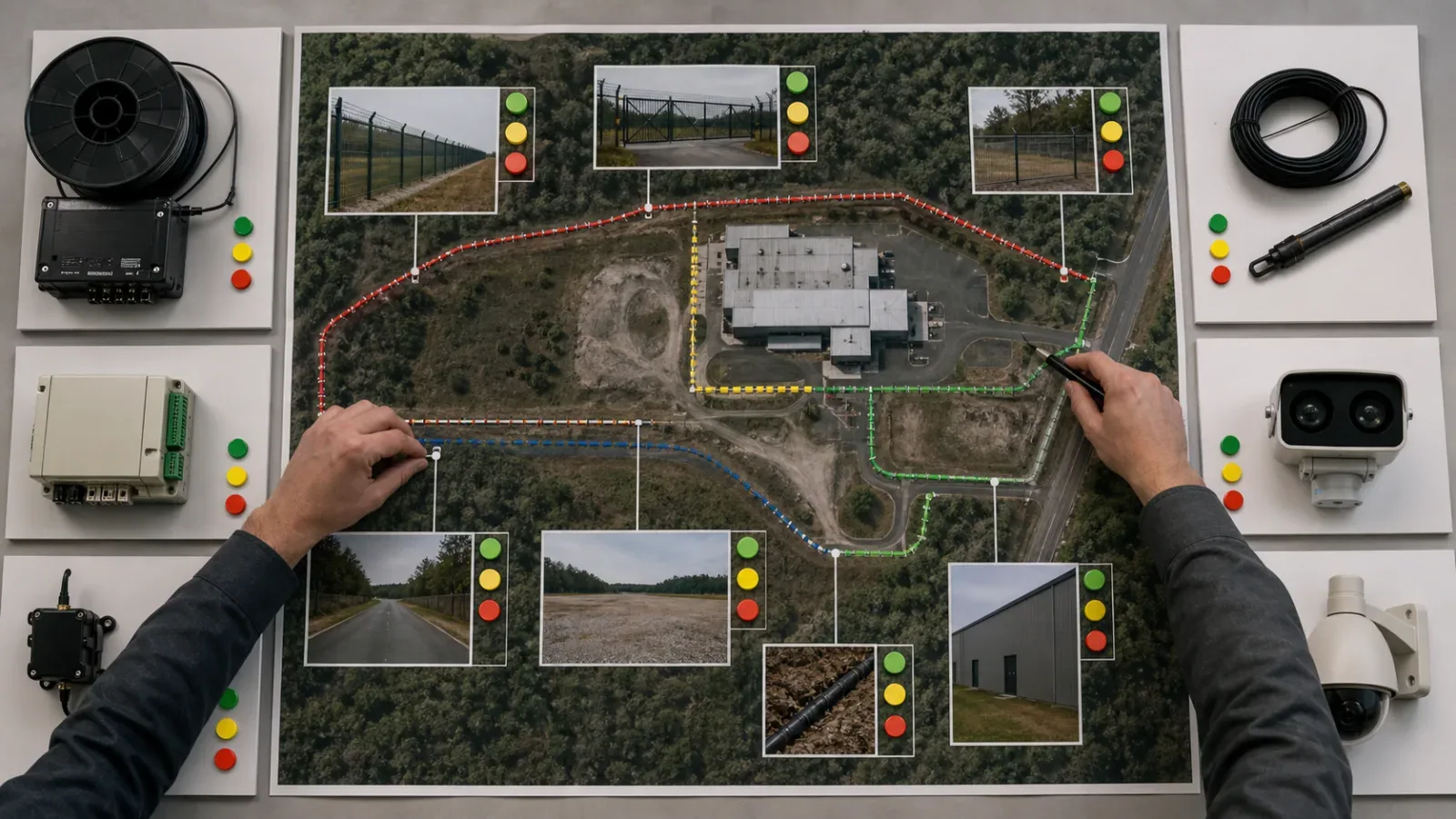
Zone-based fiber PIDS: best when passive sensing is desired but physical response, cameras, and maintenance are organized into known sectors.
Point fence sensors: best for isolated panels, gates, short runs, or locations needing direct local attribution and independent replacement.
Purpose-installed buried detection: best when covert line detection is required and soil, trench, drainage, and coupling can be engineered.
Radar or wide-area sensing: best when open-space detection and track behavior matter more than fence vibration.
Video analytics: best where the scene, lighting, weather exposure, camera geometry, and verification workflow can be controlled.
Hybrid architecture: best when no single technology covers long fences, gates, roads, buildings, open areas, and response needs with acceptable risk.
The fiber-optic fence sensor buyer guide supports vendor and architecture screening after the no-fit conditions are understood. For critical sites, review the critical infrastructure security application and the United States deployment context.
Final Decision Rule
Choose continuous DAS only when the protected route, physical coupling, event signatures, localization value, integration, resilience, asset control, and operating model are supported by site evidence. If one or more conditions fail, redesign the route, narrow the DAS role, or select a better-matched zone, point, buried, wide-area, video, or hybrid architecture.
For a site-specific technology fit and integration review, request a FortSense perimeter architecture consultation.
For sectors where DAS still fits the mission, use the border-security DAS design guide to define route segmentation, verification, and response workflow.