A fiber PIDS proof of concept should determine whether a defined system configuration can meet a site-specific operational requirement under representative route, weather, threat, and integration conditions. It should not be an unrestricted demonstration or a sequence of tests adjusted until the system passes.
The defensible method is to define the requirement first, divide the site into meaningful test strata, establish an environmental baseline, tune with a declared training dataset, freeze the configuration, and then conduct blind acceptance trials using previously unseen events. The final decision must be supported by traceable event records rather than vendor presentation material.
IEC 61757-3-2:2022 defines terminology, performance parameters, and associated test or calculation methods for coherent OTDR-based distributed acoustic and vibration sensing. It does not establish a universal perimeter-security pass threshold. The POC team must translate the site operational requirement into documented, measurable acceptance criteria.
Quick Fiber PIDS POC Requirements
A defined protected boundary, threat model, response workflow, and integration scope.
Representative fence, buried route, gate, corner, terrain, and environmental conditions.
A threat-event matrix covering relevant intrusion methods, non-threat activity, and locations.
Separate datasets for tuning and blind acceptance.
A frozen, identifiable configuration before scored testing begins.
Detection, localization, latency, unwanted-alarm, availability, and integration evidence.
Controlled retesting, documented change management, and a signed exit decision.
Before defining the trial boundary, review how to evaluate DAS detection range claims. A laboratory range statement does not prove acceptable performance along the installed route.
Define the Operational Requirement Before the POC
The POC begins with an operational requirement, not with equipment installation. NPSA operational-requirement guidance calls for the protected boundary, threats and activities, vulnerable points, external constraints, response arrangements, integration requirements, and environmental conditions to be defined before security measures are selected.
The trial statement should be explicit: determine whether the proposed fiber PIDS configuration can detect, locate, communicate, and support verification of defined threat events across representative site conditions without creating an operationally unacceptable unwanted-alarm burden.
Boundary sections included and excluded from the trial.
Fence, wall, buried, gate, culvert, corner, and route-transition conditions.
Credible climbing, cutting, lifting, digging, crawling, vehicle, or tampering events.
Nearby roads, railways, machinery, vegetation, drainage, wildlife, and public activity.
Required alarm destination, camera response, event data, and operator workflow.
Expected environmental limits plus safety, access, cybersecurity, and evidence-retention constraints.
When an existing telecom route is in scope, complete the separate dark-fiber reuse feasibility assessment before treating that strand as an acceptable POC asset.
Assign POC Roles and Decision Authority
A vendor should not design the test, operate the system, score the results, and approve its own evidence without independent oversight. The site owner owns the operational requirement and exit decision. The test authority owns the protocol and scoring rules. The integrator owns installation, interfaces, and configuration records. The vendor provides product expertise and approved tuning. Operations personnel validate alarm presentation and response usability.
Name one person authorized to approve configuration changes and one person authorized to accept or reject evidence. The evidence custodian must preserve event identifiers, timestamps, raw records, photographs or video, configuration versions, deviations, and the decision history.
Use a Stage-Gate POC Plan
Entry: approve the operational requirement, scope, roles, access, safety controls, interfaces, and candidate configuration. Exit with a signed charter and responsibility matrix.
Site characterization: survey route construction, coupling, transitions, interference sources, vulnerable points, and environmental constraints. Exit with an annotated route map and constraint register.
Baseline: record representative environmental and operational activity without staged intrusions. Exit with a time-aligned dataset and observed-event diary.
Installation qualification: verify cable attachment or burial, optical condition, topology, power, timing, network, and alarm interfaces. Exit with installation records and configuration backup.
Training and tuning: use declared events to configure zones, sensitivity, filters, and classifications. Exit with the tuning dataset and complete change log.
Configuration freeze: export and identify the exact tested configuration, software, firmware, zone map, classifier, integration, and timing state.
Blind acceptance: run undisclosed, randomized threat and non-threat events using personnel separated from tuning. Preserve raw records and independently scored results.
Review and exit: classify failures, control corrective changes and retests, then sign a proceed, conditional proceed, redesign, extend, or reject decision.
Do not progress to blind testing while the route map, event definitions, timing source, evidence capture, or acceptance logic remains ambiguous.
Stratify the Route and Environment
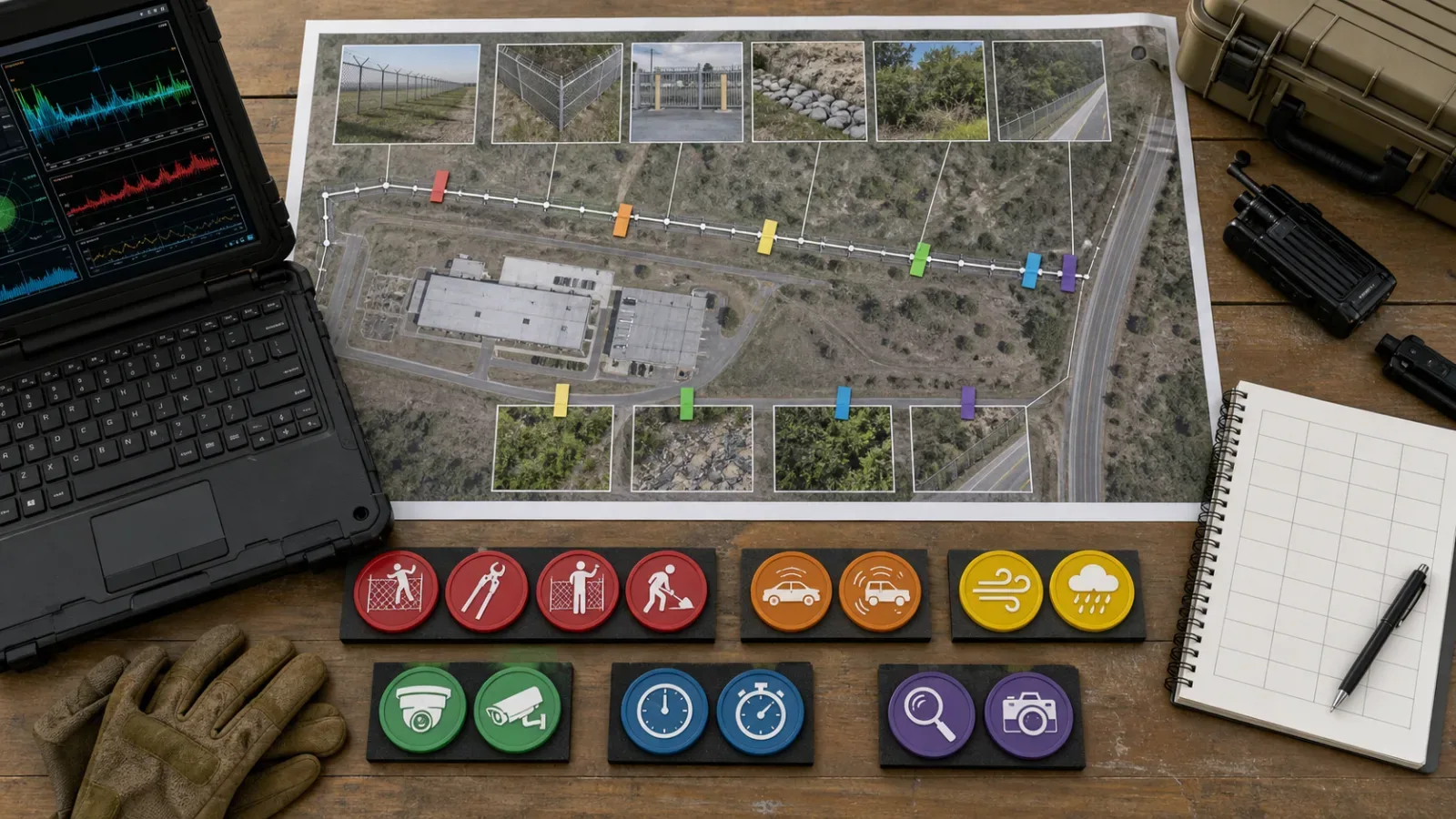
A convenient straight section of fence is not representative of an entire perimeter. Divide the trial into strata that could materially affect detection, localization, classification, latency, or unwanted alarms.
Fence construction, height, rigidity, condition, and attachment method.
Buried cable depth, backfill, soil, conduit, and surface treatment.
Corners, gates, culverts, expansion joints, walls, and cable crossings.
Distance from the interrogator and position relative to splices or connectors.
Vegetation, wind, rainfall, drainage, frost, standing water, and temperature exposure.
Roads, rail, transformers, pumps, generators, conveyors, or blasting activity.
Areas requiring different response zones or camera assignments.
The POC need not reproduce every meter of the final deployment, but it must include every condition capable of changing the procurement decision. Use the dedicated method for comparing fiber PIDS localization accuracy claims when event position is a scored outcome.
Build the Threat-Event Matrix
Create one row per event class and capture route stratum, location, direction, tool or method, operator, environmental state, expected alarm behavior, verification source, and evidence required. Threat events must come from the operational requirement. Include benign activities that resemble threats because operational discrimination matters.
Assign every event a unique identifier before execution. Ground truth should record actual start time, surveyed position, method, duration, environmental context, operator, and any deviation from the script. Keep the blind schedule unavailable to the tuning team and control-room operator until scoring is complete.
Establish an Environmental Baseline
Run the system through representative ordinary activity before scored intrusion trials. Record sensor data and an independent site diary so signals can be associated with known causes such as wind, rain, gate movement, traffic, vegetation contact, scheduled maintenance, machinery cycles, and routine staff activity.
NPSA PIDS guidance states that commissioning must balance detection against unwanted or false alarms and that alarms require verification. A credible POC therefore must not promise zero false alarms. Its purpose is to expose and measure operational tradeoffs under observed conditions.
Separate Tuning Data from Blind Acceptance Data
The training dataset configures the system. The blind dataset tests whether that frozen configuration generalizes to unseen events. During training, disclose event type, position, timing, and route condition to the tuning team and record every threshold, zone, filter, classification, and processing change.
At freeze, export the configuration, software and firmware versions, zone map, classifier versions, integration settings, and time-synchronization state. The blind coordinator then selects and randomizes events without disclosing the schedule. Do not retune between blind events unless the run is formally stopped and the affected evidence is invalidated.
Allocate Test Samples Without Inventing Universal Counts
There is no defensible universal number of trials for every fiber PIDS POC. Define allocation before seeing scored results and base it on decision risk and variability: required allocation is a function of event criticality, route variability, environmental variability, execution variability, consequence of failure, uncertainty, and desired decision confidence.
Increase allocation where failure would leave a critical threat path unprotected.
Increase allocation where route construction, coupling, weather, or human execution varies materially.
Increase allocation where the technology is unfamiliar or early outcomes are inconsistent.
Reduce duplication only where conditions are demonstrably equivalent and the rationale is recorded.
Reserve broader seasonal and statistical acceptance for the later commissioning plan when the POC cannot observe those conditions.
Measure Performance and Preserve Evidence
Detection: ground-truth event ID, sensor record, alarm log, and scored outcome.
Localization: surveyed route reference, reported position or zone, and declared calculation method.
Latency: synchronized event onset, sensor, server, VMS, and operator timestamps.
Unwanted alarms: alarm-producing non-threat activity, observed operating time, verification result, and conditions.
Classification: declared event class, output class, raw event, and confidence data when available.
Integration: delivery, mapping, acknowledgement, camera association, and failure behavior.
Availability: interruptions, restarts, dropped events, degraded states, and recovery action.
Configuration integrity: approved export, version identifiers, hash or signature, and change log.
Test whether each accepted alarm reaches the correct operational destination and presents enough information for the expected response. Review how FortSense 4 supports perimeter alarm integration when the POC includes sensor, camera, zone, and control-room workflows.
Control Retesting and Configuration Changes
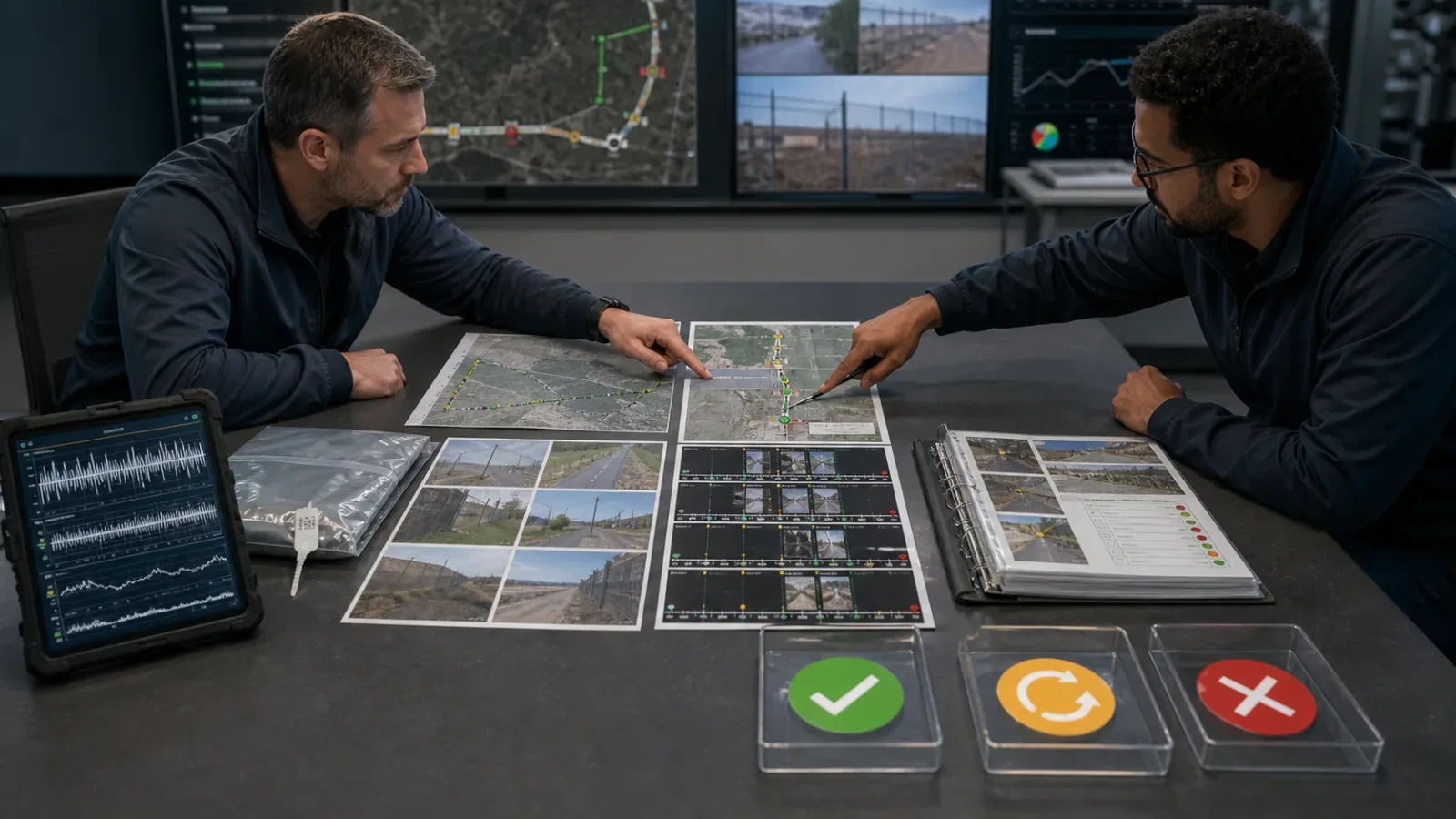
A failed event does not automatically require rejection, but an undocumented retest is not valid evidence. Open a deviation record and classify the cause as installation, coupling, configuration, integration, test execution, environmental interference, or product limitation. Approve the corrective action before applying it.
Any material change after freeze creates a new baseline. Repeat the affected blind tests and any previously passed tests the change could reasonably influence. Preserve original and revised results; never replace failed evidence with a successful retest.
Make an Explicit Exit Decision
Proceed to detailed design or procurement.
Proceed with documented conditions, exclusions, or remediation.
Redesign the sensing route, installation, or integration and repeat bounded tests.
Extend the POC because critical environmental or operational evidence is missing.
Reject the proposed configuration for the defined requirement.
Evaluate the resulting architecture, maintenance burden, evidence gaps, and lifecycle assumptions separately through the fiber PIDS total-cost-of-ownership model. A POC performance decision and a lifecycle commercial decision are related but not interchangeable.
Handoff from POC to FAT and SAT
A successful POC does not accept the final deployed system. It establishes evidence that a defined approach is suitable enough to proceed. Transfer the operational requirement, route assumptions, threat matrix, configuration principles, unresolved risks, test tools, evidence format, interface behavior, and decision conditions into factory and site acceptance documentation.
NPSA perimeter intrusion detection guidance says commissioning tests should occur after installation and before acceptance, and that regular maintenance helps prevent performance degradation. The handoff should therefore define inspection, maintenance, recalibration, configuration backup, and periodic performance testing.
For broader technology selection, use the fiber-optic fence sensor buyer guide. Critical sites can also review applications for critical infrastructure perimeter protection and deployment support in the United States.
For a site-specific trial architecture, acceptance framework, and integration review, request a FortSense engineering consultation.
After the proof of concept and final installation are stable, use the blind PIDS site-acceptance protocol to test the deployed alarm workflow without operator anticipation.
Use proof-of-concept observations to identify strata, then build the formal acceptance matrix with the PIDS detection sample-size guide rather than pooling unlike conditions.
For long border or remote corridor trials, extend this POC method with the border-security DAS perimeter detection design guide.