There is no defensible universal fiber PIDS price per kilometer. The comparable procurement metric is present-value lifecycle cost divided by the number of route-kilometers that pass the project’s detection, location, unwanted-alarm, integration, and availability requirements.
Do not divide a proposal by advertised interrogator reach or total optical-cable length. Lead-in fiber, service loops, return paths, redundancy, and unprotected transitions can consume cable without protecting additional perimeter.
Use cost per accepted protected kilometer
PV TCO per protected km = Present-value lifecycle cost / Accepted protected route length
Define the model inputs before comparing bids:
P: accepted protected route length in kilometers.
N: common study period in years.
r: discount rate consistent with the cash-flow basis.
C0: initial design, equipment, site work, installation, integration, and acceptance cost.
Ct: operating, support, maintenance, response, and repair cost in year t.
Rt: replacement or major upgrade cost in year t.
D: end-of-study removal or disposal cost.
V: evidence-supported residual value at the end of the study period.
PV_TCO = C0 + sum[(Ct + Rt) / (1 + r)^t] + D / (1 + r)^N - V / (1 + r)^N
PV_TCO_per_km = PV_TCO / P
This structure follows the categories and present-value approach documented in NIST Handbook 135. When alternatives have different service lives, compare equivalent annual cost per accepted protected kilometer-year instead of raw totals.
EAC = PV_TCO x [r(1 + r)^N / ((1 + r)^N - 1)]
EAC per protected km-year = EAC / P
Define an accepted protected kilometer
An accepted protected kilometer is a contiguous section of fence, wall, buried boundary, or corridor that passes the agreed operational and acceptance requirements. Include a segment in the denominator only when it meets the required:
Intrusion-event detection criteria.
Zone or continuous-localization requirement.
Alarm latency.
Unwanted-alarm limit.
Camera, VMS, PSIM, relay, or SCADA workflow.
Tamper and health-monitoring behavior.
Availability and resilience requirement.
Exclude insensitive lead cable, service loops, unprotected gate transitions, return fiber, unused capacity, and failed acceptance segments. The DAS detection-range claims guide separates optical path, sensing fiber, protected route, and usable detection coverage. The fiber PIDS localization guide defines the additional evidence needed when continuous event position is part of acceptance.
Include the full fiber PIDS lifecycle
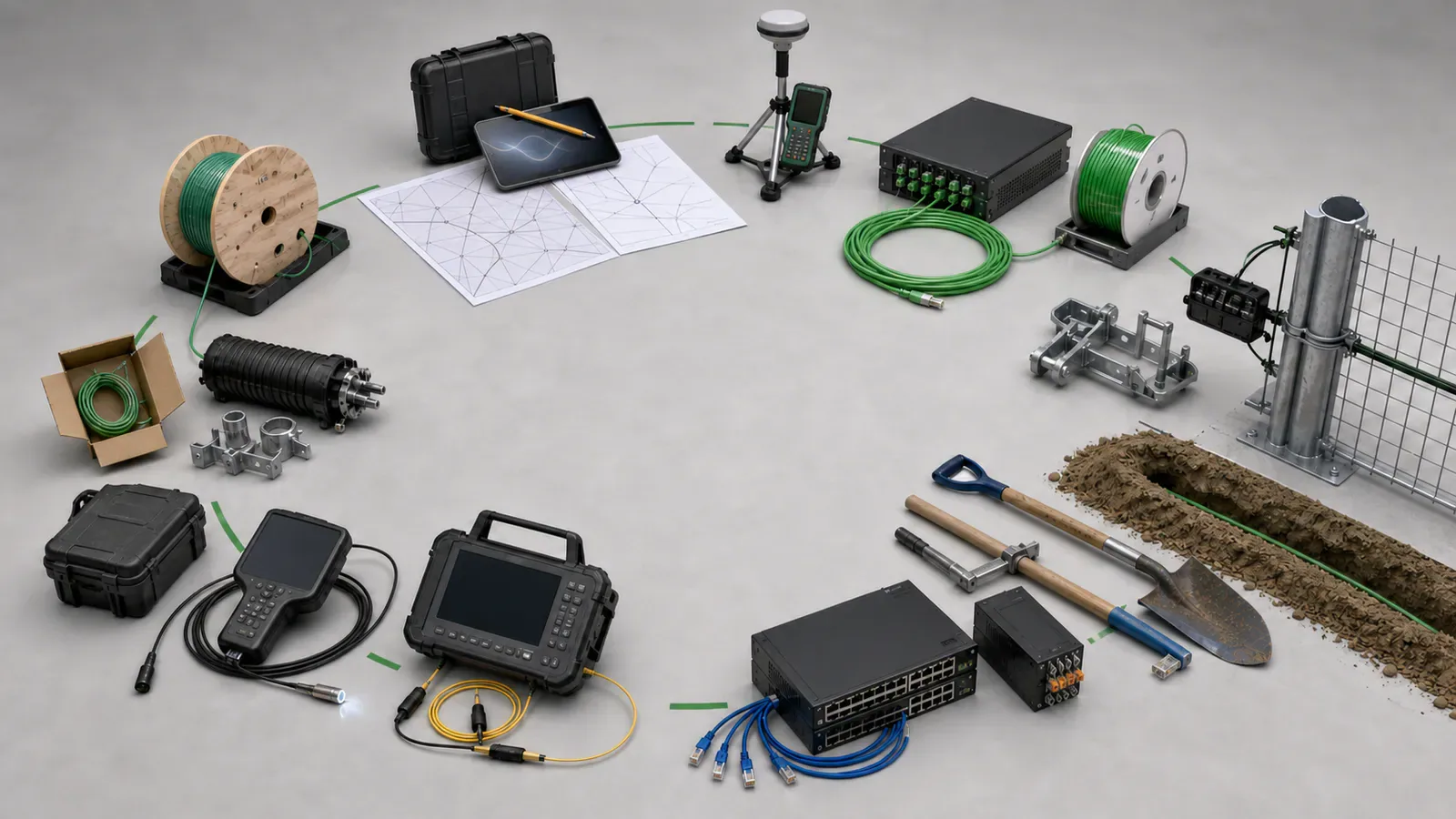
Requirements and design: threat assessment, site survey, chainage mapping, zone design, engineering, permits, and cybersecurity requirements.
Equipment: interrogators or controllers, sensing and lead cable, enclosures, servers, software, UPS, networking, relays, and spares.
Site preparation: fence remediation, vegetation clearance, access work, trenching, conduit, and mounting infrastructure.
Installation: cable attachment or burial, splicing, termination, control-room work, power, and communications.
Integration: VMS, PSIM, SCADA, alarm panel, camera presets, GIS, and operator workflow configuration.
Acceptance: FAT, SAT, background soak, witness testing, discrepancy closure, documentation, training, and independent commissioning.
Operations: software support, electricity, networking, monitoring labor, and investigated unwanted alarms.
Maintenance: fence and vegetation upkeep, inspection, tuning, calibration, testing, repair, and retesting.
Sustainment: firmware, cybersecurity support, replacement hardware, server migration, and end-of-support response.
End of study: removal, disposal, and supported residual value.
NPSA perimeter intrusion detection guidance ties selection to site-specific operational requirements and includes commissioning and regular system/site maintenance. Those activities belong in lifecycle cost; they are not optional extras.
Compare continuous DAS and zone-based architectures with variables
Model alternatives over the same accepted route P, study period N, discount basis, operational requirement, and acceptance test. Use traceable bid variables rather than public market averages.
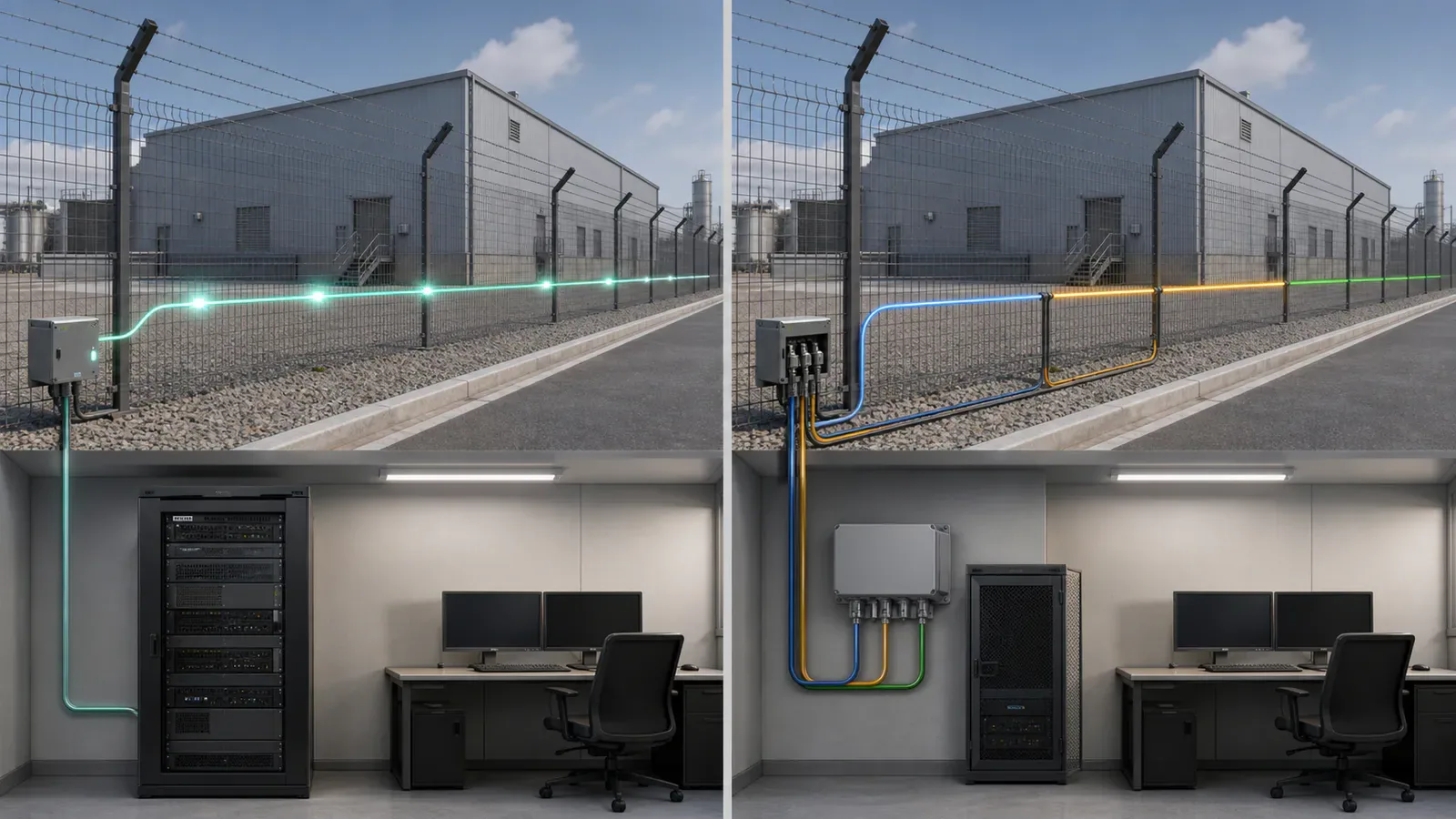
Continuous DAS alternative
U0 = head-end + fiber + civil work + integration + acceptance
Annual_U = support + maintenance + energy + investigated alarms
PV_U = U0 + discounted Annual_U + discounted replacements - discounted residual value
Physically zoned alternative
Z0 = controllers + sensing cable + distributed power + network + integration + acceptance
Annual_Z = support + maintenance + energy + investigated alarms
PV_Z = Z0 + discounted Annual_Z + discounted replacements - discounted residual value
Normalize both results by the route each alternative actually passes:
KU = PV_U / accepted_PU
KZ = PV_Z / accepted_PZ
A lower K is meaningful only when both systems meet the same Operational Requirement. A proposal that fails a route segment, event class, location criterion, or integration test is not a lower-cost equivalent.
Architecture should follow the response requirement
Continuous DAS can fit extended routes where operators require chainage-level event location and the installed system proves that performance. Evaluate FortSense Ultra and the long-perimeter fiber architecture guide for this design path.
Physically defined zones can fit sites whose cameras, patrol sectors, and dispatch workflow already follow named boundary sections. Evaluate FortSense 4 for this architecture. This is not a claim that either design is universally cheaper.
Run sensitivity and break-even analysis
A single estimate hides the assumptions most likely to change the result. The GAO Cost Estimating and Assessment Guide treats sensitivity and risk analysis, documented assumptions, and estimate updates as core parts of a reliable cost process.
Test at least these inputs:
Accepted protected route length and sensing-cable-to-route ratio.
Fence-mounted versus buried quantities and fence remediation.
Existing usable fiber, conduit, power, and network infrastructure.
Processor or controller count and redundancy topology.
Hardware, server, and software replacement timing.
Maintenance, inspection, and retesting frequency.
Cable-damage and repair rate.
Software and support escalation.
Investigated unwanted-alarm volume and cost per investigation.
Study period, discount rate, residual value, and future expansion.
Use bills of quantities, labor schedules, warranty terms, pilot results, and documented low/base/high assumptions. Do not apply an arbitrary percentage to every input.
Break-even test for alarm-response cost
Required annual avoided investigations = PV cost difference excluding investigations / [Cost per investigation x annuity factor]
This result does not prove that an alarm reduction will occur. It identifies the operational claim that must be validated during a representative pilot or background soak.
Normalize global and United States proposals
ISO 15686-5:2017 provides a lifecycle-cost framework covering relevant cash flows from acquisition through operation to disposal over an agreed period. For United States federal acquisition, FAR 7.101 defines lifecycle cost to include acquisition, operation, support, and applicable disposal costs.
For every proposal, state:
Base date, study period, and base currency.
Exchange-rate date and source.
Constant-dollar or current-dollar basis.
Real or nominal discount rate and matching cash-flow basis.
Taxes, duties, freight, bonds, and permits.
Owner-provided infrastructure.
Labor, travel, warranty, and support territory assumptions.
Applicable domestic-sourcing requirements.
Use the purchaser’s mandated discount rate or documented cost of capital. Never mix nominal cash flows with a real discount rate.
Require comparable RFP evidence
Scope and denominator
GIS or chainage schedule and accepted route length by segment.
Sensing cable, insensitive lead, loops, and return paths reported separately.
Gates, corners, transitions, and excluded segments identified.
Required event classes, conditions, and zone or localization criteria.
Architecture
Interrogator, controller, server, enclosure, cable, and network quantities.
Fiber, power, communications, and redundancy topology.
Post-fault behavior and expansion capacity.
VMS, PSIM, SCADA, relay, GIS, and camera-preset scope.
Lifecycle cost
Itemized initial investment and owner responsibilities.
Annual licenses, support, preventive maintenance, and retesting.
Spares, repair labor, travel, and response charges.
Replacement schedule and end-of-support assumptions.
Decommissioning, residual value, and exclusions.
Performance evidence
Frozen test configuration and route-level detection results.
Localization or correct-zone results and alarm latency.
Simultaneous-event behavior.
Background-soak and unwanted-alarm evidence.
FAT, SAT, witness records, discrepancy closure, training, and as-built handover.
The United States Department of Defense UFGS 28 08 10 electronic security acceptance-testing specification reinforces the need to define acceptance testing as a procurement deliverable rather than an informal demonstration.
Avoid common cost-comparison errors
Dividing cost by total cable length or advertised maximum reach.
Comparing different study periods or discount bases.
Counting cameras, servers, civil work, or integration in only one proposal.
Assuming every fence kilometer passes acceptance.
Treating future expansion capacity as currently protected route.
Ignoring replacement and end-of-support timing.
Assuming zero unwanted alarms.
Mixing avoided incident losses into TCO.
Selecting the lowest estimate before confirming equivalent performance.
Avoided losses, risk reduction, and business payback belong in the perimeter intrusion detection ROI guide. This page owns cost normalization, not the value of prevented incidents.
Continue the procurement sequence
Use the fiber optic fence sensor buyer guide if the technology shortlist is not settled. Then review broad PIDS cost drivers, PIDS technology and upgrade selection, and acceptance-test witness criteria.
For application and market context, see critical infrastructure perimeter security and fiber optic perimeter security in the United States.
Treat existing-fiber availability as a TCO input only after the route passes the dark-fiber DAS feasibility and acceptance decision.
Build the model around the real route
Before modeling lifecycle ownership, create the installed-material takeoff so cable, attachments, gates, splices, head-end infrastructure, integration, tests, and spares are explicit inputs.
Bring the route schedule, topology, acceptance requirements, integration scope, study period, and operating assumptions to a FortSense design review. The review can determine which variables belong in a continuous DAS or zone-based comparison before bidders are scored.